KCC Institute of Legal and Higher Education, Greater Noida
Law Admissions 2026 Open | Avail Merit-Based Scholarships


The large intestine is the final part of the human digestive system responsible for absorption of water and electrolytes and formation of faeces. It consists of the caecum, colon, rectum, and anal canal, and houses beneficial gut microbiota. This guide explains the structure, functions, microbiota, disorders, and NEET-focused questions on the large intestine.
This Story also Contains
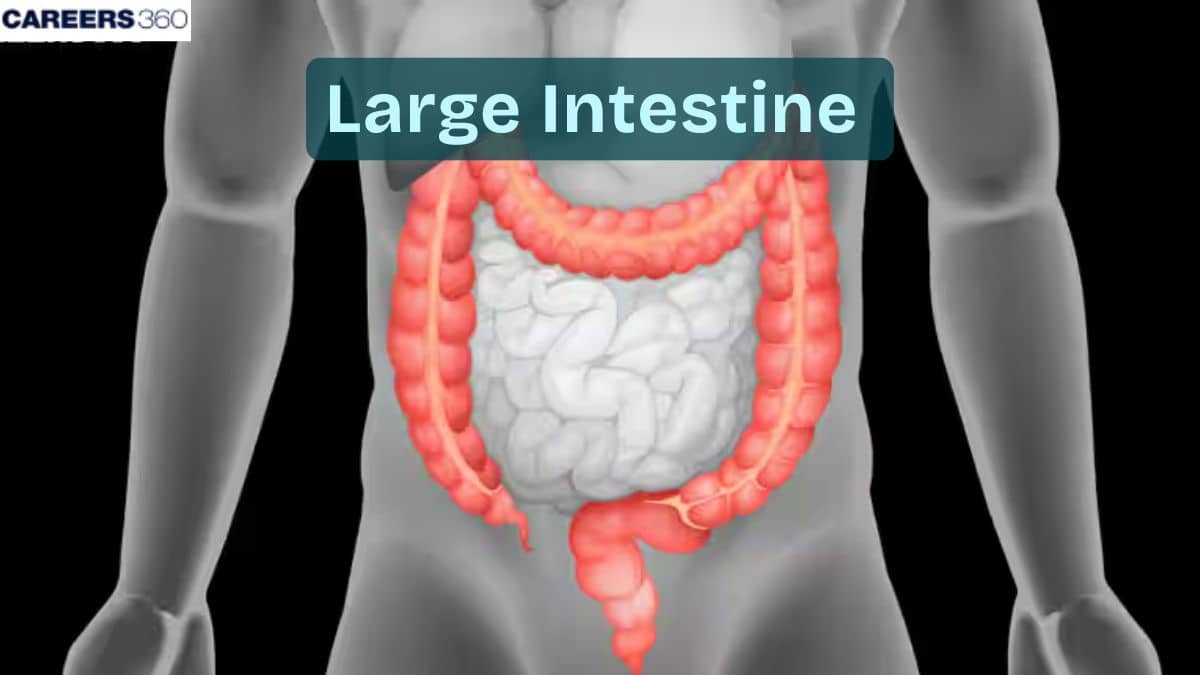
The large intestine is the final part of the digestive system and absorbs the remaining water and electrolytes from the undigested food particles. It consists of the cecum, colon, rectum, and anal canal. The large intestine plays an important role in forming and storing faeces until excretion. It also hosts gut bacteria, which ferments undigested carbohydrates and produces vitamins like vitamin K. Similar to the small intestine, it does not absorb nutrients considerably. The large intestine regulates body hydration and proper removal of waste products, thus maintaining digestive health.
The position and extent of the large intestine is discussed below:
Begins at the end of the small intestine
Ends at the anal canal
Surrounds the small intestine in the abdominal cavity
Law Admissions 2026 Open | Avail Merit-Based Scholarships
BBA/MBA/PGDM Early Bird Applications Deadline 19th Oct '26. Apply now using coupon code CAREER250 and get ₹250 off the application fee
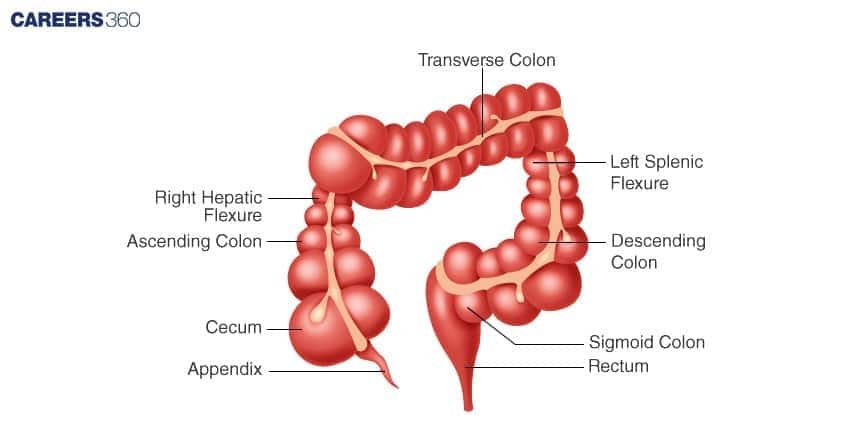
It is further divided into :
First part of the large intestine.
Attached to the small intestine.
Ascending Colon: Goes up the right side of the abdomen
Transverse Colon: Crosses the abdomen from right to left.
Descending Colon: Goes down the left side.
Sigmoid Colon: This is an S-shaped segment that leads into the rectum.
Acts as a storage site for faeces before they are expelled.
Needs Signal for defecation.
The last part of the digestive tract
Faeces are expelled during defecation
The large intestine carries out certain important functions like:
The reabsorption of water and key electrolytes from indigestible food matter.
The waste is formed into solid stool and the process stores it until defecation.
This system also contains bacteria that can ferment undigested carbohydrates to short-chain fatty acids.
Certain intestinal microbes synthesise biologically essential Vitamins, such as Vitamin K and B vitamins.
There is a huge diversity in the population of microorganisms in the large intestine:
Bacteria, viruses, fungi, and protozoa.
Beneficial bacteria work in digestion and immunity.
On the contrary, any type of imbalance leads to diseases.
The gut microbiota influences metabolic processes and helps to protect against pathogens.
Some common disorders of the large intestine are:
Difficulty in passing stools or infrequent bowel movements.
Frequent watery bowel movements.
A chronic disorder characterised by abdominal pain and bloating, associated with changes in bowel habits.
Represents Crohn's Disease and Ulcerative Colitis.
These are conditions characterised by chronic inflammation of the gastrointestinal tract.
Cancer that affects the colon or rectum. It is usually identified with screening tests.
Maintaining good health in the large intestine can be achieved in various ways:
Increased intake of fibre, and water and avoidance of trigger foods.
Laxatives in case of constipation, anti-diarrheal drugs in diarrhoea, anti-inflammatory in the inflamed lining of the intestine, and antibiotics in case of infection.
Surgery may be performed in severe conditions in which removal of diseased parts of the intestine is necessary.
Supplements for maintaining a healthy balance of gut bacteria.
Important questions asked in NEET from this topic are:
Structure of Large Intestine
Functions of Large Intestine
Q1. The junction of ileum and large intestine is seen in the form of an orifice called
Peyer’s patch
Ileocolic
Plicae circulares
Hiatus
Correct answer: 2) Ileocolic
Explanation:
The sphincter muscle valve that controls the passage of waste from the small intestine to the large intestine is called the ileocecal orifice, sometimes referred to as the ileal orifice, ileocecal valve, or Bauhin valve.
Hence, the correct answer is option 1) The junction of the ileum and large intestine is seen in the form of an orifice called Ileocolic
Q2. Where do certain symbiotic microorganisms normally occur in the human body?
Oral lining and tongue surface
Vermiform appendix and rectum
Duodenum
Caecum
Correct answer: 1) Caecum
Explanation:
The cecum is a pouch-like structure located at the beginning of the large intestine, specifically at the junction of the small intestine and the colon. It is the first section of the colon and is involved in digestion. The caecum is a small blind sac that hosts some symbiotic micro-organisms. The appendix is a narrow finger-like projection attached to the caecum which contains beneficial symbiotic bacteria that helps in maintaining gut health.
Hence, the correct answer is option 4) Caecum.
Q3. Last section of large intestine is
Caecum
Colon
Rectum
Anus
Correct answer: 3) Rectum
Explanation:
The rectum is the final part of the large intestine, situated just before the anus. It plays a vital role in the elimination of waste from the body. The rectum stores formed faeces, which are the byproducts of digestion and absorption until they are ready to be expelled from the body during defecation.
Hence, the correct answer is option 3) Rectum
Also Read:
Frequently Asked Questions (FAQs)
The large intestine is wider and shorter than the small intestine, primarily absorbs water and electrolytes, and is involved in the formation of faeces, while the small intestine is responsible for nutrient absorption.
Common diseases include constipation, diarrhoea, irritable bowel syndrome (IBS), inflammatory bowel disease (IBD), and colorectal cancer.
Maintaining a healthy large intestine involves a high-fibre diet, staying hydrated, regular exercise, and avoiding processed foods.
Probiotics help maintain a healthy balance of gut microbiota, which is crucial for digestive health, immunity, and overall well-being.
The primary functions of the large intestine include absorbing water and electrolytes, forming and storing faeces, and housing gut microbiota.


Law Admissions 2026 Open | Avail Merit-Based Scholarships
BBA/MBA/PGDM Early Bird Applications Deadline 19th Oct '26. Apply now using coupon code CAREER250 and get ₹250 off the application fee
Ranked #36 amongst institutions in Management by NIRF | 100% Placement
Globally Recognized by AACSB (US) & AMBA (UK) | 18 LPA Avg. CTC for PGPM 2026
Leading Design College | 95% Placement Record | Merit-cum-Means Scholarships for Deserving Students
NEET PG All India & State College Predictor with Admission Process Guide