KCC Institute of Legal and Higher Education, Greater Noida
Law Admissions 2026 Open | Avail Merit-Based Scholarships


Assimilation is the biological process by which absorbed nutrients are converted into utilizable forms for energy production, growth, and tissue repair. It is an anabolic process that transforms simple molecules into complex biomolecules like proteins, fats, and carbohydrates. This guide explains assimilation in plants, animals, and humans with cellular pathways and NEET-focused clarity.
This Story also Contains
Assimilation is the intake of food by living organisms and its conversion into vital forces. In biology, it is the most vital process by which nutrients being absorbed are transformed into a utilizable form in an organism. Assimilation helps in the growth and repair processes, along with being the source of energy for all living beings. This is an anabolic process because it builds bigger from smaller molecules. Hence, essential for survival of all living organisms.
Assimilation is important because:
Supplies energy for life processes
Enables growth and repair of tissues
Helps synthesis of enzymes and hormones
Maintains metabolism and cellular activities
Law Admissions 2026 Open | Avail Merit-Based Scholarships
BBA/MBA/PGDM Early Bird Applications Deadline 06th Nov'26. Apply now using coupon code CAREER250 and get ₹250 off the application fee
Plants introduce nutrients as a consequence of assimilation, for example by photosynthesis and nitrogen assimilation.
Photosynthesis is the series of acts by which plants transform, in the collaboration of sunlight energy, carbon dioxide and water to glucose and oxygen, so glucose obtained by the plants is a source of energy as well as a basic material from which all other requisites will be built.
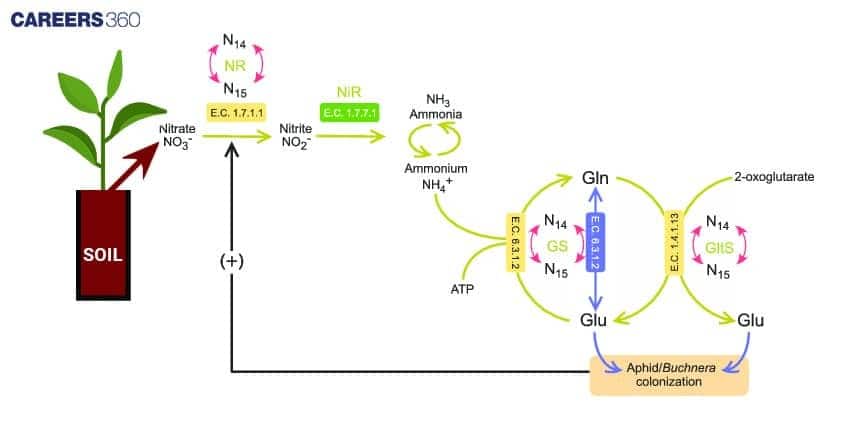
Plants absorb nitrogen from the soil, generally in the form of nitrates or ammonium salts. They synthesize this into amino acids and proteins, which plants need in large quantities for their growth and development.
Photosynthesis occurs specifically in the chloroplasts. Other organelles, such as vacuoles and mitochondria also play roles in storing and utilizing the produced nutrients.
Nutrient absorption follows the completion of digestion and assimilation. Communication Assimilation and nutrient uptake follow the mode of nutrition.
The ingested nutrient is broken down by the animal's digestive system into simpler and smaller molecules, after which the walls of the intestines absorb those small molecules into the blood.
Once the nutrients are assimilated, some are absorbed in the blood and transported to the appropriate cells in the form of specific amino acids, fatty acids, and glucose, which, upon formation, become identified proteins, lipids, and glycogen, respectively.
The assimilated nutrients yield proteins that are synthesized for repairing muscles and tissue, fats for storage as long-term energy sources, and carbohydrates for use as an immediate energy source.
Proteins are formed for the repairing of muscles and tissue, fats are stored as long-term energy sources, and carbohydrates are ingested to provide immediate energy.
Assimilation is a process where, in humans, this work is collectively done by different organs and forms a groundwork of complex biochemical pathways.
The ingestion of the food, its digestion, and the absorption of the absorbed molecules occur in the gastrointestinal tract. The molecules are then transferred into the blood by absorption and infuse into the liver and other constituent tissues to convert them into useful forms.
Dietary nutrition metabolism, glycogen storage, and detoxification of harmful materials become central functions of the liver. Other organs, such as the pancreas and kidneys, equally play their part in regulating and using up the nutrients.
This is respiration at the cellular level — conversion of nutrients into energy and building of cellular constituents.
The energy corpuscles responsible for converting the nutrients needed are the mitochondria, which break down the replete nutrients available into adenosine triphosphate, ATP, which is the actual form of energy in a cell.
The cellular respiration process includes glycolysis, the Krebs cycle, and oxidative phosphorylation. All these take place at the cellular level and are the main processes for assimilation and use of the digested nutrients.
Absorption becomes relevant for a number of the following vital functions associated with the biological life processes:
Energy for all cellular activities and all organismal functions comes from assimilated nutrients by the process of absorption.
Nutrients are to be used for synthesizing proteins and several other molecules necessary to enable tissue growth and repair.
Assimilation brings with it synthesis—enzymes, hormones, and all such required biomolecules.
Assimilation takes place in plant and animal kingdoms as well and sometimes finds practical applications.
For example, in the case of plant nitrogen assimilation, it occurs in plant growth and development. In the case of animals, it is used for protein synthesis. Then, farmers grow such organisms for food using even more nitrogen-based fertilizers.
Understanding assimilation can help enhance proper quantity usage in applications, such as farming and further medical innovations regarding disorders that are caused by nutritional deficiencies.
Important questions asked in NEET from this topic are:
Assimilation in Plants and Animals
Need and function of assimilation
Q1. Absorbed substances finally reach the tissues which utilise them for their activities , this process is called
Assimilation
Absorption
Digestion
Mastication
Correct answer: 1) Assimilation
Explanation:
Assimilation is the process by which absorbed nutrients are delivered to the cells and tissues that need them for various functions. After digestion and absorption, nutrients such as glucose, amino acids, and fatty acids are transported through the bloodstream to different cells throughout the body. This process takes place at the cellular level in organs like the liver, muscles, adipose tissue, and other target cells.
Hence, the correct answer is option 1) Assimilation.
Q2. Which of the following statements is incorrect?
Faecal accumulation in the rectum initiates a neural reflex causing an urge for its removal.
Irregular bowel movements cause constipation.
In diarrhea absorption of food is increased.
All of the these
Correct answer: 3) In diarrhea absorption of food is increased.
Explanation:
The digestive wastes, solidified into coherent faeces in the rectum initiate a neural reflex causing an urge or desire for its removal. The egestion of faeces to the outside through the anal opening is called defecation. It is a voluntary process and is carried out by a mass peristaltic movement
Hence, the correct answer is option 3) In diarrhoea absorption of food is increased.
Q3. Removal of digestive wastes, solidified into coherent feces in the rectum initiates a neural reflex causing an urge or desire for its removal the process is known as:
Ingestion
Defaecation
Egestion
Assimilation
Correct answer: 2) Defaecation
Explanation:
The above process is termed the defecation reflex. Thus, when the rectum is filled with fecal matter, it activates the stretch receptors and sends information to the brain, initiating an urge to move it out. It is also, therefore, a process consisting of both involuntary and voluntary actions within the muscles that expel waste from the body.
Hence, the correct answer is option 2) Defaecation.
Also Read:
Frequently Asked Questions (FAQs)
Plants assimilate the intake of absorbed nutrients into usable compounds such as sugars and proteins, which become essential in growth and metabolism.
In human beings, assimilated nutrients are employed in tissue repair, storage of energy in the form of fats, and immediate energy demand in the form of carbohydrates.
Absorption is the transfer of nutrients into the body's flesh, whereas, in assimilation, the food materials pass through conversion, either into living cells or into energy.
The ingested food goes another step through processing in the liver before being converted into other types to be used by the tissues and organs of the body.

Law Admissions 2026 Open | Avail Merit-Based Scholarships
BBA/MBA/PGDM Early Bird Applications Deadline 06th Nov'26. Apply now using coupon code CAREER250 and get ₹250 off the application fee
Ranked #36 amongst institutions in Management by NIRF | 100% Placement
Globally Recognized by AACSB (US) & AMBA (UK) | 18 LPA Avg. CTC for PGPM 2026
NEET PG All India & State College Predictor with Admission Process Guide
Top B-School: Ranked #9 in NIRF Management Rankings 2025.