


Gallbladder: Definition, Function, Diagram, Examples
The gallbladder is a small, hollow organ located beneath the liver that stores and concentrates bile. Bile released from the gallbladder plays a crucial role in fat digestion and absorption in the small intestine. This guide explains the structure, functions, bile composition, disorders, diagnosis, and NEET-focused concepts of the gallbladder.
This Story also Contains
- What Is the Gallbladder?
- Location and Position of the Gallbladder
- Structure of the Gallbladder
- Histology of the Gallbladder Wall
- Functions of the Gallbladder
- Role of Bile in Digestion
- Common Gallbladder Conditions
- Diagnosis and Treatment
- Prevention of Gallbladder Disorders
- Gallbladder NEET MCQs (With Answers & Explanations)
- Recommended video for "Gall bladder"
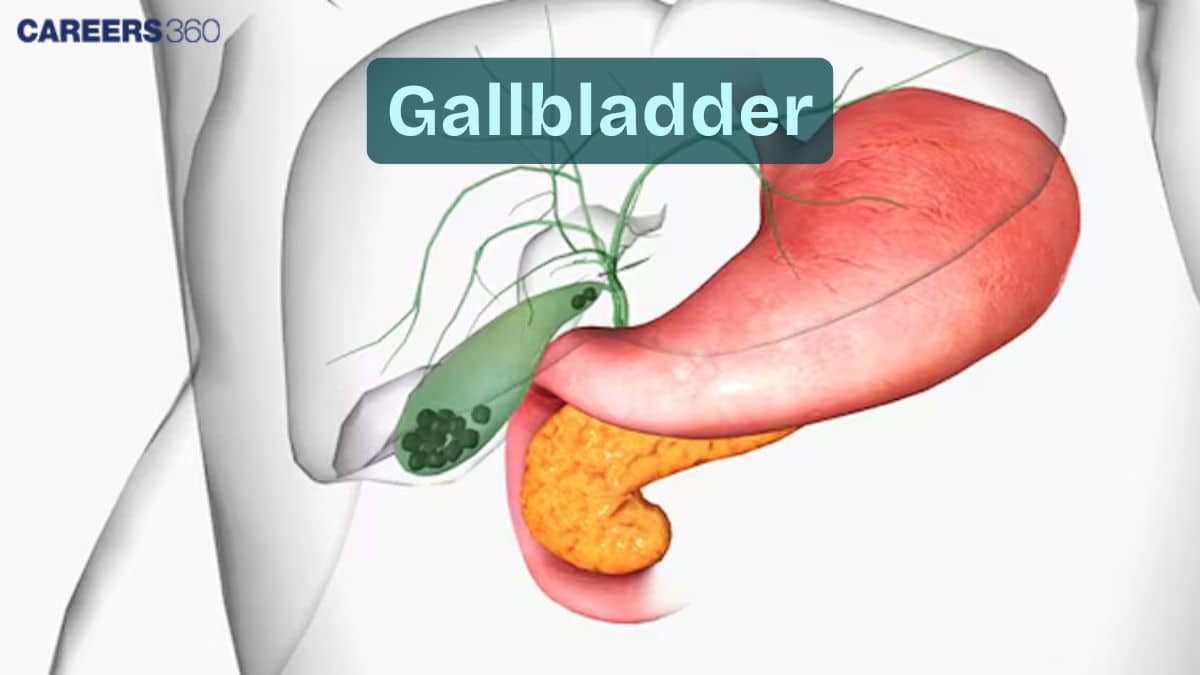
What Is the Gallbladder?
The gallbladder is located under the liver and is connected to it through the bile ducts. The main function of this organ is to store bile produced from the liver and then discharge it into the small intestine while food is being digested.
Location and Position of the Gallbladder
The location and position of gall bladder is listed below:
Lies on the undersurface of the liver.
Connect through the hepatic and cystic ducts.
Directly drains into the common bile duct.
Opens into the small intestine (duodenum)
Structure of the Gallbladder
The general structure of the gallbladder is:
Small, hollow viscus
Can hold about 30-50 millilitres of bile.
It has three parts: fundus, body, and neck.
Histology of the Gallbladder Wall
The wall of the gallbladder consists of three layers, namely:
Mucosa
Muscular
Serosa.
Within the three layers lies the mucosal epithelial cell that absorbs water and electrolytes, thus concentrating the bile.
Functions of the Gallbladder
The functions of gall bladder is listed below-
Storage and Concentration of Bile
Bile prepared by the liver is stored and concentrated in the gall bladder. It contracts and releases into the small intestine as soon as food enters the small intestine.
Secretion of Bile
Bile secreted from the gall bladder is transported through the cystic duct and into the common bile duct. It reaches the small intestine where finally digestion and absorption of the fats are completed.
Role of Bile in Digestion
The role of bile in the process of digestion.
Composition of Bile .
Bile is composed of bile salts, cholesterol, the breakdown pigment bilirubin, and electrolytes, which act in synergy and make fats emulsify.
Role in Fat Digestion
Emulsification of fat molecules by bile salts into minute droplets increases the surface area for the action of digestive enzymes and therefore helps in efficient digestion and absorption of dietary fats.
Common Gallbladder Conditions
The common gall bladder conditions are listed below:
Gallstones (Cholelithiasis)
Hard deposits formed in the gallbladder out of bile components.
Either be made of cholesterol or bilirubin.
Symptoms: Pain, nausea, and jaundice.
Cholecystitis
Inflammation of the gallbladder.
Mostly due to a gallstone obstructing the cystic duct.
It is reflected in a sudden acute or chronic condition of inflammation accompanied by abdominal pain, fever, and vomiting.
Other Conditions
Other complications about the gallbladder include polyps, and growths on the wall of the gallbladder.
Relatively severe, though uncommon, are gallbladder cancer.
Diagnosis and Treatment
The diagnosis and treatment is listed below-
Diagnosis
The common diagnostic tools are ultrasound, CT scan, and HIDA scan.
These are used to visualize the gallbladder and help to point out abnormalities.
Treatment
Treatments depend on the nature of the condition.
Gallstones can either be chemically dissolved or surgically removed (cholecystectomy).
The surgical technique applied in this procedure is laparoscopic, that is, it is a minimal invasion technique used.
Prevention of Gallbladder Disorders
The prevention methods are listed below-
Diet and Lifestyle
The low-cholesterol, high-fibre diet, coupled with regular exercise and a healthy body mass index, helps in keeping problems concerning the gallbladder at bay.
Regular Check-ups
Any problem with the gallbladder can be detected early if one goes for regular check-ups. As such, treatment and management are assured at the right time.
Gallbladder NEET MCQs (With Answers & Explanations)
Important questions asked in NEET from this topic are:
Structure and histology of gallbladder
Functions of bile in digestion
Disorders related to gallbladder
Practice Questions for NEET
Q1. Assertion: Gallstones can lead to inflammation of the gallbladder.
Reason: Gallstones can block the flow of bile from the gallbladder.
Assertion and reason are both true, and reason is an accurate account of assertion.
Both assertion and reason are accurate, but reason does not adequately explain assertion.
The assertion is correct, but the reasoning is incorrect.
Both the assertion and reason are incorrect.
Correct answer: 1) Assertion and reason are both true, and reason is an accurate account of assertion.
Explanation:
Gallstones are solid particles that form in the gallbladder, and they can block the flow of bile from the gallbladder. When the bile cannot flow out of the gallbladder, it can build up and cause inflammation, which can lead to pain, fever, and nausea. If left untreated, gallstones can also lead to serious complications, such as infection or the development of gallbladder cancer. Therefore, it is essential to seek medical attention if you experience any symptoms of gallstones or inflammation of the gallbladder.
Hence, the correct answer is option 1) Assertion and reason are both true, and reason is an accurate account of assertion.
Q2. Ductus choledochus is formed when
Cystic duct of the gallbladder combines with the common hepatic duct of the liver
Rivinus duct of the gallbladder combines with the hepatic duct of the liver
The hepatic duct of the gallbladder combines with the cystic duct of the liver
The right hepatic duct of the liver combines with the left hepatic duct of the liver
Correct answer: 1) cystic duct of the gallbladder combines with the common hepatic duct of the liver
Explanation:
The ductus choledochus also referred to as the common bile duct, is formed by the merging of the cystic duct from the gallbladder and the common hepatic duct from the liver. This duct plays an important role in the digestive system as it carries the bile from the liver and the gallbladder to the duodenum for emulsification and further digestion of fats.
Hence, the correct answer is the option 1) Cystic duct of the gallbladder combines with the common hepatic duct of the liver.
Q3. Assertion: Gallbladder has a cystic duct.
Reason: The common bile duct arises from the cystic duct of the gall bladder.
Assertion and reason are both true, and reason is an accurate account of assertion.
Both assertion and reason are accurate, but reason does not adequately explain assertion.
The assertion is correct, but the reasoning is incorrect.
Both the assertion and reason are incorrect.
Correct answer: 3) The assertion is correct, but the reasoning is incorrect.
Explanation:
The assertion and reason are both true, but the reasoning is incorrect. The correct reasoning would be that the cystic duct arises from the gallbladder and merges with the common hepatic duct to form the common bile duct.
Hence, the correct answer is 3) The assertion is correct, but the reasoning is incorrect.
Also Read:
Recommended video for "Gall bladder"
Frequently Asked Questions (FAQs)
A low-cholesterol, high-fibre diet, with regular exercise, will help prevent most of the problems related to the gallbladder.
Gallbladder surgery is very safe, especially today's laparoscopic cholecystectomy. Most surgeries are very successful.
Yes, you can live without a gallbladder. Bile will simply flow directly from the liver into the small intestine, although some adjustments in the diet might have to be made.
The prominent symptoms include generalized abdominal distress, nausea, vomiting, and jaundice.
The crystallization of either cholesterol or bilirubin causes the formation of gallstones due to an imbalance in the composition of bile.
