KCC Institute of Legal and Higher Education, Greater Noida
Law Admissions 2026 Open | Avail Merit-Based Scholarships


Disorders of the digestive system affect the normal digestion, absorption, and elimination of food, leading to nutritional imbalance and health issues. Common digestive disorders include vomiting, constipation, diarrhoea, indigestion, irritable bowel syndrome, and liver diseases. This guide explains causes, symptoms, diagnosis, treatment, and NEET-focused points related to digestive system disorders.
This Story also Contains
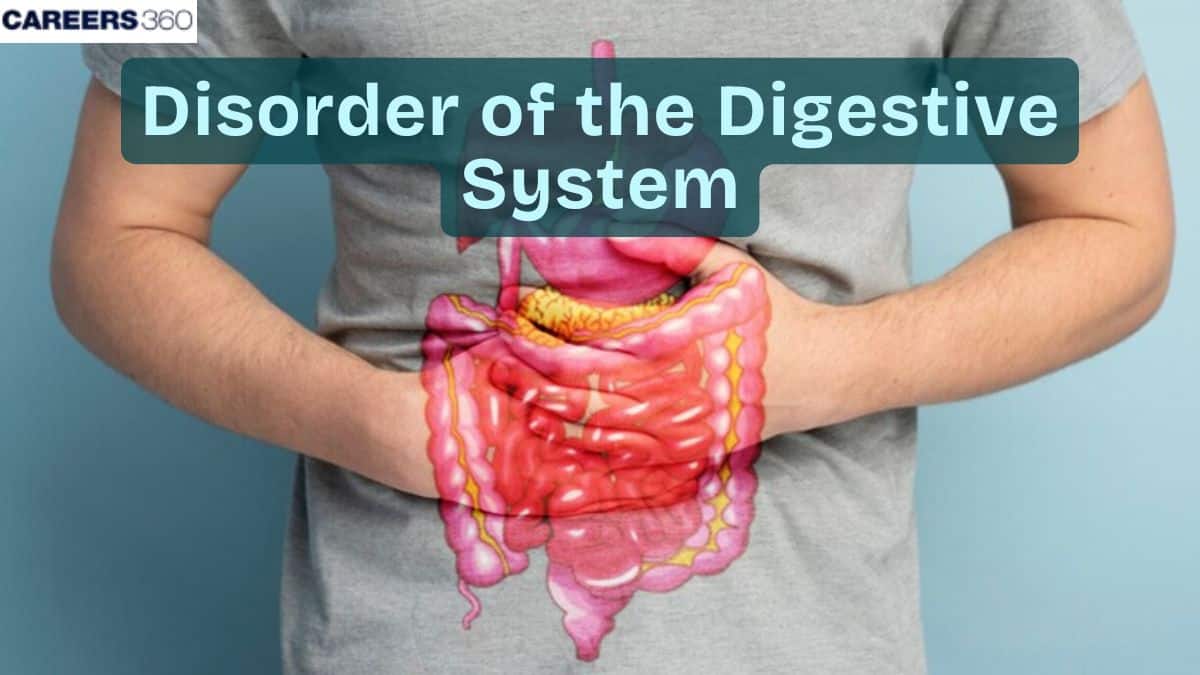
The digestive system is defined as a group of organs working together. It has a central function of sustaining human health through the digestion of food as well as the synthesis of energy and nutrients. Digestive health helps enhance metabolism and immune response hence it is crucial for well-being. Predominant disorders that affect this balance include irritable bowel syndrome, gastritis, as well as peptic ulcers; considering this the need for digestive health cannot be underestimated.
The common disorders are:
Symptoms: Nausea is the irritation in the stomach that results in a forceful throwing up.
Causes: Gastric ulcers, helicobacter pylori infection, travel sickness and food poisoning, or certain drugs that have this side effect.
Treatment and Management: Adequate fluids, tablets against vomiting, changes in the diet.
Law Admissions 2026 Open | Avail Merit-Based Scholarships
BBA/MBA/PGDM Early Bird Applications Deadline 19th Oct '26. Apply now using coupon code CAREER250 and get ₹250 off the application fee
Symptoms: Difficulty to pass stool, gas and bloated stomach.
Causes: Lack of fibre-rich foods, medicines (NSAIDs), kidney diseases (oliguric renal insufficiency), Helicobacter pylori infection.
Treatment and Management: Fibre-rich diet, increased water intake, mild laxatives (if required).
Symptoms: Stomach cramps, gas, nausea, vomiting, and changes in the bowel movements.
Causes: Stress, diet, changes in gut microbiota.
Treatment and Management: Lifestyle modifications including the use of Ergot and lactose-free diet, reducing stress, medications like antispasmodics and laxatives.
Symptoms: Abdominal pain or bloating, nausea or burping.
Causes: Spicy and fatty foods, stress, certain medications
Treatment and Management: Lifestyle changes, medications, avoiding foods that cause antacids
Symptoms: Frequent diarrhoea, less concentration of faeces, abdominal pain pains, and lack of water.
Causes: Bacterial and viral infections, food allergies, drugs.
Treatment and Management: ORS, Anti diarrhoea agents, and Foods that should not be consumed.
The two major liver disorders are:
Types (A, B, C): Infectious hepatitis, due to viral infections of the liver.
Symptoms: Jaundice, fatigue, abdominal pain.
Causes: Food and water-borne (Hepatitis A), contaminated blood (Hepatitis B, C).
Treatment and Management: Anti-viral drugs, immunisation (Hepatitis – A & B), periodic check-ups.
Symptoms: These include yellowing of the skin, loss of energy, build-up of fluid in the abdomen and swollen legs.
Causes: Chronic alcohol use, chronic viral hepatitis, FLD.
Treatment and Management: Treating the infection’s causes, pharmacotherapy, diet and life changes, and a liver transplant in critical situations.
Digestive disorders are diagnosed in the following ways:
An examination using a flexible tube which contains a camera.
To view the upper digestive system, including the oesophagus, stomach and duodenum.
It assists in diagnosing conditions such as ulcers, inflammation and even tumours.
A technique that uses a long narrow telescope that is passed through the rectum and the colon to examine the large intestine.
This is useful in the diagnosis of colorectal cancer, adenomatous colonic polyps as well as inflammatory bowel disease.
Uses procedures like radiography, computerised axial tomography or CAT scans, or MRI.
Used to locate and assess the condition of the internal organs of the digestive system including tumours, obstructions or inflammation.
Blood tests are used in diagnosing inflammation, infection, anaemia, as well as the liver’s functional capacity.
Serum enzymes and other clinical lab tests like LFTs and CBC give information about digestive wellness.
Stool tests are used to detect infections, blood, or irregularity in the manner in which food passes through the digestive system as seen from the faeces.
It can help detect parasites, bacteria or diseases such as celiac disease or inflammatory bowel disease.
Biopsy includes obtaining a small tissue from the gut tissue to examine using the microscope.
They diagnose cancer, chronic inflammation or an infection.
Endoscopic biopsies are frequently curative, and the results are as specific about tissue.
Important questions asked in NEET from this topic are:
Common disorder of digestive system
Diagnosis of disorders
Q1. Which one of the following is the correct matching of a vitamin, its nature, and its deficiency disease:
Vitamin K – Fat soluble – Beri-Beri
Vitamin A – Fat-soluble – Beri-Beri
Vitamin K – Water soluble – Pellagra
Vitamin A – Fat-soluble – Night blindness
Correct answer: 4) Vitamin A – Fat-soluble – Night blindness
Explanation:
Vitamin A – Fat-soluble – Night blindness, is the correct matching. Vitamin A is a fat-soluble vitamin, and its deficiency can lead to night blindness, where a person has difficulty seeing in low-light conditions. Night blindness is a characteristic symptom of vitamin A deficiency.
Hence, the correct answer is option 4. Vitamin A – Fat-soluble – Night blindness
Q2. When breast feeding is replaced by less nutritive food low in proteins and calories; the infants below the age of one year are likely to suffer from:
Rickets
Kwashiorkor
Pellagra
Marasmus
Correct answer: 4) Marasmus
Explanation:
Marasmus is a severe health disease that occurs in infants of less than 1 year when breastfeeding is replaced by less nutritious food low in proteins and calories. It leads to extreme wasting of body tissues, resulting in significant weight loss and muscle depletion. The affected child appears emaciated, with prominent bones and dry, wrinkled skin. Marasmus weakens the immune system, making the child more susceptible to infections and other health complications. Proper nutrition and care are essential for prevention and recovery.
Hence, the correct answer is option 4) Marasmus.
Q3. Which malfunctioning organ is responsible for the presence of a whitish-grey color in a person's stool?
Pancreas
Gall Bladder
Kidney
Liver
Correct answer: 4) Liver
Explanation:
When the liver is not functioning properly, it can lead to changes in stool colour. A malfunctioning liver can affect the production and release of bile, which is responsible for giving stool its normal brown colour. If there is a problem with bile production or excretion, the stool may appear whitish or greyish.
Hence, the correct answer is option 4) Liver.
Also Read:
Frequently Asked Questions (FAQs)
The most common treatment for this condition is a GF diet, which means that the patient should avoid gluten throughout his or her life. This means do not consume anything that is made from wheat, barley, or rye, this includes products such as bread, pasta, and beer. It also involves ensuring the client has a medical checkup to detect the nutritional deficiencies and other associated risks training in label reading and learning other forms of gluten that might be hidden.
Signs and symptoms that many people associate with digestive system ailments are pain in the stomach region, bloating, nausea, vomiting, gas, diarrhoea and or constipation as well as changes in bowel habits. The other signs may be; a bloated stomach, a burning sensation around the chest, and loss of weight for no apparent reason. The symptoms which are associated with these disorders may differ from one another or be different depending on the degree of development of the particular pathology.
GERD is usually, assessed by the patient history, clinical examination and investigations including endoscopy, pH studies and oesophageal–manometry. Management of LPR consists of patient education on lifestyle alterations, including the administration of medication (PPI and or antacids) and, in severe cases, surgery such as fundoplication.
This condition is precipitated by Helicobacter pylori bacteria infection, NSAID use or alcohol abuse. The approach of treatment includes the use of antibiotics to eliminate the bacteria, antisecretory agents such as PPI to decrease acidity and ulcer protective agents. These momentary actions consist of lifestyle modifications that can help prevent the development of further complications, including avoiding regular alcohol and the consumption of NSAIDs.
Crohn's disease and ulcerative colitis both are types of IBD; however, they are different in the localization of the inflammation in the digestive tract. Crohn's can occur anywhere, right from the mouth to the anus, and as a rule, targets all the bowel wall layers. Crohn’s disease, on the other hand, commonly spreads across the entire thickness of the bowel at various sections of the gastrointestinal tract while ulcerative colitis is limited to the colon and rectum and involves only the lining of the colon. It is important to note that while the two conditions present symptoms and complications it is also advisable to point out that the treatments of the two conditions also differ in some ways.

Law Admissions 2026 Open | Avail Merit-Based Scholarships
BBA/MBA/PGDM Early Bird Applications Deadline 19th Oct '26. Apply now using coupon code CAREER250 and get ₹250 off the application fee
Ranked #36 amongst institutions in Management by NIRF | 100% Placement
Globally Recognized by AACSB (US) & AMBA (UK) | 18 LPA Avg. CTC for PGPM 2026
Leading Design College | 95% Placement Record | Merit-cum-Means Scholarships for Deserving Students
NEET PG All India & State College Predictor with Admission Process Guide