


Esterification - Meaning, Definition, Examples, Uses, FAQs
What happens when an alcohol reacts with a carboxylic acid? How are the pleasant fruity smells of perfumes and flavouring agents produced? Why is an acid catalyst needed to speed up the reaction? The answers to all these questions lie in esterification. A fundamental organic reaction in which alcohols and carboxylic acids combine to form esters and water, widely used in everyday life and industrial chemistry.
This Story also Contains
- Esterification
- Examples of Esterification Reaction
- Properties of Esters
- Uses of Esters
- IUPAC nomenclature
- Some Solved Example
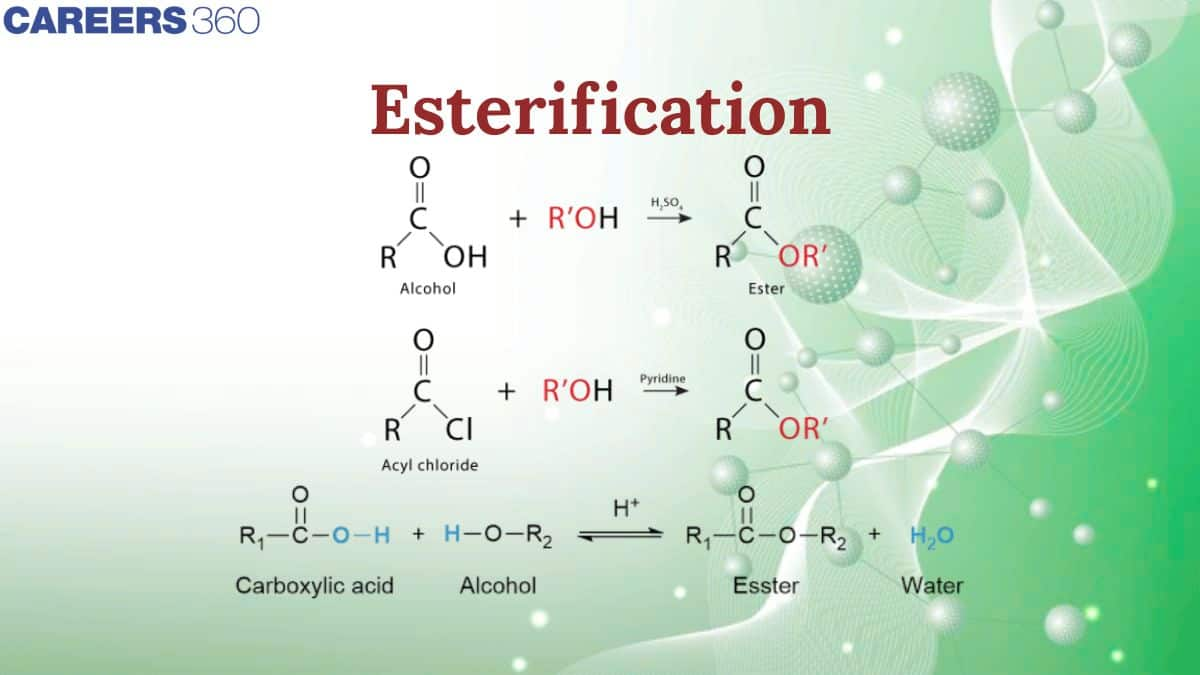
Esterification
Esterification is a chemical reaction in which a carboxylic acid reacts with an alcohol in the presence of an acid catalyst (usually concentrated sulphuric acid) to form an ester and water.
Carboxylic acid + Alcohol $\xrightarrow{\text { conc. } \mathrm{H}_2 \mathrm{SO}_4}$ Ester + Water
This reaction is reversible, and the esters formed often have pleasant fruity smells, which is why esterification is important in making perfumes, flavouring agents, medicines, and plastics.
The compound is produced by a reaction between a carboxylic acid reaction and an alkyl (alkoxy) group in an acid (organic or inorganic). They have a crucial role in biology, comprising the bulk of animal fats and vegetable oils, and are one of the main classes of lipids. Aromatic esters typically have a pleasing smell; low-molecular-weight esters are commonly found in pheromones and essential oils as fragrances. In recent decades, they have become one of the most important synthetic lubricants on the commercial market and serve as excellent solvents for a broad spectrum of plastics, plasticizers, resins, and lacquers. The backbone of DNA molecules is formed by phosphodiester. The explosive properties of nitro glycerine and other nitrate esters are well known.
Examples of Esterification Reaction
In the process of forming the ester, a chemical reaction takes place called esterification.
A chemical reaction that results in the formation of at least one ester product occurs when an organic acid alcohol (RCOOH) is combined with an alcohol (ROH) to form an ester (RCOOR) and water. Carboxylic acid reactions and alcohol are esterified to produce an ester.
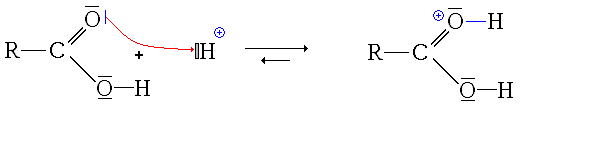
Here is an explanation of the esterification chemical reaction.
Read more :
Properties of Esters
- As a result of the esterification reaction, an ester is named after its carboxylic acid reactions.
- An enjoyable smell emanates from them.
- The food and perfume industries use them extensively.
- Oils and fats contain esters, which are organic compounds.
|
Related Topics Link |
Uses of Esters
Here are some examples of common ester applications.
- Food flavourings, perfumes, and cosmetics use esters that contain fragrant compounds.
- A solvent for organics.
- The explosive properties of nitrogen glycerine have made it famous.
- Detergents, soaps, and detergents contain surfactants.
- Ester compounds are found in pheromones naturally
- DNA is made of phosphate esters, which form the backbone of the molecule.
- Plastics are produced using polyesters
IUPAC nomenclature
Inorganic and organic acids may both exist as parent acids of esters, where the latter comes from the parent alcohol. Esters are derived from one or more complex carboxylic acid reactions are more commonly specified using the systematic IUPAC names, which are derived from naming the acids followed by "-oate".
In the IUPAC system, esters are named as alkyl alkanoates. The name has two parts:
Alkyl group name → derived from the alcohol (named first)
Alkanoate name → derived from the carboxylic acid (named second, with the ending -oic acid changed to -oate)
Steps for Naming an Ester
- Identify the alkyl group attached to the oxygen atom (from the alcohol).
- Identify the parent acid part of the ester.
- Replace -oic acid of the acid with -oate.
- Write the name as: Alkyl + Alkanoate
General Formula: $\mathrm{R}-\mathrm{COO}-\mathrm{R} \prime$
Examples:
| Ester | Alcohol part | Acid part | IUPAC Name |
|---|---|---|---|
| $\mathrm{CH}_3 \mathrm{COOCH}_3$ | Methyl | Ethanoic acid | Methyl ethanoate |
| $\mathrm{CH}_3 \mathrm{COOC}_2 \mathrm{H}_5$ | Ethyl | Ethanoic acid | Ethyl ethanoate |
| $\mathrm{C}_2 \mathrm{H}_5 \mathrm{COOCH}_3$ | Methyl | Propanoic acid | Methyl propanoate |
| $\mathrm{HCOOC}_2 \mathrm{H}_5$ | Ethyl | Methanoic acid | Ethyl methanoate |
Also read -
Some Solved Example
Question 1: Esterification of ethanol with acetic acid in the presence of conc. H2SO4\text{H}_2\text{SO}_4H2SO4 is an example of:
A. Irreversible reaction
B. Reversible reaction
C. Redox reaction
D. Neutralisation reaction
Solution:
Esterification is a reversible reaction because ester and water can react back to form alcohol and acid.
Hence, the correct answer is option (B)
Question 2: Which of the following is the correct product when methanol reacts with ethanoic acid?
A. Ethyl methanoate
B. Methyl ethanoate
C. Ethyl ethanoic acid
D. Methanoic ester
Solution:
Alcohol → methanol → methyl
Acid → ethanoic acid → ethanoate
So product = methyl ethanoate
Hence, the correct answer is option (B)
Question 3: The role of concentrated sulphuric acid in esterification is to:
A. Act as a catalyst only
B. Act as a dehydrating agent only
C. Act as both catalyst and dehydrating agent
D. Increase temperature of reaction
Solution:
Conc. $\mathrm{H}_2 \mathrm{SO}_4$
speeds up the reaction (catalyst)
removes water formed (dehydrating agent)
Hence, the correct answer is option (C)
Question 4: Which of the following will increase the yield of ester in esterification?
A. Adding excess water
B. Removing ester as it is formed
C. Using dilute acid
D. Lowering temperature
Solution:
According to Le Chatelier’s principle, removing ester shifts equilibrium forward, increasing yield.
Hence, the correct answer is option (B)
Frequently Asked Questions (FAQs)
Examples of esters are methyl formate, ethyl acetate, etc.
Esterification reactions can only occur in presence of acid catalyst as well as heat. It takes lot of energy to remove the -OH from carboxylic acid, so catalyst along with heat are needed to produce required energy..
The esterification reaction has two major uses:
1. Medicines are manufactured.
2. Paint and dye manufacturing.
Esters, which contain fragrant compounds, are used to flavour foods, perfumes, and cosmetics.
Also used as Organic solvents.
A chemical reaction called esterification occurs during the formation of the ester.
An organic acid (RCOOH) and alcohol (ROH) combine to form an ester (RCOOR) and water in the presence of at least one ester product obtained from the chemical reaction. An ester is produced by esterifying carboxylic acid reactions and alcohol.