


Pinacol Pinacolone Rearrangement Process with FAQs
Have you ever wondered how a vicinal diol can be converted into a carbonyl compound without changing the carbon skeleton? What causes the migration of an alkyl or aryl group during an acid-catalysed reaction? The Pinacol Pinacolone rearrangement is an organic transformation in which a 1,2-diol (pinacol) undergoes molecular rearrangement in the presence of an acid to form a ketone (pinacolone). This reaction is an important example of carbocation rearrangement and demonstrates the migratory aptitude of different groups.
This Story also Contains
- Pinacol
- Pinacolone
- Pinacol Pinacolone Rearrangement
- Mechanism of Pinacol Pinacolone Rearrangement
- Some Solved Examples
Pinacol
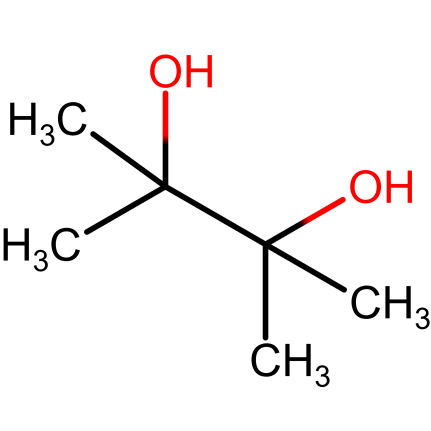
Pinacol is an organic compound belonging to the class of vicinal diols (1,2-diols), in which two hydroxyl (-OH) groups are attached to adjacent carbon atoms. Its IUPAC name is 2,3-dimethylbutane-2,3-diol. It is a solid organic compound, white in colour.
Structure
$\left(\mathrm{CH}_3\right)_2 \mathrm{C}(\mathrm{OH})-\mathrm{C}(\mathrm{OH})\left(\mathrm{CH}_3\right)_2$
Preparation
Pinacol is commonly prepared by the reduction of acetone using magnesium amalgam or other reducing agents.
$2 \mathrm{CH}_3 \mathrm{COCH}_3 \xrightarrow[\text { Reduction }]{ }\left(\mathrm{CH}_3\right)_2 \mathrm{C}(\mathrm{OH})-\mathrm{C}(\mathrm{OH})\left(\mathrm{CH}_3\right)_2$
Properties
- Colourless crystalline solid.
- Contains two hydroxyl groups attached to adjacent carbon atoms.
- Soluble in water and many organic solvents.
- Undergoes Pinacol Pinacolone rearrangement in the presence of acids to form ketones.
Pinacolone
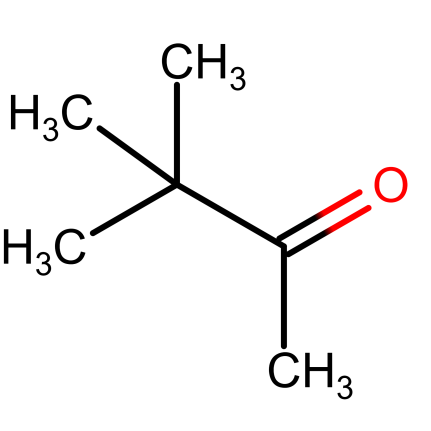
Pinacolone is a ketone, a colourless liquid with a gentle peppermint- or camphor-like smell. The IUPAC name of pinacolone is 3, 3-dimethyl-2-butanone. Pinacolone is an unsymmetrical ketone with an alpha-methyl group that can participate in condensation reactions. Being a ketone, pinacolone also has a carbonyl carbon that can undergo nucleophilic addition reactions like hydrogenation etc. Pinacol undergoes protonation to form pinacolone.
Structure
$\left(\mathrm{CH}_3\right)_3 \mathrm{C}-\mathrm{CO}-\mathrm{CH}_3$
Preparation
Pinacol undergoes dehydration and molecular rearrangement in the presence of a strong acid to form pinacolone.
$\left(\mathrm{CH}_3\right)_2 \mathrm{C}(\mathrm{OH})-\mathrm{C}(\mathrm{OH})\left(\mathrm{CH}_3\right)_2 \xrightarrow{\mathrm{H}^{+}}\left(\mathrm{CH}_3\right)_3 \mathrm{C}-\mathrm{CO}-\mathrm{CH}_3$
Properties
- Colorless liquid with a characteristic odor.
- Contains a carbonyl group (>C=O), making it a ketone.
- Less polar than pinacol due to the absence of hydroxyl groups.
- Soluble in common organic solvents.
Also Read
- NCERT solutions for Class 12 Chemistry Chapter 11 Alcohols, Phenols and Ethers
- NCERT Exemplar Class 12 Chemistry Solutions Chapter 11 Alcohols, Phenols and Ethers
- NCERT notes Class 12 Chemistry Chapter 11 Alcohols, Phenols and Ethers
Pinacol Pinacolone Rearrangement
The Pinacol–Pinacolone rearrangement, commonly known as the Pinacol rearrangement, is an acid-catalyzed reaction in which a vicinal diol (1,2-diol) is converted into a carbonyl compound (aldehyde or ketone) through dehydration followed by the migration of an alkyl or aryl group. The reaction proceeds via a carbocation intermediate and is an important example of molecular rearrangement in organic chemistry.
Reaction

Related Topics,
Mechanism of Pinacol Pinacolone Rearrangement
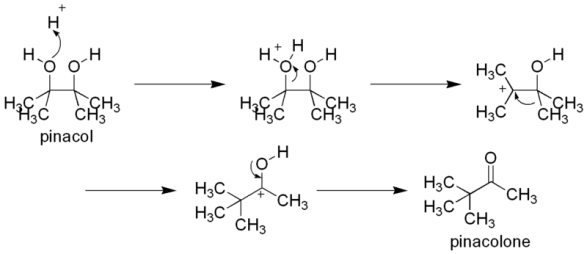
The Pinacol–Pinacolone rearrangement occurs in the presence of a strong acid and involves the conversion of a vicinal diol (pinacol) into a ketone (pinacolone) through dehydration and group migration.
Step 1: Protonation of the Hydroxyl Group
One of the hydroxyl groups of pinacol gets protonated by the acid, converting it into a better leaving group.
$\left(\mathrm{CH}_3\right)_2 \mathrm{C}(\mathrm{OH})-\mathrm{C}(\mathrm{OH})\left(\mathrm{CH}_3\right)_2+\mathrm{H}^{+} \rightarrow\left(\mathrm{CH}_3\right)_2 \mathrm{C}(\mathrm{OH})-\mathrm{C}\left(\mathrm{OH}_2^{+}\right)\left(\mathrm{CH}_3\right)_2$
Step 2: Loss of Water
The protonated hydroxyl group leaves as a water molecule, producing a carbocation.
$\left(\mathrm{CH}_3\right)_2 \mathrm{C}(\mathrm{OH})-\mathrm{C}^{+}\left(\mathrm{CH}_3\right)_2+\mathrm{H}_2 \mathrm{O}$
Step 3: 1,2-Methyl Shift (Rearrangement)
A methyl group from the adjacent carbon migrates to the carbocation center. Simultaneously, the lone pair of electrons on the oxygen forms a carbon-oxygen double bond.
$\left(\mathrm{CH}_3\right)_2 \mathrm{C}(\mathrm{OH})-\mathrm{C}^{+}\left(\mathrm{CH}_3\right)_2 \rightarrow\left(\mathrm{CH}_3\right)_3 \mathrm{C}-\mathrm{C}(\mathrm{OH})^{+}-\mathrm{CH}_3$
This step is called the 1,2-methyl shift or group migration.
Step 4: Deprotonation
The oxonium ion loses a proton to form the ketone, pinacolone.
$\left(\mathrm{CH}_3\right)_3 \mathrm{C}-\mathrm{C}(\mathrm{OH})^{+}-\mathrm{CH}_3 \rightarrow\left(\mathrm{CH}_3\right)_3 \mathrm{C}-\mathrm{CO}-\mathrm{CH}_3+\mathrm{H}^{+}$
Overall Reaction
$\left(\mathrm{CH}_3\right)_2 \mathrm{C}(\mathrm{OH})-\mathrm{C}(\mathrm{OH})\left(\mathrm{CH}_3\right)_2 \xrightarrow{\mathrm{H}^{+}}\left(\mathrm{CH}_3\right)_3 \mathrm{C}-\mathrm{CO}-\mathrm{CH}_3$
One of the important characteristics of pinacol pinacolone rearrangement is that the configuration of the migration group is retained or remains unchanged.
Migratory Aptitude
This process is not limited to 1,2-methyl shifts. A carbon can have different types of groups attached to it. Some of the group may rearrange more readily than others. Depending on the reaction conditions and on the nature of the substrate, it could be deduced which group might migrate.
Generally, the order of migration of groups can be given as:
H > aryl > alkyl
If hydrogen is present as a migratory group, aldehydes can also be produced by undergoing 1,2-shift.
As observed, the more nucleophilic a group is, the more readily it will migrate. Order of migration in aryl groups can be given as:
p-anisyl > p-tolyl > phenyl > p –chlorophenyl
Also read
Some Solved Examples
Question 1: The major product formed in the following reaction is:
$\left(\mathrm{CH}_3\right)_2 \mathrm{C}(\mathrm{OH})-\mathrm{C}(\mathrm{OH})\left(\mathrm{CH}_3\right)_2 \xrightarrow{\mathrm{H}^{+}} ?$
A. 2,3-Dimethylbutane
B. 3,3-Dimethylbutan-2-one
C. 2-Methylbutan-2-ol
D. Butan-2-one
Solution:
The given compound is pinacol. Under acidic conditions, it undergoes Pinacol-Pinacolone rearrangement involving dehydration followed by a 1,2-methyl shift.
Product formed:
$\left(\mathrm{CH}_3\right)_3 \mathrm{C}-\mathrm{CO}-\mathrm{CH}_3$
which is 3,3-Dimethylbutan-2-one (Pinacolone).
Hence, the correct answer is option (B)
Question 2: The key intermediate in the Pinacol-Pinacolone rearrangement is:
A. Free radical
B. Carbocation
C. Carbanion
D. Benzyne
Solution:
After protonation of one hydroxyl group, water leaves producing a carbocation. The rearrangement then proceeds through a 1,2-shift.
Hence, the correct answer is option (B)
Question 3: Which of the following migrates most readily during Pinacol rearrangement?
A. Methyl
B. Primary alkyl
C. Phenyl
D. Secondary alkyl
Solution
Migratory aptitude:
$H^{-}>P h^{-}>3^{\circ}>2^{\circ}>1^{\circ}>\mathrm{CH}_3^{-}$
Among the given options, phenyl has the highest migratory aptitude.
Hence, the correct answer is option (C)
Question 4: The major product obtained from
$\left(\mathrm{CH}_3\right)_2 \mathrm{C}(\mathrm{OH})-\mathrm{CH}(\mathrm{OH})-\mathrm{CH}_3$
on treatment with concentrated $\mathrm{H}_2 \mathrm{SO}_4$ is:
A. 3-Methylbutan-2-one
B. 2-Methylbutan-2-one
C. Butan-2-one
D. 2-Methylbutanal
Solution:
Water leaves from the carbon capable of generating the more stable tertiary carbocation.
$\left(\mathrm{CH}_3\right)_2 \mathrm{C}^{+}-\mathrm{CH}(\mathrm{OH})-\mathrm{CH}_3$
A hydride shift from the adjacent carbon occurs, followed by formation of the carbonyl group.
Product:
$\mathrm{CH}_3 \mathrm{COCH}\left(\mathrm{CH}_3\right) \mathrm{CH}_3$
which is 3-Methylbutan-2-one.
