


Amperes Law -Definition, Statement, Examples, Equation, FAQs
Ampere’s Law provides a simpler and more convenient way of expressing the same ideas described by the Biot–Savart Law. Both laws relate current to the magnetic field it produces and give the same results for a steady, unchanging current. In simple terms, Ampere’s Law is to Biot–Savart Law what Gauss’s Law is to Coulomb’s Law an easier method when symmetry is present. However this comparison is valid only for steady currents where the current remains constant with time. In this article, we will understand Ampere’s Law in detail, including its statement, formula, meaning, and application. We will also look at solved examples to help students clearly understand how the law is applied in different situations.
This Story also Contains
- What is Ampere’s Law?
- Who Was André-Marie Ampère?
- Ampere’s Circuital Law
- Ampere's Circuital Law Formula
- Ampere's Law Derivation From Bio-Savart Law
- Maxwell-Ampere Circuital Law
- Determining Magnetic Field by Ampere’s Law
- Application of Ampere’s Circuital Law
- Ampere’s Law Solved Examples
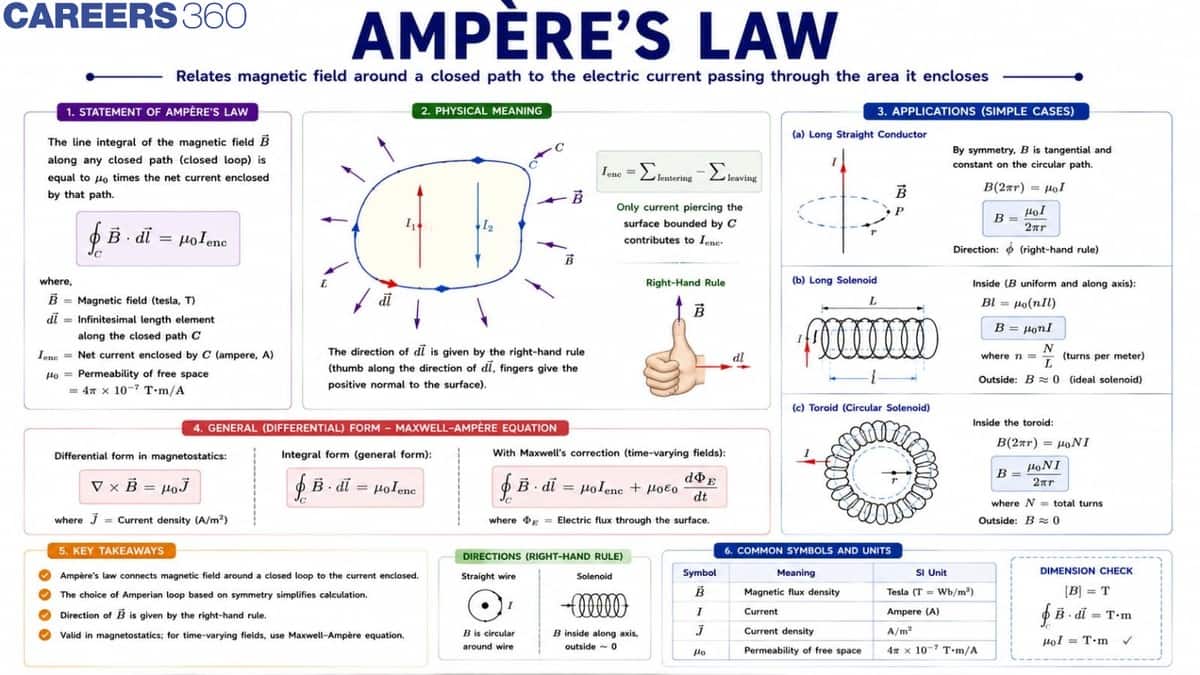
What is Ampere’s Law?
The Ampere Law statement is as follows: “The magnetic field produced by an electric current is proportional to its magnitude, with proportionality constant equal to the permeability of empty space.”
According to Ampere circuital law, magnetic fields are related to the electric current created in them. The law specifies the magnetic field is associated with a particular current or vice versa as long as the electric field remains constant.
Who Was André-Marie Ampère?
André-Marie Ampère was a scientist who experimented with current-carrying wires and the forces acting on them. The experiment took place in the late 1820s, during the time Faraday was developing his Faraday's Law. Faraday and Ampere had no notion that their work would be integrated four years later by Maxwell himself.
Ampere’s Circuital Law
The line integral of the magnetic field surrounding a closed loop equals the algebraic total of currents going through the loop. This is understood better using the Ampere circuital law's equation.
Ampere's Circuital Law Formula
If a conductor is carrying current I, the current flow generates a magnetic field around the wire. Ampere's circuital law formula is given as:
$\int \mathrm{B} \cdot \mathrm{dl}=\mu_o I$
- where,
- $\int \mathrm{B} \cdot \mathrm{dl}$ is the line integral of B in a closed path
- $\mu$ is the permeability of free space
- $I$ is the current enclosed
The left side of the equation states that if an imaginary path encircles the wire and the magnetic field is added at each point, the current surrounded by this path, as represented by the current enclosed, is numerically equivalent to the current encircled by this route.
Also read -
- NCERT Solutions for Class 11 Physics
- NCERT Solutions for Class 12 Physics
- NCERT Solutions for All Subjects
Ampere's Law Derivation From Bio-Savart Law
The Bio-savart law is given as
$d \vec{B}=\frac{\mu_0}{4 \pi} \frac{I d \vec{l} \times \hat{r}}{r^2}$
Integrating on both sides,
$\vec{B}=\frac{\mu_0}{4 \pi} \int \frac{I d \vec{l} \times \hat{r}}{r^2}$
Take the line integral of the equation
$\oint \vec{B} \cdot d \vec{l}=\oint\left(\frac{\mu_0}{4 \pi} \int \frac{I d \vec{l}^{\prime} \times \hat{r}}{r^2}\right) \cdot d \vec{l}$
Simplify the integral
$\oint \vec{B} \cdot d \vec{l}=\frac{\mu_0}{4 \pi} \int\left(I d \vec{l} \times \oint \frac{\hat{r}}{r^2} \cdot d \vec{l}\right)$
Stoke's theorem states that the surface integral of the curl of a vector field is equal to the line integral of the field along that boundary. Applying Stoke's theorem on the above equation we get,
$\oint \vec{B} \cdot d \vec{l}=\mu_0 I_{\mathrm{enc}}$
This is the Ampere's law equation.
Maxwell-Ampere Circuital Law
It is an extension of Ampere's law. It states that an electric current or changing electric flux passing through a surface generates a rotating magnetic field around any boundary path.
$\nabla \times \mathbf{B}=\mu_0 \mathbf{J}+\mu_0 \epsilon_0 \frac{\partial \mathbf{E}}{\partial t}$
where,
$\nabla \times \mathbf{B}$ is the curl of magnetic field
$\mu_0$ is the permeability of free space
$J$ is the current density
$\epsilon_0$ is the permittivity of free space
${\partial \mathbf{E}}/{\partial t}$ is the time rate of change of electric field
Determining Magnetic Field by Ampere’s Law
Ampere's Law helps us calculate the magnetic field produced by electric current in situations where the field has a symmetrical pattern. According to Ampere's Law:
$\oint \vec{B} \cdot d \vec{l}=\mu_0 I$
This means that the total magnetic field along a closed loop is proportional to the current passing through the loop.
Magnetic Field for different cases are given below:
| Case | Magnetic Field |
| Straight wire | $ B = \frac{\mu_0 I}{2\pi r} $ |
| Solenoid (inside) | $ B = \mu_0 n I $ |
| Solenoid (outside) | ≈ 0 |
| Toroid | $ B = \frac{\mu_0 N I}{2\pi r} $ |
| Toroid (outside) | 0 |
| Circular loop (center) | $B = \frac{\mu_0 I}{2R} $ |
| Coaxial cable | Depends on region (given above) |
Application of Ampere’s Circuital Law
Ampere's circuital law can be applied in the following ways.
-
Determine the magnetic induction that occurs when a long current-carrying wire is used.
-
To find the magnetic field inside a toroid, use the ampere circuital law.
-
Calculate the magnetic field that a long current-carrying conducting cylinder generates.
-
The magnetic field inside the conductor must be determined.
-
Find the forces that exist between currents.
|
Related Topics, |
Ampere’s Law Solved Examples
Q.1 A long straight wire carries a current of $I=5 \mathrm{~A}$. Find the magnetic field at a point $r=0.1 \mathrm{~m}$ from the wire.
(Take $\mu_0=4 \pi \times 10^{-7} \mathrm{H} / \mathrm{m}$ )
Solution:
For a long straight wire,
$
B=\frac{\mu_0 I}{2 \pi r}
$
Substitute values:
$
\begin{gathered}
B=\frac{4 \pi \times 10^{-7} \times 5}{2 \pi \times 0.1} \\
B=\frac{20 \pi \times 10^{-7}}{0.2 \pi}=100 \times 10^{-7} \mathrm{~T}=1 \times 10^{-5} \mathrm{~T}
\end{gathered}
$
Answer:
$
B=1.0 \times 10^{-5} \mathrm{~T}
$
Q.2 A long solenoid has 1000 turns per metre and carries a current of 2 A . Find the magnetic field inside the solenoid.
Solution:
For a long solenoid,
$
B=\mu_0 n I
$
Where $n=$ number of turns per metre.
Given: $n=1000$ turns/m, $I=2 \mathrm{~A}$
$
\begin{gathered}
B=4 \pi \times 10^{-7} \times 1000 \times 2 \\
B=8 \pi \times 10^{-4} \mathrm{~T} \approx 2.51 \times 10^{-3} \mathrm{~T}
\end{gathered}
$
Answer:
$
B \approx 2.5 \times 10^{-3} \mathrm{~T}
$
Q.3 A toroid has 500 turns and carries a current of 3 A . The mean radius of the toroid is $r=0.2 \mathrm{~m}$. Find the magnetic field inside the toroid.
Solution:
For a toroid,
$
B=\frac{\mu_0 N I}{2 \pi r}
$
Given: $N=500, I=3 \mathrm{~A}, r=0.2 \mathrm{~m}$
$
\begin{gathered}
B=\frac{4 \pi \times 10^{-7} \times 500 \times 3}{2 \pi \times 0.2} \\
B=\frac{6000 \pi \times 10^{-7}}{0.4 \pi}=15000 \times 10^{-7} \mathrm{~T}=1.5 \times 10^{-3} \mathrm{~T}
\end{gathered}
$
Answer:
$
B=1.5 \times 10^{-3} \mathrm{~T}
$
Q.4 The magnetic field at a distance 0.05 m from a long straight wire is $4 \times 10^{-5} \mathrm{~T}$. Find the current in the wire.
Solution:
Use
$
B=\frac{\mu_0 I}{2 \pi r} \Rightarrow I=\frac{2 \pi r B}{\mu_0}
$
Substitute values:
$
\begin{gathered}
I=\frac{2 \pi \times 0.05 \times 4 \times 10^{-5}}{4 \pi \times 10^{-7}} \\
I=\frac{0.1 \times 4 \times 10^{-5}}{4 \times 10^{-7}}=\frac{4 \times 10^{-6}}{4 \times 10^{-7}}=10 \mathrm{~A}
\end{gathered}
$
Answer:
$
I=10 \mathrm{~A}
$
Frequently Asked Questions (FAQs)
Ampere’s Law Definition: “The magnetic field formed by electric current is proportional to magnitude of that electric current with constant of proportionality equal to permeability of empty space,” according to Ampere circuital law's equation.
Another way to compute the magnetic field owing to a particular current distribution is to use Ampere circuital law's law. Ampere circuital law can be derived from Biot-Savart law, and Ampere circuital law can be derived from Biot-Savart law. Under some symmetrical conditions, Ampere circuital law is more beneficial.
Ampere circuital law is a mathematical relationship between magnetic fields and electric currents that allows us to bridge the gap between electricity and magnetism. It allows us to determine the magnetic field created by an electric current flowing through any shape of wire.
When the symmetry of the situation allows, i.e. when the magnetic field surrounding an 'Amperian loop' is constant, you can utilize Ampere circuital law in introductory Electromagnetic theory. For example, to calculate the magnetic field of an infinite straight current carrying wire at a given radial distance.