ATIT
Merit Scholarships | NAAC A+ Accredited | Top Recruiters : E&Y, CYENT, Nvidia, CISCO, Genpact, Amazon & many more


Electric current in a conductor is not due to electrons moving rapidly in one direction, but because of their slow and systematic motion under an electric field. This motion is known as drift velocity, a fundamental concept in electrostatics and current electricity. Understanding drift velocity helps students clearly visualize how microscopic charge movement leads to macroscopic current. It also builds a strong connection between electric field, current, and mobility of electrons. For Class 12 Physics, drift velocity is an important topic, frequently asked in board exams as well as competitive exams like JEE. In this article, we will explore the concept of drift velocity, its formula, derivation, and related concepts in a clear and student-friendly manner.
This Story also Contains
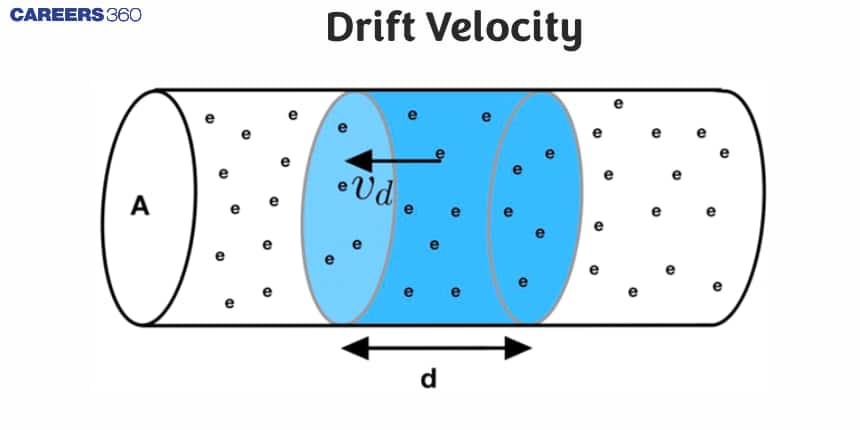
In a conductor, free electrons are in a state of continuous random motion due to thermal energy. In the absence of any external electric field, these random motions cancel out, resulting in zero net flow of charge.
When an external electric field is applied across the conductor, the electrons continue their random motion, but they also experience a force due to the electric field. As a result, they acquire a small net velocity in a particular direction. This net average velocity of charge carriers is called drift velocity.
Definition:
Drift velocity is the average velocity attained by free charge carriers in a conductor under the influence of an external electric field.
Electrons, being negatively charged, drift opposite to the direction of the electric field, while the direction of conventional current is taken along the field.
The drift velocity is given by:
$
v_d=\frac{e E \tau}{m}
$
where $e$ is the charge of an electron, $E$ is the applied electric field, $\tau$ is the relaxation time, and $m$ is the mass of the electron.
When an electric field $E$ is applied to a conductor, an electron of charge $-e$ experiences a force:
$
F=-e E
$
Using Newton's second law $F=m a$, the acceleration is:
$
a=\frac{-e E}{m}
$
Let $\tau$ be the relaxation time (average time between collisions).
The average velocity gained by the electron is:
$
v_d=a \tau
$
Substituting $a$ :
$
v_d=-\frac{e E \tau}{m}
$
Thus, drift velocity is directly proportional to the electric field and relaxation time, and is opposite to the direction of the electric field.
$
V_d=\mu E
$
$V_d$ is directly proportional to $E$:
$V_d \propto E$ when the temperature is constant, the greater the electric field, the larger the drift velocity.
Drift velocity varies inversely with the area of the cross-section

Also, read
The SI unit of drift velocity is meters per second ( $\mathrm{m} / \mathrm{s}$ ).
$V_d=\frac{I}{n A e}$
substituting unit of each term
$V_d=\frac{\mathrm{A}}{\left(\mathrm{m}^{-3}\right)\left(\mathrm{m}^2\right) \mathrm{C}}$
$V_d=\frac{\mathrm{A}}{\mathrm{m}^{-1} \cdot \mathrm{C}}$
$V_d=\frac{\mathrm{C} / \mathrm{s}}{\mathrm{m}^{-1} \cdot \mathrm{C}}$
Thus simplifying we get
$V_d=\frac{\mathrm{m}}{\mathrm{s}}$
The drift velocity is directly proportional to the current density.
$
J=n e V_d
$
where,
$J$ is the Current Density
$n$ is the number density of electrons in a conductor
$e:$ is the charge of an electron
$V_d$ is the drift velocity
The drift velocity is directly proportional to the electric current.
$
I=n A e v_d
$
hence,
$
I \propto v_d
$
The time interval between two successive collisions of electrons with the Positive ions.
The path between two consecutive collisions is called the free path. The average length of these free paths is called the “Mean Free Path”.
It is the drift velocity of an electron per unit electric field. It indicates how easily an electron can pass through the material (conductor or semiconductor) in the presence of an electric field.
$\mu=\frac{v_d}{E}$
|
Related Topics, |
Example 1: Drift speed of electrons, when 1.5 A of current flows in a copper wire of cross-section is v . If the electron density in copper is $9 \times 1028 / \mathrm{m} 3$ the value of $v$ in $\mathrm{mm} / \mathrm{s}$ is close to (Take charge of an electron to be $=1.6 \times 10-19 \mathrm{C}$ )
1) 0.02
2) 3
3) 2
4) 0.2
Solution:
$\begin{gathered}I=n e A V_d \\ V_d=\frac{I}{n e A}=\frac{9 \times 10^{28} \times 1.6 \times 10^{-19} \times 5 \times 10^{-6}}{1}=0.02 \times 10^{-3} \mathrm{~m} / \mathrm{s}=0.02 \mathrm{~mm} / \mathrm{sec}\end{gathered}$
Hence, the answer is the option (1).
Example 2: A current of 10 A exists in a wire of a cross-sectional area of 5 mm 2 with a drift velocity of $2 \times 10-3 \mathrm{~ms}-1$. The number of free electrons in each cubic meter of the wire is:
1) 1×10²³
2) 625×1025
3) 2×1025
4) 2×10⁶
Solution:
\begin{aligned}
&i=10 \mathrm{~A}, A=5 \mathrm{~mm}^2=5 \times 10^{-6} \mathrm{~m}^2 \text { and } v_d=2 \times 10^{-3} \mathrm{~m} / \mathrm{s}\\
&\text { We know, }\\
&\begin{gathered}
i=n e A v_d \\
10=n \times 1.6 \times 10^{-19} \times 5 \times 10^{-6} \times 2 \times 10^{-3} \Rightarrow n=0.625 \times 10^{28}=625 \times 10^{25}
\end{gathered}
\end{aligned}
Hence, the answer is the Option(2).
Example 3: When a 5 V potential difference is applied across a wire of length 0.1 m, the drift speed of electrons is $2.5 \times 10^{-4} \mathrm{~ms}^{-1}$. If the electron density in the wire is $8 \times 10^{28} \mathrm{~m}^{-3}$, the resistivity of the material is close to:
1) $1.6 \times 10-8 \Omega \mathrm{~m}$
2) $1.6 \times 10-7 \Omega \mathrm{~m}$
3) $1.6 \times 10-6 \Omega \mathrm{~m}$
4) $1.6 \times 10-5 \Omega \mathrm{~m}$
Solution:
\begin{aligned}
& I=A n e v_{-} d \\
& \Rightarrow V=R A n e v_{-} d \\
& \Rightarrow V(\rho I / A)=A n e v_{-} d \\
& \Rightarrow V A / \rho I=A n e v_{-} d \\
& \Rightarrow \rho=V / I^*\left(1 / n v_{-} d\right) \\
& \Rightarrow \rho=V I /\left(n e v_{-} d\right) \\
& =50.1 \times\left(8 \times 10^{\wedge} 28\right) \times\left(1.6 \times 10^{\wedge}(-19)\right) \times\left(2.5 \times 10^{\wedge}(-4)\right) \\
& \Rightarrow \rho=1.5625 \times 10^{\wedge}(-5) \Omega \mathrm{m} \approx 1.6 \times 10^{\wedge}(-5) \Omega \mathrm{m}
\end{aligned}
Hence, the answer is the option (4).
Example 4: An electron moving in a zigzag path travels a displaces by 0.2 mm in 10 seconds. Its drift speed is (in $\mathrm{m} / \mathrm{sec}$ )
1) $2 \times 10^{-5}$
2) $10^{-5}$
3) $2 \times 10^{-4}$
4) $10^{-4}$
Solution:
Drift velocity
Drift velocity is the average velocity that a particle such as an electron attains in a material due to an electric field.
Drift Velocity = Displacement/time
Displacement $=.2 \mathrm{~mm}=2 \times 10^{-4} \mathrm{~m}$
Time = 10 sec
Drift Velocity $V_d=2 \times 10^{-5} \mathrm{~m} / \mathrm{sec}$
Hence, the answer is option (1).
Example 5: Which of the following is correct regarding relaxation time?
1) Relaxation time increases with increase in temperature
2) Relaxation time decreases with increase in temperature
3) A decrease in relaxation time causes a decrease in resistivity
4) Conductivity is independent of Relaxation time
Solution:
Relaxation time ($\tau$)⟶ The time interval between two successive collisions of electrons with the ions/ atoms.
As with an increase in temperature drift velocity increases which will lead to an increase in the rate of collision and hence relaxation time decreases.
Hence, the answer is the option (2).
Frequently Asked Questions (FAQs)
The ease with which a specific type of charged particle moves through a material under the influence of an electric field is referred to as mobility in physics. Electric fields attract these particles, which interact with solid molecules on a regular basis. The average speed at which the particles travel as a result of the electric field and collision is known as drift speed. In most metals, the charge carrier is a negatively charged electron.
Electron mobility is used to determine how rapidly an electron moves through a metal or semiconductor under the influence of an electric field.
Electron mobility is expressed mathematically as: μ=VdE .
Where vd is the electron's drift velocity and E is the external electric field.
The Si unit of mobility is the m2v-1s-1.
Any conductor's drift velocity is independent of its cross-sectional area or diameter..
The average velocity that an electron achieves as a result of an electric field is known as the electron drift velocity. The average velocity, or electron drift velocity, is very low due to collisions between electrons.
The electric current produced by particles being dragged by an electric field is known as drift current. Although the phrase is most usually associated with electrons and holes in semiconductors, the concept can also be applied to metals, electrolytes, and other materials.
Velocity is defined as the rate of change of displacement of a body with respect to time.

Merit Scholarships | NAAC A+ Accredited | Top Recruiters : E&Y, CYENT, Nvidia, CISCO, Genpact, Amazon & many more
Law Admissions 2026 Open | Avail Merit-Based Scholarships
Get Job Ready in Healthcare | Employability-Focused Programs
Leading Design College | Highest CTC: ₹12 LPA | Average CTC: ₹7.5 LPA | Scholarships for Deserving Students
75+ years of legacy | #1 Entrance Exam | Score accepted by 250+ BSchools
Gateway to IBS Hyderabad & 8 other IBS campuses | Scholarships worth 10 CR