


Diagram Of Digestive System with Detailed Explanations
The diagram of the human digestive system visually represents the organs involved in digestion, absorption, and elimination of food. It includes the alimentary canal and accessory digestive organs such as the liver and pancreas. This guide explains the labelled digestive system diagram, organ-wise functions, key definitions, and NEET/Class-focused questions.
This Story also Contains
- What Is the Digestive System?
- Key Concepts and Definitions
- Diagram of the Human Digestive System
- Parts of the Human Digestive System
- Functional Significance of Digestive System Diagram
- Digestive System Diagram NEET MCQs (With Answers & Explanations)
What Is the Digestive System?
The human digestive system could be compared to a highly mechanized factory in which food is processed and turned into energy and nutrients. The process starts the moment you take a bite of food, breaking down complex substances into forms that are simple enough for your body to use.
Understanding how this system works may help you appreciate the wonders of human biology and should give you a better appreciation for the importance of proper nutrition to your health. The article deals with the anatomy, functions, and significance of the human digestive system, explaining parts and processes given their practical implication.
Key Concepts and Definitions
The human digestive system has two major divisions: the gastrointestinal tract, also known as the alimentary canal, and accessory organs.
Digestive System
The digestive system converts complex food into simple molecules.
It enables absorption of nutrients into blood and utilisation by cells.
Alimentary Canal (Gastrointestinal Tract)
The alimentary canal is a muscular, elastic tube that measures about nine meters long.
It is a continuous tube that starts at the mouth and ends at the anus.
It includes segments are the mouth, pharynx, oesophagus, stomach, small intestine, large intestine, rectum, and anus, each of which carries out certain specialized activities.
Accessory Digestive Organs
Accessory organs are the organs that secrete enzymes and juices.
It includes liver, pancreas and tongue.
Diagram of the Human Digestive System
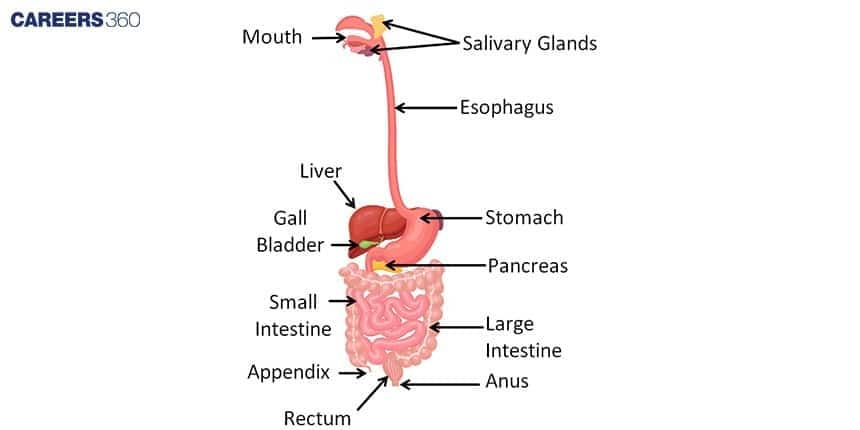
The diagram of human digestive system is discussed below:
What the Diagram Represents
The diagram represents sequential arrangement of digestive organs.
It shows the direction of the food movement.
It highlights the relationship between alimentary canal and accessory organs
Parts of the Human Digestive System
The human digestive system is such a complex system of organs that all work in coordination to break down the ingested food for the needed nutrients. Here is a detailed look at the digestive system of the human body, along with its parts and functions:
Mouth
Food is ingested into the mouth
Food undergoes mechanical and chemical digestion due to teeth and saliva, respectively.
Saliva contains enzymes like amylase that break down carbohydrates initially.
Pharynx
Pharynx serves as the common passage for food and air.
It directs the swallowed food into the oesophagus.
Prevent the food entering into the trachea.
Esophagus
The muscular tube includes food from the pharynx down to the stomach, because of peristalsis, a rhythmic muscle contraction.
No digestion occurs here.
Stomach
This sac-like organ churns and mixes food with gastric juices.
Secretes mainly hydrochloric acid, pepsin and mucus
Forms semi-fluid called chyme.
Small Intestine
Further divided into three parts, namely, duodenum, jejunum, and ileum
Site of maximum absorption of nutrients.
Villi and microvilli are small, finger-like projections lining the intestine that increase surface area.
Large Intestine
The large intestine is also referred to as the colon.
The primary functions of this organ include water and electrolyte absorption.
Converts undigested food to form solid waste, also called faeces.
Rectum And Anus
Rectus stores faeces.
They are expelled out through the anus during defecation.
Functional Significance of Digestive System Diagram
Each portion of the gastrointestinal tract has an essential role in the processing of food and absorption of nutrients.
The acidity in the stomach promotes digestion but excludes the entry of pathogens.
The absorptive surface of the small intestine is maximized by its special structure.
Digestive System Diagram NEET MCQs (With Answers & Explanations)
Important questions asked in NEET from this topic are:
Stages of digestion
Disorders of the digestive system
Practice Questions for NEET
Q1. Which of the following is not a digestive gland?
Salivary Glands
Pancreas
Liver
Gall bladder
Correct answer: 4) Gall bladder
Explanation:
The GI System is concerned with the processes of digestion and absorption of nutrient substances essential to life. This system includes an alimentary canal, which represents a hollow organ beginning at the mouth and the oesophagus, stomach, and small intestine divided into the duodenum, jejunum, and ileum, the large intestine representing the colon and rectum culminating in the anus. Glands associated with the digestive glands include the salivary gland, pancreas, and liver, but the gall bladder stores bile to be used within the digestive pathway.
Hence, the correct answer is option 4) Gallbladder.
Q2. The GI tract or alimentary canal in humans starts with the ________ and proceeds to the __________, stomach, small intestine, and then to the large intestine (colon), rectum, and terminates at the _________. Fill in the blanks by choosing the correct option.
Tongue, trachea, anus respectively
Mouth , pharynx, duodenum respectively
Mouth, esophagus, anus respectively
Salivary glands, trachea, jejunum respectively
Correct answer: 3) Mouth, oesophagus, anus respectively
Explanation:
The gastrointestinal (GI) tract, also known as the alimentary canal starts with the mouth and proceeds to the esophagus, stomach, small intestine (duodenum, jejunum, ileum), and then to the large intestine (colon), rectum, and terminates at the anus. It has an endodermal origin during embryonic development.
Hence, the correct answer is option 3) Mouth, oesophagus, and anus respectively.
Q3. Lamina propria is
Layer of loose connective tissue
It is a part of Mucosa layer of Alimentary canal
Also contains gland for the secretion of gonadotropin hormones
Both 1 and 2
Correct answer: 4) Both 1 and 2
Explanation:
Mucosa is composed of simple epithelium cells and a thin connective tissue - areolar tissue. The layer of areolar connective tissue is called lamina propria. In addition, the mucosa has a thin, smooth muscle layer, called the muscularis mucosa. Mucosa forms glands in the stomach (gastric glands) and crypts in between the bases of villi in the intestine (crypts of Lieberkuhn).
Hence, the correct answer is option 4) Both 1 and 2
Also Read:
Frequently Asked Questions (FAQs)
Common digestive disorders include:
Gastroesophageal reflux disease (GERD): Heartburn, symptoms related to the regurgitation of stomach acid, and trouble swallowing.
Irritable bowel syndrome (IBS): The predominant symptoms always include abdominal pain; next in frequency are bloating, diarrhoea, and constipation.
Crohn's disease and ulcerative colitis: Inflammatory bowel diseases characterized by abdominal pain, diarrhoea often bloody, loss of weight, and fatigue.
Celiac disease: A disorder in which the ingestion of gluten induces an immune-mediated response, causing damage to the small intestine, diarrhoea, bloating, fatigue, and other symptoms.
The food we eat has an enormous influence on how our digestive systems work and thus on the health of our whole bodies. A well-rounded diet delivers all the needed building blocks for optimal digestion, complete with colourful fruits and veggies, whole grains, lean proteins, and healthy fats. Fibre keeps one's bowel regular and promotes good bacteria in the gut. On the other hand, diets that are highly processed and full of saturated fats and added sugars have low fibre, leading to underactive digestion: constipation, bloating, and chronic inflammation. A varied and well-balanced diet gives rise to good overall digestive health and bridges towards higher quality living.
The digestion of food in the digestive system entails both mechanical and chemical digestion. Mechanical digestion begins with chewing in the mouth and then continues in the stomach through churning and mixing food muscularly with the digestive juices. Chemical digestion refers to the action of enzymes and acids in the breakdown of complex molecules into simple forms for absorption in the body. It initiates in the mouth using saliva, where there are enzymes like amylase to begin the process of digestion in breaking down a carbohydrate. Afterwards, there will be additional digestion in the stomach and small intestine with varied enzymes responsible for protein and fat digestion.
Enzymes are biological catalysts that maintain the pace of chemical reactions in the body. They assist in the breakup of food during digestion. There are various types of enzymes needed for the breakdown of different nutrients: amylases, which break down carbohydrates into sugars; proteases, which break down proteins into amino acids; and lipases, which break down fats into fatty acids and glycerol. Three types of enzymes along the digestive tract digest food and make absorption of the broken products perfect.
Mainly, fibre is essential for digestive health since it provides bulk to stool and hence helps in regular bowel movement, preventing constipation. Soluble fibre partially dissolves in water, taking a gel-like form that helps in moderating the assimilation of sugar into the blood and reducing the level of cholesterol. Insoluble fibre provides bulk to stool and helps in its passage through the guts, providing health to the guts and hence preventing digestive disorders like diverticulosis.
