KCC Institute of Legal and Higher Education, Greater Noida
Law Admissions 2026 Open | Avail Merit-Based Scholarships


Digestive glands are specialised organs of the digestive system that secrete enzymes and other substances required for food digestion. They break complex food molecules into simpler, absorbable forms, ensuring proper nutrition and energy supply. This guide covers the types, structure, functions, disorders, and NEET-focused concepts of digestive glands.
This Story also Contains
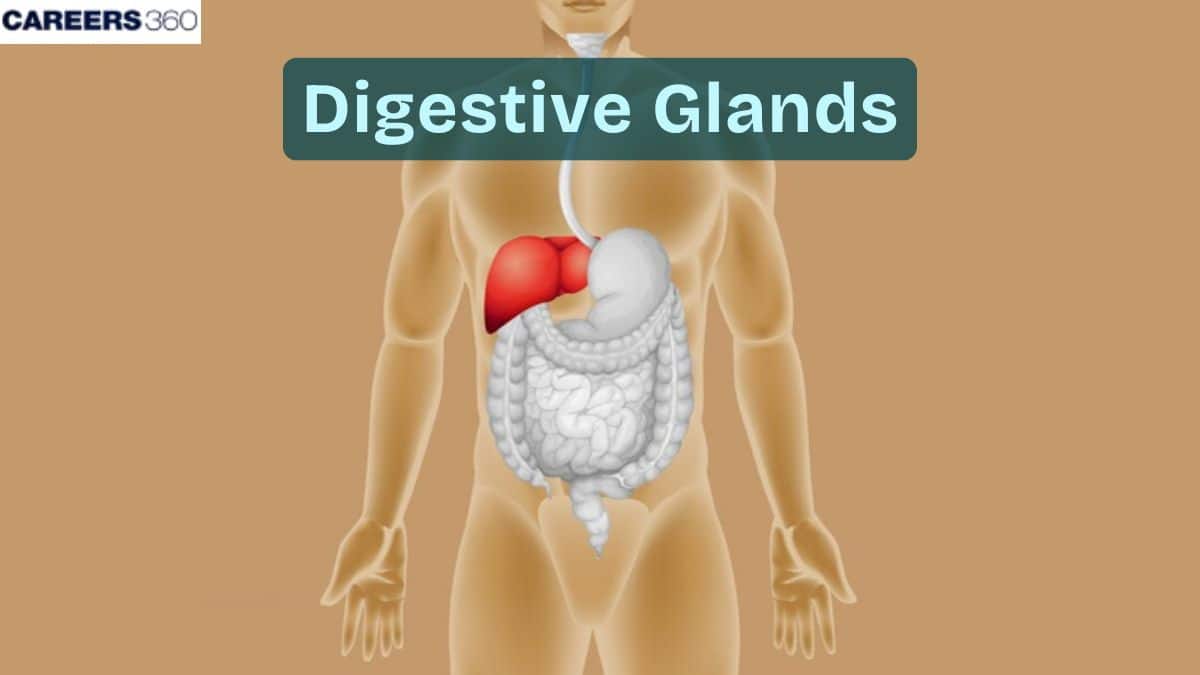
Digestive glands are part of the digestive system, designed to produce and secrete certain enzymes accompanied by other substances in charge of food digestion. They break down complex food into molecules simple enough to be easily absorbed and utilised by the body. In their absence, digestion would have its efficiency reduced considerably, often giving rise to phenomena of malnutrition and several disorders of gastrointestinal tract.
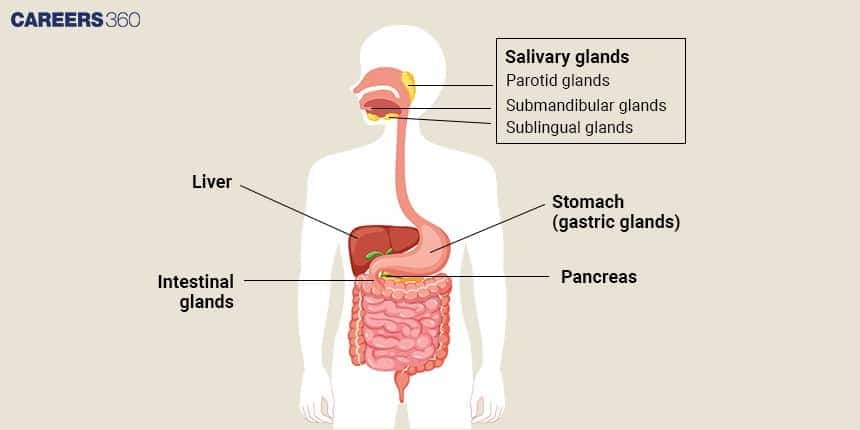
Several types of digestive glands form a part of the digestive system; each is involved in performing the activity of digestion and absorption of nutrients. The different forms of digestive glands include:
Types: Parotid, Submandibular, and Sublingual
Function: Saliva secretion, enzyme production (amylase)
Law Admissions 2026 Open | Avail Merit-Based Scholarships
BBA/MBA/PGDM Early Bird Applications Deadline 19th Oct '26. Apply now using coupon code CAREER250 and get ₹250 off the application fee
Types: Cardiac, Fundic, Pyloric
Function: Secretion of gastric juices, HCl, pepsinogen
Structure: Exocrine and endocrine parts
Function: Enzyme secretion, hormone production
Structure: Lobes and lobules
Function: Bile production, detoxification, metabolism
Function: Storing and concentrating bile
Location: Crypts of Lieberkuhn in the small intestine
Function: Secretion of intestinal juices, digestive enzymes
The diagram given below:
Shows position and structure of major digestive glands
Helps in understanding coordination among glands.
Digestive glands perform some very vital functions that are necessary for the normal digestion and absorption of nutrients.
Mechanical and Chemical Digestion: The food is mechanically broken down in the digestive glands and chemically digested by enzymatic action.
Action of enzymes on Carbohydrates, Proteins and Fats: The ingested enzymes released from these glands work on specific macromolecular entities to break them down into units that can be absorbed.
There are many disorders which affect the digestive glands and thus affect their functioning, leading to digestive disorders.
Common Issues: Mumps, sialolithiasis
Symptoms: Swelling, pain, dry mouth
Treatment: Medication or surgery.
Common Issues: Gastritis, ulcers
Symptoms: Stomach pain, nausea, bleeding
Treatment: Medication and lifestyle changes.
Common Issues: Pancreatitis, diabetes
Symptoms: Abdominal pain, digestive problems, high blood sugar.
Treatment: Medication, dietary changes, and insulin therapy.
Common Issues: Hepatitis, cirrhosis
Symptoms: Jaundice, fatigue, liver dysfunction
Treatments: Medication, lifestyle adjustments, and in such serious cases, liver transplantation.
Common Issues: Gallstones, cholecystitis
Symptoms: Pain, nausea, jaundice
Treatment: Medication or surgical removal of the gallbladder
Important questions asked in NEET from this topic are:
Types of Digestive Glands
Disorders of Digestive Glands
Q1. Which of the following is a digestive gland associated with the alimentary canal?
Liver
Pancreas
Salivary Gland
All of the above
Correct answer: 4) All of the above
Explanation:
The digestive system comprises salivary glands, the liver, and the pancreas, which all secrete essential substances for digestion. The salivary glands will secrete saliva containing salivary amylase that breaks starch into sugar. The liver secretes bile juice, which is used in the emulsification of fats. The gland from the pancreas will release pancreatic juice, which will contain trypsinogen and amylase that will digest proteins and carbohydrates. All these glands, along with their enzymes, are essential in the digestive process.
Hence, the correct answer is option 4)All of the above.
Q2. Sphincter of oddi is present at :
Ileo-Caecal junction
Junction of hepato-pancreatic duct and duodenum
Gastro-oesophageal junction
Junction of jejunum and duodenum
Correct answer: 2) Junction of hepato-pancreatic duct and duodenum
Explanation:
The Sphincter of Oddi is a muscular valve located at the junction where the hepatopancreatic duct opens into the duodenum, the first part of the small intestine. This sphincter regulates the flow of bile and pancreatic juices into the duodenum, playing a vital role in digestion.
Hence, the correct answer is option 2) the Junction of the hepato-pancreatic duct and duodenum.
Q3. A gland not associated with the alimentary canal is
Pancreas
Adrenal
Liver
Salivary glands
Correct answer: 2) Adrenal
Explanation:
The glands play a crucial role in the body’s hormonal regulation by producing hormones that influence metabolism, stress response, and electrolyte balance. Key hormones such as cortisol, aldosterone, and adrenaline are produced by these glands. Their distinct function within the endocrine system, as opposed to the digestive system, is emphasized by their separation from the alimentary canal. The adrenal medulla produces adrenaline and noradrenaline, which enable the body to react quickly to critical situations, thereby enhancing alertness and energy levels.
Hence, the correct answer is option 2) A gland not associated with the alimentary canal is the adrenal (this is the endocrine gland).
Also Read:
Frequently Asked Questions (FAQs)
Salivary glands produce saliva that carries the enzyme amylase. This enzyme starts digestion by breaking down carbohydrates into simple sugars for them to be absorbed.
Common disorders involving the organ include hepatitis, cirrhosis, and a fatty liver.
Most dietary recommendations will help keep digestive glands in proper working order if one adheres to them. These include adequate intake of a balanced diet, adequate hydration of the body, regular exercise, avoiding excessive alcohol consumption, and regular visits to the doctor.
The main digestive glands are salivary glands, gastric glands, pancreas, liver, gallbladder, and intestinal glands.
The digestive enzymes obtained from the pancreas are trypsin, lipase, and amylase. The hormones absorbed from it are insulin and glucagon.


Law Admissions 2026 Open | Avail Merit-Based Scholarships
BBA/MBA/PGDM Early Bird Applications Deadline 19th Oct '26. Apply now using coupon code CAREER250 and get ₹250 off the application fee
Ranked #36 amongst institutions in Management by NIRF | 100% Placement
Globally Recognized by AACSB (US) & AMBA (UK) | 18 LPA Avg. CTC for PGPM 2026
Leading Design College | 95% Placement Record | Merit-cum-Means Scholarships for Deserving Students
NEET PG All India & State College Predictor with Admission Process Guide