


Nerve Impulse: Definition, Meaning, Diagram, Steps, Phases, Process
A nerve impulse is an electrochemical signal traveling along neurons, enabling rapid communication across the nervous system for movement, sensation, and reflexes. The process involves resting potential, action potential, depolarisation–repolarisation, propagation, synaptic transmission, and factors affecting conduction speed. This NEET-oriented guide includes mechanisms, diagrams, factors, disorders, FAQs, and MCQs.
This Story also Contains
- What Is a Nerve Impulse?
- Nervous System
- Structure of A Neuron
- Mechanism Of Nerve Impulse
- Propagation Of Nerve Impulse
- Synaptic Transmission
- Factors Affecting Nerve Impulse Transmission
- Disorders Related to Nerve Impulses
- Importance And Applications
- Nerve Impulse NEET MCQs (With Answers & Explanations)
- Recommended Video On ‘Nerve Impulse’
What Is a Nerve Impulse?
A nerve impulse is the main electrical signal that moves through dendrites and axons to send information from one nerve cell to another. This is how the nervous system operates for all kinds of activities, whether moving muscles or thinking.
Nervous System
The nervous system works like the body’s message system. It controls the myriad messages going back and forth between different parts of the body. Muscles are the main components. Information is collected and transmitted through electronic messages and this information is also analysed.
The nervous system is split into two parts: the central nervous system (CNS), which includes the brain and spinal cord, and the peripheral nervous system (PNS), which includes all the other nerve parts not in the CNS.
The nervous system coordinates both the actions, voluntary and involuntary, and also sends signals in the body.
Structure of A Neuron
The structure of a neuron includes:
Dendrites: Receive signals from other neurons and also from sensory cells.
Soma: Contains the nucleus and supports the health of the neuron.
Axon: Transports electrical messages away from the cell body to other locations.
Myelin Sheath: Sheath around the axon to speed up impulse transmission.
Axon Terminals: Sends the message on its way to another neuron, muscle, or gland by synapsing.
Mechanism Of Nerve Impulse
Making a nerve signal involves a series of electrical events on the surface of a nerve cell. It begins with the cell at rest, then it sends a signal, and finally, it takes a short break before it can send another signal.
Resting Potential
The maintenance of membrane potential by the sodium-potassium pump, which functions to not allow the inside of the neuron to become too positive relative to the outside.
Action Potential
Depolarisation: Sodium ions enter the neuron, thus making the interior a wee bit more positive.
Repolarisation: Potassium ions leave the neuron, thus again making the inside of the membrane strong and negatively charged.
Refractory Period
Makes the one-way signal propagation functional, thereby preventing the neuron from firing another action potential for a bit.
Propagation Of Nerve Impulse
Nerve impulses conduct in a wave-like manner down the axon, propagating electrical information quickly from one end of the neuron to the other.
There are two types of propagation:
Continuous Conduction
It occurs in unmyelinated nerve fibres.
The impulse travels continuously over the axon.
Saltatory Conduction
Found in myelinated fibres.
The impulse jumps from one node of Ranvier to another, which speeds up the transmission.
Synaptic Transmission
Nerve signals move across a special link called the synapse, which allows nerves to communicate with each other.
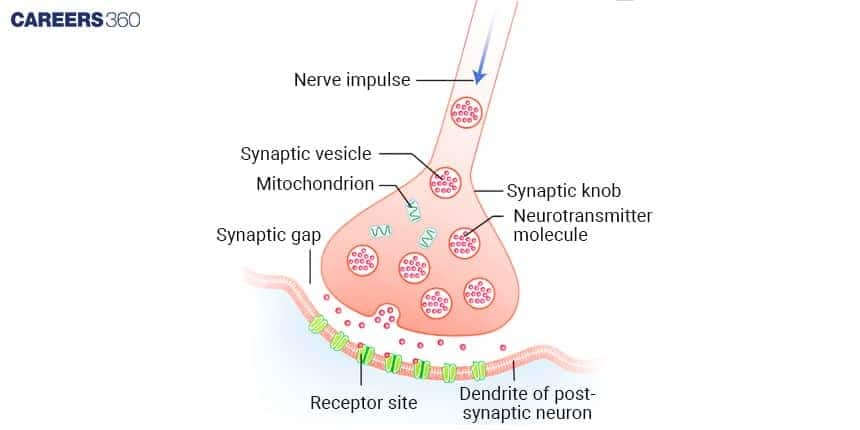
Types of Synapse
Electrical synapses: These are connections that quickly pass electrical signals from one nerve cell to another.
Chemical synapses: In these, signals are sent across the space between nerves by using special chemicals called neurotransmitters.
Components of Synapse
The synapse has three main parts:
Presynaptic terminal, the part of the nerve that sends the signal,
Synaptic cleft is the gap in between
Postsynaptic membrane, the part that gets the signal.
Transmission Process
The nerve cell that sends the message releases chemicals called neurotransmitters.
These chemicals connect to specific areas on the nerve cell that receives the message, which then triggers a new electrical signal.
Factors Affecting Nerve Impulse Transmission
Several factors can affect how quickly and efficiently nerve signals are transmitted. This can determine how fast and accurately information is passed along.
Temperature
As a general rule higher temperatures increase the rate of conduction.
Axon Diameter
The larger the axon diameter, the faster the transmission.
Myelination
Increases their speed and efficiency through the process of saltatory conduction.
Drugs & Poisons
Alter the function of the ion channels and neurotransmitter release, disturbing their impulse transmission.
Disorders Related to Nerve Impulses
Neurological disorders alter the process of impulse transmission:
Multiple Sclerosis
Disorder of demyelination and improper nerve conduction
Epilepsy
Results from unusual electrical activity in the brain.
Neuropathies
Conditions come in the way of the normal function of the nerve, and this can often lead to pain, weakness, or numbness.
Importance And Applications
The reasons for the multitude of medical and research implications in the sound understanding of nerve impulses go towards the betterment of diagnostics and treatment.
Medical Application
EEG (electroencephalogram) and EMG (electromyogram) are used in the applications of diagnosing applications of conditions related to neurology.
Research Implications
Advancements in the understanding of the functioning of the brain and the development of neuroprosthetics are to be used by people with disorders connected to the nervous system.
Nerve Impulse NEET MCQs (With Answers & Explanations)
Important questions asked in NEET from this topic are:
Structure of neuron
Mechanism of nerve impulse
Factors affecting nerve impulse
Practice Questions for NEET
Q1. Axolemma is selectively permeable for
Complex proteins
Simple organic molecules
Inorganic molecules
Both b and c
Correct answer: 4) Both b and c
Explanation:
Axolemma is selectively permeable for simple organic and inorganic molecules. The axolemma's permeability is regulated by ion channels and transporters in the membrane. These channels are specific to certain ions such as sodium, potassium, calcium, and chloride. Being selectively permeable, it also helps in maintaining the resting membrane potential.
Hence, the correct option is d. both b and c.
Q2. What is the function of the axon in a neuron?
To receive signals from other neurons
To support and protect the cell body
To transmit signals to other neurons
To synthesize neurotransmitters
Correct answer: 3) To transmit signals to other neurons
Explanation:
The function of the axon in a neuron is to transmit signals to other neurons or other cells such as muscles or glands. The axon is a long, slender projection of the neuron that carries electrical signals away from the cell body and toward the axon terminals, where neurotransmitters are released to communicate with other neurons or cells. The axon is covered by a myelin sheath, which helps to insulate and speed up the transmission of electrical signals.
Hence, the correct answer is option 3) To transmit signals to other neurons.
Q3. Resting membrane potential is maintained by
Hormones
Neurotransmitters
Ion pumps
None of the above
Correct answer: 3) Ion Pumps
Explanation:
The sodium-potassium pump and leak channels are examples of ion pumps and channels that preserve a cell's resting membrane potential:
For every ATP molecule, this pump transports two potassium ions into the cell and three sodium ions out of it. The potassium ion gradient produced by this action adds to the resting membrane potential. The electrical potential across a cell's plasma membrane when it is not activated is known as the resting membrane potential. Because more cations are released than are absorbed, the inside of the cell stays negatively charged in relation to the extracellular fluid.
Hence, the correct answer is option 3) Ion pumps.
Also Read:
Recommended Video On ‘Nerve Impulse’
Frequently Asked Questions (FAQs)
The stages include depolarisation, repolarisation) and refractory period.
The myelin sheath wraps around the nerve cell's long part and helps the signal move faster by allowing it to jump from one spot to another, known as nodes of Ranvier.
Continuous conduction is a smooth, steady movement of the signal in nerve cells without myelin, while saltatory conduction is when the signal jumps quickly from one spot to another in nerve cells with myelin.
Neurotransmitters are chemical messengers at the junction between neurons. They attach to specific sites on the next neuron and either start or stop a new nerve impulse.
A nerve impulse is an electrical signal that moves along the long part of a nerve cell, sending information by swiftly changing the cell's electrical state.