KCC Institute of Legal and Higher Education, Greater Noida
Law Admissions 2026 Open | Avail Merit-Based Scholarships


Neurons are specialised nerve cells that transmit electrical and chemical signals across the nervous system, enabling sensation, thinking, movement, and reflexes. Their structure—cell body, dendrites, axon, myelin sheath, and synapse—allows rapid communication within the CNS and PNS. This NEET-ready guide covers neuron definition, structure, types, neurotransmitters, synaptic transmission, neuroplasticity, disorders, diagrams, FAQs, and MCQs.
This Story also Contains
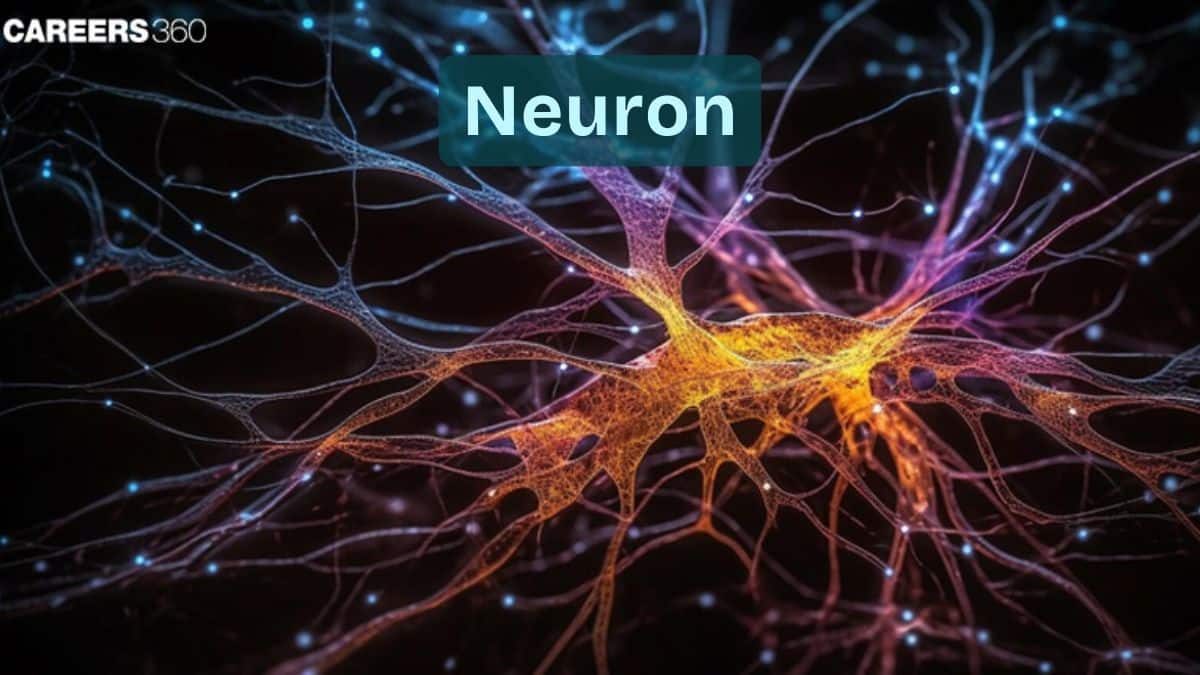
A neuron is a specific cell of the nervous system that carries electrical impulses along the pathway of the nerve, by which the brain, spinal cord, and other parts of the body can communicate with one another.
The neuron participates in the reception, processing and transmission of sensory information and motor commands to the muscles, thus they control various body functions. These are the parts of nature that have specialised cells that transfer electrical and chemical signals. Hence, they are responsible for the proper functioning of the nervous system.
Knowing the general structure of a neuron will help us appreciate how it works in the nervous system.
The portion that includes the nucleus, regarded as the control centre of the cell.
These are incoming signal-receiving ends from other neurons.
Conducts electrical impulses away from the cell body
Fatty, insulating layer of the axon, increasing the velocity of signal transmission.
These are gaps in the myelin sheath that facilitate rapid transmission of signals.
These are responsible for releasing neurotransmitters to pass on the signals to the next neuron.
There can be three primary types of neurons based on their functions.
These carry sensory information to the brain and spinal cord.
These transmit commands from the brain and spinal cord to muscles and glands.
These are neurons that connect other neurons, usually within the central nervous system. This means they connect sensory with motor neurons, therefore, facilitating communication between them.
The neurons perform various crucial functions which help the nervous system function properly.
The neurons transmit electrical impulses called action potential.
It is the process through which neurotransmitters are released to communicate with other neurons.
Thus, neurotransmitters are the chemical mediators of the signals transmitted from one neuron to another.
Neurotransmitter | Function |
Dopamine | Participates in mechanisms related to reward and pleasure. |
Serotonin | Modulates mood and social behaviour |
Acetylcholine | Involved in the action of muscles and memory |
The synapses are the junctions through which neurons communicate with each other.
The presynaptic terminal, synaptic cleft, postsynaptic membrane.
It allows the transmission of electrical or chemical signals from one neuron to another.
Law Admissions 2026 Open | Avail Merit-Based Scholarships
BBA/MBA/PGDM Early Bird Applications Deadline 19th Oct '26. Apply now using coupon code CAREER250 and get ₹250 off the application fee
It is in charge of learning and recovery; it relies on the generation of new neurons and plasticity in the brain.
Neurogenesis: The process of new neuron generation in the brain.
Neuron Plasticity: Changes a neuron undergoes as a result of new information, sensory stimulation, development, damage, or malfunction.
Several neurological diseases are claimed to be connected to the failure of neurons.
A condition characterised by the death of neurons, and the consequences are memory loss and cognitive declines
Involves the loss of dopamine-producing neurons, affecting movement and coordination.
An autoimmune disorder that attacks the myelin sheath, disrupting neural communication.
Important questions asked in NEET from this topic are:
Structure of neurons
Types of neurons
Disorders related to neurons
Q1. The major constituents of neurofilaments are
Microtubules
Intermediate filaments
Actin filaments
Protofilaments
Correct answer: 2) Intermediate filaments
Explanation:
The main structural element in the neurons of the brain is neurofilament. They are fibrous proteins having a diameter of 10 nm.
The proteins involved as structural elements in the neurons are divided into six types based on protein structure and gene organization. Neurofilaments are classed as Type IV intermediate filaments which are found in the cytoplasm of neurons. Neurofilaments majorly consist of intermediate filaments. They provide the structural support for axons as well as regulate the diameter of the axons. These intermediate filaments are also found in cyton and dendrites and transmit nerve impulses.
Hence, the correct answer is option (2) intermediate filament.
Q2. Myelinated nerve fibres are found in
Spinal nerves
Cranial nerves
Autonomic nervous system
Both a and b
Correct answer: 4) Both a and b
Explanation:
There are two types of axons, namely, myelinated and unmyelinated. The myelinated nerve fibers are enveloped with Schwann cells, which form a myelin sheath around the axon. The gaps between two adjacent myelin sheaths are called nodes of Ranvier. Myelinated nerve fibers are found in spinal and cranial nerves. Unmyelinated nerve fiber is enclosed by a Schwann cell that does not form a myelin sheath around the axon and is commonly found in autonomous and somatic neural systems.
Hence, the correct answer is option 4) Both a and b.
Q3. Nerve fibers are surrounded by an insulating fatty layer called
Adipose tissue
Myelin sheath
Hyaline sheath
Peritoneum
Correct answer: 2) Myelin Sheath
Explanation:
The myelin sheath is an insulating fatty coating that envelops nerve fibers. By enabling electrical impulses to leap between the Nodes of Ranvier, which are openings in the myelin sheath, the sheath speeds up the transmission of nerve signals. Saltatory conduction is the mechanism that speeds up and improves neuron transmission.
Hence, the correct answer is option 2) Myelin sheath.
Also Read:
Frequently Asked Questions (FAQs)
There are three types of neurons: sensory neurons, motor neurons, and interneurons
Some common disorders are Alzheimer’s, Parkinson's and multiple sclerosis.
Neurotransmitters are chemicals that cross the synaptic junction from one neuron to another neuron, thus the communication of the nervous system. The reason for the diversity of physiological functions and behaviours is largely related to them.
The neuron is made up of a body, dendrites, and an axon The soma. It contains the nucleus, the dendrites are the messengers, and the axon carries the messages between neurons and muscle, skin, and glands.
Messages are travelling down the axon as an Action potential, which is an electric. transpiration of axons. The axon is in motion by depolarising and relaxing. The neurotransmitters bring the signal to another neuron.


Law Admissions 2026 Open | Avail Merit-Based Scholarships
BBA/MBA/PGDM Early Bird Applications Deadline 19th Oct '26. Apply now using coupon code CAREER250 and get ₹250 off the application fee
Ranked #36 amongst institutions in Management by NIRF | 100% Placement
Globally Recognized by AACSB (US) & AMBA (UK) | 18 LPA Avg. CTC for PGPM 2026
Leading Design College | 95% Placement Record | Merit-cum-Means Scholarships for Deserving Students
NEET PG All India & State College Predictor with Admission Process Guide