KCC Institute of Legal and Higher Education, Greater Noida
Law Admissions 2026 Open | Avail Merit-Based Scholarships


The pharynx is a muscular tube connecting the nasal and oral cavities to the larynx and oesophagus, serving both respiratory and digestive systems. It functions as a common passage for air and food, a resonating chamber for speech, and a site of immune defence. This guide explains the definition, regions, anatomy, functions, disorders, and NEET-oriented questions on the pharynx.
This Story also Contains
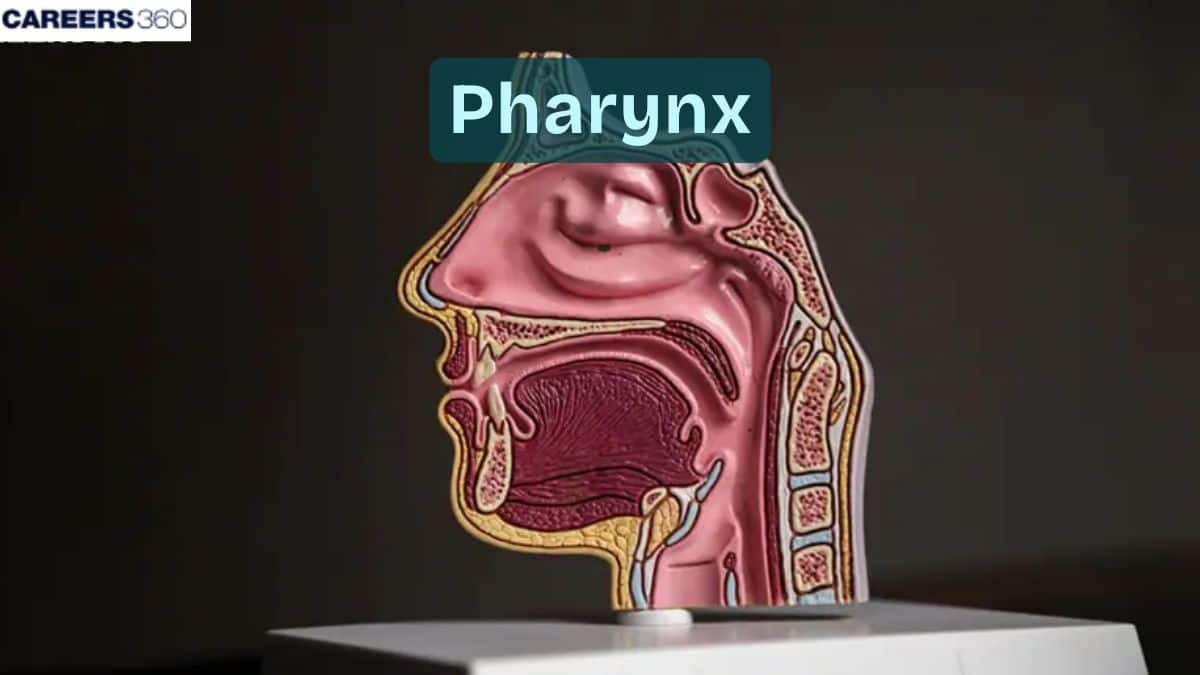
The pharynx is a muscular tube that is part of the throat connecting the mouth and nasal cavity to the larynx and esophagus. It acts as a passage into both digestive as well as the respiratory system. It participates in respiration, digestion, and immune defence.
The pharynx is the cavity located at the back of oral and nasal cavities. In the digestive system, the pharynx opens into the oesophagus while in the respiratory system, it leads into the larynx. Changes in form and structure may occur in different organisms in accordance. It may be thick and muscular in some and turned outward or rotated in others.
The pharynx is divided into three related regions as follows:
Uppermost part behind the nasal cavity that establishes the airway through the nose.
Oropharynx joins the nasopharynx through an isthmus which makes respiration through the mouth possible.
Law Admissions 2026 Open | Avail Merit-Based Scholarships
BBA/MBA/PGDM Early Bird Applications Deadline 19th Oct '26. Apply now using coupon code CAREER250 and get ₹250 off the application fee
Part behind the oral cavity
Extends from the soft palate down to the level of the hyoid bone.
Opens to the anterior using the mouth and posteriorly to the nasopharynx.
Lowermost part of the pharynx
Extending from the epiglottis downwards to the oesophagus.
The pharynx contains both sets of muscles, longitudinal and circular, which by their contraction change the shape of its lumen.
Push food downward by peristalsis.
Lift and widen pharynx during swallowing
Functional parts of such parts may be enumerated as follows:
These are mucous membranes having lymphoid tissues along the wall of the nasopharynx, hence forming part of the immune host response.
Providing an anatomic equilibration of air pressure from the middle ears opening into the pharynx.
A flap of muscle closes the entrance to the pharynx from the larynx thereby preventing food from entering the trachea.
An obliquely oriented ring including the pharyngeal, tubal, palatine and lingual tonsils which work as a barrier against the micro-organisms which enter the body both by the digestive and respiratory tracts.
The pharynx performs several important functions. For example, this structure acts as a:
Passage for Air and Food: It allows the passage of air to the lungs and food to the oesophagus.
Speech: It acts as a resonating chamber; sounds from the larynx are amplified in the pharynx.
Immune Defence: Pharynx lymphoid tissues act as the first line of defence against many pathogens in the body.
Warming and Humidifying Air: The air becomes warmed and humidified during its passage to the lungs.
Deglutition: Circular and longitudinal muscles will push the food down by peristalsis. Longitudinal muscles lift and flare the walls for the food to pass through.
Following are some common disorders of the pharynx:
An infection that causes inflammation of the pharynx, whether viral or bacterial.
The infected tonsils in those cases where infections cause all other irritation and trouble, including tenderness or difficulty in swallowing.
A successive growth of cancerous tissue in the pharynx.
The most basic variety of blocked airflow in an individual happens during rest and is brought about by the collapsing of the pharynx.
Important questions asked in NEET from this topic are:
Anatomy of the pharynx
Disorders of the pharynx
Q1. The nasopharynx is involved in
Breathing and speech
Breathing and digestion
Digestion and speech
Digestive process
Correct answer: 1) Breathing and speech
Explanation:
The nasopharynx is the superior subdivision. It lies superior to the soft palate and ends at the uvula. It is involved only in breathing and speech. It communicates laterally with the middle ear through the eustachian tube.
Hence, the correct answer is option 1) Breathing and speech.
Q2. Which of the following structures prevents the entry of food particles into the trachea during swallowing?
Glottis
Uvula
Epiglottis
Both a & c
Correct answer: 3) Epiglottis
Explanation:
The Glottis is the opening of the pharynx into the trachea and is always open during the process of respiration. The uvula is a soft muscular structure preventing the entry of food into the nasal cavity during swallowing. The Glottis is covered by a flap-like structure called epiglottis which helps prevent the food particles from moving into the trachea during swallowing instead of the food pipe.
Hence, the correct answer is option 3) Epiglottis.
Q3. Larynx consists of ________ cartilage.
6
3
1
9
Correct answer: 4) 9
Explanation:
The larynx, commonly known as the "sound box," plays a crucial role in the respiratory system as it is responsible for producing sound for speech. It is made up of nine cartilages, which include three unpaired and three paired cartilages. The unpaired cartilages consist of the thyroid cartilage, cricoid cartilage, and epiglottis. The paired cartilages include the arytenoid, corniculate, and cuneiform cartilages.
Hence, the correct answer is option 4) 9.
Also Read:
Frequently Asked Questions (FAQs)
The pharynx can be anatomically divided into three divisions: the nasopharynx, posterior to the nasal cavity; the oropharynx, from the oral cavity down to the hyoid bone; and the laryngopharynx, from the epiglottis down to the oesophagus.
The pharynx is a common passage for respiratory and digestive passages. It provides a passageway for food, water, and air. The larynx, located above the trachea, relates to the respiratory system; moreover, it prevents food from entering the lungs and produces voice with its vocal folds.
First, the pharynx opens into the larynx.
The pharynx refers to the throat region and acts to provide a common passage to both the respiratory and digestive systems. Gradualism from the mouth and the nose to the oesophagus and the larynx, respectively, is further aided by the pharynx. It also warms the air and pushes food portions during the act of swallowing.
This is a hollow tube made of muscular condition. The tube commences from the middle of the skull down to the cricoid cartilage to form the dorsal process of the larynx at the level of the C6 vertebra.

Law Admissions 2026 Open | Avail Merit-Based Scholarships
BBA/MBA/PGDM Early Bird Applications Deadline 19th Oct '26. Apply now using coupon code CAREER250 and get ₹250 off the application fee
Ranked #36 amongst institutions in Management by NIRF | 100% Placement
Globally Recognized by AACSB (US) & AMBA (UK) | 18 LPA Avg. CTC for PGPM 2026
Leading Design College | 95% Placement Record | Merit-cum-Means Scholarships for Deserving Students
NEET PG All India & State College Predictor with Admission Process Guide