KCC Institute of Legal and Higher Education, Greater Noida
Law Admissions 2026 Open | Avail Merit-Based Scholarships


Regulation of respiration keeps breathing under control. It maintains the respiratory gas balance in the human body. The regulation of respiration is an automatic process to maintain optimal oxygen and carbon dioxide levels. The neural centres, chemical receptors, feedback loops, and reflexes maintain the regulation of respiration. Understanding these mechanisms of regulation in breathing is necessary for NEET, medical entrance exams, and human physiology.
This Story also Contains

The regulation of respiration means the body knows when to breathe faster or slower. The breathing rate changes to match the oxygen demand of the body's cells. This simple respiratory system of regulation in breathing protects homeostasis. Neural regulation of respiration from the medulla and pons sets the rhythm. The chemical regulation of respiration maintains the fine-tuning of breathing based on CO2, O2, and pH levels. This article includes the regulation of respiration, neural regulation of respiration and chemical regulation of respiration pathways, respiratory regulation mechanisms, factors affecting the regulation of respiration, and recent developments in respiratory control in biology.
Regulation of Respiration is a vital process in Human physiology. An essential physiological activity that maintains the optimum level of gas exchange and regulation.
Respiration is controlled automatically through neural regulation of respiration and chemical regulation of respiration pathways. The regulation of respiration is essential for homeostasis.
The regulation of respiration is not static. It explains how the body maintains the internal conditions during rest, exercise or stress. This regulation ensures that the oxygen delivery and carbon dioxide removal remain stable during different conditions
The neural regulation of respiration is managed by special centres in the human brain. These are called respiratory centres located in the brain stem. The respiratory centres generate and adjust the rhythm of breathing to meet the body’s requirements.
The medullary respiratory centre is located in the medulla oblongata. It includes the Dorsal Respiratory Group (DRG) and Ventral Respiratory Group (VRG). Thus, the DRG establishes the fundamental rhythm of breathing, while the VRG does voluntary breathing.
The medullary respiratory centre coordinates patterns of breathing in response to information received through sensory input.
The pontine respiratory group is found in the pons. It sharpens the breath rhythm into transitions between inspiration and expiration and vice versa. It ensures breathing remains steady and efficient.
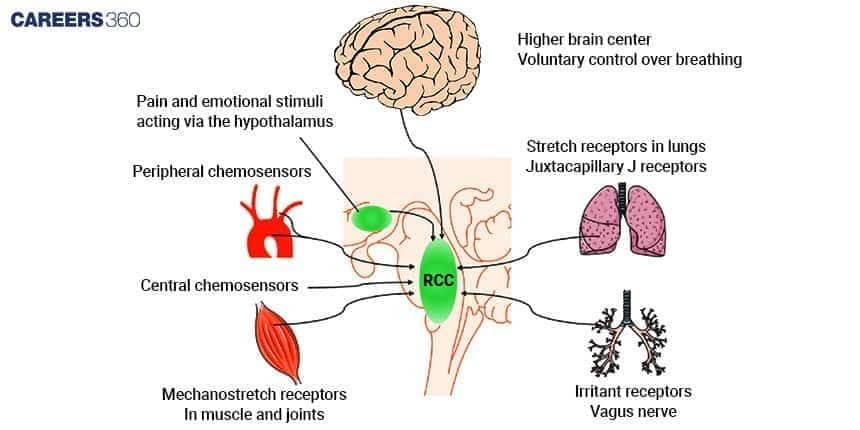
The chemical regulation of respiration depends on the chemoreceptors. They monitor oscillations of CO2, O2, and pH levels in the blood. Sensory input regarding these variables is later sent to the respiratory centres to adjust the breathing cycle. It rebalances the concentration of chemicals back to homeostatic levels within the body.
The chemical regulation of respiration is maintained by
Central Chemoreceptors
Peripheral Chemoreceptors
Law Admissions 2026 Open | Avail Merit-Based Scholarships
BBA/MBA/PGDM Early Bird Applications Deadline 19th Oct '26. Apply now using coupon code CAREER250 and get ₹250 off the application fee
The table given below shows the difference between central chemoreceptors in the medulla and peripheral chemoreceptors in the carotid and aortic bodies
Feature | Central Chemoreceptors | Peripheral Chemoreceptors |
|---|---|---|
Location | Medulla oblongata | Carotid bodies and aortic bodies |
Primary Sensitivity | Change in CO2 levels | Change in O2 levels and blood pH |
Response Speed | Slower | Faster, immediate response |
Mechanism of Action | Rising CO2 → more H+ ions → lower pH → faster breathing | Low O2 or low pH → signals to increase breathing |
High concentrations of CO2 increase the rate of breathing. When the rate of breathing becomes too low with the low concentration of oxygen, then the peripheral chemoreceptors start shifting breathing
Respiratory regulation mechanisms maintain the breathing rate efficient and balanced. The body uses feedback systems to sense changes and adjust breathing automatically. These respiratory regulation systems make sure oxygen enters, and carbon dioxide leaves at the right levels by-
Sensors detect changes in CO2, O2, and pH.
Control centres in the brain stem process this information.
Effectors (respiratory muscles) change the rate and depth of breathing.
Together, respiratory regulation mechanisms maintain homeostasis during rest, exercise, or stress. This mechanism is vital in human physiology. It explains how respiration adjusts quickly to different conditions. Regulation of respiration ensures survival and steady internal balance.
The regulation of respiration involves sensors that sense changes and control centres. The change in the rate and depth of respiration and the effectors that carry out the ultimate response maintain respiratory homeostasis. Reflexes help breathing adapt quickly to different situations.
Reflex Regulation of Breathing
The body uses multiple feedback systems to govern breathing efficiently.
Hering-Breuer Reflex
This reflex prevents overinflation of the lungs by inhibiting the inspiratory neurons through the activation of stretch receptors in the lungs.
Proprioceptor Response During Exercise
Proprioceptors in muscles and joints stimulate the respiratory centres to increase the rate of breathing during exercise.
The regulation of respiration is affected by many factors. The breathing rate and depth are not fixed. It changes with different conditions. There are some factors which influence the rate of respiration and the depth of respiration.
Physical Factors
The respiration rate will increase to provide a greater amount of oxygen to the muscles due to exercise or exertion.
Emotional Factors
Stress and anxiety may affect breathing patterns. It is usually the rate of respiration that is increased in these states.
Chemical Factors
The blood levels of CO2, O2 and pH directly vary and impact respiration. CO2 levels in the blood directly control breathing rate. Low O2 levels trigger faster breathing. pH changes adjust the depth of respiration.
Respiratory regulation can be disturbed by certain diseases. These disorders affect how the body controls breathing and may lead to serious health issues. Familiarity with the most common diseases will help you recognise and manage disorders of respiratory control.
Sleep Apnea - The breathing stops temporarily during sleep due to failure of respiratory control.
Respiratory Depression - It is slow or shallow breathing caused by reduced activity of the respiratory centres.
This can be caused by damage to nerves, chemical imbalance in CO2, O2 or pH levels, or sometimes even by not providing the correct amount of oxygen to tissues. The drug effects or trauma can also suppress the respiratory centres.
Continuous research in respiratory control has come up with many breakthroughs. The scientist and doctor are finding new ways to understand and manage breathing. It includes:
New molecular pathways linked to breathing have been discovered. These findings explain how neurons and receptors interact to control respiration. Molecular studies help in identifying new treatment targets for respiratory disorders.
Modern medical devices now monitor breathing patterns more accurately. Non‑invasive sensors can measure CO2, O2, and pH in real time. These advanced technologies help in the better diagnosis and management of respiratory disorders.
Important topics for NEET are:
Neural and chemical regulation of respiration
Factors affecting the regulation of respiration
Q1. Which of the following statements accurately describes the role of peripheral chemoreceptors in respiration regulation?
Peripheral chemoreceptors are primarily sensitive to changes in oxygen levels.
Peripheral chemoreceptors are located in the medulla oblongata.
Peripheral chemoreceptors are not involved in the regulation of respiration.
Peripheral chemoreceptors respond to changes in carbon dioxide and oxygen levels.
Correct answer: 4) Peripheral chemoreceptors respond to changes in carbon dioxide and oxygen levels.
Explanation:
Peripheral chemoreceptors are specialised sensory receptors located in the carotid bodies and aortic bodies. These chemoreceptors are primarily sensitive to changes in carbon dioxide and oxygen levels in the blood. When there is an increase in CO2 or a decrease in O2, the peripheral chemoreceptors are activated and send signals to the respiratory centres in the brain, primarily the medulla oblongata, to increase the rate and depth of breathing. This helps to restore proper blood gas levels by increasing the removal of CO2 and increasing the intake of O2.
Hence, the correct answer is option 4) Peripheral chemoreceptors respond to changes in carbon dioxide and oxygen levels.
Q2. Which of the following statements accurately describes the effect of pH on the regulation of respiration?
An increase in pH leads to an increased respiration rate.
A decrease in pH leads to decreased respiration rate.
pH does not have any effect on the regulation of respiration.
Changes in pH primarily affect the depth of respiration.
Correct answer: 4) Changes in pH primarily affect the depth of respiration.
Explanation:
pH is important for regulating respiration. Blood pH reflects its acidity or alkalinity. Increased CO2 in the blood forms Carbonic acid through a reaction with water, releasing hydrogen ions (H+) and bicarbonate ions (HCO3-) with the help of carbonic anhydrase enzyme. The concentration of hydrogen ions (H+) affects blood pH. More hydrogen ions (H+) lower pH, causing acidosis, while fewer hydrogen ions (H+) raise pH, causing alkalosis. pH changes impact respiration depth. In acidosis, respiration increases to remove excess CO2, reducing the hydrogen ion concentration and restoring pH balance. In alkalosis, respiration decreases to retain CO2, increasing hydrogen ions and restoring pH balance.
Hence, the correct answer is option 4) Changes in pH primarily affect the depth of respiration.
Q3. The carbon dioxide that enters the RBCs forms a reversible compound with an amino group, NH2, of the globin part of haemoglobin. This compound is called
Carbaminohemoglobin
Oxyhaemoglobin
Carboxyhaemoglobin
Carbaminohemoglobin
Correct answer: 1) Carbaminohemoglobin
Explanation:
The carbon dioxide that enters the RBCs forms a reversible compound with an amino group, NH2, of the globin part of haemoglobin. The compound so formed is called carbaminohemoglobin.
Hence, the correct answer is option 1) Carbaminohemoglobin.
Frequently Asked Questions (FAQs)
Mainly, it is the medullary respiratory centre and the pontine respiratory group: DRG and VRG.
Automatic control of breathing to balance O2 intake and CO2 removal.
It prevents lung over‑inflation by activating stretch receptors. These receptors inhibit inspiratory neurons to stop excessive breathing effort.
Examples include sleep apnea, respiratory depression, and disorders such as those resulting in nerve damage or chemical imbalance that damages respiratory control.

Law Admissions 2026 Open | Avail Merit-Based Scholarships
BBA/MBA/PGDM Early Bird Applications Deadline 19th Oct '26. Apply now using coupon code CAREER250 and get ₹250 off the application fee
Ranked #36 amongst institutions in Management by NIRF | 100% Placement
Globally Recognized by AACSB (US) & AMBA (UK) | 18 LPA Avg. CTC for PGPM 2026
Leading Design College | 95% Placement Record | Merit-cum-Means Scholarships for Deserving Students
NEET PG All India & State College Predictor with Admission Process Guide