KCC Institute of Legal and Higher Education, Greater Noida
Law Admissions 2026 Open | Avail Merit-Based Scholarships


Synovial joints are freely movable joints characterized by a synovial cavity filled with lubricating fluid that allows smooth and wide-ranging movement. They are the most advanced joint type, enabling complex actions such as bending, rotation, opposition, and locomotion. This guide covers synovial joint definition, structural features, classification, examples, disorders, diagrams, FAQs, and NEET MCQs.
This Story also Contains
A synovial joint is one of the most paramount structural formations of the skeletal system. It plays a significant role in the elevation of movement and supports the body structure in various sections of the human structure. One of the major peculiarities is the shape of their design which allows people to move in different sections from other kinds of joints.
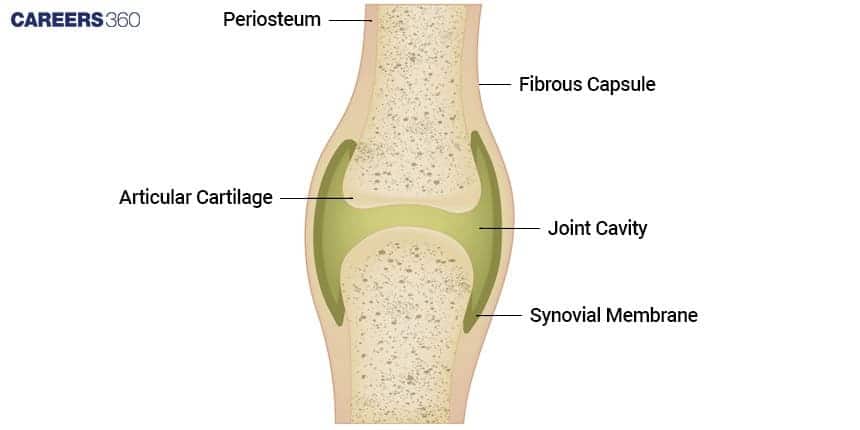
There are several key structural components of the synovial joint that are responsible for defining the functionality of the same:
A viscous fluid fills the joint cavity lubricating the articulating surfaces and also reducing any friction inside the joint.
It is a sheath that surrounds the joint and encloses the joint cavity, providing structural support to the joint.
Its smooth, white tissue covers the articulating surface of the bones forming the joints. It provides frictionless, smooth motion, so the wear and tear are reduced.
Ligaments are dense bands of fibrous connective tissue that stabilize the joint and help guide the movements of the articulating bones.
A space that exists between the articulating bones in the digits, padded by the synovial fluid enabling the free, nonbinding movement of bones.
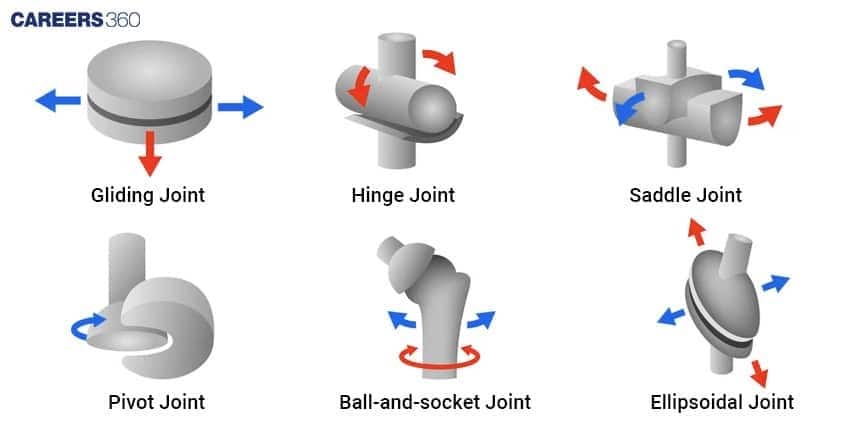
Six major types of synovial joints are distinguished based on the shapes of their articulating surfaces and the movements they allow:
Flat articulating surfaces that allow for sliding or gliding movements. Carpals of the wrist and tarsals of the ankle allow for movement and nonaxial playing.
Hinge joints have a hinge shape configuration, thus allowing for uniaxial movement either in flexion or extension, along one plane.
Interphalangeal joints of the fingers and toes.
The rounded end of a bone rests against another bone that has a ringlike structure, thereby allowing rotational movement along with the main axis.
A representative example is the proximal radioulnar joint, which allows the bones of the forearm, the radius, to cross over the ulna when rotating the hand from palm down to palm up positions.
These are characterized by an oval-shaped convex surface fitting into a complementary concave surface. It permits biaxial movements (flexion-extension and abduction adduction). It is found in the wrist joints (radiocarpal) and knuckle joints (metacarpophalangeal).
This joint resembles a saddle shape with concave and convex surfaces that fit together. It allows for biaxial movements similar to condyloid joints. It is present at the carpometacarpal joint of the thumb; it allows the opposition of the thumb.
Ball and socket joints have the ball in one bone and a socket in another. Ball and socket joints allow the largest range of motion of all synovial joints and also allow movement in multiple axes. Examples include the shoulder joint and hip joint.
Importance of synovial joints is:
Enable free movement
Essential for locomotion & manipulation
Allow complex body actions
Maintain flexibility and posture
Law Admissions 2026 Open | Avail Merit-Based Scholarships
BBA/MBA/PGDM Early Bird Applications Deadline 06th Nov'26. Apply now using coupon code CAREER250 and get ₹250 off the application fee
Synovial joints play an extremely crucial role in movement and general body functionality. However, these joints happen to be susceptible to many disorders, such as:
Degenerative joint disease of the articular cartilage.
Inflammatory disease that leads to joint destruction.
Injuries of the ligaments and tendons around a joint, leading to its stability and mobility being compromised.
Important questions asked in NEET from this topic are:
Classification of synovial joints
Disorders of synovial joints
Q1. Which of the following options correctly identifies the location of a pivot joint?
The hip and shoulder joint
Between the atlas and the odontoid process of the axis
Sternoclavicular joint
Temporomandibular joint
Correct answer: 2) Between the atlas and the odontoid process of the axis
Explanation:
A pivot joint is a type of synovial joint that allows rotational movement. It occurs specifically between the first (atlas) and second (axis) cervical vertebrae in the neck. The atlas is the topmost vertebra that connects to the skull while the axis lies just below the atlas. The odontoid process is a bony projection on the axis that acts as a pivot point. The pivot joint formed between the atlas and the odontoid process allows for the rotation of the head from side to side, as in shaking the head to indicate "no." This joint enables the important function of head rotation and is an example of a pivot joint in the human body.
Hence, the correct answer is option 2) Between the atlas and the odontoid process of the axis.
Q2. The pivot joint between the atlas and the axis is a type of:
Fibrous joint
Cartilaginous joint
Synovial joint
Saddle joint
Correct answer: 3) Synovial joint
Explanation:
The pivot joint connecting the atlas (C1) and axis (C2) vertebrae is a unique synovial joint, commonly referred to as the atlantoaxial pivot joint. It is essential for the head's rotational movement, such as when one nods in disagreement or affirmation. This joint's structure includes the odontoid process (dens) of the axis, which serves as the pivot, while the anterior arch of the atlas and the transverse ligament provide stability and keep the dens in position. The primary function of this joint is to allow the atlas to rotate around the dens, facilitating the head's rotation. It is a key component of the cervical spine, contributing significantly to neck flexibility and overall body coordination. It is crucial to recognize that pivot joints are designed for rotation around a single axis, and the atlantoaxial joint exemplifies this, playing a pivotal role in head and neck mobility.
Hence, the correct answer is option 3) Synovial joint.
Q3. The elbow joint is an example of:
Hinge joint
Gliding joint
Ball and socket joint
Pivot joint
Correct answer: 1) Hinge joint
Explanation:
One type of synovial joint, also referred to as a freely moving joint, is the hinge joint. The elbow and knee both have hinge joints. The pivot joint is located between the atlas and axis, the gliding joint is located between the carpals and the ball and socket joint is located between the shoulder and hips.
Hence, the correct answer is option 1) Hinge joint.
Also Read:
Frequently Asked Questions (FAQs)
Exercising regularly, watching your pounds, and proper nutrition may keep your joints healthy and reduce the chances of having joint disorders too.
Treatment depends largely on the disorder, but it can run the gamut—from drug and exercise treatments to even joint injections or even surgery—if the case is that adverse.
Synovial joints are the joints that help perform different movements of the body, which are required to move and perform day-to-day activities.
Synovial joints encompass hinge, ball and socket, pivot, saddle, condyloid, and plane. The joints help in performing rigid movements such as bending, rotation and sliding.
Osteoarthritis, rheumatoid arthritis and joint injuries like sprains are some common disorders of synovial joints. The basic symptoms from which a person can realize the presence of such a disorder are pain, stiffness and immobility of the joint.

Law Admissions 2026 Open | Avail Merit-Based Scholarships
BBA/MBA/PGDM Early Bird Applications Deadline 06th Nov'26. Apply now using coupon code CAREER250 and get ₹250 off the application fee
Ranked #36 amongst institutions in Management by NIRF | 100% Placement
Globally Recognized by AACSB (US) & AMBA (UK) | 18 LPA Avg. CTC for PGPM 2026
NEET PG All India & State College Predictor with Admission Process Guide
Top B-School: Ranked #9 in NIRF Management Rankings 2025.