KCC Institute of Legal and Higher Education, Greater Noida
Law Admissions 2026 Open | Avail Merit-Based Scholarships


The rib cage, also called the thoracic cage, is a bony framework formed by ribs, sternum, and thoracic vertebrae that protects the heart and lungs. Beyond protection, it plays a dynamic role in breathing by expanding and contracting during respiration. This guide explains rib anatomy, classification, functions, development, clinical relevance, diagrams, FAQs, and NEET MCQs.
This Story also Contains
The human rib cage helps protect and support some of the most vital organs of the human body. It has a bony framework, comprising ribs and sternum bones. Accompanied by the ribcage, it provides a sturdy yet agile space for heart and lung protection through every breath, pulsation, and movement.
The anatomic structure forms part of the integral mechanism of respiration. Ribs are not just rigid protective coverings but are dynamic to respiration and movement. An understanding of anatomy, types, functions, and development of the rib cage is very important to appreciate how this human body stands in various situations yet maintains itself substantially.
The rib cage is a basketlike skeleton structure made from the ribs, the sternum, and the vertebral column. It offers bony protection to the lungs as well as the heart, but at the same time, has the power of expansion and contraction, which enables respiration.
The anatomy of the ribs is discussed below:
Ribs are flat, narrow, and curved strips of bones which are found in all vertebrates. In humans, there are typically twelve pairs of ribs, each comprising several parts.
Costal groove
Tubercle
Neck Shaft
Head with two articular facets
Law Admissions 2026 Open | Avail Merit-Based Scholarships
BBA/MBA/PGDM Early Bird Applications Deadline 06th Nov'26. Apply now using coupon code CAREER250 and get ₹250 off the application fee
The first rib possesses two costal grooves, and one articular facet, and is wide and short.
The second rib is long and thin.
The tenth has only one particular facet.
The eleventh and twelfth ribs do not have a neck and their articular facet is single.
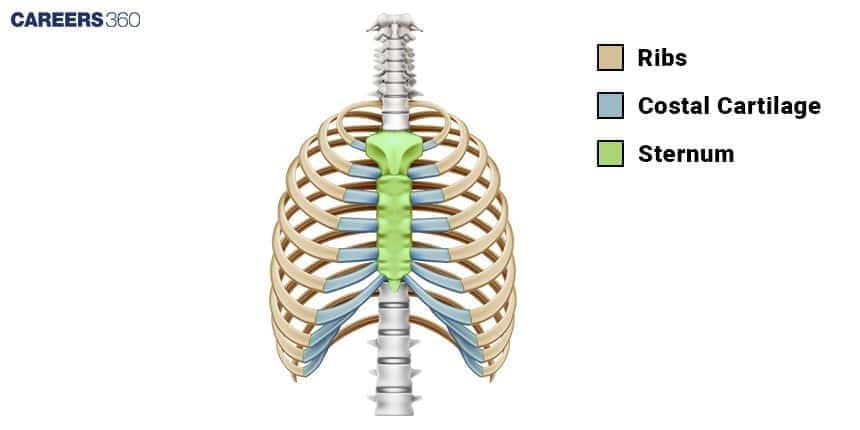
Ribs articulate posteriorly with the thoracic vertebrae and anteriorly with the sternum through costal cartilage and form sternocostal joints.
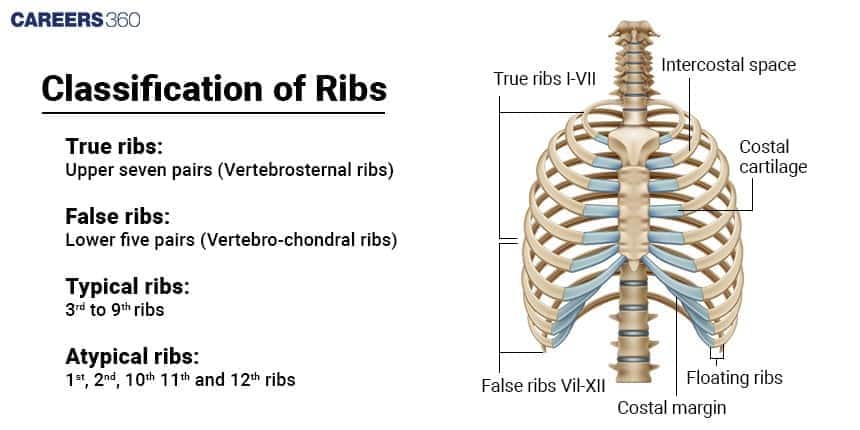
Ribs can be classified according to their connection towards the sternum.
First to seventh ribs
Articulates directly with the sternum using costal cartilage only
Eighth to tenth ribs
Indirect articulation with the sternum via the cartilage of the seventh rib
Eleventh and twelfth ribs
Does not articulate with the sternum
Some functions of the ribs are:
Protects the heart and lungs from physical injuries
Expansion and contraction during breathing
Maintains the structure and shape of the thorax
Ribs develop from the sclerotome, a portion of paired paraxial mesoderm called somites, which forms vertebrae. It also contributes to the formation of vertebral column.
Ribs in other animals include:
Jawed Fish: Has dorsal and ventral ribs
Reptiles: First forms showing rib attachment to the breastbone
Snakes: Ribs attach to all vertebrae
Mammals: Ribs attach only to thoracic vertebrae
Turtles: Eight pairs of ribs
Amphibians (Frogs): No ribs
The clinical importance is explained below:
Caused by accidents, falls, or trauma
Symptoms include pain and difficulty breathing
Results from lifting heavy objects
Causes severe pain
Inflammation of costal cartilage
Can mimic heart attack pain
Primary or secondary lesions
Medical evaluation warranted
Important questions asked in NEET from this topic are:
Anatomy of the rib
Classification of ribs
Functions of the rib cage
Q1. Ventrally ribs connected to sternum with the help of
Elastic cartilage
Hyaline cartilage
Collagen fibres
None of these
Correct answer: 2) Hyaline cartilage
Explanation:
The ribs are curved and flat bones that form the protective cage around the heart and lungs known as the rib cage. Dorsally each rib is attached to the thoracic vertebrae which acts as a connecting link to the spine. Ventrally the ribs are connected to the sternum by hyaline cartilage which allows some flexibility for the expansion and contraction of the chest during breathing.
Hence, the correct answer is option 2) Hyaline cartilage.
Q2. Ribs having two articulation surfaces on its dorsal end are called
Monocephalic
Bicephalic
Tetracephalic
Both 1 and 2
Correct answer: 2) Bicephalic
Explanation:
Ribs are bicephalic, having two articulation surfaces at their dorsal ends. This means each rib articulates with two different vertebrae, one of which is the body of a thoracic vertebra at the head of the rib and the other the body of an adjacent vertebra. Dual articulation helps in the flexibility and stability of the ribcage, thus aiding in the expansion and contraction of the thoracic cavity during respiration.
Hence, the correct answer is option 2) Bicephalic.
Q3. The _______ pairs of ribs do not articulate directly with sternum but join the 7th rib with the help of hyaline cartilage
5th , 6th only
8th , 9th , 10th , 11th only
11th , 12th only
8th , 9th , 10th only
Correct answer: 4) 8th , 9th , 10th only
Explanation:
False Ribs - The 8th, 9th and 10th pairs of ribs do not articulate directly with the sternum but join the seventh rib with the help of hyaline cartilage. These are called vertebra chondral (false) ribs. False ribs are termed "vertebrochondral" because they connect to the sternum indirectly through the cartilage of the rib above. These ribs provide some protection to the internal organs but are more flexible than the true ribs. They help in the movement and expansion of the chest during respiration. The cartilage connection allows for slight movement, which aids in respiratory flexibility. The 11th and 12th pairs of ribs are also considered false ribs, but they are "floating ribs" because they do not connect to the sternum or the cartilage at all.
Hence, the correct answer is option 4 - 8th, 9th, 10th only
Also Read:
Frequently Asked Questions (FAQs)
Ribs are the portion or thorax of the chest in tetrapods.
Female rib cages are on average about 10% smaller in volume than male rib cages; the importance of this difference is not known.
The first seven pairs of ribs, which join directly to the sternum through their costal cartilages, are the true ribs.
The head of a rib is the end nearest the vertebra to which it articulates and has articular surfaces for connection.
There are true ribs, false ribs, and floating ribs.

Law Admissions 2026 Open | Avail Merit-Based Scholarships
BBA/MBA/PGDM Early Bird Applications Deadline 06th Nov'26. Apply now using coupon code CAREER250 and get ₹250 off the application fee
Ranked #36 amongst institutions in Management by NIRF | 100% Placement
Globally Recognized by AACSB (US) & AMBA (UK) | 18 LPA Avg. CTC for PGPM 2026
NEET PG All India & State College Predictor with Admission Process Guide
Top B-School: Ranked #9 in NIRF Management Rankings 2025.