ATIT
Ranked 1 st among Top Law Schools of super Excellence in India - GHRDC | NAAC A+ Accredited | #36 by NIRF


The adult human skeletal system is made up of 206 bones, forming a strong yet flexible internal framework. These bones are systematically divided into the axial skeleton (80 bones) and appendicular skeleton (126 bones) based on structure and function. This guide presents the complete list of 206 bones, classification, functions, diagrams, FAQs, and NEET-focused MCQs.
This Story also Contains
The human skeletal system can be considered to be divided into axial skeleton and appendicular skeleton are axial consists of 80 bones involving the skull, vertebral column, and thoracic cage that is, the central support and protection of vital organs and appendicular, composed of 126 bones of limbs and girdles like a pelvic girdle and pectoral girdle which are involved in mobility functions.
The human skeleton is composed of 206 bones, which are grouped into the axial skeleton and appendicular skeleton.
The axial skeleton system includes:
Cranial Bones (8)
Frontal (1)
Parietal (2)
Temporal (2)
Occipital (1)
Sphenoid (1)
Ethmoid (1)
Facial Bones (14)
Nasal (2)
Maxilla (2)
Zygomatic (2)
Palatine (2)
Lacrimal (2)
Inferior nasal concha (2)
Vomer (1)
Mandible (1)
U-shaped
Supports tongue and larynx
Does not articulate with other bone
Malleus (2)
Incus (2)
Stapes (2)
Transmit sound vibrations
Cervical Vertebrae (7)
Thoracic Vertebrae (12)
Lumbar Vertebrae (5)
Sacrum (1)
Coccyx (1)
Sternum (1)
Ribs (24)
The appendicular skeleton system consists of the bones which are discussed below:
Clavicles (2)
Scapulae (2)
Humerus (2)
Radius (2)
Ulna (2)
Carpals (16)
Metacarpals (10)
Phalanges (28)
Hip Bones (2)
Femur (2)
Patella (2)
Tibia (2)
Fibula (2)
Tarsals (14)
Metatarsals (10)
Phalanges (28)
The bones have following functions in the human body:
Bones support structurally and maintain the form of the human body within the human body.
The bones protect the organs such as the brain, the heart, and the lungs, which are among the important organs that are considered protection sites by the bones.
Other important functions that bones play include their function as a mineral reserve, specifically for calcium and phosphorus
They also have a role in hematopoiesis, the production of blood cells within the bone marrow.
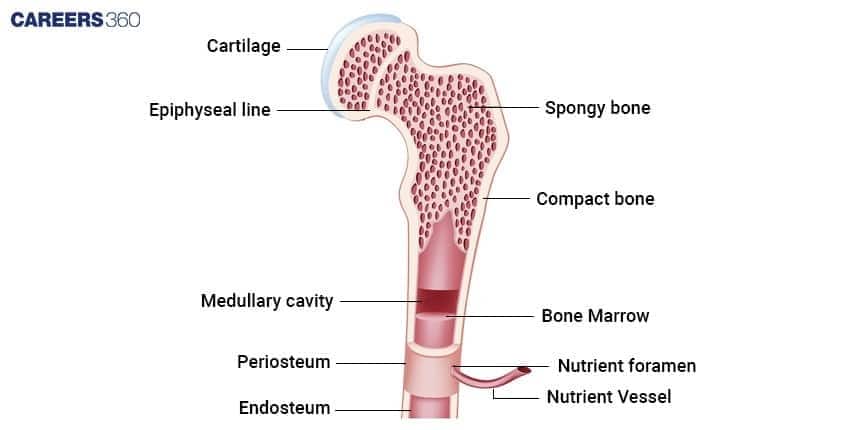
Bones are solid structures that make the skeleton of a human body, supporting, protecting, and helping it to move. Mostly made up of a collagen fibre matrix and mineral deposits in the form of calcium and phosphate, bones are both stiff and light. Outside, they have dense compact bone and inside spongy bone with bone marrow to produce blood. Bones are dynamic tissues, remodelled continuously by osteoblasts, the bone-forming cells, and osteoclasts, the bone-resorbing cells, to suit stresses or repair damage. They store minerals and maintain homeostasis in the body.
Important questions asked in NEET from this topic are:
Major components of skeletal system
Physiology of skeletal system
Q1. Which tissue is Avascular and Aneural?
Epithelium
Tendons
Cartilage
Epithelium and Cartilage
Correct answer: 3) cartilage
Explanation:
Cartilage is avascular and aneural.
When cartilage lacks blood arteries it is said to be avascular. To absorb nutrients and eliminate waste it instead depends on diffusion from nearby tissues.
Aneural refers to cartilage that lacks a direct nerve supply because it lacks nerve cells. For this reason, under normal circumstances, cartilage is not responsive to pain.
An example of connective tissue is cartilage which gives joints, the nose, ears, and the respiratory tract support, flexibility, and cushioning. Compared to other bodily tissues, cartilage heals more slowly because it lacks blood arteries and nerves.
Hence, the correct answer is option 3)Cartilage.
Q2. The study of the skeletal system is known as
Osteology
Myology
Skeletology
Both a and c
Correct answer: 4) Both a and c
Explanation:
The human skeletal system is made up of a framework of bones and cartilage, providing structural support to the body. The study of this system is called osteology or skeletology. Besides offering protection to vital organs, the skeletal system plays a crucial role in enabling body movement by serving as points of attachment for muscles and acting as levers during motion.
Hence, the correct answer is option 4. both a and c.
Q3. The axial skeleton consists of
Skull
Vertebral column
Sternum and ribs
All of the above
Correct answer: 4) All of the above
Explanation:
In human beings, this system is made up of 206 bones and a few cartilages. It is grouped into two principal divisions –
Hence, the correct option is 4) All of the above
Also Read:
Frequently Asked Questions (FAQs)
Bones grow and develop through ossification, including the gradual replacement of cartilage with bone.
Bones provide a structural framework, protection for organs, movement, mineral storage, and manufacturing sites for blood cells.
The axial skeleton comprises the central axis bones, while the appendicular skeleton includes limb bones and girdles.
An adult human body contains 206 bones.
It is the stapes, inside the middle ear.

Ranked 1 st among Top Law Schools of super Excellence in India - GHRDC | NAAC A+ Accredited | #36 by NIRF
Law Admissions 2026 Open | Avail Merit-Based Scholarships
Get Job Ready in Healthcare | Employability-Focused Programs
Highest CTC: 24 LPA | Average CTC: 12.32 LPA | 85 Placement Partners
Leading Design College | Highest CTC: ₹12 LPA | Average CTC: ₹7.5 LPA | Scholarships for Deserving Students
Attend 9-Hour Masterclass on 10th October 2026 to help you score 99+ percentile in CAT 2026