KCC Institute of Legal and Higher Education, Greater Noida
Law Admissions 2026 Open | Avail Merit-Based Scholarships


Arthritis is a disorder characterized by inflammation of joints, leading to pain, stiffness, swelling, and restricted movement. It refers to over 100 different joint-related conditions, commonly affecting locomotion and movement in humans. This guide explains arthritis definition, joint anatomy, types, symptoms, causes, diagnosis, treatment, FAQs, and NEET-focused MCQs.
This Story also Contains
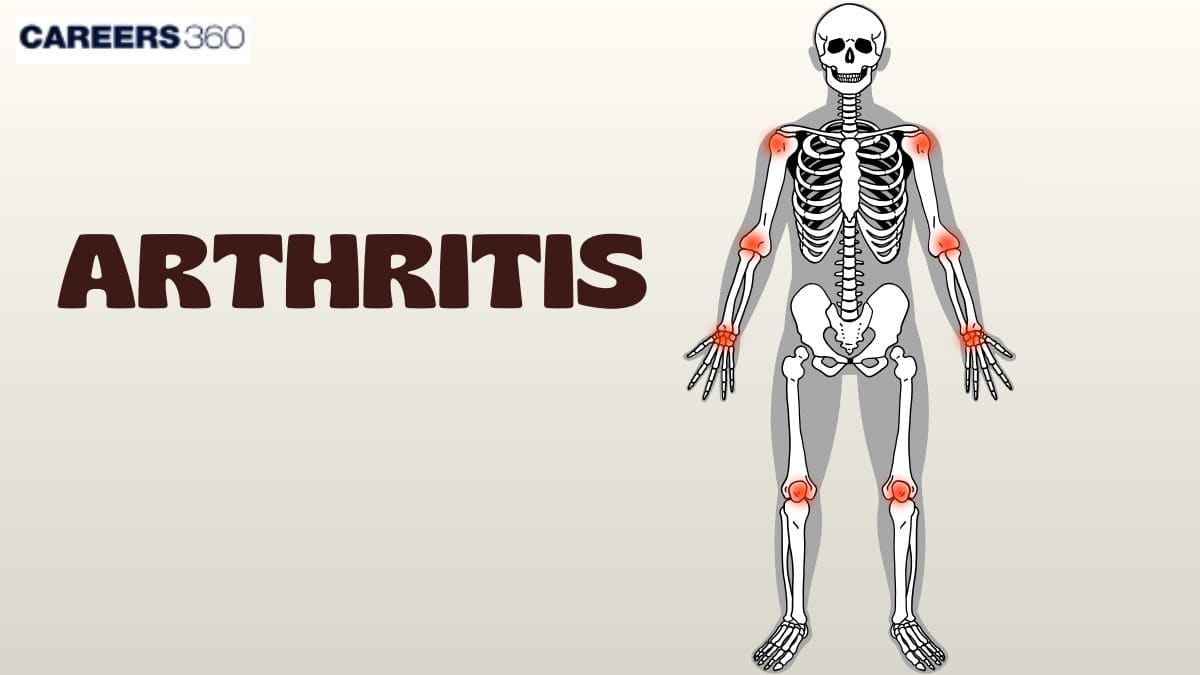
Arthritis is a disorder of the muscular and skeletal system. It refers to pain or disease in the joint and forms the term for more than 100 types and associated conditions. When these symptoms appear in one or more joints, they are classified as arthritis. It is not a single disease but is a broad term for a range of joint disorders. People of any age, from toddlers to adolescents, may be affected although different types are much more common in older adults. The cause of arthritis has not been identified, but much is understood within the realm of medicines, especially over the past decades. Early treatment, especially in the case of inflammatory arthritis, has shown impressive results.
Joints are soft tissues that support and cushion your bones, preventing them from rubbing against one another.
An essential component is cartilage, a type of connective tissue. Joints can move easily and without resistance with its assistance.
Some joints have a synovial membrane, a cushioned fluid pocket that lubricates the joints.
As with other joints, tendons and ligaments support your knees. Ligaments join one bone to another, whereas tendons join muscles to your bones.
Arthritis refers to the inflammation of joints. Several types are known, with their unique causes, symptoms, and forms of treatment. Some of the most common ones include;
An infection, whether bacterial, viral, or fungal, causes infectious arthritis. A joint, commonly the knee, becomes infected when an infection from another region of the body moves there.
Rheumatoid arthritis is a protracted inflammatory disorder that can affect more than just your joints. In certain people with the sickness, the skin, eyes, heart, lungs, and blood vessels may be harmed in addition to other body systems.
Millions of people worldwide suffer from osteoarthritis, the most prevalent type of arthritis. It happens as a result of the deterioration of the protective cartilage that cushions the ends of the bones over time.
Anyone can develop gout, a common and complicated form of arthritis. Frequent discomfort in the big toe and rapid, severe flare-ups of swelling, redness, and tenderness in one or more joints are the main symptoms.
The most prevalent kind of arthritis in children under the age of 16 is rheumatoid arthritis.
Different arthritis types result in different symptoms. They might range from mild to severe, depending on the person. Joint discomfort might come and go or be constant. Typical symptoms include:
Aches and redness
Stiffness
Swelling
Tenderness
Warmth
Law Admissions 2026 Open | Avail Merit-Based Scholarships
BBA/MBA/PGDM Early Bird Applications Deadline 19th Oct '26. Apply now using coupon code CAREER250 and get ₹250 off the application fee
The symptoms of different arthritis includes:
Fever
Chills
Joint pain
Sensitivity
Sharp pain originates from an infection or injury in another part of your body.
During at least six weeks, joint discomfort, swelling, and tenderness
30 minutes or more of morning stiffness
Numerous joints are impacted particularly the tiny joints in your hands, wrists, and feet.
Affected joints on both sides of the body are the same joints.
Painful joint
Stiffness in the morning or during prolonged periods of sitting
Touching the area causes pain because of the tenderness.
The joint does not move through its complete range of motion, preventing movement.
The joint may feel like it is grinding against something when it is grating.
Symptoms of a Gout include:
A severe pain
Redness
Stiffness
Swelling
Tenderness even to a light touch like bedsheet
Symptoms of Juvenile Idiopathic arthritis include:
Even if your child doesn't express any joint pain, you might still notice that he or she limps, especially in the morning or right after a nap.
Although joint swelling is prevalent, it frequently manifests itself in larger joints like the knee.
The patient may seem clumsier than normal, especially in the morning or right after naps.
Rash, enlarged lymph nodes, and fever.
Numerous reasons can result in any form of arthritis. There could be a single cause or several, depending on the type or form of arthritis.
Possible causes could be:
An accident that may cause degenerative arthritis.
Both gout and calcium pyrophosphate deposition illness can be brought on by an aberrant metabolism.
Osteoarthritis can occur as a result of genetic predisposition.
It is possible for an infection, such as Lyme disease, to cause arthritis symptoms.
Dysfunction of the immune system, such as that which results in rheumatoid Arthritis and lupus.
Numerous factors contribute to the majority of kinds of arthritis. Some, though, appear to arise suddenly and for no apparent reason.
For example, you are more prone to get arthritis:
Age: Your risk of developing arthritis increases as you become older.
Lifestyle: Your risk of developing arthritis is higher if you smoke or don't exercise.
Gender: Most types of arthritis affect more women than males.
Weight: Being overweight causes your joints additional stress, which can cause arthritis.
Consulting a medical professional if there are symptoms of arthritis. The symptoms will be discussed by the doctor, who will also ask how joint discomfort affects the daily activities.
A physical examination will be conducted by the doctor, and it may involve the following:
Evaluating the flexibility and range of motion in your joints.
Any pain or oedema in the areas near joints.
Assessing general health to see whether the symptoms could be brought on by a different illness.
Imaging exams provide a greater understanding of your soft tissues, joints, and bones. An ultrasound, MRI, or X-ray can show:
Joint discomfort may be brought on by bone fractures or dislocations.
Cartilage near your joints deteriorating
Injury to a muscle, ligament, or tendon close to a joint.
Inflammation of soft tissues
Even though arthritis has no known treatment, there are techniques to control your symptoms. The severity of your arthritis, its symptoms, and your general health will all affect your treatment options.
Medication: Arthritis symptoms may be helped by anti-inflammatory and pain medications. Inflammation brought on by your immune system can be reduced with biological medications. According to a medical expert, biologics may be used to treat your psoriatic or rheumatoid arthritis.
Physical therapy: Rehabilitation can help to increase strength, range of motion, and overall mobility. Therapists can teach you how to alter your regular routines to lessen arthritis symptoms.
Therapeutic injections: Cortisone injections may temporarily lessen the pain and inflammation in your joints. One treatment for arthritis in specific joints, like your knee, is called Visco supplementation. It administers lubricant to enable simple joint mobility.
These are some instances where conservative therapy has not improved the situation. The subsequent surgical possibilities:
The permanent merging of two or more bones is known as fusion. Fusion reduces discomfort caused by movement and stabilizes a joint.
Joint replacement is an artificial joint used to replace a damaged or arthritic joint. Joint replacement maintains the movement and functionality of the joint. The ankle, hip, knee, and shoulder replacements are a few examples.
You can lessen your risk of developing arthritis by:
Avoiding products made with tobacco.
Exercising lightly and without lifting anything.
Maintaining an appropriate weight.
Reducing the possibility of joint injury.
Some people find that certain types of weather make their arthritis worse. Joint discomfort frequently results from cold and dampness. There are numerous reasons why this might happen. People tend to be less active during the winter and in damp weather. The cold and wetness can also tighten joints and aggravate arthritis. Other theories claim that the barometric pressure, or air pressure around us, may have an impact on arthritis.
Important questions asked in NEET from this topic are:
Types and symptoms of different arthritis
Diagnosis and prevention of arthritis
Q1. Which of the following abnormalities will include the secretion of abnormal granules - pannus?
Osteoarthritis
Rheumatoid arthritis
Gout
Osteoporosis
Correct answer: 2) Rheumatoid arthritis
Explanation:
The secretion of irregular granular material, termed pannus, is commonly linked with rheumatoid arthritis (RA). This pannus is an aberrant fibrovascular tissue layer that originates from the persistent inflammation of the synovial membrane, which is the joint lining. It is composed of various immune cells such as T cells, macrophages, and granulocytes, as well as harmful granules. These granules, like matrix metalloproteinases (MMPs) and inflammatory cytokines, are instrumental in the degradation of cartilage and bone, leading to the distinct joint damage characteristic of RA.
Hence, the correct answer is option 2) Rheumatoid arthritis.
Q2. Select the correct statement with respect to locomotion in humans:
The joint between adjacent vertebrae is a fibrous joint.
A decreased level of progesterone causes osteoporosis in old people.
Accumulation of uric acid crystals in joints causes their inflammation.
The vertebral column has 10 thoracic vertebrae.
Correct answer: 3) Accumulation of uric acid crystals in joints causes their inflammation.
Explanation:
Gout is a form of arthritis characterized by sudden and severe episodes of pain, redness, and swelling in the joints. It is caused by the accumulation of uric acid crystals in the joints, leading to inflammation. Uric acid is a waste product formed when the body breaks down purines, substances found in certain foods and drinks
Hence, the correct option is 3) Accumulation of uric acid crystals in joints causes inflammation.
Q3. The disorders that arise when the immune system destroys 'self ' cells are called autoimmune disorders. Which of the following would be classified under this ?
Rheumatoid arthritis
Asthma
Rhinitis
Eczema
Correct answer: 1) Rheumatoid arthritis
Explanation:
The chronic inflammatory disorder that may affect more than the joints is known as rheumatoid arthritis. It can damage the other body systems as well including the lungs, heart, blood vessels, eyes, and skin. It affects the linings of the joints causing painful swelling and may eventually cause bone erosion as well as joint deformity.
Rheumatoid arthritis is an auto-immune disorder that occurs when the immune system attacks the tissues mistakenly of your own body. When the synovium is attacked by the immune system it causes rheumatoid arthritis. Synovium is the lining of the membrane that covers joints. The synovium thickens due to the inflammation and may eventually destroy bone and cartilage within the joints. The ligaments and tendons holding the joint together get weakened and stretch. The joint loses its alignment and shape gradually.
The inflammation in rheumatoid arthritis can damage other parts of the body as well.
Hence, the correct answer is option 1) rheumatoid arthritis.
Also Read:
Frequently Asked Questions (FAQs)
There are several over-the-counter pain relievers that can help with occasional pain brought on by physical activity, like gardening after winters. These include acetaminophen (Tylenol, among others), ibuprofen (Advil, Motrin IB, among others), or naproxen sodium (Aleve).
Typically, a patient's medical history, physical examination, X-rays, and blood tests are used to diagnose arthritis. It is possible to experience multiple forms of arthritis concurrently.
The first sign of arthritis is often pain, also known as arthralgia. This could be a burning or throbbing pain. When you've used the joint a lot, as after gardening or after climbing a flight of stairs, pain frequently starts to appear. Others experience pain in the morning.
On Question asked by student community
Correct Answer: Atropa belladonna
Solution : The correct answer is Atropa belladonna.
Atropa belladonna, a perennial herbaceous plant in the Solanaceae family, is also referred to as deadly nightshade or belladonna. It can be found in Western Asia, North America, and Europe. It is a very significant medicinal herb. It
Correct Answer: Lungs
Solution : Given:
Arthritis : Joints :: Asthma : ?
Like, Arthritis is a disease that affects the joints of the human body.
Similarly, Asthma is a disease that affects the lungs of the human body.
Hence, the second option is correct.

Law Admissions 2026 Open | Avail Merit-Based Scholarships
BBA/MBA/PGDM Early Bird Applications Deadline 19th Oct '26. Apply now using coupon code CAREER250 and get ₹250 off the application fee
Ranked #36 amongst institutions in Management by NIRF | 100% Placement
Globally Recognized by AACSB (US) & AMBA (UK) | 18 LPA Avg. CTC for PGPM 2026
Leading Design College | 95% Placement Record | Merit-cum-Means Scholarships for Deserving Students
NEET PG All India & State College Predictor with Admission Process Guide