ATIT
Ranked 1 st among Top Law Schools of super Excellence in India - GHRDC | NAAC A+ Accredited | #36 by NIRF


The pectoral (shoulder) girdle connects the upper limbs to the axial skeleton, allowing a wide range of arm and shoulder movements. It is composed of the clavicles and scapulae, forming a flexible yet stable framework for muscular attachment and joint articulation. This guide covers the anatomy, joints, muscles, nerve and blood supply, biomechanics, disorders, FAQs, and NEET MCQs.
This Story also Contains
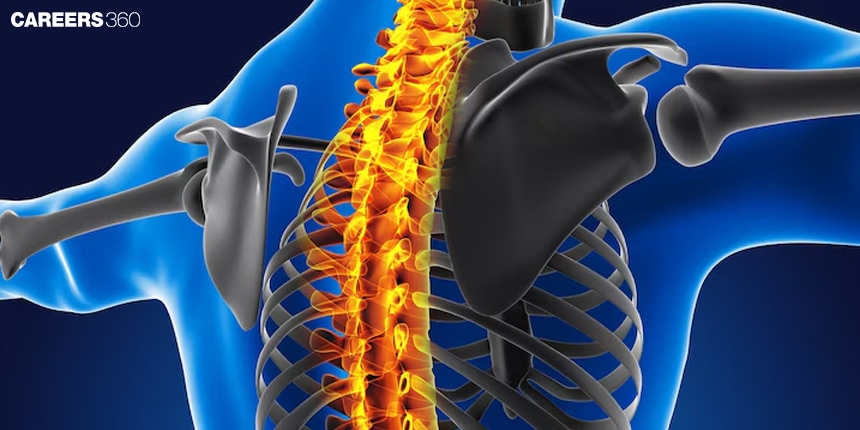
The pectoral girdle, also known as the shoulder girdle, is composed of clavicles and scapulae. The structure it forms provides for attaching the upper limbs to the trunk. Thus, it becomes a vital part of human anatomy that provides attachments for muscles to facilitate arm movements and ranges of motion required for activities of the upper limbs. For activities that involve arm and shoulder mobility, what is essential is merely the basic structure of the pectoral girdle, providing freedom for movement in all directions.
The pectoral girdle has two general bones. These are:
S-shaped bone between the sternum and the scapula.
Acts as a strut to hold the scapula in place, thereby providing for movement of the arm.
Common Injuries: Fractures; most commonly as the result of falls or direct blows.
Flat, triangular bone on the posteri¬or side of the ribcage.
Offer attachment points for a good number of muscles involved actively in the movements of the arm.
Common injuries includes dislocations.
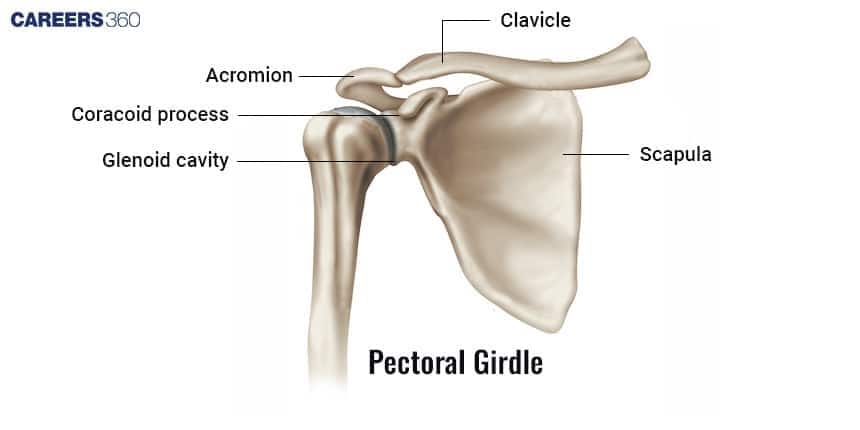
The joints of the pectoral girdle include:
Synovial articulation between the sternum and clavicle.
Allow swinging motion of the clavicle in multiple planes.
The articulation between the acromion of the scapula and the clavicle.
It helps in the movement of the scapula, thus providing flexibility to the shoulder.
Ball and socket joint between the scapula and the humerus.
Allow for a large range of motion for the arm.
Allows maximum range of movement including flexion, extension, abduction, adduction and rotation.
Among the long list of muscles articulating at the pectoral girdle, one finds the following:
Pectoralis major and minor
Deltoid
Trapezius
Serratus Anterior
Rhomboid Major and Minor
These muscles offer stability and maintenance of the position of the scapula and clavicle during upper limb movements.
The nerve supply to the pectoral girdle allows muscle function and sensation. These include:
Brachial Plexus
Suprascapular Nerve
Axillary Nerve
Long Thoracic Nerve
Blood supply to the pectoral girdle allows for the delivery of oxygen and nutrients to the bones and muscles. These include:
Subclavian Artery
Axillary Artery
Brachial Artery
The biomechanics of the pectoral girdle provide for complex motions around the upper limb:
Flexion, Extension, Abduction, Adduction
Rotation (Medial and Lateral)
Role in activities like lifting, pushing, and pulling.
Coordination between the muscles and joints in the pectoral girdle is essential for forming energetic and powerful movements.
The pectoral girdle is susceptible to various forms of disorders and injuries, which include:
Clavicle fractures: This is the most common type and is generally caused by falls or direct impacts.
Shoulder dislocation: Most commonly caused by trauma or through the excessive application of force excessively.
Rotator cuff tears: Generally, this kind of injury occurs because of overuse or acute injury.
Shoulder impingement syndrome: It is essentially the compression of rotator cuff tendons.
Frozen Shoulder (adhesive capsulitis): Stiffness and pain in the shoulder joint.
Bursitis: The bursa becomes inflamed; this is usually the result of repetitive motion.
Important questions asked in NEET from this topic are:
Major components of skeletal system
Physiology of skeletal system
Q1. The collar bone is also known as
Pollex
Phallanges
Clavicle
Scapula
Correct answer: 3) Clavicle
Explanation:
The clavicle is another name for the collarbone. Between the scapula (shoulder blade) and the sternum (breastbone), this long, S-shaped bone acts as a strut. The clavicle permits the arm's complete range of motion and aids in shoulder stabilization. Because of its location and role in supporting the shoulder joint, it is one of the most often fractured bones in the body.
Hence, the correct answer is option c)Clavicle.
Q2. The scapula is a large triangular flat bone situated in the dorsal part of the thorax between
Second and seventh rib
Third and fourth rib
Fifth and sixth rib
Second and fifth rib
Correct answer: 1) Second and seventh rib
Explanation:
The scapula, also known as the shoulder blade, is a large, triangular, flat bone situated in the dorsal part of the thorax, typically between the second and seventh ribs. It forms a part of the pectoral girdle, connecting the upper limb to the trunk. The scapula has several important features, including the spine, which divides the posterior surface into two regions, and the acromion, a bony prominence that forms the highest point of the shoulder. It also has the coracoid process, which serves as an attachment point for muscles and ligaments. The glenoid cavity is a shallow depression where the humerus (upper arm bone) articulates with the scapula, forming the shoulder joint. The scapula provides attachment for muscles involved in arm movement, such as the deltoid, supraspinatus, infraspinatus, and others. Its mobility and structure are essential for a wide range of shoulder movements, including raising the arm, rotation, and lifting.
Hence, the correct answer is option 1, second, and seventh rib.
Q3. The large, flat, triangular bone present in two halves of the pectoral girdle is
Scapula
Ulna
Clavicle
Radius
Correct answer: 1) Scapula
Explanation:
The pectoral girdle is made of two bones. These are the clavicle and the scapula. The scapula is the large triangular flat bone located on the dorsal aspect of the thorax between the second and seventh ribs. A ridge known as the spine gives off to the acromion. The clavicle articulates with the acromion and is termed the collarbone. The glenoid cavity lying beneath the acromion forms the shoulder joint by articulating with the humerus.
Hence, the correct answer is Option (1) Scapula.
Q3. A large triangular flat bone called a scapula is situated in the dorsal part of the thorax between
2nd and 7th ribs
5th and 9th ribs
8th and 10th ribs
2nd and 11th ribs
Correct answer: 1) 2nd and 7th ribs
Explanation:
The pectoral girdle consists of two bones: the clavicle and the scapula. The clavicle is a slender, S-shaped bone that connects the arm to the body, while the scapula is a flat, triangular bone that provides attachment points for muscles and supports the shoulder joint.
Hence, the correct option is 1) 2nd and 7th ribs.
Also Read:
Frequently Asked Questions (FAQs)
This would involve Physiotherapy, and in some cases, even surgery, accompanied by subsequent exercises to regain strength, flexibility, and range of motion.
The pectoral girdle, formed by the clavicle and scapula, provides attachment of the upper limb to the axial skeleton and thus allows for various movements of the shoulder.
The two long bones that make up major parts of the pectoral girdle are the clavicle, or collarbone, and the scapula, or shoulder blade.
Injuries as minor as fractures to the clavicle, or paralysis as dislocation of the shoulder can lead to loss of motion and be inclusive of medical involvement for recovery and restoration of functions.
The prime contributors are the pectoralis major and minor, deltoid, trapezius, serratus anterior, and rhomboid muscles, each of which participates differently during every kind of action on the shoulder or arm.

Ranked 1 st among Top Law Schools of super Excellence in India - GHRDC | NAAC A+ Accredited | #36 by NIRF
Law Admissions 2026 Open | Avail Merit-Based Scholarships
Get Job Ready in Healthcare | Employability-Focused Programs
Highest CTC: 24 LPA | Average CTC: 12.32 LPA | 85 Placement Partners
Leading Design College | Highest CTC: ₹12 LPA | Average CTC: ₹7.5 LPA | Scholarships for Deserving Students
Attend 9-Hour Masterclass on 10th October 2026 to help you score 99+ percentile in CAT 2026