ATIT
Ranked 1 st among Top Law Schools of super Excellence in India - GHRDC | NAAC A+ Accredited | #36 by NIRF


A hinge joint is a type of synovial joint that permits movement in only one plane, similar to the opening and closing of a door. It plays a vital role in daily actions like walking, bending limbs, grasping, and locomotion. This guide explains hinge joint definition, structure, movements, examples, clinical importance, FAQs, and NEET-focused MCQs.
This Story also Contains
The hinge joint holds paramount importance in the human skeleton. It enables a special kind of movement used in our everyday routines and activities. Instead of ball and socket joint movement, which allows movement in multiple directions, the hinge joint moves on a single plane or two-directional movement backwards and forward.
These structure of hinge joint includes:
A convex surface of one bone
Fits into the concave surface of another.
Envelops the joint
Contains synovial fluid to lubricate.
Join bones together
Prevent excess movement of the joint.
Hinge joints allow motion in the following manner:
Flexion: Decrease in the angle between the bones
Extension: Increase in the angle between the bones
These types of movement are involved in vital activities like walking, holding, and bending limbs.
The examples of hinge joints are:
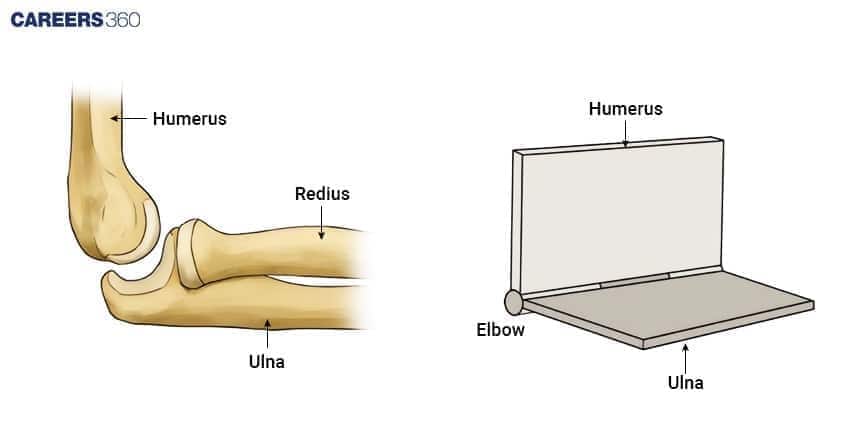
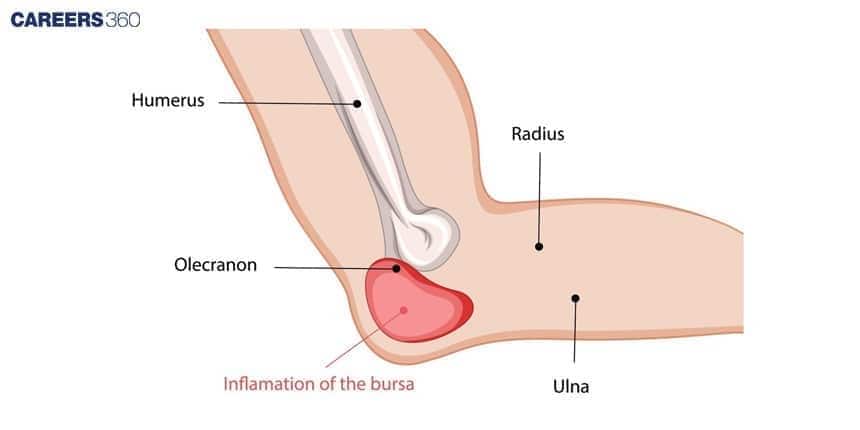
Occurs between the humerus, radius, and ulna.
Allows flexion and extension of forearm
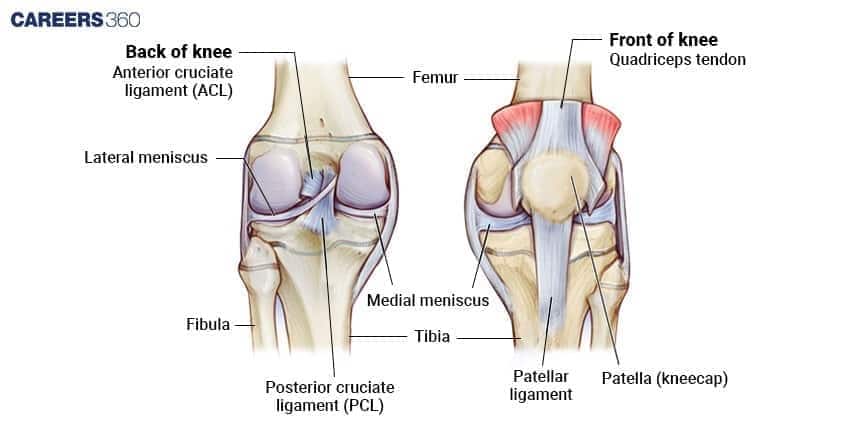
The articulation between the femur, tibia, and patella.
Largest hinge joint
Allows limited side-to-side movement along with flexion and extension
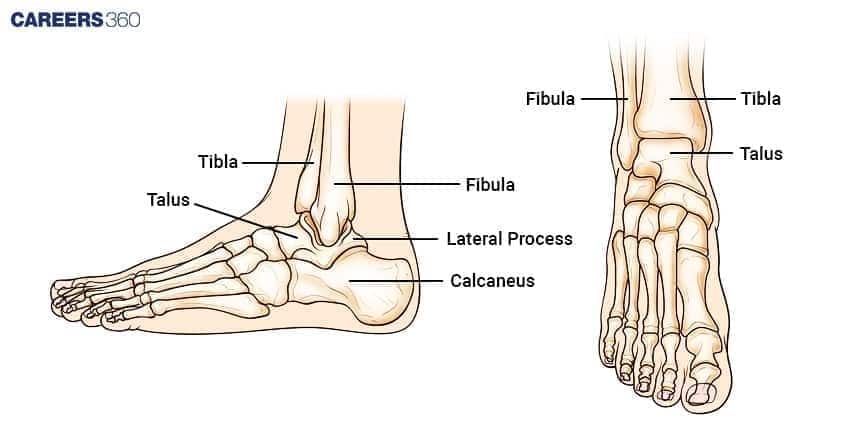
The joint between the tibia, fibula, and talus.
Also called talocrural joint
Helps in walking and stability
Fingers: Proximal & distal interphalangeal joints
Toes: Permit flexion and extension
Essential for fine motor control and balance
Not a pure hinge joint
Allows opening and closing of mouth
Also permits limited side-to-side movement
Both ball and socket joint and hinge joint are synovial joints but they differ in the structure and movement. The differences between the two joints are:
Feature | Hinge Joint | Ball and Socket Joint |
Structure | Cylindrical end of one bone fits into a trough-like surface of another bone | Rounded head of one bone fits into a cup-like socket of another bone |
Movement | Unidirectional: mainly flexion and extension | Multidirectional: flexion, extension, abduction, adduction, rotation |
Mobility | Limited mobility | Highest mobility |
Examples in humans | Elbow joint, Knee joint, Interphalangeal joints | Shoulder joint, Hip joint |
The common disorders include:-
Degeneration of cartilage leading to joint pain and stiffness.
Injuries to ligaments and tendons surrounding the hinge joints.
Occasional displacement caused due to trauma or high stress.
Important questions asked in NEET from this topic are:
Structure of hinge joint
Examples of hinge joint in human
Q1. Assertion (A): The knee joint belongs to the category of hinge joints.
Reason (R): The femur, patella, and fibula are associated with the knee joint.
Both (A) and (R) are true, and (R) correctly explains (A).
Both (A) and (R) are true, but (R) does not correctly explain (A).
(A) is true, but (R) is false.
Both (A) and (R) are false.
Correct answer: 3) (A) is true, but (R) is false.
Explanation:
Assertion (A) correctly states that the knee joint belongs to the category of hinge joints. Hinge joints are characterized by their ability to allow movement primarily in one direction. The knee joint specifically allows flexion and extension movements similar to the opening and closing of a door.
However, the reason (R) stating that the femur, patella, and fibula are associated with the knee joint is incorrect. While the femur is indeed connected to the knee joint, the patella (kneecap) and fibula are not directly involved in the structure or functioning of the knee joint. The patella is a sesamoid bone that lies in front of the knee joint and acts as a protector and improves mechanical advantage for knee extension. The fibula is a bone located in the lower leg but does not directly participate in the knee joint itself.
Hence, the correct answer is option 3) (A) is true, but (R) is false.
Q2. The elbow joint is an example of:
Hinge Joint
Gliding Joint
Ball and socket Joint
Pivot Joint
Correct answer: 1) Hinge Joint
Explanation:
One type of synovial joint, also referred to as a freely moving joint, is the hinge joint. The elbow and knee both have hinge joints. The pivot joint is located between the atlas and axis, the gliding joint is located between the carpals and the ball and socket joint is located between the shoulder and hips.
Hence, the correct answer is option 1) Hinge joint.
Q3. Match the following columns
Column I (Types of Synovial) | Column II (Bones Involved) | ||
A | Ball and Socket | 1 | Carpal and metacarpal of thumb |
B | Hinge | 2 | Atlas and axis |
C | Pivot | 3 | Humerus and pectoral girdle |
D | Saddle | 4 | Knee |
A-3, B-4,C-2, D-1
A-1, B-4, C-3, D-2
A-2, B-3, C-4, D-1
A-3, B-4, C-1, D-2
Correct answer: 1) A-3, B-4,C-2, D-1
Explanation:
Hinge Joint: The convex surface of one bone articulates with the concave surface of another. Up-and-down motion in one plane is possible. Examples: the elbow and knee joints.
Ball-and-socket joint: The ball-shaped head of one bone fits into the cup-shaped socket of another. Movement in all planes, as well as rotation, is possible. Examples: the shoulder and hip joints.
Saddle joint: Each bone is saddle-shaped and fits into the complementary regions of the other. A variety of movements are possible. Example: the joint between the carpal and metacarpal bones of the thumb.
Pivot joint: A small, cylindrical projection of one bone pivots within the ring formed of bone and ligament of another bone. Only rotation is possible. Examples: the joint between the proximal ends of the radius and ulna, and the joint between the atlas and axis.
Hence, the correct answer is option 1) A-3, B-4,C-2, D-1.
Also Read:
Frequently Asked Questions (FAQs)
Hinge joints are constructed in the body to only allow movement in one plane, hence the advantage of stability and efficiency in movement.
Hinged joints provide movement in one plane of motion by the action of flexion—the angle becomes smaller and with extension— the angle becomes larger.
No, the shoulder is a ball and socket type joint which can make wide degrees of movement in different directions.

Ranked 1 st among Top Law Schools of super Excellence in India - GHRDC | NAAC A+ Accredited | #36 by NIRF
Law Admissions 2026 Open | Avail Merit-Based Scholarships
Get Job Ready in Healthcare | Employability-Focused Programs
Highest CTC: 24 LPA | Average CTC: 12.32 LPA | 85 Placement Partners
Leading Design College | Highest CTC: ₹12 LPA | Average CTC: ₹7.5 LPA | Scholarships for Deserving Students
Attend 9-Hour Masterclass on 10th October 2026 to help you score 99+ percentile in CAT 2026