KCC Institute of Legal and Higher Education, Greater Noida
Law Admissions 2026 Open | Avail Merit-Based Scholarships


Human teeth are hard, mineralised structures in the oral cavity that play a crucial role in chewing, speech, and digestion. Humans possess two sets of teeth—primary (milk) teeth and permanent teeth—each adapted for specific functions. This guide explains types of human teeth, structure, functions, dentition, eruption timeline, and NEET-focused MCQs.
This Story also Contains
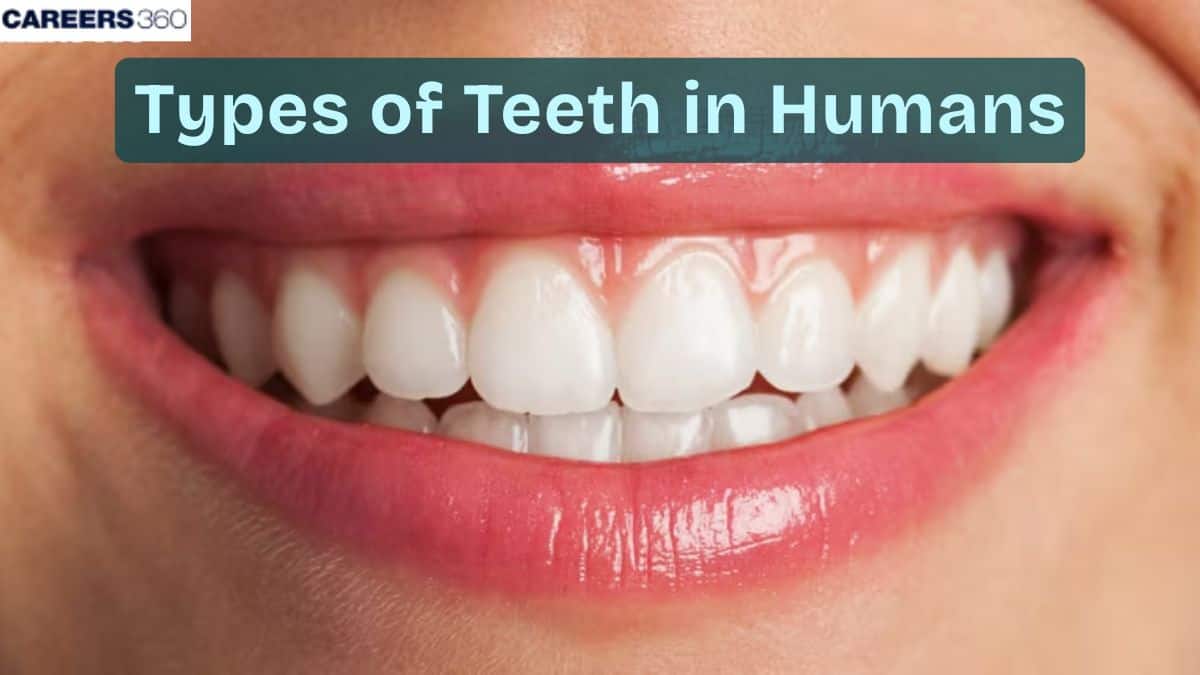
Teeth perform many vital functions in our daily lives. Teeth are essential for eating, articulation, and facial structure. They play an important role in the initial process of digestion where they tear down the food into small parts, which aids in better absorption of nutrients by the body. Teeth also form an important part of clear speech because, during articulation, they help in the formation of sound and enunciate the words properly.
One of the strongest organs in the human body is the tooth. It is mostly made up of minerals (calcium) and proteins (collagen). In addition to aiding in digestion, teeth are crucial for communication. Including the wisdom teeth, an adult will have 32 teeth. Humans have two sets of teeth during their lifetime:
Law Admissions 2026 Open | Avail Merit-Based Scholarships
BBA/MBA/PGDM Early Bird Applications Deadline 19th Oct '26. Apply now using coupon code CAREER250 and get ₹250 off the application fee
Primary (milk) teeth
Permanent (secondary) teeth
Humans have two sets of teeth:
Total number: 20 teeth
Present in children
Begin erupting at 6–12 months
Fully replaced by permanent teeth by 6–7 years
Distribution:
8 incisors
4 canines
8 molars
32 permanent or secondary teeth in total
Begin erupting around 6 years of age
All permanent teeth usually present by 21 years
Distribution:
8 incisors
4 canines
8 premolars
12 molars (4 wisdom teeth)
Types of teeth in humans are:
Pointed, chisel-shaped teeth at the front of the mouth.
Four upper and four lower incisors in the centre and at the sides of the front of the mouth.
Function: Helps in cutting and slicing food into manageable pieces.
First baby teeth to erupt in children at the age ranging between 6-12 months.
First to get replaced with permanent teeth at about 6-8 years.
Pointed teeth and located beside the incisors.
There are two upper and two lower canines.
Function: Tearing and ripping food
Single-rooted and longest root of any tooth in humans.
Erupt in a child about 16-20 months and are replaced by permanent canines around 9-12 years.
Flat-crowned teeth with two cusps
Located on either side of the canines, in front of the molars.
Function: Grinding and crushing food.
Have one or two roots and are exclusively permanent dentition teeth.
Erupt at about 10-12 years of age.
Large flattened teeth, located at the back of the mouth.
Function: Grinding and mashing food.
Molars have a large flat surface area with four to five cusps and 2-3 roots.
Erupt at around 6 years of age and the second molars come into place at around 12 years of age.
Last molars in the dental series
Usually erupt in late adolescence or early adulthood.
Historically used to grind tough plant fibres, such as roots and leaves. Not as essential today due to dietary and food preparation changes.
Wisdom teeth mostly develop problems resulting from the lack of space in the jaw to accommodate these extra teeth.
Most of the time, they are extracted to save one from future dental complications.
Humans have four major kinds of teeth, all fitted for some particular function associated with the preparing and articulating of food. They are: Incisors, Canines, Premolars, and Molars. The following shows their locations, functions, and numbers in both adults and children.
| Types of Teeth | Location | Function | Number in Adults | Number in Children |
|---|---|---|---|---|
Incisors | Front of the mouth | Cutting and slicing food | 8 | 8 |
Canines | Next to incisors | Tearing and ripping food | 4 | 4 |
Premolars | Between canines and molars | Crushing and grinding food | 8 | 0 |
Molars | Back of the mouth | Grinding and mashing | 12 | 8 |
Normal teeth development follows a definite pattern that begins at the period of infancy and proceeds through early adulthood.
0-6 months: No teeth.
6-12 months: Primary teeth bud.
6-7 years: First permanent teeth replace primary teeth.
12-13 years: Most permanent teeth erupt.
Late teens to early 20s: Wisdom teeth may erupt.
Important questions asked in NEET from this topic are:
Human teeth and dental formula
Types of Teeth in human
Q1. Which are regarded as Monophyodont Teeth ?
Premolars
Premolars and Molars
Wisdom teeth
Both 1 and 3
Correct answer: 4) Both 1 and 3
Explanation:
Monophyodont teeth are teeth that appear only once in a lifetime. In humans, these typically include the premolars and third molars (wisdom teeth). There are three such teeth in each quadrant of the mouth, so in total, humans have 12 monophyodont teeth.
Hence, the correct answer is option 4) Both 1 and 3.
Q2. The softer , living inner structure of teeth , is called
Enamel
Periodontal ligament
Pulp
Dentine
Correct answer: 3) Pulp
Explanation:
The pulp is the softer, living inner core of a tooth, surrounded by dentin. It contains a network of blood vessels, nerves, and connective tissue that extend from the pulp chamber in the crown to the root canals within the roots of the tooth. Blood vessels in the pulp supply essential nutrients and oxygen to keep the tooth alive, while the nerves provide sensory functions, enabling the tooth to detect sensations like pain, pressure, and temperature changes. The pulp plays a critical role during the development of teeth, contributing to the formation of dentin, and continues to support repair and maintenance throughout the tooth's life. If the pulp becomes infected or damaged, it can lead to significant pain and require treatments such as root canal therapy to preserve the tooth.
Hence, the correct answer is option 3) Pulp.
Q3. The part of teeth projecting above the gingiva is called
Root
Crown
Socket
Dentine
Correct answer: 2) Crown
Explanation:
Teeth are differentiated into three regions namely crown, neck and root. The part of the tooth projecting above the gum line or gingiva is called the crown.
Hence, the correct answer is option 2) Crown.
Also Read:
Frequently Asked Questions (FAQs)
They were quite useful to early humans who had a diet comprising hard foods. Nowadays, when the jaw has become of a relatively smaller size, they crowd and mostly misalign; thus, extractions are frequent.
Twice daily brushing of teeth, flossing once daily, and avoiding sugary foods and juices are good dental hygiene practices. Regular check-ups at the dentist are equally required.
The children's teeth develop from an eruption at 6 months of age to one of the primary teeth, then progress with the permanent ones replacing those at 6-12 years of age. These are completed by an eruption of wisdom teeth later in teenagers and young adults.
Humans have incisors for cutting, canines for tearing and ripping, premolars for crushing, and grinding, and molars for grinding/mashing food.
Children have 20 Milk teeth. Adults have 32 Permanent teeth. Within this number, wisdom teeth are included.

Law Admissions 2026 Open | Avail Merit-Based Scholarships
BBA/MBA/PGDM Early Bird Applications Deadline 19th Oct '26. Apply now using coupon code CAREER250 and get ₹250 off the application fee
Ranked #36 amongst institutions in Management by NIRF | 100% Placement
Globally Recognized by AACSB (US) & AMBA (UK) | 18 LPA Avg. CTC for PGPM 2026
Leading Design College | 95% Placement Record | Merit-cum-Means Scholarships for Deserving Students
NEET PG All India & State College Predictor with Admission Process Guide