


Phosphorous Acid (H3PO3) - Reactions, Structure, Properties, Uses, FAQs
Have you ever wondered why phosphorous acid ($\mathrm{H}_3 \mathrm{PO}_3$) behaves differently from phosphoric acid ($\mathrm{H}_3 \mathrm{PO}_4$) even though both contain phosphorus and oxygen? You will find this answer by reading this article. Phosphorus acid ($\mathrm{H}_3 \mathrm{PO}_3$) is an oxyacid of phosphorus. Phosphorous acid is also a conjugate acid of dihydrogen phosphite. It is a crystalline, colorless solid with a sour taste that dissolves readily in water.
This Story also Contains
- Preparation Of Phosphorous Acid
- Properties of Phosphorous Acid
- Toxicity Of Phosphorous Acid
- Structure Of Phosphorus Acid ($\mathrm{H}_3 \mathrm{PO}_3$)
- Basicity Of Phosphoric Acid
- Uses Of Phosphorous Acid ($\mathrm{H}_3 \mathrm{PO}_3$).
- Application Of Phosphorous Acid($\mathrm{H}_3 \mathrm{PO}_3$)
- Some Solved Examples
.jpg)
Phosphorous acid ($\mathrm{H}_3 \mathrm{PO}_3$) is a tribasic acid with one phosphorus, four oxygen, and three hydrogen atoms. And the basicity of phosphoric acid is 3 since it contains three acidic hydrogen atoms. In this article we read about Preparation of Phosphorous Acid, Structure, Toxicity, and Reactions of Phosphorous Acid.
Preparation Of Phosphorous Acid
1. By Hydrolysis of Phosphorus Trichloride $\left(\mathrm{PCl}_3\right)$
Phosphorous acid is commonly prepared by the hydrolysis of phosphorus trichloride with water.
$\mathrm{PCl}_3+3 \mathrm{H}_2 \mathrm{O} \rightarrow \mathrm{H}_3 \mathrm{PO}_3+3 \mathrm{HCl}$
In this reaction, phosphorus trichloride reacts with water to produce phosphorous acid along with hydrochloric acid.
2. By Action of Steam on Phosphorus Trioxide ( $\mathrm{P}_4 \mathrm{O}_6$ )
Phosphorous acid can also be prepared by passing steam over phosphorus trioxide.
$\mathrm{P}_4 \mathrm{O}_6+6 \mathrm{H}_2 \mathrm{O} \rightarrow 4 \mathrm{H}_3 \mathrm{PO}_3$
In this method, phosphorus trioxide combines with water to form phosphorous acid.
3. By Oxidation of Phosphine $\left(\mathrm{PH}_3\right)$
Phosphorous acid is also obtained by the controlled oxidation of phosphine gas.
$\mathrm{PH}_3+\mathrm{O}_2 \rightarrow \mathrm{H}_3 \mathrm{PO}_3$
Phosphine is oxidized in the presence of a limited supply of oxygen under controlled conditions to produce phosphorous acid.
Properties of Phosphorous Acid
- Phosphorous acid is a white crystalline solid.
- It has a sour odour and a garlic-like taste.
- It is highly soluble in water.
- It is also soluble in ethanol.
- The chemical formula of phosphorous acid is $\mathrm{H}_3 \mathrm{PO}_3$
- Although its formula contains three hydrogen atoms, it behaves as a diprotic acid because only two hydrogen atoms are ionizable.
- The molar mass of phosphorous acid is $81.9 \mathrm{~g} / \mathrm{mol}$
- Its density is 1.651 g/cm3.
- The melting point of phosphorous acid is $73.6^{\circ} \mathrm{C}$.
- The boiling point of phosphorous acid is 200$^{\circ} \mathrm{C}$.
Toxicity Of Phosphorous Acid
- Phosphorous acid causes severe irritation when it comes in contact with the eyes, skin, and mucous membranes.
- It may lead to serious eye damage and skin burns.
- The acid is toxic when inhaled or absorbed through the skin.
- Inhalation of phosphorous acid can irritate the nose, throat, and lungs.
- Exposure may cause coughing, wheezing, and breathing difficulties.
- It can severely affect and damage the respiratory system.
Structure Of Phosphorus Acid ($\mathrm{H}_3 \mathrm{PO}_3$)
Phosphorous acid has the molecular formula $\mathrm{H}_3 \mathrm{PO}_3$. Its actual structure contains one phosphorus atom bonded to:
- One double bonded oxygen atom ( $\mathrm{P}=\mathrm{O}$ )
- Two hydroxyl groups ( -OH )
- One hydrogen atom directly attached to phosphorus $(\mathrm{P}-\mathrm{H})$
Structural Representation
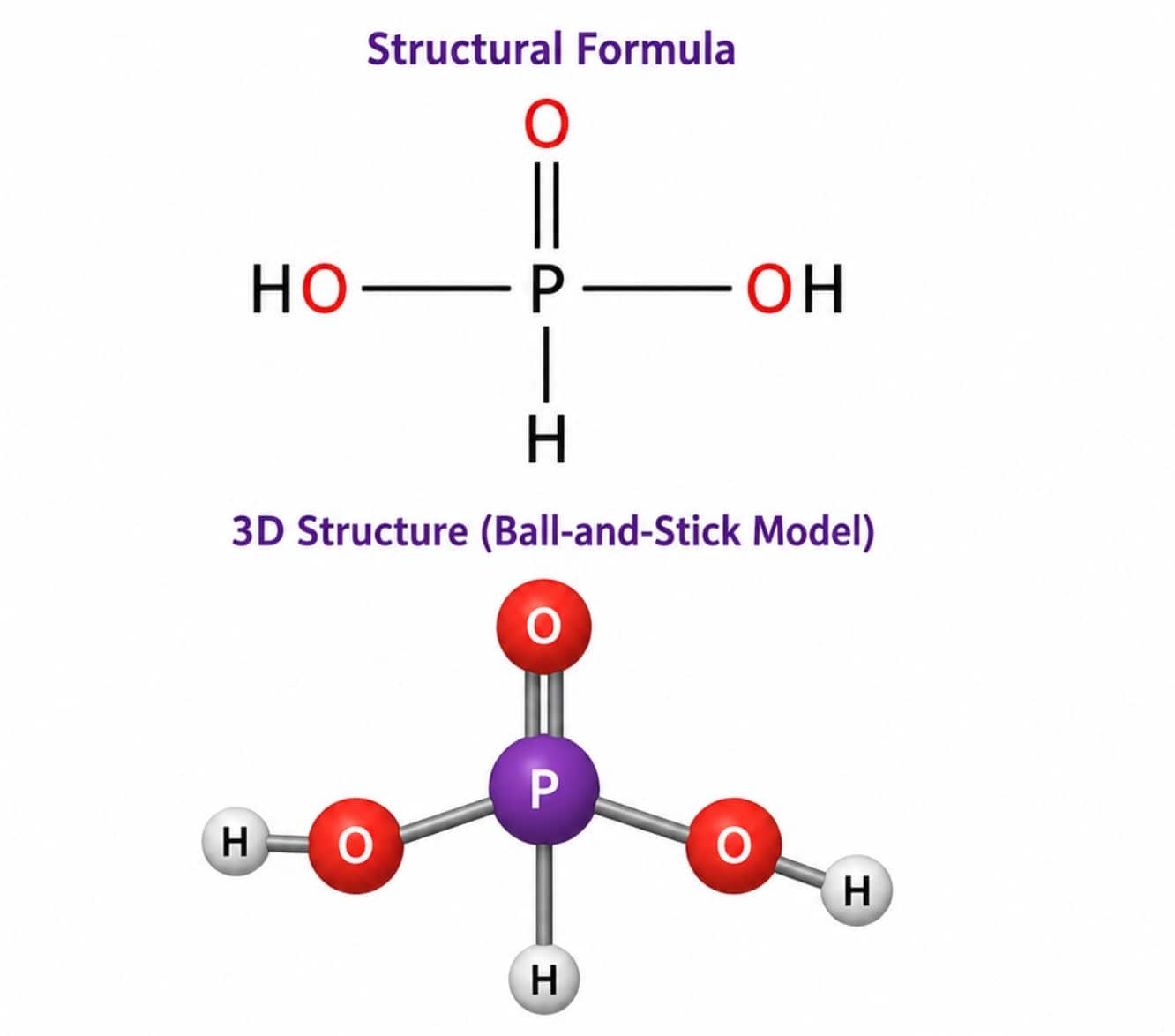
The structure of H3PO3 can be more accurately explained using the chemical formula HPO(OH)2. In the solid state phosphorous acid is tetrahedrally coordinated with one P-H and PO and two longer POH bonds. While it exists in equilibrium with the tautomer form containing three P-OH bonds. The one containing two hydroxyl groups is phosphonic acid while the other with three hydroxyl groups is phosphorous acid. The name ending with ‘ous’ means it is in the reduced form. The following structure shows this fact.
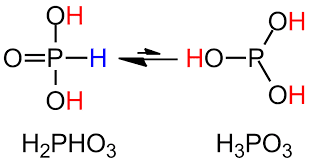
Tautomerism in phosphorous acid
Other important oxyacids are phosphoric acid and hypophosphorous acid. These compounds also show tautomerism similar to phosphorous acid by the shift in the position of H. This is all about the structure of $\mathrm{H}_3 \mathrm{PO}_3$.
Basicity Of Phosphoric Acid
Phosphoric acid $\left(\mathrm{H}_3 \mathrm{PO}_4\right)$ contains three hydroxyl $(-\mathrm{OH})$ groups attached to the phosphorus atom. Therefore, it is a tribasic acid with a basicity of three.
Explanation of Basicity
- Basicity is the number of ionizable hydrogen ions $\left(\mathrm{H}^{+}\right)$present in an acid molecule.
- In phosphoric acid, all three hydrogen atoms are attached to oxygen atoms.
- Since oxygen is highly electronegative, these hydrogen atoms can be released as hydrogen ions in aqueous solution.
- Thus, phosphoric acid can donate three hydrogen ions and shows a basicity of three.
Uses Of Phosphorous Acid ($\mathrm{H}_3 \mathrm{PO}_3$).
-
Phosphorous acid, $\mathrm{H}_3 \mathrm{PO}_3$ is widely used for the production of PVC stabilizers, amino methylene phosphonic acid, etc.
-
Because of its strong reducing nature, it can be used as a reducing agent.
-
It is used in the production of synthetic fibers and organophosphorus pesticides.
-
It is used for the production of amino trimethylene phosphonic acid which is used as a water treatment agent.
-
Phosphorous acid, $\mathrm{H}_3 \mathrm{PO}_3$ is used to produce the fertilizer phosphate salt.
-
Phosphorous acid, $\mathrm{H}_3 \mathrm{PO}_3$ also has many applications in the medical field mostly the dental field.
-
It is used for protecting ferrous materials including steel from rusting.
-
Basic lead phosphite is prepared by using phosphorous acid.
Application Of Phosphorous Acid($\mathrm{H}_3 \mathrm{PO}_3$)
Phosphorous acid, also called orthophosphorous acid, is a dibasic acid with the formula $\mathrm{H}_3 \mathrm{PO}_3$. It acts as a strong reducing agent and has multiple industrial and agricultural uses.
1. Production of Phosphites
-
$\mathrm{H}_3 \mathrm{PO}_3$ is used to produce phosphite salts such as sodium phosphite ($\mathrm{Na}_2 \mathrm{HPO}_3$) and potassium phosphite ($\mathrm{KH}_2 \mathrm{PO}_3$). These are used in fertilizers and as stabilizers in plastics.
2. Reducing Agent in Chemical Reactions
-
Phosphorous acid is a powerful reducing agent. It can reduce gold, silver, and mercury salts to their metallic form.
3. Synthesis of Organophosphorus Compounds
-
Used in the preparation of phosphonates and phosphite esters, which are important in Plastic stabilizers, Lubricant additives, Flame retardants
4. Manufacture of Plastic Stabilizers
- Acts as a stabilizer in PVC (Polyvinyl Chloride) production to prevent oxidative degradation.
5. Agricultural Use
- Phosphorous acid and its salts help control fungal and oomycete infections in crops like grapes and potatoes.
Also read :
Some Solved Examples
Question.1 The oxidation state of phosphorus in hypophosphoric acid is +
1) 4
2) 5
3) 3
4) 1
Solution:
Phosphorus forms a number of oxoacids.
The compositions of the oxoacids are interrelated in terms of loss or gain of H2O molecule or an O-atom. The structures of some important oxoacids are given in later pictures. In oxoacids, phosphorus is tetrahedrally surrounded by other atoms. All these acids contain at least one P=O bond and one P–OH bond. The oxoacids in which phosphorus has a lower oxidation state (less than +5) contain, in addition to P=O and P–OH bonds, either P–P (e.g., in H4P2O6) or P–H (e.g., in H3PO2) bonds but not both. These acids in the +3 oxidation state of phosphorus tend to be disproportionate to higher and lower oxidation states. For example, orthophosphorous acid (or phosphorous acid) on heating disproportionates to give orthophosphoric acid (or phosphoric acid) and phosphine.
$4 \mathrm{H}_3 \mathrm{PO}_3 \rightarrow 3 \mathrm{H}_3 \mathrm{PO}_4+\mathrm{PH}_3$
Hypophosphoric acid is $\mathrm{H}_4 \mathrm{P}_2 \mathrm{O}_6$ oxidation state of P is +4 .
Hence, the answer is option (1).
Question. 2 Which of the Phosphorus oxoacid can create silver mirror from $\mathrm{AgNO}_3$ solution?
1)$\left(\mathrm{HPO}_3\right)_n$
2)$\mathrm{H}_4 \mathrm{P}_2 \mathrm{O}_6$
3) $\mathrm{H}_4 \mathrm{P}_2 \mathrm{O}_5$
4)$\mathrm{H}_4 \mathrm{P}_2 \mathrm{O}_7$
Solution:
Phosphorus forms several oxoacids. These are the important phosphorus oxoacids, with their formulas, methods of preparation, and the presence of some characteristic bonds in their structures.
The compositions of the oxoacids are interrelated in terms of loss or gain of H2O molecule or O-atom. The structures of some important oxoacids are given in later pictures. In oxoacids, phosphorus is tetrahedrally surrounded by other atoms. All these acids contain at least one P=O bond and one P–OH bond. The oxoacids in which phosphorus has a lower oxidation state (less than +5) include, in addition to P=O and P–OH bonds, either P–P (e.g., in H4P2O6) or P–H (e.g., in H3PO2) bonds but not both. These acids in the +3 oxidation state of phosphorus tend to be disproportionate to higher and lower oxidation states. For example, orthophophorous acid (or phosphorous acid) on heating disproportionates to give orthophosphoric acid (or phosphoric acid) and phosphine.
Silver mirror test can be given by $\mathrm{P}^{+3}, \mathrm{P}^{+1}$ ox acid
$\mathrm{H}_4 \stackrel{+3}{\mathrm{P}_2} \mathrm{O}_5+\mathrm{Ag}_2 \mathrm{O} \rightarrow \mathrm{Ag}$
Silver mirror
Hence, the answer is the option (3).
Question.3 Phosphorous acid (H3PO3) is prepared by the hydrolysis of:
a) $\mathrm{PCl}_5$
b) $\mathrm{PCl}_3$
c) $\mathrm{P}_4 \mathrm{O}_{10}$
d) $\mathrm{PH}_3$
Solution:
Hydrolysis of phosphorus trichloride with water gives H₃PO₃ and HCl gas.
Hence, the correct option is (b) $\mathrm{PCl}_3$
Practice More Questions With the Link Given Below
Frequently Asked Questions (FAQs)
Formula of Phosphorous acid is H3PO3.
Phosphorous acid is diprotic because only two of its hydrogen atoms are ionizable (the third hydrogen is bonded directly to phosphorus and is non-ionizable).
Phosphoric acid, H3PO3 is a colorless weak acid. For phosphoric acid the chemical formula is H3PO4. It contains one phosphorus atom, four oxygen atoms, and three hydrogen atoms. It is different from phosphorous acid, H3PO3 since it contains four oxygen atoms. For phosphoric acid, three OH groups are bonded to the phosphorus atom so it is a tribasic group with basicity of three. Basicity is the number of hydrogen atoms present in a chemical compound. And here the three hydrogen atoms are strongly bonded with an electronegative atom of oxygen so it is acidic. While the basicity of phosphorus acid is only two. As all the hydrogen atoms are acidic it is dissociated completely in water except at low pH. When all the three hydrogen ions have been removed the compound obtained is called orthophosphates.
Molecular weight of Phosphrous acid is 82g/mol.
The oxidation state of phosphorus in H₃PO₃ is +3.
It is used as a reducing agent, in chemical synthesis, in the production of phosphites, and as a fungicide in agriculture.
Due to the presence of P-H bonds, it can donate electrons, making it a good reducing agent.