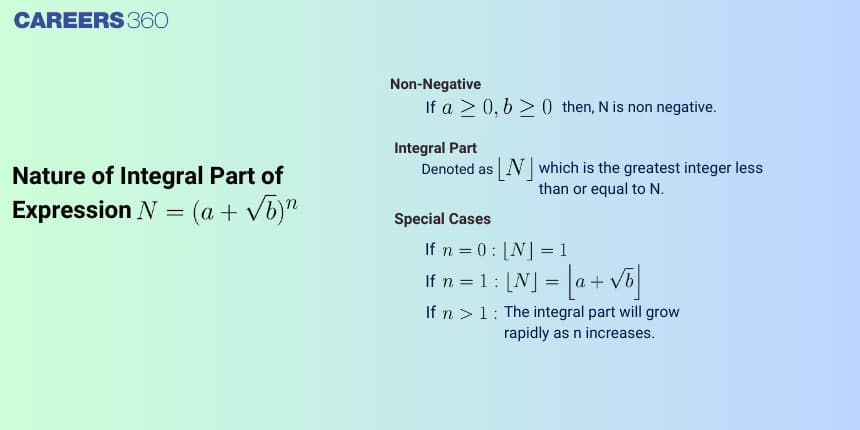
Imagine you’re trying to guess the final amount on a restaurant bill before it actually arrives — you may not know the exact value, but you can still estimate the whole number part quite easily. In maths, we do something similar with expressions like $N = (a + \sqrt{b})^n$, where the exact value may look complicated, yet the integral part can be found using simple ideas. In this article, we’ll explore the nature of the integral part of $ (a + \sqrt{b})^n $, understand how these expressions behave, and learn easy methods, examples, and exam-focused tricks based on the Binomial Theorem and algebra to help you solve such questions confidently.
This Story also Contains
Binomial Theorem: Definition, Concepts, and Application in Integral Expressions
Understanding the Binomial Theorem
Binomial Coefficients and Their Properties
Integral Part Problems: Expressions of the Form $(a + \sqrt{b})^n$
Key Properties of $(a+\sqrt{b})^n$ and $(a-\sqrt{b})^n$
Step-by-Step Method to Find the Integral Part
Solved Examples based on Nature of Integral Part of Expression $N = (a + \sqrt {b})^n$
List of Topics related to Binomial Theorem
NCERT Resources
Practice Questions based on the Nature of Integral Part of Expression
Nature of Integral Part of Expression N = (a + sqrt b)^n
Binomial Theorem: Definition, Concepts, and Application in Integral Expressions
The Binomial Theorem is one of the most important algebraic resources in Class 11 Mathematics, widely used in JEE Main & Advanced, CUET, NDA, and other competitive exams. It provides a systematic method to expand expressions of the form $(a+b)^n$ without repeated multiplication and forms the foundation for concepts like binomial coefficients, general term, and greatest term.
In addition to standard expansions, special expressions such as $(a+\sqrt{b})^n$ and $(a-\sqrt{b})^n$ play a crucial role in problems involving the integral part and fractional part of algebraic expressions. These identities are frequently tested in higher-order binomial theorem questions, especially in integer-based and maximum–minimum problems.
Below is a structured explanation covering the Binomial Theorem, properties of binomial coefficients, and the method to find the integral part of expressions involving square roots, aligned with exam requirements and quick revision needs.
Understanding the Binomial Theorem
When you have an expression like $(a + b)^n$, expanding it directly becomes extremely lengthy for large values of $n$. The Binomial Theorem gives a shortcut.
The binomial coefficient $\binom{n}{r}$ or $^nC_r$ represents the number of ways to choose $r$ elements from $n$. It is calculated using:
$\binom{n}{r} = \frac{n!}{r!(n-r)!}$
Key Properties Useful for Exams
$\binom{n}{r} = \binom{n}{n-r}$
$\binom{n}{0} = \binom{n}{n} = 1$
All coefficients in an expansion are positive integers.
They form Pascal’s Triangle.
These properties help simplify expressions, find specific terms, and solve combinatorics problems efficiently.
Integral Part Problems: Expressions of the Form $(a + \sqrt{b})^n$
One of the most interesting applications of the binomial theorem is determining the integral part of expressions like:
$N = (a + \sqrt{b})^n$
Even though the expression includes a square root and looks non-integer, the integral part can be found using conjugates.
Why These Expressions Are Special
For numbers such as $(a + \sqrt{b})$ where $a$ and $b$ are integers but $\sqrt{b}$ is irrational, raising them to a power still creates structured patterns.
A key idea:
The irrational part cancels out when we consider both $(a + \sqrt{b})^n$ and $(a - \sqrt{b})^n$ together.
This is why these problems often appear in JEE and Olympiad-level algebra.
Key Properties of $(a+\sqrt{b})^n$ and $(a-\sqrt{b})^n$
Expressions of the form $(a+\sqrt{b})^n$ and $(a-\sqrt{b})^n$ are called conjugate binomial expressions. They are extremely important in Class 12 Binomial Theorem, especially for questions involving the integral part, fractional part, and integer-valued expressions. These properties are frequently used in JEE, CUET, NDA, and board-level exams.
Why $(a-\sqrt{b})^n$ Lies Between 0 and 1
If $a$ and $b$ are positive real numbers such that $a^2 - b = 1$
Then, $(a+\sqrt{b})(a-\sqrt{b}) = 1$
This implies, $a-\sqrt{b} = \dfrac{1}{a+\sqrt{b}}$
Since $a+\sqrt{b} > 1$, we get $0 < a-\sqrt{b} < 1$
Raising both sides to a positive integer power $n$, $0 < (a-\sqrt{b})^n < 1$
This result is crucial because it guarantees that $(a-\sqrt{b})^n$ contributes only a fractional value, which plays a key role in identifying the integral part of $(a+\sqrt{b})^n$.
Sum of Conjugate Expressions and Integer Value Property
Using the Binomial Theorem, $(a+\sqrt{b})^n + (a-\sqrt{b})^n$
On expansion, all odd powers of $\sqrt{b}$ cancel out, leaving only even-powered terms.
Thus, the sum becomes: $(a+\sqrt{b})^n + (a-\sqrt{b})^n = 2\left[{}^nC_0 a^n + {}^nC_2 a^{n-2} b + {}^nC_4 a^{n-4} b^2 + \cdots \right]$
If $a$ and $b$ are integers, then the right-hand side is an integer.
This property is widely used to show that: $(a+\sqrt{b})^n + (a-\sqrt{b})^n$ is an integer and helps determine the greatest integer less than $(a+\sqrt{b})^n$.
Product of Conjugate Expressions and Its Applications
The product of conjugate expressions is given by: $(a+\sqrt{b})^n (a-\sqrt{b})^n = (a^2 - b)^n$
If $a^2 - b = 1$, then $(a+\sqrt{b})^n (a-\sqrt{b})^n = 1$
This identity is extremely powerful in integral part and fractional part problems, allowing us to write: $(a-\sqrt{b})^n = \dfrac{1}{(a+\sqrt{b})^n}$
This directly leads to results such as:
If $(a+\sqrt{b})^n = I + f$ where $0<f<1$, then $(a-\sqrt{b})^n = 1 - f$ and hence, $(a+\sqrt{b})^n (1 - f) = 1$
Step-by-Step Method to Find the Integral Part
This section walks you through an easy, systematic method to find the integral part of expressions like $(a + \sqrt{b})^n$. By using conjugates and basic algebraic properties, you can determine the integer value without expanding the entire expression.
Step 1: Choose the appropriate conjugate
Define the conjugate expression as:
$N' = (a - \sqrt{b})^n$ if $a > \sqrt{b}$
$N' = (\sqrt{b} - a)^n$ if $\sqrt{b} > a$
This helps eliminate $\sqrt{b}$ in the next step.
Step 2: Form an integer by adding or subtracting
Both expressions:
$(a + \sqrt{b})^n + (a - \sqrt{b})^n$ $(a + \sqrt{b})^n - (a - \sqrt{b})^n$
always produce integers because the irrational parts cancel out.
Thus, you obtain a clean integer relation involving $N$.
Step 3: Write the number in standard form
Write:
$N = I + f$
where:
$I = [N]$ is the integer part
$f = {N}$ is the fractional part
Then use the integer expression from Step 2 to solve for $I$.
Example: Integral Part of $(3\sqrt{3} + 5)^{2n+1}$
Let:
$P = (3\sqrt{3} + 5)^{2n+1}$
Step 1: Conjugate Expression
$P' = (3\sqrt{3} - 5)^{2n+1}$
Since $3\sqrt{3} - 5$ is a number between 0 and 1, we have $0 < P' < 1$.
Step 2: Subtract to remove irrational components
Consider:
$P - P' = 2\left[\binom{2n+1}{1}(3\sqrt{3})^{2n}5 + \binom{2n+1}{3}(3\sqrt{3})^{2n-2}5^3 + \ldots\right]$
This entire right side is an even integer. Let that be $2k$.
Step 3: Use fractional part properties
Write $P = I + f$.
Then:
$I + f - P' = 2k$
Since both $f$ and $P'$ lie between 0 and 1:
$-1 < f - P' < 1$
But $f - P'$ must also be an integer. The only integer between −1 and 1 is 0.
So:
$f - P' = 0$ $I = 2k$
This shows that the integer part is always even.
Final Result
The integral part of $(3\sqrt{3} + 5)^{2n+1}$ is always an even integer, regardless of the value of $n$.
Solved Examples based on Nature of Integral Part of Expression $N = (a + \sqrt {b})^n$
Example 1: If $P=(7+4\sqrt{3})^9$ and $P=I+f$, where $I$ is the integer just less than $P$, then the value of $P(1-f)$ is
This section gives you a simple overview of all the important ideas linked to the Binomial Theorem, helping you quickly see what to study and how each topic connects to algebra and competitive exam preparation.
This section brings together all the important NCERT-based study materials you need, including chapter notes, solutions, and exemplar questions to strengthen your foundation in the Binomial Theorem.
Practice Questions based on the Nature of Integral Part of Expression
This section gives you a set of focused practice questions that help you understand how to work with the integral part of expressions using binomial concepts. It’s designed to strengthen your problem-solving skills for competitive exams by showing how these expressions behave and how to evaluate them quickly and correctly.
Q: What is the role of fractional part ${N}$ in solving these problems?
A:
Writing $N = I + f$, where $I$ is the integer part and $f$ is the fractional part ($0 < f < 1$), helps compare $N$ with $N'$. Since $N'$ is also tiny, we examine the difference $f - N'$ to determine the exact integer value of $I$.
Q: How does using $N + N'$ or $N - N'$ help find the integer part?
A:
Expressions like $(a + \sqrt{b})^n + (a - \sqrt{b})^n$ eliminate irrational components, yielding a pure integer. Once you know this integer and the tiny value of $N'$, you can easily isolate the integer part of $N$.
Q: Why is $(a - \sqrt{b})^n$ often a very small value?
A:
When $a < \sqrt{b}$ or $a$ is only slightly larger, the expression $a - \sqrt{b}$ becomes a fraction between $-1$ and $1$. Raising it to the $n$th power makes its magnitude even smaller, often approaching zero.
Q: Why do we use the conjugate $(a - \sqrt{b})^n$ while finding the integral part?
A:
The conjugate helps cancel out the irrational terms involving $\sqrt{b}$. Expressions like $(a + \sqrt{b})^n + (a - \sqrt{b})^n$ become integers, making it easier to determine the integral part of $N$.
Q: What does the integral part of the expression $(a + \sqrt{b})^n$ mean?
A:
The integral part of $(a + \sqrt{b})^n$ refers to the greatest integer less than or equal to its actual value. If $N = (a + \sqrt{b})^n$, then its integral part is written as $[N]$.