Important Results of Binomial Theorem for any Index

Search Colleges, Exams, Schools & more


Login
Sum of Binomial Coefficients
Imagine you're stacking boxes in different ways - sometimes you choose 2 boxes out of a pile, sometimes 3, sometimes all of them. Every possible arrangement you can make is, in a simple sense, what binomial coefficients help us count. They show up in everyday situations like forming teams, arranging items, or even checking how many ways a password can be created. In this article, we’ll break down the sum of binomial coefficients in an easy, student-friendly way, explore key formulas, understand why these sums matter, and walk through important identities that often appear in Class 11 maths, competitive exams, and permutation-combination problems.
This Story also Contains
- Binomial Expression: Definition, Example
- The Binomial Theorem
- What Is a Binomial Coefficient?
- Key Results on the Sum of Binomial Coefficients
- Why These Binomial Identities Matter in Real Life
- List of Topics related to Sum of Binomial Coefficients
- NCERT Resources
- Practice Questions based on the Sum of Binomial Coefficients
Binomial Expression: Definition, Example
A binomial expression is simply an algebraic expression that contains exactly two terms. You see them all the time in algebra — expressions like
$ (a+b)^2 $,
$ \left(\sqrt{x}+\frac{k}{x^2}\right)^5 $,
$ (x+9y)^{-2/3} $.
Even though these expressions look small, raising them to higher powers can quickly become complicated. Imagine trying to expand $(x+y)^{52}$ by multiplying $(x+y)$ again and again — nobody has that kind of patience.
Understanding Patterns Through Simple Binomial Expansions
Before jumping to large powers, it helps to observe how smaller powers behave:
$
(x+y)^2 = x^2 + 2xy + y^2
$
$
(x+y)^3 = x^3 + 3x^2y + 3xy^2 + y^3
$
$
(x+y)^4 = x^4 + 4x^3y + 6x^2y^2 + 4xy^3 + y^4
$
If you look closely:
The exponent of $x$ decreases by 1 in each term.
The exponent of $y$ increases by 1 in each term.
The sum of exponents in each term is always n.
The coefficients follow a predictable pattern:
$ \binom{n}{0}, \binom{n}{1}, \binom{n}{2}, \dots, \binom{n}{n} $
These exactly match the numbers found in Pascal’s Triangle, and they form the heart of the Binomial Theorem.
The Binomial Theorem
When $n$ is a positive integer, the expansion of $(a+b)^n$ can be written directly as:
$ (a+b)^n = \binom{n}{0} a^n + \binom{n}{1} a^{n-1}b + \binom{n}{2} a^{n-2} b^2 + \dots + \binom{n}{n} b^n $
This formula saves you from endless multiplication and is foundational in algebra, combinatorics, and data science applications.
What Is a Binomial Coefficient?
The coefficient
$ \binom{n}{r} = \frac{n!}{r!(n-r)!} $
is called a binomial coefficient.
It represents the number of ways to choose r objects out of n, making it extremely useful in probability, counting problems, statistics, and even machine learning model calculations.
Key Results on the Sum of Binomial Coefficients
These identities help simplify expressions and solve higher-level problems in competitive exams like JEE, CUET, and in real-world computation.
1. Sum of All Binomial Coefficients
A beautiful identity states:
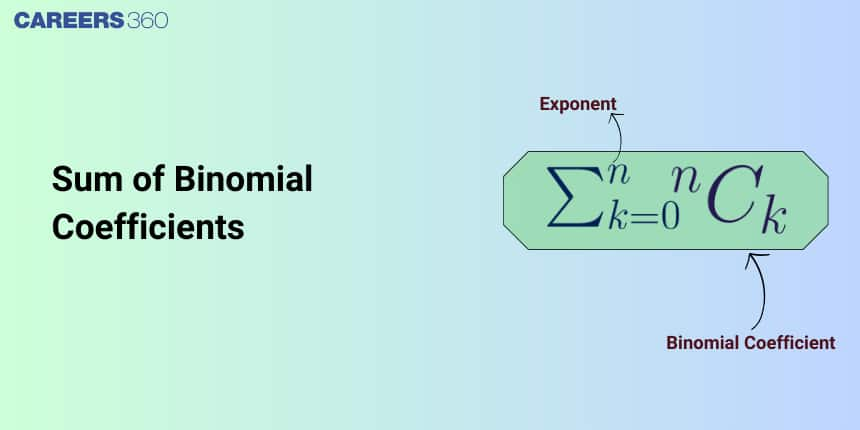
$ \sum_{r=0}^n {^nC_r} = 2^n $
This comes from simply substituting $a = 1$ and $b = 1$ in the Binomial Theorem:
$(1+1)^n = 2^n$
This result is widely used in:
probability distributions
algorithmic complexity
combinatorial counting
2. Alternating Binomial Sum
Surprisingly, the alternating sum equals zero:
$ \sum_{r=0}^n (-1)^r {^nC_r} = 0 $
This happens because terms pair up as $T_k$ and $T_{n-k}$, canceling each other out.
You’ll see this identity used in:
evaluating alternating series
solving recursive relations
simplifying probability expressions
JEE Main Highest Scoring Chapters & Topics
Focus on high-weightage topics with this eBook and prepare smarter. Gain accuracy, speed, and a better chance at scoring higher.
Download E-book3. Even vs Odd Binomial Coefficients
Both the sums of even-indexed and odd-indexed binomial coefficients equal:
$ 2^{n-1} $
Meaning:
$C_0 + C_2 + C_4 + \dots = 2^{n-1}$
$C_1 + C_3 + C_5 + \dots = 2^{n-1}$
This symmetry is extremely helpful when working with balanced outcomes, such as in:
coin-tossing experiments
symmetric probability distributions
partitioning data into equal-weight categories
Key Formulae of Binomial Theorem
Provided below are the important formulae related to the binomial theorem:
| Concept | Formula |
|---|---|
| General Binomial Expansion | $(a + b)^n = \sum_{r=0}^{n} \binom{n}{r} a^{,n-r} b^{,r}$ |
| Binomial Coefficient | $\binom{n}{r} = \dfrac{n!}{r! (n-r)!}$ |
| Term Number | $(r+1)\text{th term} = \binom{n}{r} a^{,n-r} b^{,r}$ |
| General Term (T₍ᵣ₊₁₎) | $T_{r+1} = \binom{n}{r} a^{,n-r} b^{,r}$ |
| Middle Term(s) (when n is even) | Only one middle term: $T_{\frac{n}{2}+1}$ |
| Middle Terms (when n is odd) | Two middle terms: $T_{\frac{n+1}{2}}$ and $T_{\frac{n+3}{2}}$ |
| Sum of All Binomial Coefficients | $\sum_{r=0}^{n} \binom{n}{r} = 2^n$ |
| Sum of Even-Indexed Coefficients | $\dfrac{2^n}{2} = 2^{,n-1}$ |
| Sum of Odd-Indexed Coefficients | $2^{,n-1}$ |
| Alternate Sign Sum | $\sum_{r=0}^{n} (-1)^r \binom{n}{r} = 0$ |
| Binomial Expansion for Any Index | $(1 + x)^n = 1 + nx + \dfrac{n(n-1)}{2!} x^2 + \dfrac{n(n-1)(n-2)}{3!} x^3 + \ldots$ |
| Binomial Expansion Remainder Term | $(1 + x)^n = 1 + nx + \dfrac{n(n-1)}{2!} x^2 + \ldots$ (valid for fractional/negative $n$ and $ |
| Largest Term Approximation | $\text{Max term occurs near } r = \lfloor (n+1)\frac{b}{a+b} \rfloor$ (for $(a+b)^n$) |
| Ratio of Consecutive Terms | $\dfrac{T_{r+1}}{T_r} = \dfrac{n-r}{r+1} \cdot \dfrac{b}{a}$ |
Why These Binomial Identities Matter in Real Life
These formulas aren’t just abstract math — they help solve real-life complex problems such as:
calculating the number of possible datasets in machine learning models
analyzing network combinations in computer science
computing probabilities in finance and risk analysis
optimizing resource allocation problems
designing encryption and secure password systems
Whenever you need to count possibilities or understand how quantities grow, binomial coefficients and their sums step in as powerful resources.
Solved Examples Based on Sum of Binomial Coefficients
Example 1:
Let
$S_n = 1 + q + q^2 + \ldots + q^n$
and
$T_n = 1 + \left(\frac{q+1}{2}\right) + \left(\frac{q+1}{2}\right)^2 + \ldots + \left(\frac{q+1}{2}\right)^n$
where $q$ is a real number and $q \neq 1$.
If
${ }^{101} C_1 + { }^{101} C_2 S_1 + \ldots + { }^{101} C_{101} S_{100} = \alpha T_{100}$
then $\alpha$ is equal to:
200
$2^{100}$
2021
$2^{99}$
Solution
Sum of binomial coefficients:
$C_0 + C_1 + C_2 + \ldots + C_n = 2^n$
$T_n = 1 + \left(\frac{q+1}{2}\right) + \left(\frac{q+1}{2}\right)^2 + \cdots + \left(\frac{q+1}{2}\right)^n$
$T_n = \frac{\left(\frac{q+1}{2}\right)^{n+1} - 1}{\left(\frac{q+1}{2}\right)-1}$
Given:
${ }^{101}C_1 + { }^{101}C_2 S_1 + \cdots + { }^{101}C_{101} S_{100} = \alpha T_{100}$
$\alpha T_{100} = \sum_{r=1}^{101} { }^{101}C_r \cdot S_{r-1}$
$\alpha T_{100} = \sum_{r=1}^{101} { }^{101}C_r \left[\frac{q^r - 1}{q - 1}\right]$
$\alpha T_{100} = \frac{1}{q-1} \left(\sum_{r=1}^{101} { }^{101}C_r (q^r - 1)\right)$
$\alpha T_{100} = \frac{1}{q-1} \left((1+q)^{101} - 1 - (2^{101} - 1)\right)$
$\alpha T_{100} = \frac{(1+q)^{101} - 2^{101}}{q - 1}$
$\frac{\alpha \left(\left(\frac{q+1}{2}\right)^{101} - 1\right)}{\left(\frac{q+1}{2}\right)-1} = \frac{(1+q)^{101} - 2^{101}}{q-1}$
$\frac{2}{2^{101}} \alpha \left(\frac{(q+1)^{101} - 2^{101}}{(q+1)-2}\right) = \frac{(1+q)^{101} - 2^{101}}{q-1}$
$\alpha \left(\frac{1}{2^{100}}\right) = 1$
$\alpha = 2^{100}$
Correct option: 2.
Example 2:
If the number of terms in the expansion of
$\left(1 - \frac{2}{x} + \frac{4}{y}\right)^n$
(where $x \neq 0, y \neq 0$) is $28$, then the sum of coefficients is:
$64$
$2187$
$243$
$729$
Solution
Using multinomial theorem:
${ }^{n+2} C_2 = 28$
$\frac{(n+2)!}{2! , n!} = 28$
$\frac{(n+2)(n+1)n!}{2n!} = 28$
$(n+2)(n+1) = 56$
Thus $n = 6$.
Sum of coefficients found by putting $x=1, y=1$:
$(1 - 2 + 4)^6 = 3^6 = 729$
Correct option: 4.
Example 3:
If the fractional part of
$\frac{2^{403}}{15}$
is $\frac{k}{15}$, then $k$ equals:
6
8
4
14
Solution
$2^{403} = 2^3 \cdot 2^{400} = 8(2^4)^{100} = 8(15+1)^{100}$
$\frac{8}{15}(15+1)^{100} = \frac{8}{15}(15\lambda + 1)$
$= 8\lambda + \frac{8}{15}$
Fractional part = $\frac{8}{15}$
So $k = 8$.
Correct option: 2.
Example 4:
What is the sum of the coefficients of
$(\sqrt{2} - \sqrt[3]{3} + \sqrt[6]{5})^{10}$?
$3^{10}$
$2^{10}$
1
None
Solution
For $(x+y+z)^n$, sum of coefficients = $(1+1+1)^n = 3^n$.
To determine the coefficient in question, substitute:
$x_1 = 1, x_2 = -1, x_3 = 1, n = 10$
$(1 - 1 + 1)^{10} = 1^{10} = 1$
Correct option: 3.
Example 5:
If $C_r = { }^{25}C_r$ and
$C_0 + 5C_1 + 9C_2 + \cdots + 101 C_{25} = 2^{25} k$,
then $k$ equals:
15
30
51
27
Solution
General term:
$(4r + 1)\cdot { }^{25}C_r$
Applying summation:
$= 4 \sum_{r=0}^{25} r \cdot { }^{25}C_r + 2^{25}$
$= 4 \cdot 25 \cdot 2^{24} + 2^{25}$
$= 50 \cdot 2^{25} + 2^{25}$
$= 51 \cdot 2^{25}$
Thus $k = 51$.
Correct option: 3.
List of Topics related to Sum of Binomial Coefficients
This section gives you a quick idea of all the key concepts that branch out from the sum of binomial coefficients. You'll find the core ideas linked to the Binomial Theorem - ranging from its use with any index to solving nested binomial expressions, applying essential identities, and tackling last-digit and remainder problems using binomial expansion.
Binomial Theorem for any Index
Binomial Inside Binomial
Last Digits and Remainder using the Binomial Expansion
NCERT Resources
This section gathers all the NCERT-based learning resources you need to strengthen your understanding of the Binomial Theorem. From clear chapter notes to fully solved textbook questions and exemplar problems, these resources help you master the fundamentals while building the accuracy and confidence required for school exams and competitive tests.
NCERT Maths Class 11 Notes for Chapter 8 - Binomial Theorem and its applications
NCERT Maths Class 11 Solutions for Chapter 8 - Binomial Theorem and its applications
NCERT Maths Class 11 Exemplar Solutions for Chapter 8 - Binomial Theorem and its applications
Practice Questions based on the Sum of Binomial Coefficients
This section gives you exam-focused practice questions that specifically target the sum of binomial coefficients and related identities. These problems help you test your understanding, improve speed, and apply formulas confidently in board exams, JEE, and other competitive tests.
Series Involving Binomial Coefficients- Practice Question MCQ
We have shared below the links to practice questions for the topics related to the binomial theorem:
Frequently Asked Questions (FAQs)
Q: How is the binomial theorem helpful for large powers like $(x+y)^{50}$?
A:
Instead of multiplying $(x+y)$ fifty times, the binomial theorem gives each term directly using
$\binom{n}{r} x^{n-r} y^r$.
Q: Where do binomial coefficients appear in real-life applications?
A:
They show up in:
Counting possible outcomes in probability
Predicting combinations of features in machine learning models
Designing secure passwords and encryption algorithms
Calculating financial risk models
Computer science problems involving subsets, recursion, and complexity
Whenever you choose, arrange, or combine items, binomial coefficients step into the picture.
Q: Why do alternate-sign binomial coefficients add up to zero?
A:
Because the expansion of $(1 - 1)^n$ results in $0^n = 0$, the terms
$C_0 - C_1 + C_2 - C_3 + \ldots$
collapse to zero. This cancellation happens because each pair of terms mirrors each other in size but opposite in sign.
Q: How do I quickly find the sum of even or odd binomial coefficients?
A:
Symmetry result tells us:
Sum of even-indexed coefficients = $2^{n-1}$
Sum of odd-indexed coefficients = $2^{n-1}$
This comes from splitting $(1+1)^n$ and $(1-1)^n$ and comparing their expansions.
Q: What is the sum of binomial coefficients and why is it important?
A:
The sum of all binomial coefficients in the expansion of $(1 + 1)^n$ is $2^n$.
This identity matters because it shows how many total subsets a set of size $n$ can have — a key idea in combinatorics, probability, data structures, and even machine learning.
Articles
Upcoming Exams
