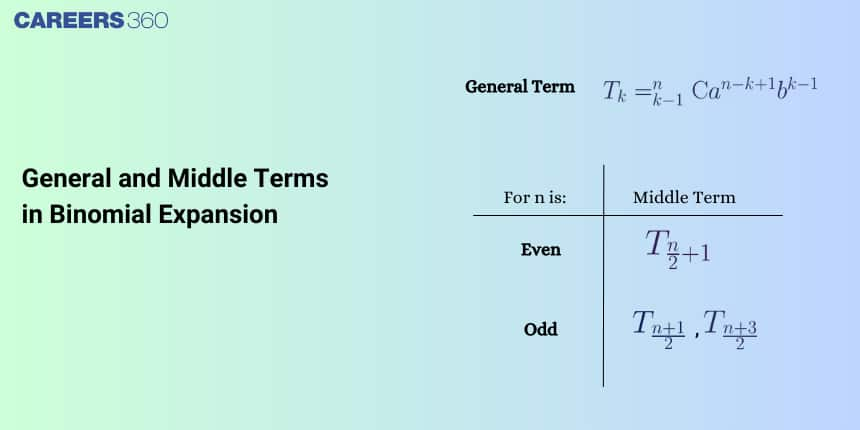
General and Middle Terms in Binomial Expansion

General and Middle Terms in Binomial Expansion

Komal MiglaniUpdated on 15 Dec 2025, 05:33 PM IST

Imagine you’re sharing a box of chocolates with friends. Each friend picks a different mix - some take more dark chocolates, some choose more milk chocolates—and suddenly you realise there’s a pattern in how many unique combinations can be made. This simple idea of mixing and matching is exactly how binomial expansion works. And when you want to locate a specific term—like the one right in the middle or any general term—you rely on clear formulas that make the process quick and predictable. In this article, you’ll learn the meaning of general and middle terms in binomial expansion, the formulas you need, step-by-step examples, and smart shortcuts that help you score higher in competitive exams where these questions frequently appear in mathematics section.

This Story also Contains

  1. General Term in Binomial Expansion
  2. Middle Term in Binomial Expansion
  3. Step-by-Step Method to Find General and Middle Terms in Binomial Expansion
  4. Solved Examples Based on General and Middle Terms in Binomial Expansion:
  5. List of Topics related to Binomial Theorem
  6. NCERT Resources
  7. Practice Questions based on the General Term and the Middle Term of Binomial Expansion
General and Middle Terms in Binomial Expansion

General Term in Binomial Expansion

A binomial expression is any algebraic expression containing exactly two terms. These expressions commonly appear in algebra, JEE-level questions, CUET exams, and competitive math problems.

Examples of binomial expressions include:
$ (a+b)^2,\ \left(\sqrt{x}+\dfrac{k}{x^2}\right)^5,\ (x+9y)^{-2/3} $

When expanding $(x+y)^n$, we often need only one specific term instead of the full expansion. The $(r+1)^{\text{th}}$ term is called the general term, given by:

$T_{r+1} = {}^nC_r \cdot x^{n-r} \cdot y^r$

This formula helps quickly extract any required term—very helpful in competitive exams.

Term Independent of $x$

A term is independent of $x$ when its power of $x$ becomes zero, i.e., $x^0$.

Example: Find the term independent of $x$ in $(x - \dfrac{1}{x})^{20}$.

$T_{r+1} = {}^{20}C_r \cdot x^{20-r} \cdot (-1)^r \cdot x^{-r}$

$T_{r+1} = {}^{20}C_r \cdot x^{20 - 2r} \cdot (-1)^r$

To make exponent of $x$ equal to zero:

$20 - 2r = 0 \Rightarrow r = 10$

So, the term independent of $x$ is the $11^{\text{th}}$ term.

$(p+1)$th Term From the End

The binomial expansion of $(x+y)^n$ is:

$ {}^nC_0 x^n + {}^nC_1 x^{n-1}y + {}^nC_2 x^{n-2}y^2 + \cdots + {}^nC_n y^n $

From the Beginning

$ \underbrace{{}^nC_0 x^n}{1^{st}} + \underbrace{{}^nC_1 x^{n-1}y}{2^{nd}} + \underbrace{{}^nC_2 x^{n-2}y^2}{3^{rd}} + \cdots + \underbrace{{}^nC_n y^n}{(n+1)^{th}} $

From the End

$ \underbrace{{}^nC_0 y^n}{1^{st}} + \underbrace{{}^nC_1 y^{n-1}x}{2^{nd}} + \underbrace{{}^nC_2 y^{n-2}x^2}{3^{rd}} + \cdots + \underbrace{{}^nC_n x^n}{(n+1)^{th}} $

Using the identity:

$ {}^nC_r = {}^nC_{n-r} $

So the $(p+1)^{\text{th}}$ term from the end of $(x+y)^n$ equals the $(p+1)^{\text{th}}$ term from the beginning of $(y+x)^n$:

$ T_{p+1} = {}^nC_p \cdot y^{,n-p} \cdot x^p $

Radical-Free or Rational Terms

In an expansion like $(x^{1/a} + y^{1/b})^N$, a term is rational only if the exponents of $x$ and $y$ are integers.

General term:

$T_{r+1} = {}^N C_r \cdot x^{\frac{N-r}{a}} \cdot y^{\frac{r}{b}}$

Example: Number of rational terms in $(\sqrt[4]{9} + \sqrt[6]{8})^{100}$

Rewrite in prime form:

$\sqrt[4]{9} = 3^{1/2}$
$\sqrt[6]{8} = 2^{1/2}$

General term:

$T_{r+1} = {}^{100}C_r \cdot 3^{50 - r/2} \cdot 2^{r/2}$

For the indices to be integers:

$\dfrac{r}{2} \in \mathbb{Z} \Rightarrow r$ must be even.

Possible values:
$r = 0, 2, 4, …, 100$

Number of values = $50 + 1 = 51$

So, 51 rational terms exist.

Middle Term in Binomial Expansion

The middle term(s) depend on whether $n$ is even or odd.

Case 1: $n$ Even

Total terms = $n+1$ → odd → one middle term

Position:

$\left(\dfrac{n}{2} + 1\right)^{th}$

Middle term:

$T_{\frac{n}{2}+1} = \binom{n}{\frac{n}{2}} x^{\frac{n}{2}} y^{\frac{n}{2}}$

Case 2: $n$ Odd

Total terms = $n+1$ → even → two middle terms

Positions:

$\left(\dfrac{n+1}{2}\right)^{th},\quad \left(\dfrac{n+3}{2}\right)^{th}$

Values:

$T_{\frac{n+1}{2}} = \binom{n}{\frac{n-1}{2}} x^{\frac{n+1}{2}} y^{\frac{n-1}{2}}$

$T_{\frac{n+3}{2}} = \binom{n}{\frac{n+1}{2}} x^{\frac{n-1}{2}} y^{\frac{n+1}{2}}$

Note on Largest Binomial Coefficient

  • If $n$ is even, the maximum value occurs at ${}^nC_{n/2}$

  • If $n$ is odd, the two equal maximum values occur at:
    $ {}^nC_{(n-1)/2} $ and $ {}^nC_{(n+1)/2} $

Step-by-Step Method to Find General and Middle Terms in Binomial Expansion

Understanding how to find the general term and middle term in a binomial expansion helps you solve lengthy expressions quickly without fully expanding them. This method is widely used in Class 11 and 12 Mathematics, CBSE exams, JEE Main, and other competitive tests.

Step 1: Write the Standard Binomial Form

Ensure the expression is written in the form
$(a+b)^n$

If needed, rearrange or factor the given expression so that it matches the standard binomial expansion format.

Step 2: Use the General Term Formula

The general term (or $(r+1)^{\text{th}}$ term) in the expansion of $(a+b)^n$ is given by
$\mathrm{T}{r+1} = {}^{n}C{r} , a^{,n-r} , b^{,r}$

This formula allows you to find any specific term directly, making it extremely useful in exam-oriented problems.

Step 3: Identify the Required Term

  • For the general term, substitute the given value of $r$.

  • For the middle term, determine the value of $r$ based on whether $n$ is even or odd.

Step 4: Find the Middle Term

  • If $n$ is even, there is one middle term:
    $r = \dfrac{n}{2}$
    Middle term $= \mathrm{T}_{\frac{n}{2}+1}$

  • If $n$ is odd, there are two middle terms:
    $r = \dfrac{n-1}{2}$ and $r = \dfrac{n+1}{2}$
    Middle terms $= \mathrm{T}{\frac{n+1}{2}}$ and $\mathrm{T}{\frac{n+3}{2}}$

JEE Main Highest Scoring Chapters & Topics
Focus on high-weightage topics with this eBook and prepare smarter. Gain accuracy, speed, and a better chance at scoring higher.
Download E-book

Step 5: Substitute and Simplify

Substitute the value of $r$ into the general term formula and simplify carefully using:

  • binomial coefficients

  • index laws

  • basic algebra

This step gives you the exact general or middle term without expanding the entire expression.

Solved Examples Based on General and Middle Terms in Binomial Expansion:

Example 1: The sum of the real values of $x$ for which the middle term in the binomial expansion of $\left(\frac{x^3}{3}+\frac{3}{x}\right)^8$ equals 5670 is :
1) 6
2) 4
3) 0
4) 8

Solution: Middle term in Binomial Expression if n is even
$\left(\frac{n}{2}+1\right)_{\text {th term is middle term }}$
And it equals ${ }^n C_{\frac{n}{2}} \cdot x^{\frac{n}{2}} \cdot y^{\frac{n}{2}}$

Now,

The middle term can be written as

$
\begin{aligned}
& T_5={ }^8 C_4\left(\frac{x^3}{3}\right)^4\left(\frac{3}{x}\right)^4=5670 \\
& \Rightarrow 70 x^8=5670 \\
& \Rightarrow x^8=81 \\
& \Rightarrow x= \pm \sqrt{3}
\end{aligned}
$

The sum of real values $=0$
Hence, the answer is the option 3.


Example 2: In the binomial expansion of $(a-b)^n, n \geq 5$, the sum of $5^{\text {th }}$ and $6^{\text {th }}$ terms is zero, then $a / b$ equals:
1) $\frac{n-5}{6}$
2) $\frac{n-4}{5}$
3) $\frac{5}{n-4}$
4) $\frac{6}{n-5}$

Solution

As we learned in

General Term in the expansion of $(x+a)^n$

$
T_{r+1}={ }^n C_r \cdot x^{n-r} \cdot a^r
$

Now,

$
\begin{aligned}
& \text { In }(\mathrm{a}-\mathrm{b})^{\mathrm{n}} \\
& T_5={ }^n C_4(a)^{n-4}(-b)^4 \text { and } T_6={ }^n C_5(a)^{n-5}(-b)^5 \\
& \mathrm{~T}_5+\mathrm{T}_6=0 \\
& { }^n C_4(a)^{n-4}(b)^4={ }^n C_5(a)^{n-5}(b)^5 \\
& \frac{a}{b}=\frac{{ }^n C_5}{{ }^n C_4}=\frac{\frac{n!}{5!(n-5)!}}{\frac{n!}{4!(n-4)!}}=\frac{n-4}{5}
\end{aligned}
$

Hence, the answer is an option (2).

Example 3: The coefficient of $x^7$ in the expansion of $\left(1-x-x^2+x^3\right)^6$ is
1) -144
2) 132
3) 144
4) -132

Solution

As we learnt in

General Term in the expansion of $(x+a)^n$

$
T_{r+1}={ }^n C_r \cdot x^{n-r} \cdot a^r
$

Now,
We have to simplify $\left(1-x-x^2+x^3\right)^6$
We get $\left[(1-x)-x^2(1-x)\right]^6$

$
\begin{aligned}
& =\left[(1-x)\left(1-x^2\right)\right]^6 \\
& =(1-x)^6\left(1-x^2\right)^6
\end{aligned}
$

For a coefficient of $\mathrm{x}^7$ in $(1-x)^6\left(1-x^2\right)^6$

$
\begin{aligned}
& =\left(1-{ }^6 C_1 x+{ }^6 C_2 x^2 \ldots \ldots \ldots \ldots \ldots\right)\left(1-{ }^6 C_1 x^2+{ }^6 C_2 x^4-{ }^6 C_3 x^6 \ldots \ldots \ldots \ldots\right) \\
& ={ }^6 C_1 \cdot{ }^6 C_3-{ }^6 C_3 \cdot{ }^6 C_2+{ }^6 C_5 \cdot{ }^6 C_1 \\
& =120-300+36=-144
\end{aligned}
$
Hence, the answer is the option 1.

Example 4: The term independent of $x$ in expansion of $\left(\frac{x+1}{x^{2 / 3}-x^{1 / 3}+1}-\frac{x-1}{x-x^{1 / 2}}\right)^{10}$ is :
1) 310
2) 4
3) 120
4) 210

Solution

Now,

$
\begin{aligned}
& S=\left(\frac{\left(x^{1 / 3}+1\right)\left(x^{2 / 3}-x^{1 / 3}+1\right)}{\left(x^{2 / 3}-x^{1 / 3}+1\right)}-\frac{\left(x^{1 / 2}-1\right)\left(x^{1 / 2}+1\right)}{x^{1 / 2}\left(x^{1 / 2}-1\right)}\right)^{10} \\
& =\left(\left(x^{1 / 3}+1\right)-\left(1+x^{-1 / 2}\right)\right)^{10} \\
& =\left(x^{1 / 3}-x^{-1 / 2}\right)^{10} \\
& T_{r+1}={ }^{10} C_r\left(x^{1 / 3}\right)^{10-r}\left(-x^{-1 / 2}\right)^r \\
& =(-1)^r \cdot{ }^{10} C_r \cdot x^{\frac{10-r}{3}-\frac{r}{2}}
\end{aligned}
$

For term independent of $x$,

$
\Rightarrow \quad \frac{10-r}{3}-\frac{r}{2}=0 \Rightarrow 5 r=20
$

So, $T_{r+1}={ }^{10} C_4=210$
Hence, the answer is the option (4).

$x^7$ in $\left[a x^2+\left(\frac{1}{b x}\right)\right]^{11}$ equals the coefficient of $x^{-7}$ in $\left[a x-\left(\frac{1}{b x^2}\right)\right]^{11}$, if $a=1 / 2$, then $b=$
1)$1 / 2$
2)1
3) (correct)
2
4)None of these

$
\begin{aligned}
& T_{r+1} \text { of }\left(a x^2+\frac{1}{b x}\right)^{11}={ }^{11} C_r\left(a x^2\right)^{11-r}\left(\frac{1}{b x}\right)^r \\
& T_{r+1} \text { of }\left(a x-\frac{1}{b x^2}\right)^{11}={ }^{11} C_r(a x)^{11-r}\left(-\frac{1}{b x^2}\right)^r
\end{aligned}
$

$\therefore$ Coefficient of $x^7$ in $\left(a x^2+\frac{1}{b x}\right)^{11}={ }^{11} C_5 \frac{a^6}{b^5}$ and coefficient of $x^{-7}$ in $\left(a x-\frac{1}{b x^2}\right)^{11}={ }^{11} C_6 \frac{a^5}{b^6}$ Now ${ }^{11} C_5 \frac{a^6}{b^5}={ }^{11} C_6 \frac{a^5}{b^6} \quad \therefore a b=1$.

Hence, the answer is the option(3).

Last Digits and Remainder using the Binomial Expansion

Greatest Binomial Coefficient

NCERT Resources

In this part, you’ll find essential NCERT resources that strengthen your basics, including chapter notes, exemplar solutions and solutions that support a strong foundation for the Binomial Theorem and its applications.

NCERT Maths Class 11 Notes for Chapter 8 - Binomial Theorem and its applications

NCERT Maths Class 11 Solutions for Chapter 8 - Binomial Theorem and its applications

NCERT Maths Class 11 Exemplar Solutions for Chapter 8 - Binomial Theorem and its applications

Practice Questions based on the General Term and the Middle Term of Binomial Expansion

Here, you’ll get exam-focused practice questions that test your understanding of general term, middle term, term-independent-of-x, and related concepts—ideal for JEE, CUET, and school board exam revision.

General And Middle Terms- Practice Question MCQ

We have shared below the links to practice questions for the topics related to binomial theorem:

Frequently Asked Questions (FAQs)

Q: Which binomial coefficient is the largest in an expansion?
A:

If $n$ is even, the largest is ${}^nC_{n/2}$.

If $n$ is odd, the two largest (equal) coefficients are

${}^nC_{(n-1)/2}$ and ${}^nC_{(n+1)/2}$.

Q: How many terms are there in the expansion of $(x + y)^n$?
A:

There are always $n + 1$ terms, regardless of the values of $x$ and $y$.

Q: What is the $(p+1)^{th}$ term from the end of $(x + y)^n$?
A:

It is equal to the $(p+1)^{th}$ term from the beginning of $(y + x)^n$:

$T_{p+1} = {}^nC_p \cdot y^{n-p} \cdot x^p$.

Q: How do you find the middle term in $(x + y)^n$?
A:

If $n$ is even, there is one middle term:

Position = $\left(\dfrac{n}{2} + 1\right)^{th}$.

If $n$ is odd, there are two middle terms:

Positions = $\left(\dfrac{n+1}{2}\right)^{th}$ and $\left(\dfrac{n+3}{2}\right)^{th}$.

Q: What is the general term in the binomial expansion of $(x + y)^n$?
A:

The general term is the $(r+1)^{th}$ term of the expansion, given by

$T_{r+1} = {}^nC_r \cdot x^{n-r} \cdot y^r$.

It allows you to directly find any specific term without expanding everything.