
$\tan \theta = \dfrac{3}{a/2}$
$\Rightarrow \dfrac{1}{\sqrt{3}} = \dfrac{6}{a}$
$\Rightarrow a = 6\sqrt{3}$
$\text{Area of triangle} = \dfrac{\sqrt{3}}{4} a^2$
$= \dfrac{\sqrt{3}}{4} \times 108$
$= 27\sqrt{3}$
Hence, the answer is Option 4.


Think about solving a puzzle where different pieces look unrelated at first, but once you spot the pattern, everything suddenly fits together. That’s exactly how trigonometric identities work in mathematics. They show us that many trigonometric expressions, though they may look different, are actually just different forms of the same relationship. In trigonometry, trigonometric identities are equations involving trigonometric ratios that are true for all values of the angle (where they are defined). They are essential tools for simplifying expressions, proving results, solving equations, and tackling higher-level problems in mathematics, physics, and engineering. In this article, we’ll clearly explore the meaning of trigonometric identities, their types, key formulas, and worked examples, so you can recognize and apply them confidently in exams and problem-solving.
This Story also Contains
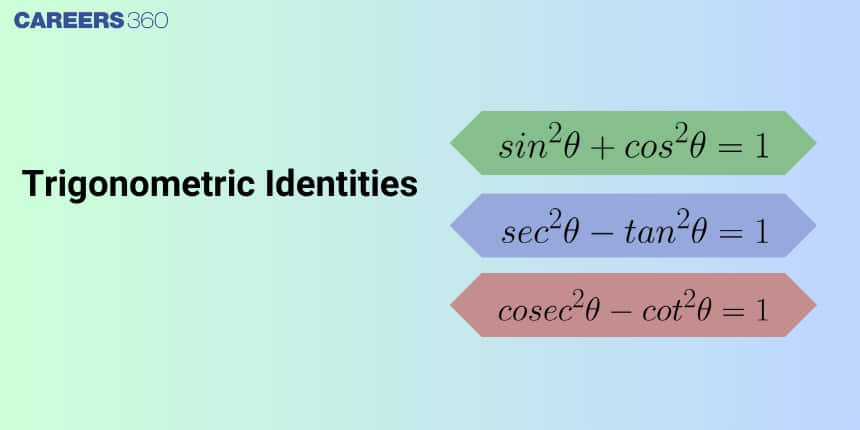
Trigonometric Identities are the relationship which involve different trigonometric ratios which hold true for all the value of angles within the equation. These identities represent the relationship between the angles of a right angle triangle, and its sides. Here the ratios are defined on the basis of sides of a right angled triangle, such as the adjacent side, opposite side and the longest side(being hypotenuse). There are six trigonometric ratios namely as the sine, cosine, tangent, cotangent, secant and cosecant.
In trigonometry, trigonometric identities are equations involving trigonometric ratios that are true for all values of an angle (where the expressions are defined). These identities are extremely useful for simplifying expressions, solving trigonometric equations, proving results, and applying concepts in geometry, calculus, physics, and engineering.
Trigonometric identities are usually grouped based on their origin and application, as explained below.
Pythagorean identities are derived from the Pythagoras theorem applied to a right-angled triangle. They show fundamental relationships between sine, cosine, tangent, and their reciprocal ratios.
The most important Pythagorean identity states that the sum of the squares of sine and cosine of an angle is always equal to one:
$\sin^2 t + \cos^2 t = 1$
Using this identity, we also obtain relationships involving tangent, secant, cotangent, and cosecant:
$1 + \tan^2 t = \sec^2 t$
$1 + \cot^2 t = \csc^2 t$
These identities are frequently used to simplify trigonometric expressions and prove other identities.
Reciprocal identities define the relationship between a trigonometric ratio and its reciprocal. They allow us to express sine, cosine, and tangent in terms of cosecant, secant, and cotangent.
The reciprocal identities are:
$\csc t = \dfrac{1}{\sin t}$
$\sec t = \dfrac{1}{\cos t}$
$\cot t = \dfrac{1}{\tan t}$
These identities are especially helpful when converting one trigonometric ratio into another during problem solving.
Addition identities are used to find the trigonometric values of the sum of two angles. These formulas are useful in simplifying expressions and solving equations involving multiple angles.
If $A$ and $B$ are two angles, then:
$\sin(A + B) = \sin A \cos B + \cos A \sin B$
$\cos(A + B) = \cos A \cos B - \sin A \sin B$
$\tan(A + B) = \dfrac{\tan A + \tan B}{1 - \tan A \tan B}$
Difference identities help evaluate trigonometric expressions involving the difference of two angles.
If $A$ and $B$ are two angles, then:
$\sin(A - B) = \sin A \cos B - \cos A \sin B$
$\cos(A - B) = \cos A \cos B + \sin A \sin B$
$\tan(A - B) = \dfrac{\tan A - \tan B}{1 + \tan A \tan B}$
These identities are widely used in problem-solving and identity verification.
Double-angle identities express trigonometric ratios of $2A$ in terms of a single angle $A$. They are derived using addition identities by substituting $A = B$.
The commonly used double-angle identities are:
$\sin(2A) = 2 \sin A \cos A$
$\cos(2A) = \cos^2 A - \sin^2 A$
$\cos(2A) = 2 \cos^2 A - 1$
$\cos(2A) = 1 - 2 \sin^2 A$
$\tan(2A) = \dfrac{2 \tan A}{1 - \tan^2 A}$
These identities are useful for simplifying expressions and solving trigonometric equations.
Two angles are called allied angles if their sum or difference is a multiple of $90^\circ$ or $\dfrac{\pi}{2}$. These identities help evaluate trigonometric ratios of non-standard angles.
$\sin(90^\circ - \theta) = \cos \theta$
$\cos(90^\circ - \theta) = \sin \theta$
$\tan(90^\circ - \theta) = \cot \theta$
$\sin(180^\circ - \theta) = \sin \theta$
$\cos(180^\circ - \theta) = -\cos \theta$
$\tan(180^\circ - \theta) = -\tan \theta$
$\sin(180^\circ + \theta) = -\sin \theta$
$\cos(180^\circ + \theta) = -\cos \theta$
$\tan(180^\circ + \theta) = \tan \theta$
Triple-angle identities express trigonometric functions of $3A$ in terms of $A$. These are useful in advanced trigonometric simplifications.
$\sin(3A) = 3 \sin A - 4 \sin^3 A$
$\cos(3A) = 4 \cos^3 A - 3 \cos A$
$\tan(3A) = \dfrac{3 \tan A - \tan^3 A}{1 - 3 \tan^2 A}$
Opposite angle identities describe how trigonometric ratios behave when the angle is negative.
$\sin(-A) = -\sin A$
$\cos(-A) = \cos A$
$\tan(-A) = -\tan A$
These identities are important in coordinate geometry and graph-based problems.
Ratio identities express one trigonometric ratio in terms of others and are often used for simplification.
$\tan \theta = \dfrac{\sin \theta}{\cos \theta}$
$\cot \theta = \dfrac{\cos \theta}{\sin \theta}$
Unlike earlier identities, triangle identities apply to all triangles, not just right-angled ones.
The ratio of the sine of an angle to its opposite side is the same for all three angles of a triangle:
$\dfrac{\sin A}{a} = \dfrac{\sin B}{b} = \dfrac{\sin C}{c}$
The cosine rule relates the sides and angles of a triangle and is a generalization of the Pythagoras theorem:
$\cos A = \dfrac{b^2 + c^2 - a^2}{2bc}$
The tangent rule relates the difference and sum of two sides to the difference of the opposite angles:
$\tan\left(\dfrac{A - B}{2}\right) = \dfrac{a - b}{a + b} \cot\left(\dfrac{C}{2}\right)$
Trigonometric identities are used in many areas of mathematics and science. Some key applications include:
Simplifying complex trigonometric expressions
Solving trigonometric equations efficiently
Proving trigonometric identities in exams
Finding exact values of trigonometric ratios
Solving problems on heights and distances
Applying concepts in geometry and calculus
Using trigonometry in physics and engineering problems
Example 1: For a triangle $A B C$, the value of $\cos 2 A+\cos 2 B+\cos 2 C$ is least. If its inradius is 3 and incentre is $M$, then which of the following is NOT correct? [JEE MAINS 2023]
1) The perimeter of $\triangle A B C$ is $18 \sqrt{3}$
2) $\sin 2 A+\sin 2 B+\sin 2 C=\sin A+\sin B+\sin C$
3) $\overrightarrow{M A} \cdot \overrightarrow{M B}=-18$
4) The area of $\triangle A B C$ is $\frac{27 \sqrt{3}}{2}$
Solution:
Let P
$=\cos 2 \mathrm{~A}+\cos 2 \mathrm{~B}+\cos 2 \mathrm{C}$
$=2 \cos (\mathrm{A}+\mathrm{B}) \cos (\mathrm{A}-\mathrm{B})+2 \cos ^2 \mathrm{C}-1$
$=2 \cos (\pi-\mathrm{C}) \cos (\mathrm{A}-\mathrm{B})+2 \cos ^2 \mathrm{C}-1$
$=-2 \cos \mathrm{C}[\cos (\mathrm{A}-\mathrm{B})+\cos (\mathrm{A}+\mathrm{B})]-1$
$=-1-4 \cos \mathrm{A} \cos \mathrm{B} \cos \mathrm{C}$
for $P$ to be the minimum
$\cos \mathrm{A} \cos \mathrm{B} \cos \mathrm{C}$ must be maximum
$\Rightarrow \triangle \mathrm{ABC}$ is an equilateral triangle
Let the side length of the triangle be a
$\tan \theta = \dfrac{3}{a/2}$
$\Rightarrow \dfrac{1}{\sqrt{3}} = \dfrac{6}{a}$
$\Rightarrow a = 6\sqrt{3}$
$\text{Area of triangle} = \dfrac{\sqrt{3}}{4} a^2$
$= \dfrac{\sqrt{3}}{4} \times 108$
$= 27\sqrt{3}$
Hence, the answer is Option 4.
Example 2: Let $f_k(x)=\frac{1}{k}\left(\sin ^k+\cos ^k x\right)$ for $\mathrm{k}=1,2,3, \ldots .$. Then for all real values of x , the value of $f_4(x)-f_6(x)$ is equal to:
1) $\frac{1}{4}$
2) $\frac{-1}{12}$
3) $\frac{5}{12}$
4) $\frac{1}{12}$
Solution:
$f_4(x) = \dfrac{1}{4}\left(\sin^4 x + \cos^4 x\right)$
$= \dfrac{1}{4}\left[\left(\sin^2 x + \cos^2 x\right)^2 - 2\sin^2 x \cos^2 x\right]$
$= \dfrac{1}{4}\left[1 - 2\sin^2 x \cos^2 x\right]$
$= \dfrac{1}{4} - \dfrac{1}{2}\sin^2 x \cos^2 x$
$f_6(x) = \dfrac{1}{6}\left(\sin^6 x + \cos^6 x\right)$
$= \dfrac{1}{6}\left[\left(\sin^2 x + \cos^2 x\right)^3 - 3\sin^4 x \cos^2 x - 3\sin^2 x \cos^4 x\right]$
$= \dfrac{1}{6}\left[1 - 3\sin^2 x \cos^2 x\left(\sin^2 x + \cos^2 x\right)\right]$
$= \dfrac{1}{6} - \dfrac{1}{2}\sin^2 x \cos^2 x$
$f_4(x) - f_6(x) = \dfrac{1}{4} - \dfrac{1}{6}$
$= \dfrac{1}{12}$
Hence, the answer is Option 4.
Example 3: If $15 \sin ^4 \alpha+10 \cos ^4 \alpha=6$ for some $\alpha \epsilon R$, then the value of $27 \sec ^6 \alpha+8 \operatorname{cosec}^6 \alpha$ is equal to: [JEE MAINS 2021]
1) 350
2) 250
3) 400
4) 500
Solution
$15\sin^4 \alpha + 10\cos^4 \alpha = 6$
$15\sin^4 \alpha + 10\cos^4 \alpha = 6\left(\sin^2 \alpha + \cos^2 \alpha\right)^2$
$\left(3\sin^2 \alpha - 2\cos^2 \alpha\right)^2 = 0$
$\tan^2 \alpha = \dfrac{2}{3}$
$\Rightarrow \cot^2 \alpha = \dfrac{3}{2}$
$27\sec^6 \alpha + 8\csc^6 \alpha$
$= 27\left(1 + \tan^2 \alpha\right)^3 + 8\left(1 + \cot^2 \alpha\right)^3$
$= 27\left(1 + \dfrac{2}{3}\right)^3 + 8\left(1 + \dfrac{3}{2}\right)^3$
$= 27\left(\dfrac{5}{3}\right)^3 + 8\left(\dfrac{5}{2}\right)^3$
$= 125 + 125$
$= 250$
Hence, the answer is Option 3.
Example 4: Let $S=\left\{\theta \epsilon[-2 \pi, 2 \pi]: 2 \cos ^2 \theta+3 \sin \theta=0\right\}$. Then the sum of the elements of $S$ is: [JEE MAINS 2019]
1) $\frac{13 \pi}{6}$
2) $\frac{5 \pi}{3}$
3) $2 \pi$
4) $\pi$
Solution:
Given equation
$2\cos^2 \theta + 3\sin \theta = 0$
$2(1 - \sin^2 \theta) + 3\sin \theta = 0$
$2 - 2\sin^2 \theta + 3\sin \theta = 0$
Or, $2\sin^2 \theta - 3\sin \theta - 2 = 0$
$\sin \theta = -\dfrac{1}{2} \quad \text{or} \quad \sin \theta = 2$
$\sin \theta \neq 2$
Since the solution lies in $[-2\pi, 2\pi]$,
$\theta = -\pi + \dfrac{\pi}{6}, -\dfrac{\pi}{6}, \pi + \dfrac{\pi}{6}, 2\pi - \dfrac{\pi}{6}$
$\text{Sum} = 2\pi$
Hence, the answer is option 3.
Example 5: If $\frac{\sqrt{2} \sin \alpha}{\sqrt{1+\cos 2 \alpha}}=\frac{1}{7}$ and $\sqrt{\frac{1-\cos 2 \beta}{2}}=\frac{1}{\sqrt{10}}, \alpha, \beta \space\epsilon\left(0, \frac{\pi}{2}\right)$, then $\tan (\alpha+2 \beta)$ is equal to
1) 0
2) 1
3) 0.5
4) 2
Solution:
$\dfrac{\sqrt{2}\sin \alpha}{\sqrt{2}\cos \alpha} = \dfrac{1}{7}$
$\tan \alpha = \dfrac{1}{7}$
$\sin \beta = \dfrac{1}{\sqrt{10}}$
$\tan \beta = \dfrac{1}{\sqrt{3}}$
$\tan 2\beta = \dfrac{2\tan \beta}{1 - \tan^2 \beta}$
$= \dfrac{2 \cdot \dfrac{1}{\sqrt{3}}}{1 - \dfrac{1}{3}}$
$= \dfrac{\dfrac{2}{\sqrt{3}}}{\dfrac{2}{3}}$
$= \dfrac{3}{\sqrt{3}}$
$= \sqrt{3}$
$\tan(\alpha + 2\beta) = \dfrac{\tan \alpha + \tan 2\beta}{1 - \tan \alpha \tan 2\beta}$
$= \dfrac{\dfrac{1}{7} + \sqrt{3}}{1 - \dfrac{\sqrt{3}}{7}}$
$= 1$
Hence, the answer is option 2.
This section provides a structured list of topics related to trigonometric ratios, covering both fundamental and advanced concepts required for school-level mathematics and competitive exams. It highlights connected areas such as angle measurement, allied and compound angles, function signs, identities, graphs, and special formulas, helping learners plan a complete and systematic study.
This section brings together important NCERT resources for Class 11 Chapter 3 - Trigonometric Functions, curated to build a strong conceptual foundation. It includes concise notes, step-by-step NCERT solutions, and exemplar problems, helping students understand trigonometric ratios and functions effectively and prepare confidently for exams.
NCERT Class 11 Chapter 3 Trigonometric Functions Notes
This section offers targeted practice questions on trigonometric identities, ranging from basic concepts to advanced applications. It covers key areas like signs of trigonometric functions, graphs, allied and compound angles, sum–product formulas, and multiple-angle identities, helping students strengthen problem-solving skills for school and competitive exams.
Trigonometric Identities - Practice Question
Below is the list of the next topics which you can practice:
Frequently Asked Questions (FAQs)
Trigonometric identities are equations involving trigonometric functions that remain true for all values of the variables in the equation.
The three primary trigonometric identities are sinA,cosA, and TanA.
Trigonometric ratios which are reciprocal to other trigonometric ratios are called reciprocal identities.
The double-angle trigonometric identities are used to transform the trigonometric ratios of double angles into the trigonometric ratios of single angles.
Allied angle identities relate trigonometric ratios of angles whose sum or difference is a multiple of $90^\circ$ or $\dfrac{\pi}{2}$. They help evaluate ratios of non-standard angles.