KCC Institute of Legal and Higher Education, Greater Noida
Law Admissions 2026 Open | Avail Merit-Based Scholarships


Think about turning a ladder a little more or combining two turns while rotating an object — the final position depends on the sum or difference of angles involved. In trigonometry, when angles combine like this, we use trigonometric ratios of compound angles to find accurate values. The trigonometric ratios of compound angles deal with expressions such as $\sin(A \pm B)$, $\cos(A \pm B)$, and $\tan(A \pm B)$. What happens when two angles are added or subtracted inside a trigonometric function? Can $\sin(A+B)$ simply be written as $\sin A+\sin B$? Questions like these lead to the important concept of trigonometric ratios of compound angles. These formulas help us evaluate the sine, cosine, and tangent of sums and differences of angles and form the foundation for advanced trigonometry identities. From solving complex trigonometric equations to applications in physics, engineering, and calculus, compound angle formulas are indispensable resources in mathematics. In this article, we will explore the formulas, derivations, identities, properties, solved examples, and practical applications of trigonometric ratios of compound angles.
This Story also Contains
In trigonometry, a compound angle is formed when two or more angles are added or subtracted. If $A$, $B$, and $C$ are angles, then expressions such as $A + B$, $A - B$, $A + B + C$, and $A + B - C$ are all called compound angles.
The study of compound angles is important because many trigonometric values cannot be evaluated directly using standard angles. This leads to the use of trigonometric ratios of compound angles, which are widely used in simplification, proofs, and problem-solving.
Before learning compound angle formulas, it is important to understand what compound angles actually are. Compound angles are formed when two angles are added or subtracted, resulting in expressions such as $(A+B)$ or $(A-B)$. These expressions are widely used in trigonometry to derive identities, simplify calculations, and solve advanced mathematical problems. A clear understanding of angle sums, angle differences, and basic trigonometric ratios makes it easier to apply compound angle formulas correctly.
An angle sum is formed when two angles are added together to create a new angle. In trigonometry, angle sums are commonly represented as $(A+B)$ and are used in formulas involving sine, cosine, and tangent functions.
For example:
Law Admissions 2026 Open | Avail Merit-Based Scholarships
BBA/MBA/PGDM Early Bird Applications Deadline 06th Nov'26. Apply now using coupon code CAREER250 and get ₹250 off the application fee
When dealing with trigonometric functions, the value of $\sin(A+B)$ is not simply equal to $\sin A+\sin B$. Instead, special compound angle formulas are required to evaluate such expressions accurately.
Angle sums are widely used in:
An angle difference is obtained when one angle is subtracted from another angle. It is represented by expressions such as $(A-B)$.
Examples include:
Just like angle sums, trigonometric functions involving angle differences require special formulas.
For example:
These formulas help evaluate trigonometric ratios of angles that may not appear directly in standard trigonometric tables.
Angle difference formulas are particularly useful when:
A compound angle expression contains two angles connected by either addition or subtraction.
General forms include:
Some common trigonometric compound angle expressions are:
These expressions cannot be evaluated by simply applying arithmetic operations to individual trigonometric values. Instead, they follow specific identities known as compound angle formulas.
For example:
$\sin(30^\circ+60^\circ)$ cannot be calculated as: $\sin30^\circ+\sin60^\circ$
Instead, the compound angle formula must be used.
Understanding these expressions is essential because they serve as the foundation for:
Before studying compound angles, students should be familiar with the six basic trigonometric ratios.
For a right-angled triangle:
| Trigonometric Ratio | Formula |
|---|---|
| Sine | $\sin\theta=\frac{\text{Perpendicular}}{\text{Hypotenuse}}$ |
| Cosine | $\cos\theta=\frac{\text{Base}}{\text{Hypotenuse}}$ |
| Tangent | $\tan\theta=\frac{\text{Perpendicular}}{\text{Base}}$ |
| Cosecant | $\csc\theta=\frac{\text{Hypotenuse}}{\text{Perpendicular}}$ |
| Secant | $\sec\theta=\frac{\text{Hypotenuse}}{\text{Base}}$ |
| Cotangent | $\cot\theta=\frac{\text{Base}}{\text{Perpendicular}}$ |
Important relationships include:
These fundamental identities are frequently used while deriving and applying compound angle formulas.
Compound angle formulas possess several important mathematical properties that make them useful for simplifying expressions and solving trigonometric problems. Understanding these properties helps students recognize patterns and apply formulas more effectively in examinations and advanced mathematics.
Many compound angle formulas exhibit symmetry, meaning their structure follows predictable mathematical patterns.
For sine:
Since addition is commutative, $\sin(A+B)=\sin(B+A)$
For cosine:
Therefore, $\cos(A+B)=\cos(B+A)$
These symmetry properties make many trigonometric manipulations easier.
Important observations:
Trigonometric functions repeat their values after specific intervals. This repeating behavior is known as periodicity.
The periods of common trigonometric functions are:
| Function | Period |
|---|---|
| $\sin\theta$ | $2\pi$ |
| $\cos\theta$ | $2\pi$ |
| $\tan\theta$ | $\pi$ |
| $\cot\theta$ | $\pi$ |
Examples:
Because of periodicity, compound angle formulas remain valid even when large multiples of $\pi$ or $360^\circ$ are added to the angles.
Applications include:
The sign of a trigonometric function depends on the quadrant in which the angle lies.
The standard quadrant rule is often remembered using:
ASTC (All Students Take Calculus)
| Quadrant | Positive Functions |
|---|---|
| I | All |
| II | Sine, Cosecant |
| III | Tangent, Cotangent |
| IV | Cosine, Secant |
Examples:
Sign conventions become extremely important when applying compound angle formulas because an incorrect sign often leads to an incorrect final answer.
Students should always:
Compound angle formulas reveal strong relationships between various trigonometric functions.
Some important relationships are:
$\tan\theta=\frac{\sin\theta}{\cos\theta}$
$\cot\theta=\frac{\cos\theta}{\sin\theta}$
$\sec\theta=\frac{1}{\cos\theta}$
$\csc\theta=\frac{1}{\sin\theta}$
Using the sine and cosine compound angle formulas, the tangent compound angle formula can be derived.
For example:
$\tan(A+B)=\frac{\sin(A+B)}{\cos(A+B)}$
Substituting the compound angle identities for sine and cosine leads directly to the tangent addition formula.
This interconnected nature of trigonometric functions allows mathematicians to:
Understanding these relationships is essential for mastering trigonometric ratios of compound angles and forms the basis for higher-level trigonometry, calculus, and mathematical analysis.
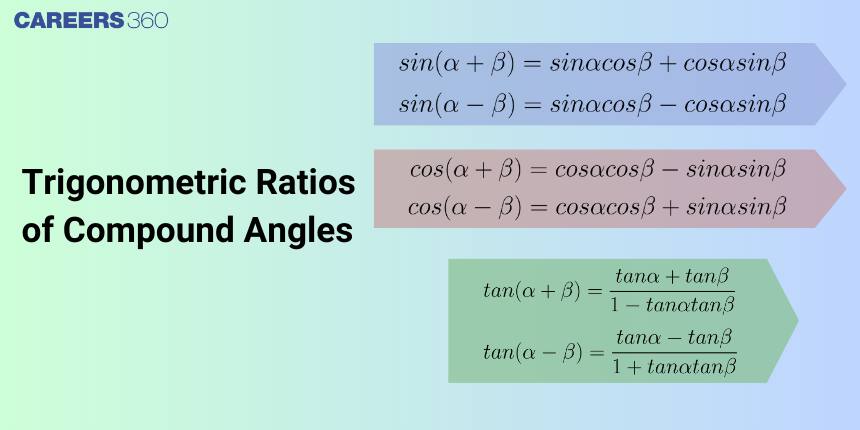
The trigonometric ratios of compound angles express the sine, cosine, and tangent of the sum or difference of two angles in terms of the trigonometric ratios of the individual angles. These identities are also known as sum and difference formulas.
$\sin(\alpha + \beta) = \sin \alpha \cos \beta + \cos \alpha \sin \beta$
$\sin(\alpha - \beta) = \sin \alpha \cos \beta - \cos \alpha \sin \beta$
$\cos(\alpha + \beta) = \cos \alpha \cos \beta - \sin \alpha \sin \beta$
$\cos(\alpha - \beta) = \cos \alpha \cos \beta + \sin \alpha \sin \beta$
These formulas are frequently used to find exact values of trigonometric expressions and to prove identities.
Tangent of Sum and Difference of Angles
$\tan(\alpha + \beta) = \dfrac{\tan \alpha + \tan \beta}{1 - \tan \alpha \tan \beta}$
$\tan(\alpha - \beta) = \dfrac{\tan \alpha - \tan \beta}{1 + \tan \alpha \tan \beta}$
These identities are especially useful in algebraic simplifications and equation solving.
Cotangent of Sum and Difference of Angles
$\cot(\alpha + \beta) = \dfrac{\cot \alpha \cot \beta - 1}{\cot \alpha + \cot \beta}$
$\cot(\alpha - \beta) = \dfrac{\cot \alpha \cot \beta + 1}{\cot \beta - \cot \alpha}$
Cotangent formulas are often applied in advanced trigonometric proofs and transformations.
The derivations of compound angle formulas help us understand why formulas like $\sin(\alpha \pm \beta)$ and $\cos(\alpha \pm \beta)$ work, rather than just memorising them. These derivations are commonly based on unit circle geometry, coordinate geometry, and triangle properties, making them important for conceptual clarity in trigonometry.
To derive the cosine of the difference of two angles, we use the unit circle and coordinate geometry approach, which is both intuitive and mathematically sound.
Consider a unit circle centered at the origin $O$.
Let point $P$ lie on the unit circle at an angle $\alpha$ from the positive $x$-axis.
Its coordinates are $(\cos \alpha, \sin \alpha)$.
Let point $Q$ lie on the unit circle at an angle $\beta$ from the positive $x$-axis.
Its coordinates are $(\cos \beta, \sin \beta)$.
The angle between the rays $OP$ and $OQ$ is therefore $\alpha - \beta$.
Now consider two additional points:
Point $A$ lies on the unit circle at an angle $(\alpha - \beta)$ from the positive $x$-axis, with coordinates
$(\cos(\alpha - \beta), \sin(\alpha - \beta))$.
Point $B$ lies on the positive $x$-axis at coordinates $(1, 0)$.
Triangle $POQ$ can be viewed as a rotation of triangle $AOB$, since both triangles subtend the same angle at the center.
Because rotation does not change distances:
The distance between points $P$ and $Q$
is equal to the distance between points $A$ and $B$
Using the distance formula, we can equate these two distances.
Distance between $P(\cos \alpha, \sin \alpha)$ and $Q(\cos \beta, \sin \beta)$:
$(PQ)^2 = (\cos \alpha - \cos \beta)^2 + (\sin \alpha - \sin \beta)^2$
Distance between $A(\cos(\alpha - \beta), \sin(\alpha - \beta))$ and $B(1, 0)$:
$(AB)^2 = (\cos(\alpha - \beta) - 1)^2 + \sin^2(\alpha - \beta)$
Since $PQ = AB$, equating these expressions and simplifying leads to the identity:
$\cos(\alpha - \beta) = \cos \alpha \cos \beta + \sin \alpha \sin \beta$
Final Result
The cosine of the difference of two angles is given by:
$\cos(\alpha - \beta) = \cos \alpha \cos \beta + \sin \alpha \sin \beta$

Using the identity $\cos(\alpha + \beta) = \cos(\alpha - (-\beta))$,
$\cos(\alpha + \beta) = \cos \alpha \cos(-\beta) + \sin \alpha \sin(-\beta)$
Using even–odd properties,
$\cos(-\beta) = \cos \beta$
$\sin(-\beta) = -\sin \beta$
So, $\cos(\alpha + \beta) = \cos \alpha \cos \beta - \sin \alpha \sin \beta$
$\sin(\alpha - \beta) = \cos\left(90^\circ - (\alpha - \beta)\right)$
$= \cos\left((90^\circ - \alpha) + \beta\right)$
$= \cos(90^\circ - \alpha)\cos \beta - \sin(90^\circ - \alpha)\sin \beta$
$= \sin \alpha \cos \beta - \cos \alpha \sin \beta$
$\sin(\alpha + \beta) = \sin(\alpha - (-\beta))$
$= \sin \alpha \cos(-\beta) - \cos \alpha \sin(-\beta)$
$= \sin \alpha \cos \beta + \cos \alpha \sin \beta$
$\tan(\alpha + \beta) = \dfrac{\sin(\alpha + \beta)}{\cos(\alpha + \beta)}$
$= \dfrac{\sin \alpha \cos \beta + \cos \alpha \sin \beta}{\cos \alpha \cos \beta - \sin \alpha \sin \beta}$
Dividing numerator and denominator by $\cos \alpha \cos \beta$,
$\tan(\alpha + \beta) = \dfrac{\tan \alpha + \tan \beta}{1 - \tan \alpha \tan \beta}$
$\tan(\alpha - \beta) = \dfrac{\tan \alpha - \tan \beta}{1 + \tan \alpha \tan \beta}$
$\cot(\alpha + \beta) = \dfrac{\cos(\alpha + \beta)}{\sin(\alpha + \beta)}$
$= \dfrac{\cos \alpha \cos \beta - \sin \alpha \sin \beta}{\sin \alpha \cos \beta + \cos \alpha \sin \beta}$
Dividing numerator and denominator by $\sin \alpha \sin \beta$,
$\cot(\alpha + \beta) = \dfrac{\cot \alpha \cot \beta - 1}{\cot \alpha + \cot \beta}$
$\cot(\alpha - \beta) = \dfrac{\cot \alpha \cot \beta + 1}{\cot \beta - \cot \alpha}$
$\sin(A+B)\sin(A-B) = \sin^2 A - \sin^2 B = \cos^2 B - \cos^2 A$
$\cos(A+B)\cos(A-B) = \cos^2 A - \sin^2 B = \cos^2 B - \sin^2 A$
$\tan(A+B+C) = \dfrac{\tan A + \tan B + \tan C - \tan A \tan B \tan C}{1 - \tan A \tan B - \tan B \tan C - \tan C \tan A}$
In trigonometry, product-to-sum formulas help convert the product of sine and cosine functions into a sum or difference of trigonometric ratios. These identities are extremely useful for simplifying expressions, proving identities, and solving trigonometric equations, especially in board and competitive exams.
The standard transformation of products into sums or differences is given below:
$2\sin A \cos B = \sin(A+B) + \sin(A-B)$
$2\cos A \cos B = \cos(A+B) + \cos(A-B)$
$2\cos A \sin B = \sin(A+B) - \sin(A-B)$
$2\sin A \sin B = \cos(A-B) - \cos(A+B)$
These formulas allow us to rewrite products of trigonometric functions in a simpler and more workable form.
Multiple-angle identities express trigonometric ratios of angles like $2A$ or $3A$ in terms of the ratio of angle $A$. These identities play a key role in simplification, evaluation, and solving higher-level trigonometric problems.
The double angle identities are derived from compound angle formulas:
$\sin 2A = 2\sin A \cos A$
$\sin 2A = \frac{2\tan A}{1+\tan^2 A}$
$\cos 2A = \cos^2 A - \sin^2 A$
$\cos 2A = 2\cos^2 A - 1$
$\cos 2A = 1 - 2\sin^2 A$
$\cos 2A = \frac{1-\tan^2 A}{1+\tan^2 A}$
$\tan 2A = \frac{2\tan A}{1-\tan^2 A}$
A strong understanding of compound angle formulas is essential for mastering trigonometric identities, equations, inverse trigonometry, and calculus. The following books provide detailed theory, derivations, and practice questions.
| Book Name | Best For | Why It Helps |
|---|---|---|
| NCERT Mathematics Class 11 | School Students | Covers trigonometric identities and formulas |
| Plane Trigonometry – S.L. Loney | Advanced Learning | Detailed theory and derivations |
| Trigonometry – S. Chand | Board Exams | Concept-focused explanations |
| Mathematics for JEE Main & Advanced – Cengage | JEE Preparation | Extensive practice problems |
| Objective Mathematics – R.D. Sharma | Competitive Exams | Exam-oriented trigonometry questions |
Remembering a few standard patterns can make solving compound angle problems much faster and reduce calculation errors.
| Trick | Explanation |
|---|---|
| Remember the Sign Pattern | "Same Sign for Cos, Opposite Sign for Sin" |
| Learn Core Formulas First | $\sin(A\pm B)$ and $\cos(A\pm B)$ form the base of all identities |
| Use Special Angles | Memorize values of $0^\circ$, $30^\circ$, $45^\circ$, $60^\circ$, and $90^\circ$ |
| Convert Complex Angles | Express angles as sum or difference of known angles |
| Use Symmetry Identities | Simplifies lengthy calculations |
| Practice Tangent Formulas | Frequently asked in exams |
| Verify Signs Carefully | Most mistakes occur due to incorrect signs |
This formula table summarizes the most important compound angle identities used in trigonometry.
| Concept | Formula |
|---|---|
| $\sin(A+B)$ | $\sin A\cos B+\cos A\sin B$ |
| $\sin(A-B)$ | $\sin A\cos B-\cos A\sin B$ |
| $\cos(A+B)$ | $\cos A\cos B-\sin A\sin B$ |
| $\cos(A-B)$ | $\cos A\cos B+\sin A\sin B$ |
| $\tan(A+B)$ | $\frac{\tan A+\tan B}{1-\tan A\tan B}$ |
| $\tan(A-B)$ | $\frac{\tan A-\tan B}{1+\tan A\tan B}$ |
| Double Angle Formula | $\sin 2A=2\sin A\cos A$ |
| Double Angle Formula | $\cos 2A=\cos^2A-\sin^2A$ |
Example 1: The value of $\tan 9^{\circ}-\tan 27^{\circ}-\tan 63^{\circ}+\tan 81^{\circ}$ is
[JEE MAINS 2023]
Solution
$\left(\tan 9^{\circ}+\cot 9^{\circ}\right)-\left(\tan 27^{\circ}+\cot 27^{\circ}\right)$
$\dfrac{1}{\sin 9^{\circ} \cos 9^{\circ}}-\dfrac{1}{\sin 27^{\circ} \cos 27^{\circ}}$
$\dfrac{2}{\sin 18^{\circ}}-\dfrac{2}{\sin 54^{\circ}}$
$\dfrac{2(4)}{\sqrt{5}-1}-\dfrac{2(4)}{\sqrt{5}+1}$
$\dfrac{8(\sqrt{5}+1)}{4}-\dfrac{8(\sqrt{5}-1)}{4}$
$2[(\sqrt{5}+1)-(\sqrt{5}-1)]$
$=4$
Hence, the answer is option 4.
Example 2: Let $\mathrm{S}={\theta\in[0,2\pi]:8^{2\sin^2\theta}+8^{2\cos^2\theta}=16}$
Then $\mathrm{n(S)}+\sum_{\theta\in S}\left(\sec\left(\dfrac{\pi}{4}+2\theta\right)\csc\left(\dfrac{\pi}{4}+2\theta\right)\right)$ equals
[JEE MAINS 2022]
Solution
$8^{2\sin^2\theta}+8^{2-2\sin^2\theta}=16$
$y+\dfrac{64}{y}=16$
$y=8$
$\sin^2\theta=\dfrac{1}{2}$
So, $\mathrm{n(S)}+\sum_{\theta\in S}\dfrac{1}{\cos\left(\dfrac{\pi}{4}+2\theta\right)\sin\left(\dfrac{\pi}{4}+2\theta\right)}$
$=4+(-2)\times4$
$=-4$
Hence, the answer is option 3.
Example 3: If $\cot\alpha=1$ and $\sec\beta=-\dfrac{5}{3}$, where
$\pi<\alpha<\dfrac{3\pi}{2}$ and $\dfrac{\pi}{2}<\beta<\pi$, find $\tan(\alpha+\beta)$ and the quadrant.
[JEE MAINS 2022]
Solution
$\cot\alpha=1 \Rightarrow \tan\alpha=1$
$\sec\beta=-\dfrac{5}{3} \Rightarrow \tan\beta=-\dfrac{4}{3}$
$\tan(\alpha+\beta)=\dfrac{\tan\alpha+\tan\beta}{1-\tan\alpha\tan\beta}$
$=\dfrac{1-\dfrac{4}{3}}{1+\dfrac{4}{3}}$
$=-\dfrac{1}{7}$
$\pi<\alpha<\dfrac{3\pi}{2}$ and $\dfrac{\pi}{2}<\beta<\pi$
$\Rightarrow \dfrac{3\pi}{2}<\alpha+\beta<\dfrac{5\pi}{2}$
$\tan(\alpha+\beta)<0 \Rightarrow$ IV quadrant
Hence, the answer is option 1.
Example 4: Let $f(x+y)+f(x-y)=2f(x)f(y)$ and $f\left(\dfrac{1}{2}\right)=-1$
[JEE MAINS 2021]
Solution
$f(x+y)+f(x-y)=2f(x)f(y)$
Clearly, $f(x)=\cos(ax)$
$f\left(\dfrac{1}{2}\right)=-1$
$-1=\cos\left(-\dfrac{a}{2}\right)$
$-\dfrac{a}{2}=\pi \Rightarrow a=-2\pi$
$f(x)=\cos(-2\pi x)$
For $k\in\mathbb{N}$, $f(k)=1$
$\dfrac{1}{\sin k\sin(k+1)}$
$=\dfrac{1}{\sin1}\left(\cot k-\cot(k+1)\right)$
Required sum
$=\dfrac{1}{\sin1}(\cot1-\cot21)$
$=\dfrac{1}{\sin1}\left(\dfrac{\cos1}{\sin1}-\dfrac{\cos21}{\sin21}\right)$
$=\dfrac{\sin(21-1)}{\sin^2 1\cdot\sin21}$
$=\csc^2(1)\csc(21)\sin(20)$
Hence, the answer is option 3.
This section outlines all important and related topics connected to trigonometric ratios of compound angles, helping you build strong conceptual links. It serves as a quick reference guide for revision, practice, and exam-oriented preparation.
We have given below the list of NCERT resources, including NCERT Notes, solutions and exemplar solutions for class 11, chapter 3 Trigonometric Functions:
NCERT Class 11 Chapter 3 Trigonometric Functions Notes
This section includes carefully selected practice questions on trigonometric ratios of compound angles, designed to strengthen your understanding of sum and difference formulas. These problems help you apply compound angle identities effectively in board exams and competitive exams like JEE.
Trigonometric Ratios Of Compound Angles - Practice Question
We have provided the list of practice questions based on the following topics:
Frequently Asked Questions (FAQs)
The sum or difference of two or more angles is called a compound angle. If $A, B$, and $C$ are any angle then $A+B, A-B, A+B+C, A+B-C$ etc all are compound angles.
Sine compound angle formulas are given by
\begin{aligned}
& \sin (\alpha-\beta)=\sin \alpha \cos \beta-\cos \alpha \sin \beta \\
& \sin (\alpha+\beta)=\sin \alpha \cos \beta+\cos \alpha \sin \beta
\end{aligned}
Finding the sum of two angles formula for tangent involves taking the quotient of the sum formulas for sine and cosine and simplifying,
\begin{aligned}
\tan (\alpha+\beta) & =\frac{\sin (\alpha+\beta)}{\cos (\alpha+\beta)} \\
& =\frac{\sin \alpha \cos \beta+\cos \alpha \sin \beta}{\cos \alpha \cos \beta-\sin \alpha \sin \beta}
\end{aligned}
The Cos compound angle formula is given by
\begin{aligned}
& \cos (\alpha-\beta)=\cos \alpha \cos \beta+\sin \alpha \sin \beta \\
& \cos (\alpha+\beta)=\cos \alpha \cos \beta-\sin \alpha \sin \beta
\end{aligned}
\begin{aligned}
\sin (A+B) \sin (A-B) & =(\sin A \cos B+\cos A \sin B)(\sin A \cos B-\cos A \sin B) \\
& =\sin ^2 A \cos ^2 B-\cos ^2 A \sin ^2 B \\
& =\sin ^2 A\left(1-\sin ^2 B\right)-\left(1-\sin ^2 A\right) \sin ^2 B \\
& =\sin ^2 A-\sin ^2 A \sin ^2 B-\sin ^2 B+\sin ^2 A \sin ^2 B=\sin ^2 A-\sin ^2 B \\
& =\left(1-\cos ^2 A\right)-\left(1-\cos ^2 B\right)=\cos ^2 B-\cos ^2 A
\end{aligned}

Law Admissions 2026 Open | Avail Merit-Based Scholarships
BBA/MBA/PGDM Early Bird Applications Deadline 06th Nov'26. Apply now using coupon code CAREER250 and get ₹250 off the application fee
Ranked #36 amongst institutions in Management by NIRF | 100% Placement
Globally Recognized by AACSB (US) & AMBA (UK) | 18 LPA Avg. CTC for PGPM 2026
NEET PG All India & State College Predictor with Admission Process Guide
Top B-School: Ranked #9 in NIRF Management Rankings 2025.