


Trigonometric Ratios - Definition, Formulas and Examples
Imagine standing at the base of a tall building and trying to figure out its height without actually climbing it. You might measure the angle your eyes make with the top of the building and the distance from where you’re standing - and that’s enough to calculate the height. From measuring the height of a building without climbing it to calculating distances in navigation and astronomy, trigonometry plays a vital role in understanding the relationship between angles and sides of a triangle. At the heart of trigonometry lie the trigonometric ratios, which provide a mathematical way to connect angles with side lengths. These ratios form the foundation for advanced topics such as trigonometric identities, equations, coordinate geometry, calculus, and physics. Understanding trigonometric ratios is essential for students preparing for board examinations, JEE, CUET, SSC, Banking, Defence, and other competitive exams. In this article, we will explore the definition of trigonometric ratios, important formulas, properties, examples, and practical applications and mathematics exams.
This Story also Contains
- What Are Trigonometric Ratios?
- Definition of Trigonometric Ratios in a Right-Angled Triangle
- Primary Trigonometric Ratios and Their Formulas
- Understanding the Trigonometric Ratios – Sine, Cosine, and Tangent
- Trigonometric Ratios Formulas
- Trigonometric Ratios Table for Standard Angles
- Relation between trigonometric Ratios
- Application of Trigonometric Ratios in Height and Distance:
- Trigonometric Ratios of Complementary Angles
- Properties of Trigonometric Ratios
- Applications of Trigonometric Ratios
- Trigonometric Ratios vs Trigonometric Functions
- Important Trigonometric Formulas
- Best Books for Trigonometric Ratios
- Shortcut Tips and Tricks for Trigonometric Ratios
- Important Formula Table
- Solved Examples based on Trigonometric Ratios
- Related Topics to Trigonometric Ratios
- NCERT Resources
- Practice Questions
What Are Trigonometric Ratios?
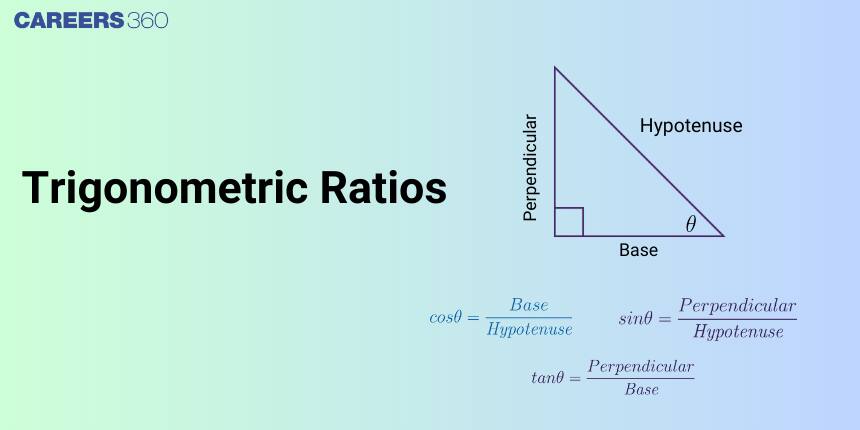
In trigonometry, trigonometric ratios are used to establish a mathematical relationship between the angles and sides of a right-angled triangle. These ratios form the backbone of trigonometry and are widely applied in solving problems related to heights and distances, angle measurement, geometry, physics, engineering, navigation, and real-life calculations.
Trigonometric ratios help us determine unknown sides or angles of a triangle when some information is already known. Because of their wide applicability, they are considered one of the most important topics in school-level and competitive mathematics.
Definition of Trigonometric Ratios in a Right-Angled Triangle
Trigonometric ratios are defined for an acute angle of a right-angled triangle as the ratio of the lengths of two sides of the triangle. Each ratio compares specific sides with respect to a chosen angle.
Let $\theta$ be an acute angle in a right-angled triangle. The three primary trigonometric ratios are defined as follows:
Primary Trigonometric Ratios and Their Formulas
We have given below the primary trigonometric ratios along with their formulae so that you can understand them properly:
Sine Ratio ($\sin$)
The sine of an angle is the ratio of the length of the opposite side to the length of the hypotenuse.
$\sin \theta = \dfrac{\text{Opposite side}}{\text{Hypotenuse}}$
Cosine Ratio ($\cos$)
The cosine of an angle is the ratio of the length of the adjacent side to the length of the hypotenuse.
$\cos \theta = \dfrac{\text{Adjacent side}}{\text{Hypotenuse}}$
Tangent Ratio ($\tan$)
The tangent of an angle is the ratio of the length of the opposite side to the length of the adjacent side.
$\tan \theta = \dfrac{\text{Opposite side}}{\text{Adjacent side}}$
In addition to these, we have the reciprocal trigonometric ratios:
$\csc \theta = \frac{1}{\sin \theta}, \quad \sec \theta = \frac{1}{\cos \theta}, \quad \cot \theta = \frac{1}{\tan \theta}$
Example:
Consider a right-angled triangle where $\theta = 30^\circ$, the opposite side is 1 unit, and the hypotenuse is 2 units. Using the definitions:
$\sin 30^\circ = \frac{1}{2}, \quad \cos 30^\circ = \frac{\sqrt{3}}{2}, \quad \tan 30^\circ = \frac{1}{\sqrt{3}}$
These values are part of the Trigonometric Ratios Table of Standard Angles, which you will learn about in a later section.
Sides and angles of a Right angled Triangle
The right angle triangle is a triangle in which one angle is 90 degrees.


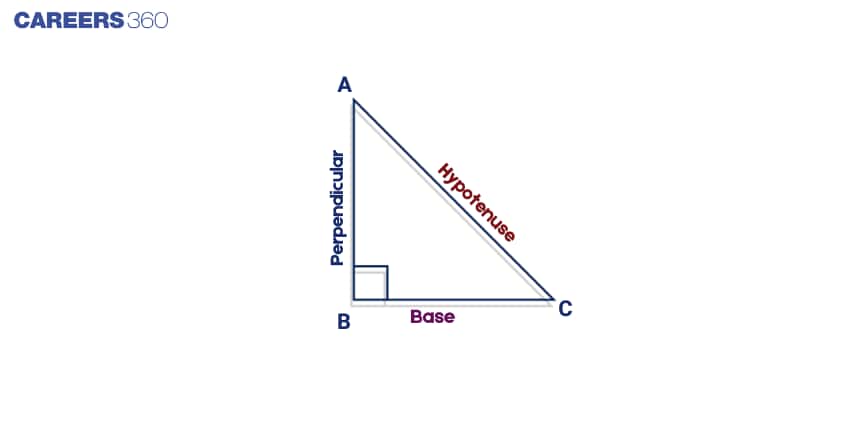

Consider the triangle ABC, given above.
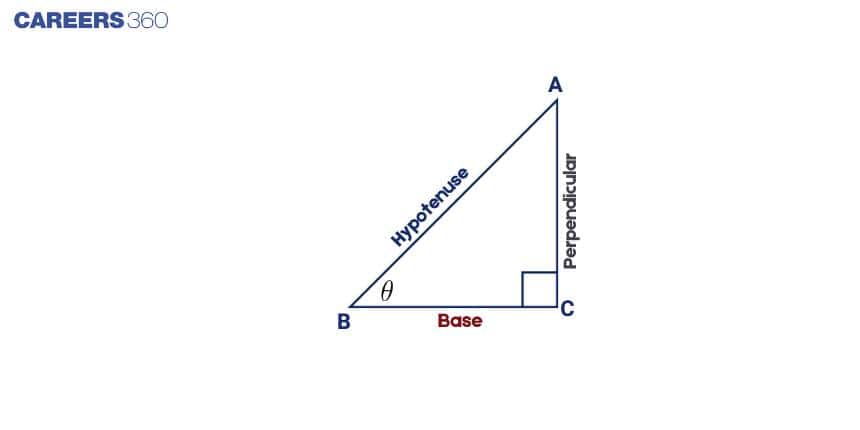
Base: If we wish to take trigonometric ratios of angle B, then the base is BC. It is the side on which the right-angle triangle stands.
Perpendicular (Altitude): Side opposite to the angle for which we want to find the trigonometric ratio.
In this case, AB is the altitude.
BC and AB are perpendicular to each other.
Hypotenuse: The side opposite to the right angle is called the hypotenuse. It is the largest side of the triangle. Side AC is the hypotenuse.
Understanding the Trigonometric Ratios – Sine, Cosine, and Tangent
In trigonometry, the core concepts revolve around three fundamental ratios: sine, cosine, and tangent. These trigonometric ratios help establish a relationship between the angles and sides of a right-angled triangle. A clear understanding of these ratios is essential for solving problems related to heights and distances, geometry, physics, and engineering applications.
In this section, we explore the meaning, formulas, examples, and interconnections of sine, cosine, and tangent to build a strong conceptual foundation.
Sine, Cosine, and Tangent – Meaning and Definitions
The three most commonly used trigonometric ratios are sine ($\sin$), cosine ($\cos$), and tangent ($\tan$). These ratios are defined with respect to an acute angle $\theta$ in a right-angled triangle.
Let $\theta$ be an acute angle in a right-angled triangle. Then:
$\sin \theta = \dfrac{\text{Opposite side}}{\text{Hypotenuse}}$
$\cos \theta = \dfrac{\text{Adjacent side}}{\text{Hypotenuse}}$
$\tan \theta = \dfrac{\text{Opposite side}}{\text{Adjacent side}}$
These definitions apply only to right-angled triangles, where one angle is exactly $90^\circ$.
Example Using Sine, Cosine, and Tangent Ratios
Let us apply these definitions to a practical problem.
Example:
In a right-angled triangle, $\theta = 60^\circ$ and the hypotenuse is $10$ cm. Find the length of the opposite side using $\sin \theta$.
Solution:
Using the sine formula,
$\sin 60^\circ = \dfrac{\text{Opposite side}}{10}$
Since $\sin 60^\circ = \dfrac{\sqrt{3}}{2}$,
$\dfrac{\sqrt{3}}{2} = \dfrac{\text{Opposite side}}{10}$
$\text{Opposite side} = 10 \times \dfrac{\sqrt{3}}{2} = 5\sqrt{3}$ cm
This example shows how trigonometric ratios help determine unknown side lengths when an angle and one side are known.
Trigonometric Ratios Formulas
A complete understanding of trigonometry requires familiarity with all six trigonometric ratios and their formulas. These formulas are widely used in school mathematics, competitive exams like JEE and NEET, and applied sciences.
Basic Formulas of Trigonometric Ratios
The six trigonometric ratios are:
$\sin \theta = \dfrac{\text{Opposite}}{\text{Hypotenuse}}$
$\cos \theta = \dfrac{\text{Adjacent}}{\text{Hypotenuse}}$
$\tan \theta = \dfrac{\text{Opposite}}{\text{Adjacent}}$
$\csc \theta = \dfrac{1}{\sin \theta}$
$\sec \theta = \dfrac{1}{\cos \theta}$
$\cot \theta = \dfrac{1}{\tan \theta}$
Reciprocal Trigonometric Ratios
The ratios cscant, secant, and cotangent are known as reciprocal trigonometric ratios, as they are reciprocals of sine, cosine, and tangent respectively.
$\csc \theta = \dfrac{1}{\sin \theta}$
$\sec \theta = \dfrac{1}{\cos \theta}$
$\cot \theta = \dfrac{1}{\tan \theta}$
These ratios are frequently used in advanced trigonometric problems, wave motion, and height–distance calculations.
Relationship Between Trigonometric Ratios
Trigonometric ratios are closely related to each other. Some important relations include:
$\tan \theta = \dfrac{\sin \theta}{\cos \theta}$
$\cot \theta = \dfrac{\cos \theta}{\sin \theta}$
Pythagorean Identities
The Pythagorean identities are fundamental trigonometric identities derived from the Pythagoras theorem:
$\sin^2 \theta + \cos^2 \theta = 1$
$1 + \tan^2 \theta = \sec^2 \theta$
$1 + \cot^2 \theta = \csc^2 \theta$
These identities are essential resources for simplifying expressions, proving identities, and solving higher-level trigonometric equations.
Trigonometric Ratios Table for Standard Angles
This section contains the complete Trigonometric Ratios Table for standard angles $0^\circ$, $30^\circ$, $45^\circ$, $60^\circ$, and $90^\circ$. Mastering this table is essential for quick calculations in both school exams and competitive tests.
Easy Tricks to Memorize the Trigonometric Ratios Table
One popular method to remember $\sin \theta$ for standard angles:
$\sin \theta = \sqrt{\frac{n}{4}}, \quad \text{where } n = 0, 1, 2, 3, 4$
So for:
- $\sin 0^\circ = \sqrt{0/4} = 0$
- $\sin 30^\circ = \sqrt{1/4} = \frac{1}{2}$
- $\sin 45^\circ = \sqrt{2/4} = \frac{1}{\sqrt{2}}$
- $\sin 60^\circ = \sqrt{3/4} = \frac{\sqrt{3}}{2}$
- $\sin 90^\circ = \sqrt{4/4} = 1$
Use this to also derive $\cos \theta$ as:
$\cos \theta = \sin (90^\circ - \theta)$
This reverse relationship is especially useful for quick mental calculations.
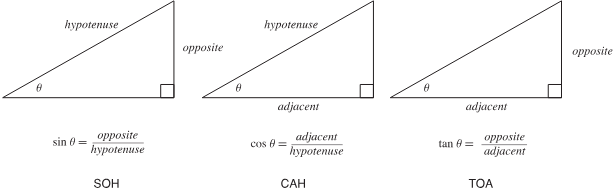
We can use some of the famous mnemonics to remember the main three sinθ, cosθ, and tanθ.
For sinθ, we will remember “Some People Have” [S = sinθ, P = Perpendicular, H = Hypotenuse]
For cosθ, we will remember “Curly Black Hair” [C = cosθ, B = Base, H = Hypotenuse]
For tanθ, we will remember “Through Proper Brushing” [T = tanθ, P = Perpendicular, B = Base]
Relation between the sides of a right-angled triangle: Pythagoras's theorem
Statement:
The square of the hypotenuse is equal to the sum of the squares of the base and the square of the altitude.
$(Hypotenuse)^2= (Base)^2 + (Altitude)^2$
Pythagorean Triplets:
The three numbers which satisfy the above equation are known as the Pythagorean triplets.
For example, $(3, 4, 5)$ is a Pythagorean triplet because we know that $3^2= 9, 4^2 = 16$, and $5^2 = 25$ and, $9 + 16 = 25$.
Therefore, $3^2+4^2=5^2$.
Any three numbers that satisfy this condition are called Pythagorean triplets like $3, 4$, and $5$.
Some of the other examples of Pythagorean triplets are $(6, 8, 10)$, and $(12, 5, 13)$.
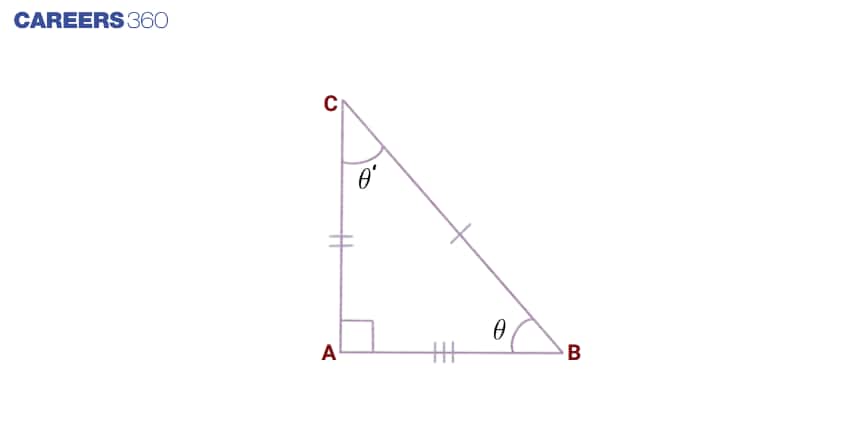

Sometimes choosing the perpendicular side can be tough. It depends on the angle.
In the above triangle ABC,
For $∠CBA$, $sin\theta = \frac{AC}{BC}$
i.e., Here $AC$ is the perpendicular.
For $∠ACB$, $sin\theta’ = \frac{AB}{BC}$,
i.e., Here $AB$ is the perpendicular.
For this, we have to remember the adjacent side and opposite side.
Perpendicular = Opposite side of the angle considered
Base = Adjacent side of the angle considered
Hypotenuse will be the same in every case.
Relation between trigonometric Ratios
As we observe that sinθ is a reciprocal of cscθ, cosθ is a reciprocal of secθ, tanθ is a reciprocal of cotθ, and vice-versa.
So, we can say
$ \sin \theta = \frac{1}{\csc \theta} $
$ \cos \theta = \frac{1}{\sec \theta} $
$ \tan \theta = \frac{1}{\cot \theta} $
$ \csc \theta = \frac{1}{\sin \theta} $
$ \sec \theta = \frac{1}{\cos \theta} $
$ \cot \theta = \frac{1}{\tan \theta} $
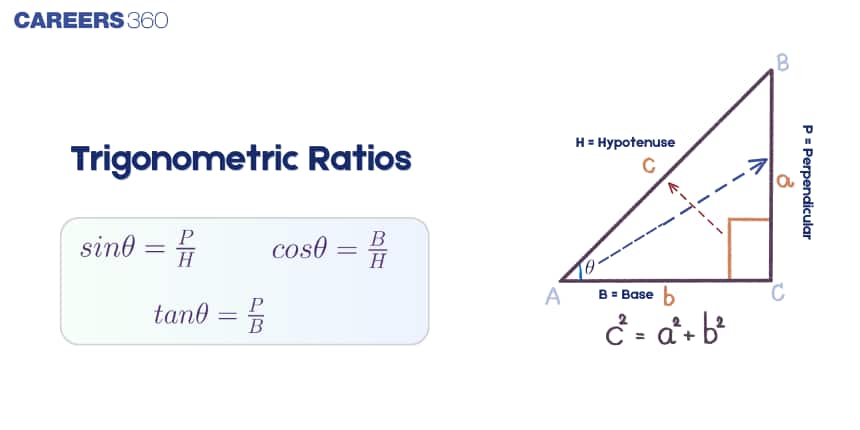

Trigonometric Ratio Table
Trigonometric Ratios of $0^\circ$, $30^\circ$, $45^\circ$, $60^\circ$, and $90^\circ$. The standard values of $\sin \theta$, $\cos \theta$, and $\tan \theta$ for the five commonly used angles are as follows:
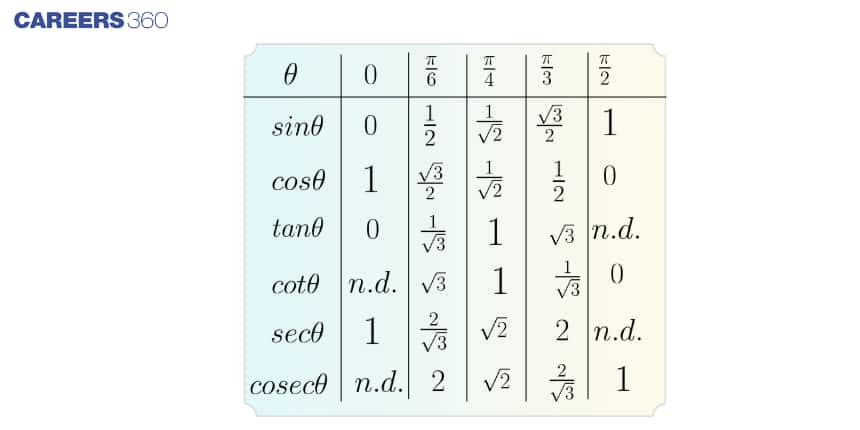

Trigonometric Ratios for Complementary Angles
The complementary angles are a pair of two angles such that their sum is equal to 90°. The complement of an angle $\theta$ is $90° - \theta$. The trigonometric ratios of complementary angles are:
$\sin(90^\circ - \theta) = \cos \theta $
$ \cos(90^\circ - \theta) = \sin \theta $
$ \csc(90^\circ - \theta) = \sec \theta $
$ \sec(90^\circ - \theta) = \csc \theta $
$ \tan(90^\circ - \theta) = \cot \theta $
$ \cot(90^\circ - \theta) = \tan \theta$
We can see from above that sine and cosine are complementary to each other, cscant and secant are complementary to each other, and tangent and cotangent are complementary to each other.
Application of Trigonometric Ratios in Height and Distance:
Trigonometry is one of the most important branches of mathematics. Some of the applications of trigonometry are:
- Measuring the heights of towers or big mountains
- Determining the distance of the shore from the sea
- Finding the distance between two celestial bodies
- Determining the power output of solar cell panels at different inclinations
- Representing different physical quantities such as mechanical waves, electromagnetic waves, etc.
Angle of Elevation and Angle of Depression:
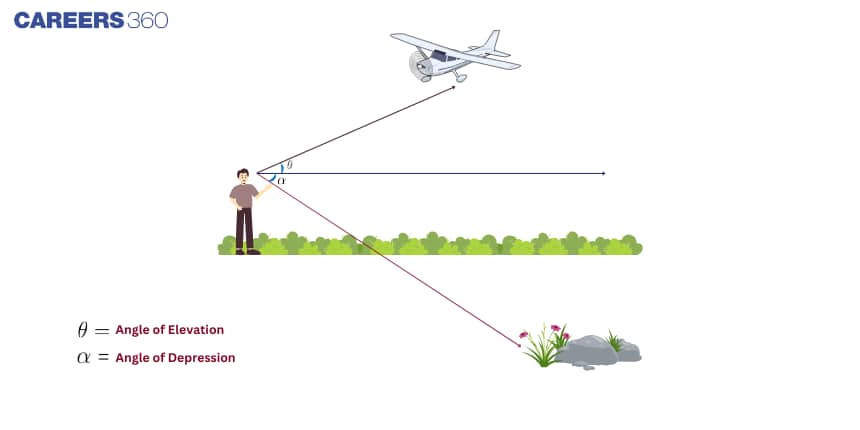


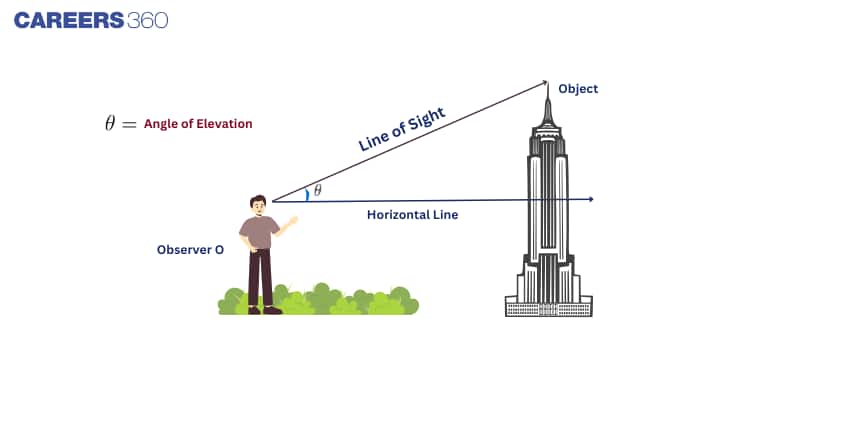
What is Angle of Elevation?
When you see an object above you, there's an angle between the horizontal and your line of sight to the object.


What is the angle of Depression?
When you see an object below you, there's an angle between the horizontal and your line of sight to the object.
Example:
A surveyor standing 50 meters away from a tower observes its top at an angle of elevation of $60^\circ$. To find the height $h$ of the tower:
$\tan 60^\circ = \frac{h}{50} \Rightarrow h = 50 \cdot \sqrt{3} \approx 86.6 \, \text{meters}$
This example shows how tangent ratio is directly applied in solving height and distance problems, which are part of both academic and real-world scenarios.
Trigonometric Ratios of Complementary Angles
Complementary angles play a fundamental role in trigonometry because they establish important relationships between different trigonometric ratios. Understanding these relationships makes it easier to simplify expressions, solve equations, and derive trigonometric identities. The concept of complementary angles forms the basis of cofunction identities, which are frequently used in geometry, calculus, and competitive examinations.
Complementary Angle Concept
Two angles are called complementary angles if their sum equals $90^\circ$ or $\frac{\pi}{2}$ radians.
Mathematically:
$A+B=90^\circ$
Examples of complementary angles include:
$30^\circ$ and $60^\circ$
$45^\circ$ and $45^\circ$
$20^\circ$ and $70^\circ$
In a right-angled triangle, the two acute angles are always complementary.
For example, if one acute angle is $35^\circ$, the other angle must be:
$90^\circ-35^\circ=55^\circ$
This relationship gives rise to several useful trigonometric identities.
Cofunction Identities
Cofunction identities express the relationship between trigonometric functions of complementary angles.
The most important cofunction identities are:
| Identity | Formula |
|---|---|
| Sine-Cosine Identity | $\sin(90^\circ-\theta)=\cos\theta$ |
| Cosine-Sine Identity | $\cos(90^\circ-\theta)=\sin\theta$ |
| Tangent-Cotangent Identity | $\tan(90^\circ-\theta)=\cot\theta$ |
| Cotangent-Tangent Identity | $\cot(90^\circ-\theta)=\tan\theta$ |
| Secant-Cosecant Identity | $\sec(90^\circ-\theta)=\csc\theta$ |
| Cosecant-Secant Identity | $\csc(90^\circ-\theta)=\sec\theta$ |
Example
Since:
$\sin(90^\circ-30^\circ)$
$=\sin60^\circ$
and
$\cos30^\circ$
both are equal to:
$\frac{\sqrt3}{2}$
Therefore:
$\sin60^\circ=\cos30^\circ$
Relationship Between Sine and Cosine
The strongest complementary angle relationship exists between sine and cosine.
For any angle $\theta$:
$\sin\theta=\cos(90^\circ-\theta)$
and
$\cos\theta=\sin(90^\circ-\theta)$
Examples
$\sin30^\circ=\cos60^\circ=\frac12$
$\sin45^\circ=\cos45^\circ=\frac{\sqrt2}{2}$
$\sin60^\circ=\cos30^\circ=\frac{\sqrt3}{2}$
This relationship is extensively used in trigonometric simplification and proofs.
Applications of Complementary Angles
Complementary angles have numerous applications in mathematics and science.
Major Applications
Simplifying trigonometric expressions
Solving trigonometric equations
Proving identities
Coordinate geometry calculations
Calculus and differentiation
Engineering and physics problems
Competitive examination questions
Understanding complementary angles significantly reduces the complexity of many trigonometric calculations.
Properties of Trigonometric Ratios
Trigonometric ratios follow several important mathematical properties and identities. These properties establish relationships between the six trigonometric functions and provide the foundation for advanced trigonometry.
Pythagorean Identities
Pythagorean identities are derived from the Pythagorean theorem and are among the most important identities in trigonometry.
The fundamental identity is:
Other important identities include:
$\sec^2\theta=1+\tan^2\theta$
$\csc^2\theta=1+\cot^2\theta$
These identities are used extensively in:
Trigonometric simplification
Equation solving
Calculus
Coordinate geometry
Reciprocal Relationships
Three trigonometric functions are reciprocals of the other three.
| Function | Reciprocal Relationship |
|---|---|
| $\csc\theta$ | $\frac{1}{\sin\theta}$ |
| $\sec\theta$ | $\frac{1}{\cos\theta}$ |
| $\cot\theta$ | $\frac{1}{\tan\theta}$ |
Similarly:
$\sin\theta=\frac{1}{\csc\theta}$
$\cos\theta=\frac{1}{\sec\theta}$
$\tan\theta=\frac{1}{\cot\theta}$
These relationships help convert expressions into simpler forms.
Periodicity of Trigonometric Functions
Trigonometric functions repeat their values after specific intervals. This property is known as periodicity.
| Function | Period |
|---|---|
| $\sin\theta$ | $360^\circ$ or $2\pi$ |
| $\cos\theta$ | $360^\circ$ or $2\pi$ |
| $\tan\theta$ | $180^\circ$ or $\pi$ |
| $\cot\theta$ | $180^\circ$ or $\pi$ |
Examples:
$\sin(\theta+360^\circ)=\sin\theta$
$\cos(\theta+360^\circ)=\cos\theta$
$\tan(\theta+180^\circ)=\tan\theta$
Periodicity is useful for solving trigonometric equations involving large angles.
Sign of Trigonometric Ratios in Different Quadrants
The sign of a trigonometric ratio depends on the quadrant in which the angle lies.
The standard ASTC rule is:
A – All Students Take Calculus
| Quadrant | Positive Functions |
|---|---|
| I | All functions |
| II | Sine and Cosecant |
| III | Tangent and Cotangent |
| IV | Cosine and Secant |
Examples
$\sin120^\circ$ is positive.
$\cos120^\circ$ is negative.
$\tan225^\circ$ is positive.
$\cos330^\circ$ is positive.
Quadrant signs are essential for evaluating trigonometric functions accurately.
Applications of Trigonometric Ratios
Trigonometric ratios are widely used in mathematics, science, engineering, and real-world measurements. They provide practical methods for calculating distances, heights, angles, and wave behavior.
Applications in Geometry
Trigonometric ratios are extensively used in geometry.
Applications
Finding unknown sides of triangles
Calculating angles
Solving right triangles
Coordinate geometry problems
Mensuration calculations
Example:
Finding the height of a tower using angle of elevation.
Applications in Physics
Many physical phenomena involve trigonometric functions.
Applications
Wave motion
Oscillations
Sound waves
Light waves
Projectile motion
For example, simple harmonic motion is often represented using sine and cosine functions.
Applications in Engineering
Engineers use trigonometry in various fields.
Applications
Structural engineering
Mechanical engineering
Civil engineering
Electrical engineering
Robotics
Trigonometric ratios help determine forces, angles, slopes, and component vectors.
Applications in Navigation and Surveying
Navigation and surveying depend heavily on trigonometric calculations.
Applications
Determining distances
Mapping land areas
GPS technology
Marine navigation
Aircraft navigation
Surveyors use trigonometric ratios to calculate inaccessible distances and heights accurately.
Trigonometric Ratios vs Trigonometric Functions
The terms trigonometric ratios and trigonometric functions are often used interchangeably, but there is a subtle distinction between them.
Key Differences
Trigonometric ratios are originally defined as ratios of sides in a right triangle.
Trigonometric functions extend these ratios to all real angles using the unit circle.
Similarities
Both concepts involve:
Sine
Cosine
Tangent
Cosecant
Secant
Cotangent
Both are used to measure relationships between angles and lengths.
Practical Uses
Trigonometric ratios are commonly used in:
Basic geometry
Right triangle problems
Trigonometric functions are used in:
Calculus
Physics
Signal processing
Advanced mathematics
Comparison Table
| Trigonometric Ratios | Trigonometric Functions |
|---|---|
| Based on right triangles | Based on unit circle definitions |
| Limited to acute angles initially | Defined for all real angles |
| Used in elementary geometry | Used in advanced mathematics |
| Ratio interpretation | Functional interpretation |
Important Trigonometric Formulas
Trigonometric formulas provide the foundation for solving problems involving angles, triangles, and periodic functions.
Basic Ratio Formulas
| Ratio | Formula |
|---|---|
| Sine | $\sin\theta=\frac{\text{Perpendicular}}{\text{Hypotenuse}}$ |
| Cosine | $\cos\theta=\frac{\text{Base}}{\text{Hypotenuse}}$ |
| Tangent | $\tan\theta=\frac{\text{Perpendicular}}{\text{Base}}$ |
Reciprocal Formulas
| Ratio | Formula |
|---|---|
| Cosecant | $\csc\theta=\frac{1}{\sin\theta}$ |
| Secant | $\sec\theta=\frac{1}{\cos\theta}$ |
| Cotangent | $\cot\theta=\frac{1}{\tan\theta}$ |
Quotient Formulas
These formulas connect the primary trigonometric functions.
$\tan\theta=\frac{\sin\theta}{\cos\theta}$
$\cot\theta=\frac{\cos\theta}{\sin\theta}$
They are frequently used in simplification and identity proofs.
Fundamental Identities
The most important trigonometric identities are:
$\sec^2\theta=1+\tan^2\theta$
$\csc^2\theta=1+\cot^2\theta$
These identities form the backbone of trigonometric equations, calculus, coordinate geometry, and advanced mathematical analysis.
Best Books for Trigonometric Ratios
A strong understanding of trigonometric ratios is essential for mastering trigonometry, coordinate geometry, calculus, and competitive mathematics. The following books provide detailed explanations, formulas, and practice questions.
| Book Name | Best For | Why It Helps |
|---|---|---|
| NCERT Mathematics Class 10 & 11 | School Students | Covers trigonometric ratios and identities clearly |
| Plane Trigonometry – S.L. Loney | Advanced Learning | Comprehensive theory and derivations |
| Trigonometry – S. Chand | Board Exams | Concept-based explanations and examples |
| Objective Mathematics – R.D. Sharma | Competitive Exams | Extensive trigonometry practice |
| Cengage Mathematics Trigonometry | JEE Preparation | Advanced-level problems and concepts |
Shortcut Tips and Tricks for Trigonometric Ratios
Remembering a few important relationships and angle values can make trigonometry questions easier and faster to solve.
| Trick | Explanation |
|---|---|
| Learn Standard Angles | Memorize values for $0^\circ$, $30^\circ$, $45^\circ$, $60^\circ$, and $90^\circ$ |
| Remember SOH-CAH-TOA | Quick way to recall basic trigonometric ratios |
| Use Reciprocal Relationships | $\sec$, $\csc$, and $\cot$ are reciprocals |
| Learn Pythagorean Identities | Useful for simplification |
| Check Quadrants | Signs of trigonometric ratios depend on quadrants |
| Use Special Triangles | $45^\circ-45^\circ-90^\circ$ and $30^\circ-60^\circ-90^\circ$ triangles simplify calculations |
| Memorize Trigonometric Table | Helps solve exam questions quickly |
Important Formula Table
This formula table summarizes the most important trigonometric ratio formulas and identities.
| Concept | Formula |
|---|---|
| Sine | $\sin\theta=\frac{\text{Perpendicular}}{\text{Hypotenuse}}$ |
| Cosine | $\cos\theta=\frac{\text{Base}}{\text{Hypotenuse}}$ |
| Tangent | $\tan\theta=\frac{\text{Perpendicular}}{\text{Base}}$ |
| Cosecant | $\csc\theta=\frac{1}{\sin\theta}$ |
| Secant | $\sec\theta=\frac{1}{\cos\theta}$ |
| Cotangent | $\cot\theta=\frac{1}{\tan\theta}$ |
| Pythagorean Identity | $\sin^2\theta+\cos^2\theta=1$ |
| Tangent Identity | $1+\tan^2\theta=\sec^2\theta$ |
| Cotangent Identity | $1+\cot^2\theta=\csc^2\theta$ |
Solved Examples based on Trigonometric Ratios
Q1. In $\triangle{XYZ}$, right-angled at $Y$, if $\sin X = \frac{1}{2}$, find the value of $\cos X \cos Z + \sin X \sin Z$.
- $\frac{\sqrt{3}}{2}$
- $\frac{\sqrt{3}}{4}$
- $\frac{2}{\sqrt{3}}$
- $\sqrt{3}$
Hint: The sum of all angles in a triangle is 180°. Use this to find the value of $\cos X \cos Z + \sin X \sin Z$.
Answer:
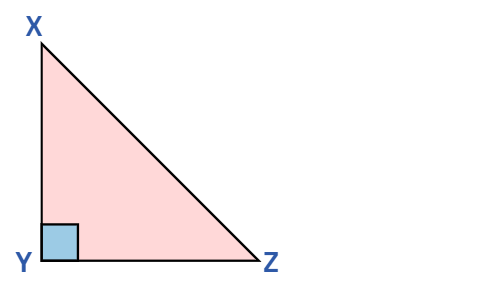


Given: In $\triangle {XYZ}$, right-angled at $Y$.
We know that the sum of all the angles in a triangle is 180°.
$\sin X = \frac{1}{2}$
⇒ $\sin X = \sin{30°}$
So, $\angle X = 30°$
Then $\angle Z = 60°$, because $\angle Y + \angle X + \angle Z = 180°$
Then, $\cos X \cos Z + \sin X \sin Z$
$=\cos 30° \cos 60° + \sin 30° \sin 60°$
$=\frac{\sqrt{3}}{2} × \frac{1}{2} + \frac{1}{2} × \frac{\sqrt{3}}{2}$
$ = \frac{\sqrt{3}}{2}$
Hence, the correct answer is $\frac{\sqrt{3}}{2}$.
Q2. The angle of elevation of the top of a building at a distance of 70 m from its foot on a horizontal plane is found to be 60°. Find the height of the building.
- $70 \sqrt{3} \mathrm{~m}$
- $60 \sqrt{3} \mathrm{~m}$
- $50 \sqrt{3} \mathrm{~m}$
- $70 \sqrt{2} \mathrm{~m}$
Hint: Use formula, $\tan \theta=\frac{\text{Perpendicular}}{\text{Base}}$
Answer:
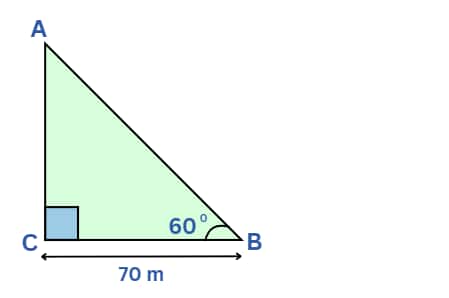


Height = AC
We know, $\tan \theta=\frac{\text{Perpendicular}}{\text{Base}}$
⇒ $\tan60° =\frac{AC}{70}$
⇒ $\sqrt3=\frac{AC}{70}$
⇒ $AC=70\sqrt3\text{ m}$
Hence, the correct answer is $70\sqrt3\text{ m}$.
Q3. If $2 \cot \theta = 3$, find the value of $\frac{\sqrt{13} \sin \theta – 3 \tan \theta}{3 \tan \theta + \sqrt{13} \cos \theta}$
- $\frac{1}{\sqrt{13}}$
- $\frac{2}{\sqrt{13}}$
- 0
- $\frac{2}{3}$
Hint: $\cot \theta=\frac{\text{Base}}{\text{Perpendicular}} =\frac{3}{2}$, then use Pythagoras's theorem to find the hypotenuse.
Answer:
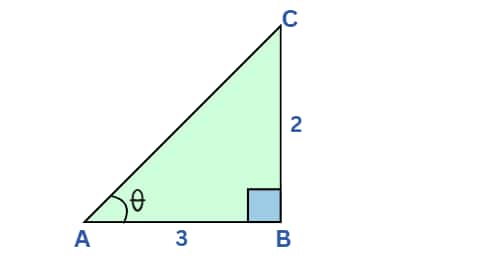


$2 \cot \theta = 3$
$⇒\cot \theta=\frac{3}{2}$
$⇒\frac{\text{Base}}{\text{Perpendicular}} =\frac{3}{2}$
$⇒\frac{AB}{BC}= \frac{3}{2}$
Let $AB = 3k, BC = 2k$
From Pythagoras' Theorem,
$AC^{2} = AB^{2} + BC^{2}$
$⇒AC^{2} = (3k)^{2} + (2k)^{2}$
$⇒AC^{2} = 13k^2$
$⇒AC = \sqrt{13}k$
$\sin\theta = \frac{\text{Perpendicular}}{\text{Hypotenuse}} = \frac{2k}{\sqrt{13}k}=\frac{2}{\sqrt{13}}$
$\cos\theta = \frac{\text{Base}}{\text{Hypotenuse}} = \frac{3k}{\sqrt{13}k}= \frac{3}{\sqrt{13}}$
$\tan \theta = \frac{\text{Perpendicular}}{\text{Base}} = \frac{2k}{3k}=\frac{2}{3}$
Putting these values in the equation, we get,
$=\frac{\sqrt{13} \sin \theta – 3 \tan \theta}{3 \tan \theta + \sqrt{13} \cos \theta}$
$=\frac{\sqrt{13} \times \frac{2}{\sqrt{13}} - 3 \times \frac{2}{3}}{3 \times\frac{2}{3} + \sqrt{13} \times \frac{3}{\sqrt{13}}}$
$=0$
Hence, the correct answer is 0.
Q4. Subhas, a 3.15 m tall tree, and an 11.25 m tall building are positioned such that their feet on the ground are collinear and the tree is located between Subhas and the building. The tree is located at a distance of 7.5 m from Subhas and a distance of 45 m from the building. Further, the eyes of Subhas, the top of the tree, and the top of the building fall in one line. Find the height (in m ) from the ground at which Subhas's eyes are situated.
- 1.75
- 1.6
- 1.8
- 1.5
Hint: Assume the required height as $h$. Draw a figure according to the given data. Solve for $h$ using the trigonometric ratios.
Answer:
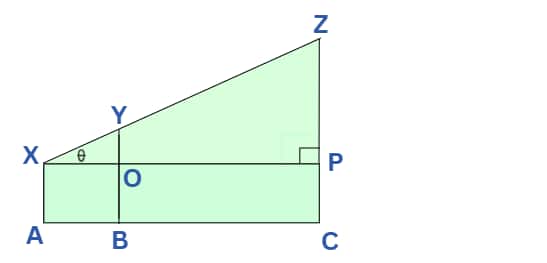


Let XA be Subhas, YB be the tree, and ZC be the building.
YB = 3.15 m
ZC = 11.25 m
AB = 7.5 m
BC = 45 m
XO = AB = 7.5 m
OP = BC = 45 m
⇒ XP = XO + OP = 7.5 + 45 = 52.5 m
Let the height from the ground at which Subhas's eyes are situated be $h$.
OY = BY – OB = 3.15 – $h$
PZ = ZC – PC = 11.25 – $h$
Let the angle of elevation be $\theta$.
In $\triangle$XPZ, $\tan \theta = \frac{\text{PZ}}{\text{PX}} = \frac{11.25-h}{52.5}$ -----------(i)
In $\triangle$XOY, $\tan \theta = \frac{\text{OY}}{\text{OX}} = \frac{3.15-h}{7.5}$ ------------(ii)
$⇒ \frac{11.25-h}{52.5} = \frac{3.15-h}{7.5}$
$⇒ \frac{11.25-h}{7} = \frac{3.15-h}{1}$
$⇒11.25-h = 7(3.15-h)$
$⇒11.25-h = 22.05-7h$
$⇒6h = 10.8$
$\therefore h = \frac{10.8}{6} = 1.8$ m
Hence, the correct answer is 1.8.
Q5. If $\triangle A B C$ is right angled at $B, A B=12 \mathrm{~cm}$ and $\angle C A B=60^{\circ}$, determine the length of $BC$.
- $24 \sqrt{3} \mathrm{~cm}$
- $12 \mathrm{~cm}$
- $12 \sqrt{2} \mathrm{~cm}$
- $12 \sqrt{3} \mathrm{~cm}$
Hint: Use the trigonometric ratio involving AB and BC.
Answer:
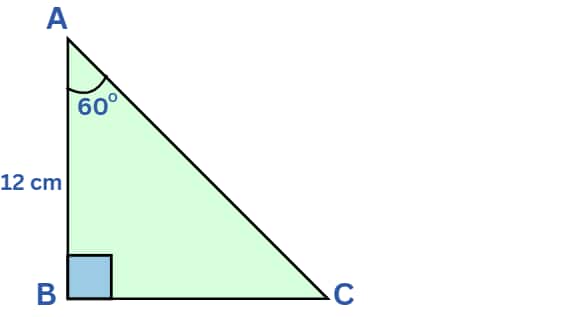

Given, $\triangle$ABC is right angled at B, where AB = 12 cm and $\angle$CAB = 60°
By using the trigonometric ratio involving AB and BC.
To $\angle$CAB, AB is the adjacent side and BC is the opposite side.
$\tan\angle CAB$ = $\tan 60°$ = $\frac{BC}{AB}$
⇒ $\sqrt3=\frac{BC}{12}$
$\therefore BC =12\sqrt3\ \text{cm}$
Hence, the correct answer is $12\sqrt3\ \text{cm}$.
Q6. From the top of an upright pole 17.75 m high, the angle of elevation of the top of an upright tower was 60°. If the tower was 57.75 m tall, how far away (in m) from the foot of the pole was the foot of the tower?
- $40 \sqrt{3}$
- $\frac{151 \sqrt{3}}{6}$
- $\frac{77}{4} \sqrt{3}$
- $\frac{40 \sqrt{3}}{3}$
Hint: Use $\tan\theta=\frac{\text{Perpendicular}}{\text{Base}}$
Answer:
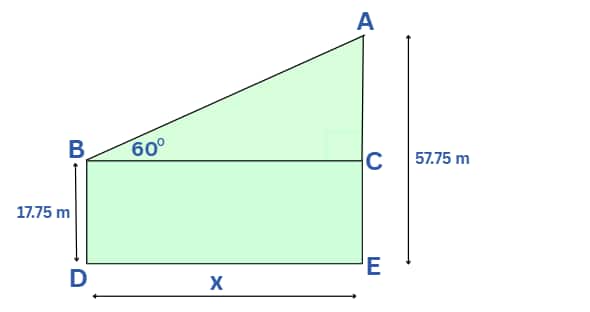


We have to find the value of $x$.
In $\triangle ABC,$
$\tan60° = \frac{AC}{BC}$
We know, $CE=BD$
⇒ $AC=AE-CE$
⇒ $AC=57.75-17.75$
⇒ $AC=40$
In $\triangle ABC,$
$\tan60° = \frac{40}{x}$
⇒ $\sqrt3=\frac{40}{x}$
⇒ $x=\frac{40}{\sqrt3}$
⇒ $x=\frac{40\sqrt3}{3}$ m
Hence, the correct answer is $\frac{40\sqrt3}{3}$.
Q7. The value of $(\sin^445°+ \cos^460°) + (\tan^445°+ \cot^445°)$ is:
- $\frac{37}{16}$
- $\frac{33}{16}$
- $\frac{35}{16}$
- $\frac{39}{16}$
Hint: $\sin45°=\frac{1}{\sqrt2},\cos60°=\frac{1}{2},\tan45°=1$ and $\cot45°=1$
Answer:
Given: $(\sin^445°+ \cos^460°) + (\tan^445°+ \cot^445°)$
= $(\frac{1}{\sqrt2})^4 + (\frac{1}{2})^4 + (1)^4 + (1)^4$
= $\frac{1}{4} + \frac{1}{16} + 1 + 1$
= $\frac{4+1+16+16}{16}$
= $\frac{37}{16}$
Hence, the correct answer is $\frac{37}{16}$.
Q8. Two ships are on the opposite of a lighthouse such that all three of them are collinear. The angles of depression of the two ships from the top of the lighthouse are 30° and 60°. If the ships are $230 \sqrt{3}$ m apart, then find the height of the lighthouse (in m).
- 175.4
- 165.2
- 172.5
- 180.5
Hint: Use the formula: $\tan\theta=\frac{\text{Perpendicular}}{\text{Base}}$
Answer:
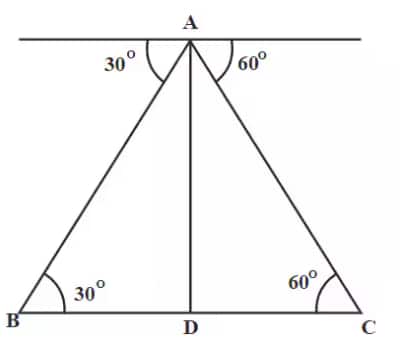
Given: The distance between the ships is BC = $230\sqrt3$ m
Let the height of the lighthouse AD be $h$ m.
From $\triangle$ABD we get,
$\tan30°=\frac{AD}{BD}$ ⇒ BD = $h\sqrt3$
Again from $\triangle$ACD we get,
$\tan60°=\frac{AD}{CD}$ ⇒ CD = $\frac{h}{\sqrt3}$
According to the question,
$h\sqrt3+\frac{h}{\sqrt3}=230\sqrt3$
⇒ $3h+h=690$
⇒ $4h=690$
⇒ $h=\frac{690}{4}=172.5$ m
Hence, the correct answer is 172.5 m.
Q9. If $\tan (A+B)=\sqrt{3}$ and $\tan (A-B)=\frac{1}{\sqrt{3}}; 0°<(A+B)<90°; A > B$, then the values of $A$ and $B$ are respectively:
- 45° and 15°
- 15° and 45°
- 30° and 30°
- 60° and 30°
Hint: $\sqrt{3}=\tan60°$ and $\frac{1}{\sqrt{3}}=\tan30°$
Answer:
Given: $\tan (A+B)=\sqrt{3}$ and $\tan (A-B)=\frac{1}{\sqrt{3}}$
$\tan (A+B)=\sqrt{3}=\tan60°$
⇒ $A+B=60°$ .........................(1)
Also, $\tan (A-B)=\frac{1}{\sqrt{3}}=\tan30°$
⇒ $A-B=30°$ ............................(2)
Solving equations (1) and (2) we get,
$A=45°$ and $B=15°$
Hence, the correct answer is 45° and 15°.
Q10. A person 1.8 metres tall is $30 \sqrt{3}$ metres away from a tower. If the angle of elevation from his eye to the top of the tower is 30°, then what is the height (in m) of the tower?
- 32.5
- 37.8
- 30.5
- 31.8
Hint: Find the height of the tower using the formulas, $\tan 30^{\circ}=\frac{1}{\sqrt3}$ and $\tan \theta=\frac{\text{Perpendicular}}{\text{Base}}$.
Answer:
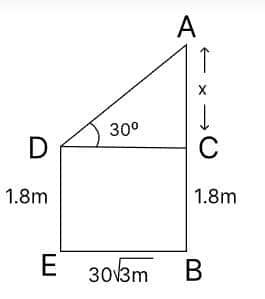
Given: A person 1.8 metres tall is $30 \sqrt{3}$ metres away from a tower.
The angle of elevation from his eye to the top of the tower is $30^{\circ}$.
We know the formulas, $\tan 30^{\circ}=\frac{1}{\sqrt3}$ and $\tan \theta=\frac{\text{Perpendicular}}{\text{Base}}$.
Let the tower's height and the person's height be AB and DE, respectively.
In $\triangle ACD$,
$\frac{AC}{DC}=\tan 30^{\circ}$
⇒ $\frac{x}{30\sqrt3}=\frac{1}{\sqrt3}$
⇒ $x=30$ m
The height of the tower AB = 30 + 1.8 = 31.8 m
Hence, the correct answer is 31.8 m.
Related Topics to Trigonometric Ratios
Understanding trigonometric ratios becomes easier when studied alongside related trigonometry concepts. These topics help build a strong foundation for advanced identities, equations, and applications.
NCERT Resources
This section provides essential NCERT resources for Class 11 Chapter 3 – Trigonometric Functions, designed to strengthen your conceptual understanding. You'll find detailed notes, step-by-step NCERT solutions, and NCERT Exemplar problems, making it easier to master Trigonometric Ratios.
NCERT Class 11 Chapter 3 Trigonometric Functions Notes
Practice Questions
Sharpen your skills with a variety of trigonometric ratio practice questions, from basic identification to complex applications. These questions are crucial for school exams and competitive tests, with step-by-step solutions.
Trigonometric Ratios - Practice Now
Below is the list of the next topics which you can practice:
Graphs Of General Trigonometric Functions - Practice Question |
Sum To Product And Product To Sum Formulas - Practice Question |
Frequently Asked Questions (FAQs)
Trigonometric ratios are ratios that express the relationship between the angles and sides of a right-angled triangle. They help determine unknown sides or angles when some values are known.
The three basic trigonometric ratios are:
Sine ($\sin$)
Cosine ($\cos$)
Tangent ($\tan$)
For an acute angle $\theta$ in a right-angled triangle:
$\sin \theta = \dfrac{\text{Opposite}}{\text{Hypotenuse}}$
$\cos \theta = \dfrac{\text{Adjacent}}{\text{Hypotenuse}}$
$\tan \theta = \dfrac{\text{Opposite}}{\text{Adjacent}}$
The reciprocal trigonometric ratios are:
Cosecant ($\csc \theta$), reciprocal of $\sin \theta$
Secant ($\sec \theta$), reciprocal of $\cos \theta$
Cotangent ($\cot \theta$), reciprocal of $\tan \theta$
They are defined as:
$\csc \theta = \dfrac{1}{\sin \theta}$,
$\sec \theta = \dfrac{1}{\cos \theta}$,
$\cot \theta = \dfrac{1}{\tan \theta}$
Sine, cosine, and tangent are related by the identities:
$\tan \theta = \dfrac{\sin \theta}{\cos \theta}$
$\cot \theta = \dfrac{\cos \theta}{\sin \theta}$
These relations are frequently used in problem-solving.
The Pythagorean identities are fundamental trigonometric identities:
$\sin^2 \theta + \cos^2 \theta = 1$
$1 + \tan^2 \theta = \sec^2 \theta$
$1 + \cot^2 \theta = \csc^2 \theta$
They are used to simplify expressions and prove identities.
