Imagine you’re trying to find the distance between two cities on a map, but you only know two sides of the triangle formed and the angle between them. That’s exactly where the Law of Cosines becomes incredibly useful. Unlike basic trigonometric ratios that work only for right-angled triangles, the Law of Cosines helps you solve any triangle, whether it’s acute, obtuse, or right-angled. It connects the sides and angles of a triangle in one powerful formula and is widely used in mathematics, physics, navigation, and competitive exams. In this article, we’ll explore the definition, proof, formula, and solved examples of the Law of Cosines to build a clear and strong understanding.
This Story also Contains
Overview of a Triangle
Introduction to Law of Cosines
Standard Notations Used in △ABC
Applications of the Law of Cosines
Solved Examples Based on Cosine Rule
List of Topics related to Law of Cosines
NCERT Resources
Practice Questions based on Law of Cosines
Law of Cosines: Proof and Examples
Overview of a Triangle
A triangle is a polygon with three sides. It is considered more special than other polygons because it has the fewest number of sides among all polygons. A triangle consists of six main elements: three sides and three angles. Several important rules and theorems connect the sides and angles of a triangle.
Some standard symbols used to represent the elements of a triangle are as follows:
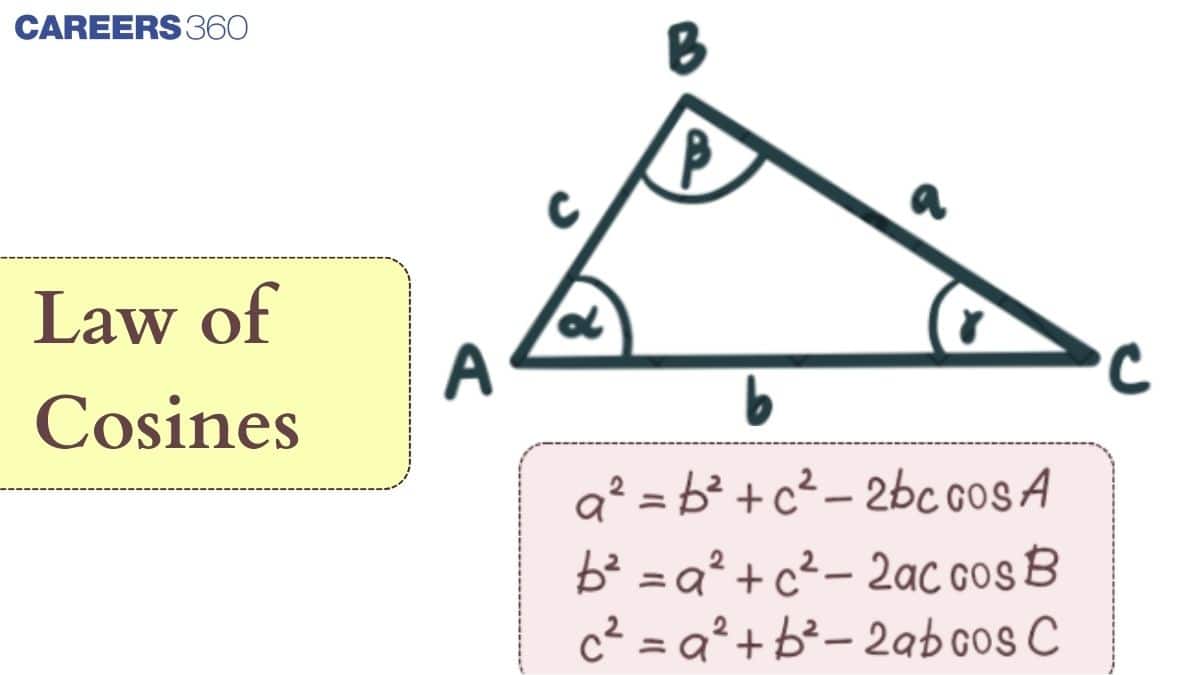
In △ABC, the angles are denoted by capital letters A,B, and C, while the sides opposite to these angles are represented by the small letters a,b, and c respectively.
The following standard notations are universally used in relation to $,\triangle ABC$:
The semi-perimeter of $,\triangle ABC$ is given by:
$s = \dfrac{a + b + c}{2}$
The perimeter of $,\triangle ABC$ is:
$2s = a + b + c$
The area of a triangle is usually denoted by $S$ or $\Delta$.
For any $,\triangle ABC$, the following properties hold:
$\angle A + \angle B + \angle C = 180^\circ$
$a + b > c$, $b + c > a$, $c + a > b$ (Triangle inequalities)
$a > 0$, $b > 0$, $c > 0$
Introduction to Law of Cosines
The Law of Cosines is one of the most important results in trigonometry, often used when the Law of Sines cannot directly solve a triangle. It gives a direct relation between the sides and angles of any triangle, which makes it highly useful in Class 11 and Class 12 mathematics, as well as in competitive exams like JEE Main and CUET. Below, we explore the basics and how it connects with the Law of Sines.
What is the Law of Cosines?
The Law of Cosines states that in any triangle, the square of one side is equal to the sum of the squares of the other two sides, minus twice the product of those two sides and the cosine of the included angle.
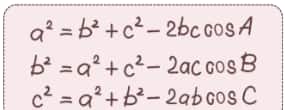
The Law of Cosines formula connects the three sides of a triangle with the cosine of one of its angles. For a triangle ABC with sides a,b,c opposite to angles ∠A,∠B,∠C, respectively, the formula is:
This formula generalises the Pythagoras Theorem because when $C = 90^\circ$, we have $\cos C = 0$, which gives:
$c^2 = a^2 + b^2$
Proof of Law of Cosines
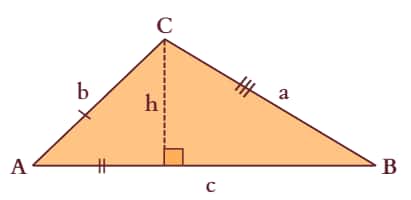
Drop a perpendicular from point C to the x-axis. Let this perpendicular be the altitude (height).
Now, since $\theta$ is the measure of $\angle A$ in $\triangle ABC$:
$a^2 = b^2 + c^2 - 2bc \cos \angle A$
Rearranging gives another useful form:
$\cos \angle A = \dfrac{b^2 + c^2 - a^2}{2bc}$
The same derivation holds whether $\angle A$ is acute, right, or obtuse.
Similarly, we can write:
$b^2 = a^2 + c^2 - 2ac \cos \angle B$
$c^2 = a^2 + b^2 - 2ab \cos \angle C$
Note:
If the lengths of all three sides of a triangle are known, we can calculate each angle using the Law of Cosines.
If two sides (say b and c) and the included angle ∠A are given, we can first find the third side a using the cosine rule:
$a^2 = b^2 + c^2 - 2bc \cos \angle A$
or equivalently,
$\cos \angle A = \dfrac{b^2 + c^2 - a^2}{2bc}$
Once a is determined, and since a,b,c are known, we can then use the Law of Cosines again to find the other angles ∠B and ∠C.
Standard Notations Used in △ABC
Before applying the Law of Cosines formula, it is important to understand the standard triangle notations used in coordinate geometry and trigonometry. In any triangle $\triangle ABC$, the naming convention follows a fixed pattern that connects angles and their opposite sides. These notations are universally used in mathematics, CBSE Class 11 & 12, JEE preparation, and competitive exams.
In $\triangle ABC$:
Angles are denoted as $\angle A$, $\angle B$, and $\angle C$
Sides opposite these angles are denoted as $a$, $b$, and $c$ respectively
So,
Side opposite $\angle A$ is $a$
Side opposite $\angle B$ is $b$
Side opposite $\angle C$ is $c$
JEE Main Highest Scoring Chapters & Topics
Focus on high-weightage topics with this eBook and prepare smarter. Gain accuracy, speed, and a better chance at scoring higher.
This consistent relationship makes it easier to apply formulas like:
$a^2 = b^2 + c^2 - 2bc \cos A$
Understanding these notations is essential for solving triangle side problems, angle calculations, and cosine rule applications.
Relationship Between Sides and Angles
One of the most important concepts in triangle geometry is the relationship between sides and their opposite angles.
In any triangle:
The largest side lies opposite the largest angle
The smallest side lies opposite the smallest angle
Equal sides correspond to equal angles (Isosceles triangle property)
For example:
If $a > b > c$, then
$\angle A > \angle B > \angle C$
This concept is extremely useful when:
Comparing angles without calculation
Determining whether a triangle is acute, right, or obtuse
Applying the Law of Cosines to classify triangles
Using the cosine rule:
If $a^2 > b^2 + c^2$, then $\angle A$ is obtuse
If $a^2 = b^2 + c^2$, then $\angle A = 90^\circ$
If $a^2 < b^2 + c^2$, then $\angle A$ is acute
These relationships are frequently tested in JEE Main, CBSE board exams, and competitive mathematics exams.
Perimeter, Semi-Perimeter, and Area of a Triangle
Understanding perimeter and semi-perimeter of a triangle is crucial for applying formulas like Heron’s formula and other geometric identities.
Perimeter of Triangle
The perimeter is the total length of all sides:
$P = a + b + c$
It represents the boundary length of $\triangle ABC$.
Semi-Perimeter of Triangle
The semi-perimeter is half of the perimeter:
$s = \dfrac{a + b + c}{2}$
This value plays a key role in Heron’s formula, which gives the area of a triangle when all three sides are known.
Area of Triangle
The area is commonly denoted by $S$ or $\Delta$.
Using trigonometry:
$S = \dfrac{1}{2} bc \sin A$
Using Heron’s Formula:
$S = \sqrt{s(s-a)(s-b)(s-c)}$
These formulas are essential for solving problems involving:
Triangle area using cosine rule
Height and distance applications
Competitive exam geometry questions
Triangle Inequality Conditions
For any valid triangle, the triangle inequality theorem must be satisfied. This is one of the most important geometric conditions.
The sides of a triangle must follow:
$a + b > c$
$b + c > a$
$c + a > b$
Also,
$a > 0$, $b > 0$, $c > 0$
These inequalities ensure that the three sides can actually form a triangle.
If any one condition fails, the triangle cannot exist.
This concept is frequently used in:
Determining possible side lengths
Verifying triangle validity in word problems
Competitive exam multiple-choice questions
Applications of the Law of Cosines
The Law of Cosines is not limited to solving textbook problems; it has wide applications in geometry, trigonometry, and even real-world scenarios like physics and engineering. It helps in determining unknown sides, angles, and solving oblique triangles. Below are some key applications you should know.
Solving Oblique Triangles
Like Law of Sines, the Law of Cosines is especially useful for solving oblique triangles (triangles that are not right-angled). Unlike the Pythagoras Theorem, which applies only to right triangles, the cosine rule works for acute and obtuse triangles as well.
If the three sides of a triangle (a,b,c) are given, we can calculate any angle using: $\cos \angle A = \dfrac{b^2 + c^2 - a^2}{2bc}$
This makes the Law of Cosines an important part in trigonometry because it allows us to determine angles without requiring right angles.
Finding Unknown Sides and Angles
The Law of Cosines also helps when we need to calculate missing sides:
If two sides and the included angle are known (SAS case), the third side can be calculated using: $a^2 = b^2 + c^2 - 2bc \cos \angle A$
Once one side is found, we can apply the same law to determine the remaining angles.
This makes it highly efficient for triangle-solving problems where the Law of Sines alone might not be sufficient (for example, in the ambiguous case of SSA).
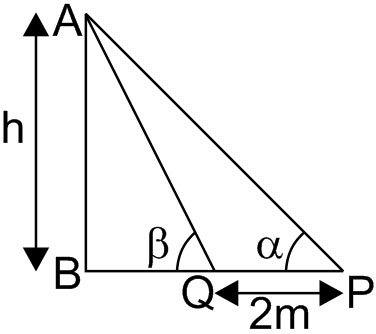
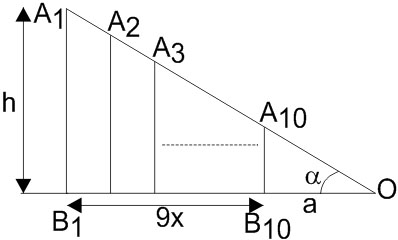
For all poles to subtend the same angle, the longest pole must be farthest, the smallest pole must be nearest, while all other poles are arranged in ascending order of height. Let the distance between 2 consecutive poles be x. Then,
Let the distance between consecutive poles be $x$.
Height and Distances -The height or length of an object or the distance between two distant objects can be determined with the help of trigonometric ratios.
The Law of Cosines is closely linked with several other trigonometric concepts that strengthen problem-solving and extend its applications. Exploring these areas gives a more complete understanding of trigonometry. Below are the related topics you can study.
For a solid grasp of trigonometric functions, NCERT study materials are among the most dependable references. They simplify concepts, provide structured practice, and help in systematic exam preparation. Below are the NCERT resources for Chapter 3: Trigonometric Functions.
Practising different types of trigonometric questions is the best way to strengthen concepts and improve accuracy. Practising MCQs not only builds confidence but also prepares you for exam-based problems. Below are the practice topics you can try.
The Law of Cosines relates the lengths of the sides of any triangle to the cosine of one of its angles, given by $c^2 = a^2 + b^2 - 2ab \cos C$, where $C$ is the angle opposite side $c$.
Q: When should you use the Law of Cosines instead of the Law of Sines?
A:
Use it when you know two sides and the included angle (SAS) or all three sides (SSS), especially to avoid the ambiguous case that can arise with SSA in the Law of Sines.
Q: How does it reduce to the Pythagorean theorem?
A:
For a right triangle where $C = 90^\circ$, $\cos 90^\circ = 0$, so $c^2 = a^2 + b^2 - 2ab \cdot 0 = a^2 + b^2$.
Q: How do you solve for an angle using the Law of Cosines?
A:
Rearrange to $\cos C = \frac{a^2 + b^2 - c^2}{2ab}$, then take $C = \cos^{-1} \left( \frac{a^2 + b^2 - c^2}{2ab} \right)$.
Q: Can it be used for equilateral triangles?
A:
Yes, with $a = b = c$ and $C = 60^\circ$, it holds: $a^2 = a^2 + a^2 - 2a^2 \cos 60^\circ = 2a^2 - 2a^2 \cdot 0.5 = a^2$.