ATIT
Ranked 1 st among Top Law Schools of super Excellence in India - GHRDC | NAAC A+ Accredited | #36 by NIRF


Think of situations where you need to simplify a long trigonometric expression quickly - like adding two sine or cosine terms in an exam problem. Instead of calculating each value separately, sum to product formulas let you rewrite these sums as simple products, making calculations faster and cleaner. In this article on Sum to Product Formula, you’ll learn the complete list of formulas, step-by-step proofs, solved examples, and practical applications that help you master trigonometric simplification for maths exams and competitive tests.
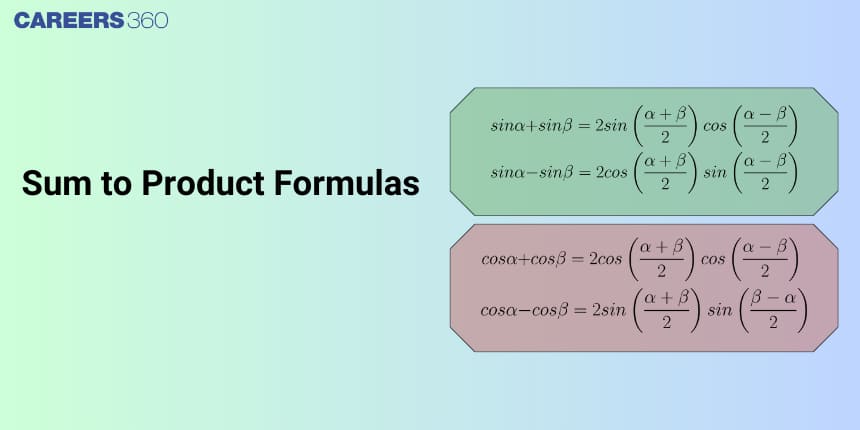
The sum to product formula (also called sum/difference into product) is an important concept in trigonometry used to convert the sum or difference of sine and cosine functions into a product of trigonometric functions. These formulas are extremely useful for simplifying trigonometric expressions, solving equations, and handling problems in board exams and competitive exams like JEE.
The sum and difference to product formulas allow us to rewrite expressions involving
$\sin \alpha \pm \sin \beta$ and $\cos \alpha \pm \cos \beta$
as products of sine and cosine terms. This transformation reduces complexity and makes further calculations easier.
Here, $\alpha$ and $\beta$ are any two angles.
We have given below the list of sum-to-product formulas:
$\sin \alpha + \sin \beta = 2 \sin \left(\frac{\alpha + \beta}{2}\right) \cos \left(\frac{\alpha - \beta}{2}\right)$
$\sin \alpha - \sin \beta = 2 \sin \left(\frac{\alpha - \beta}{2}\right) \cos \left(\frac{\alpha + \beta}{2}\right)$
$\cos \alpha + \cos \beta = 2 \cos \left(\frac{\alpha + \beta}{2}\right) \cos \left(\frac{\alpha - \beta}{2}\right)$
$\cos \alpha - \cos \beta = -2 \sin \left(\frac{\alpha + \beta}{2}\right) \sin \left(\frac{\alpha - \beta}{2}\right)$
These formulas convert sums or differences of trigonometric functions into products
They are derived using angle addition and subtraction identities
They help simplify expressions involving multiple trigonometric terms
Widely used in trigonometric simplification, integration, and equation solving
We start from the product to sum identity:
$2 \sin \alpha \cos \beta = \sin (\alpha + \beta) + \sin (\alpha - \beta)$
Let:
$\alpha = \frac{u + v}{2}$
$\beta = \frac{u - v}{2}$
Then:
$\alpha + \beta = u$
$\alpha - \beta = v$
Substituting into the identity:
$2 \sin \left(\frac{u + v}{2}\right) \cos \left(\frac{u - v}{2}\right) = \sin u + \sin v$
This proves the sum to product identity for sine.
All other sum to product formulas can be derived in a similar manner using standard trigonometric identities.
Sum to product formulas express addition or subtraction as multiplication
They are derived from product to sum identities
Helpful in simplifying trigonometric expressions and equations
Frequently used in Class 11–12 trigonometry and competitive exams
$\sin A + \sin B = 2 \sin \left(\frac{A + B}{2}\right) \cos \left(\frac{A - B}{2}\right)$
$\sin A - \sin B = 2 \sin \left(\frac{A - B}{2}\right) \cos \left(\frac{A + B}{2}\right)$
$\cos A + \cos B = 2 \cos \left(\frac{A + B}{2}\right) \cos \left(\frac{A - B}{2}\right)$
$\cos A - \cos B = -2 \sin \left(\frac{A + B}{2}\right) \sin \left(\frac{A - B}{2}\right)$
The sum to product formulas and product to sum formulas are closely connected and work as inverse tools in trigonometry. While product to sum identities convert a product of trigonometric functions into a sum or difference, sum to product identities do the exact opposite—they transform a sum or difference into a product.
Product to Sum: converts expressions like $\sin A \cos B$ into $\sin(A+B)$ and $\sin(A-B)$
Sum to Product: converts expressions like $\sin A + \sin B$ into $2\sin\left(\frac{A+B}{2}\right)\cos\left(\frac{A-B}{2}\right)$
This inverse relationship helps in:
Simplifying long trigonometric expressions
Solving trigonometric equations efficiently
Converting expressions into forms suitable for integration and series problems
Understanding how these two sets of formulas complement each other is essential for Class 11 trigonometry, NCERT problems, and competitive exams like JEE.
The derivation and application of sum to product formulas rely on a few fundamental trigonometric identities. These identities form the backbone of most transformations in trigonometry.
Sum and Difference Identities
$\sin(A+B)$, $\sin(A-B)$, $\cos(A+B)$, and $\cos(A-B)$ are directly used to derive sum to product formulas.
Pythagorean Identity
$\sin^2 x + \cos^2 x = 1$
Helps in simplification after conversion.
Even and Odd Function Properties
$\sin(-x) = -\sin x$, $\cos(-x) = \cos x$
Useful when handling negative angles during transformation.
Angle Averaging Concept
The terms $\frac{A+B}{2}$ and $\frac{A-B}{2}$ naturally arise from rearranging sum and difference identities.
Mastery of these identities ensures error-free application of sum to product trigonometric formulas.
The sum to product formula has wide-ranging applications in both academic mathematics and applied problem-solving.
Simplifying trigonometric expressions involving sums or differences
Solving trigonometric equations with multiple angles
Evaluating trigonometric sums quickly in competitive exams
Converting expressions into integrable forms in calculus
Handling wave equations and oscillatory motion in physics
Example 1: The value of $\cos 75^{\circ}+\cos 15^{\circ}$ is.
Solution
Given that, $\cos 75^{\circ}+\cos 15^{\circ}$
Using the trigonometric formula,
$\cos x+\cos y=2 \cos \left(\frac{x+y}{2}\right) \cos \left(\frac{x-y}{2}\right)$
Therefore,
$\cos 75^{\circ}+\cos 15^{\circ}=2 \cos \left(\frac{75^{\circ}+15^{\circ}}{2}\right) \cos \left(\frac{75^{\circ}-15^{\circ}}{2}\right)$
$\cos 75^{\circ}+\cos 15^{\circ}=2 \cos \left(45^{\circ}\right) \cos \left(30^{\circ}\right)$
$\cos 75^{\circ}+\cos 15^{\circ}=2\left(\frac{1}{\sqrt{2}}\right)\left(\frac{\sqrt{3}}{2}\right)$
$\cos 75^{\circ}+\cos 15^{\circ}=\frac{\sqrt{3}}{\sqrt{2}}$
Hence, the required answer is $\frac{\sqrt{3}}{\sqrt{2}}$.
Example 2: If $0<x, y<\pi$ and
$\cos x+\cos y-\cos (x+y)=\frac{3}{2}$
then $\sin x+\cos y$ is equal to.
Solution
The given equation is
$\cos x+\cos y-\cos (x+y)=\frac{3}{2}$
Observe that
$\frac{1}{2}+\frac{1}{2}-\left(-\frac{1}{2}\right)=\frac{3}{2}$
This is satisfied for
$x=y=60^{\circ}$
So,
$\sin 60^{\circ}+\cos 60^{\circ}=\frac{\sqrt{3}}{2}+\frac{1}{2}$
OR
$2 \cos \left(\frac{x+y}{2}\right) \cos \left(\frac{x-y}{2}\right)-\left[2 \cos ^2\left(\frac{x+y}{2}\right)-1\right]=\frac{3}{2}$
$2 \cos \left(\frac{x+y}{2}\right)\left[\cos \left(\frac{x-y}{2}\right)-\cos \left(\frac{x+y}{2}\right)\right]=\frac{1}{2}$
$2 \cos \left(\frac{x+y}{2}\right)\left[2 \sin \left(\frac{x}{2}\right)\sin \left(\frac{y}{2}\right)\right]=\frac{1}{2}$
$\cos \left(\frac{x+y}{2}\right)\sin \left(\frac{x}{2}\right)\sin \left(\frac{y}{2}\right)=\frac{1}{8}$
$x=y=60^{\circ}$
Hence, the required answer is
$\frac{1+\sqrt{3}}{2}$.
Example 3: The value of
$\cos (\alpha+\beta+\gamma)+\cos (\gamma+\alpha-\beta)+\cos (\alpha+\beta-\gamma)+\cos (\beta+\gamma-\alpha)$ is.
Solution
$\cos (\alpha+\beta+\gamma)+\cos (\alpha+\beta-\gamma)+\cos (\gamma+\alpha-\beta)+\cos (\beta+\gamma-\alpha)$
$=2 \cos \gamma \cos (\alpha+\beta)+2 \cos \gamma \cos (\alpha-\beta)$
$=2 \cos \gamma \cdot 2 \cos \alpha \cos \beta$
$=4 \cos \alpha \cos \beta \cos \gamma$
Hence, the required answer is
$4 \cos \alpha \cos \beta \cos \gamma$.
Example 4: The value of $\sin 75^{\circ}-\sin 15^{\circ}$ is.
Solution
Using the trigonometric formula,
$\sin x-\sin y=2 \cos \left(\frac{x+y}{2}\right) \sin \left(\frac{x-y}{2}\right)$
$\sin 75^{\circ}-\sin 15^{\circ}=2 \cos \left(\frac{75^{\circ}+15^{\circ}}{2}\right) \sin \left(\frac{75^{\circ}-15^{\circ}}{2}\right)$
$\sin 75^{\circ}-\sin 15^{\circ}=2 \cos \left(45^{\circ}\right) \sin \left(30^{\circ}\right)$
$\sin 75^{\circ}-\sin 15^{\circ}=2\left(\frac{1}{\sqrt{2}}\right)\left(\frac{1}{2}\right)$
$\sin 75^{\circ}-\sin 15^{\circ}=\frac{1}{\sqrt{2}}$
Hence, the required answer is $\frac{1}{\sqrt{2}}$.
Example 5: Find the value of
$\sin 55^{\circ}+\sin 65^{\circ}+\sqrt{3} \cos 175^{\circ}$.
Solution
$\sin 55^{\circ}+\sin 65^{\circ}+\sqrt{3} \cos 175^{\circ}$
$=2 \sin \left(\frac{55^{\circ}+65^{\circ}}{2}\right) \cos \left(\frac{55^{\circ}-65^{\circ}}{2}\right)+\sqrt{3} \cos 175^{\circ}$
$=2 \sin 60^{\circ} \cos (-5^{\circ})+\sqrt{3} \cos (180^{\circ}-5^{\circ})$
$=\sqrt{3} \cos (-5^{\circ})-\sqrt{3} \cos 5^{\circ}$
$=0$
Hence, the required answer is 0.
This section lists the important topics related to Trigonometric Functions, helping you connect core concepts like ratios, identities, and angle transformations for quick revision and exam-focused preparation.
This section brings together essential NCERT Class 11 Chapter 3 resources to help you build strong fundamentals in Trigonometric Functions. It includes concise notes, detailed solutions, and exemplar problems, all aligned with the CBSE syllabus and useful for school exams as well as competitive exam preparation.
NCERT Class 11 Chapter 3 Trigonometric Functions Notes
This section includes focused practice questions on Sum to Product formulas, designed to improve your ability to convert trigonometric sums into products and apply these identities confidently in problem-solving.
Sum To Product And Product To Sum Formulas - Practice Question
We have provided the list of practice questions based on the following topics:
Frequently Asked Questions (FAQs)
The sum to product formula is used to convert the sum or difference of sine and cosine functions into a product of sine and cosine terms. It helps simplify complex trigonometric expressions and equations.
Sum to product identities make calculations easier by reducing long expressions into compact product forms. They are widely used in Class 11 trigonometry, NCERT problems, and competitive exams like JEE and NEET.
The standard sum to product identities include:
$\sin A + \sin B$
$\sin A - \sin B$
$\cos A + \cos B$
$\cos A - \cos B$
Each of these is expressed as a product involving $\sin$ and $\cos$ of averaged angles.
Sum to product formulas are derived using product to sum identities along with angle substitution techniques. They are essentially the reverse form of product to sum formulas.
Both sets of formulas are inverse transformations of each other.
Product to Sum converts products into sums
Sum to Product converts sums into products
Together, they provide flexibility in simplifying trigonometric expressions.

Ranked 1 st among Top Law Schools of super Excellence in India - GHRDC | NAAC A+ Accredited | #36 by NIRF
Law Admissions 2026 Open | Avail Merit-Based Scholarships
Get Job Ready in Healthcare | Employability-Focused Programs
Highest CTC: 24 LPA | Average CTC: 12.32 LPA | 85 Placement Partners
Leading Design College | Highest CTC: ₹12 LPA | Average CTC: ₹7.5 LPA | Scholarships for Deserving Students
Attend 9-Hour Masterclass on 10th October 2026 to help you score 99+ percentile in CAT 2026