


Signs of Trigonometric Functions
Think about standing on a coordinate plane and moving around the origin - sometimes you’re to the right, sometimes to the left, sometimes above, sometimes below. Even though the angle keeps increasing, the values of trigonometric functions don’t behave the same way everywhere. In some regions they are positive, and in others they turn negative. Understanding this pattern is the key idea behind the signs of trigonometric functions. In mathematics, the signs of trigonometric functions depend on the quadrant in which the angle lies. Knowing whether sine, cosine, and tangent are positive or negative in each quadrant helps in evaluating trigonometric expressions, solving equations, drawing graphs, and applying identities. In this article, we will explore quadrant-wise signs of trigonometric functions, rules to remember them easily, and their importance in problem-solving.
This Story also Contains
- What Are Trigonometric Functions and Why Do Their Signs Matter?
- Trigonometric Functions in a Right-Angled Triangle
- Trigonometric Functions on the Coordinate Plane
- Signs of Trigonometric Functions
- Variation in the Values of Trigonometric Functions in Different Quadrants
- Table of Signs of Trigonometric Functions
- Signs of Trigonometric Functions for Negative Angles
- Domain and Range of Trigonometric Functions
- Real-Life Applications of Trigonometric Sign Rules
- Solved Examples Based on Sign of Trigonometric Functions
- List of Topics Related to the Trigonometric Functions
- NCERT Resources
- Practice Questions on Signs of Trigonometric Functions
What Are Trigonometric Functions and Why Do Their Signs Matter?
In trigonometry, functions such as sine, cosine, and tangent do not always remain positive. Their signs change depending on the quadrant in which the angle lies. Understanding the signs of trigonometric functions is crucial for correctly evaluating trigonometric expressions, solving equations, and applying formulas in higher mathematics.
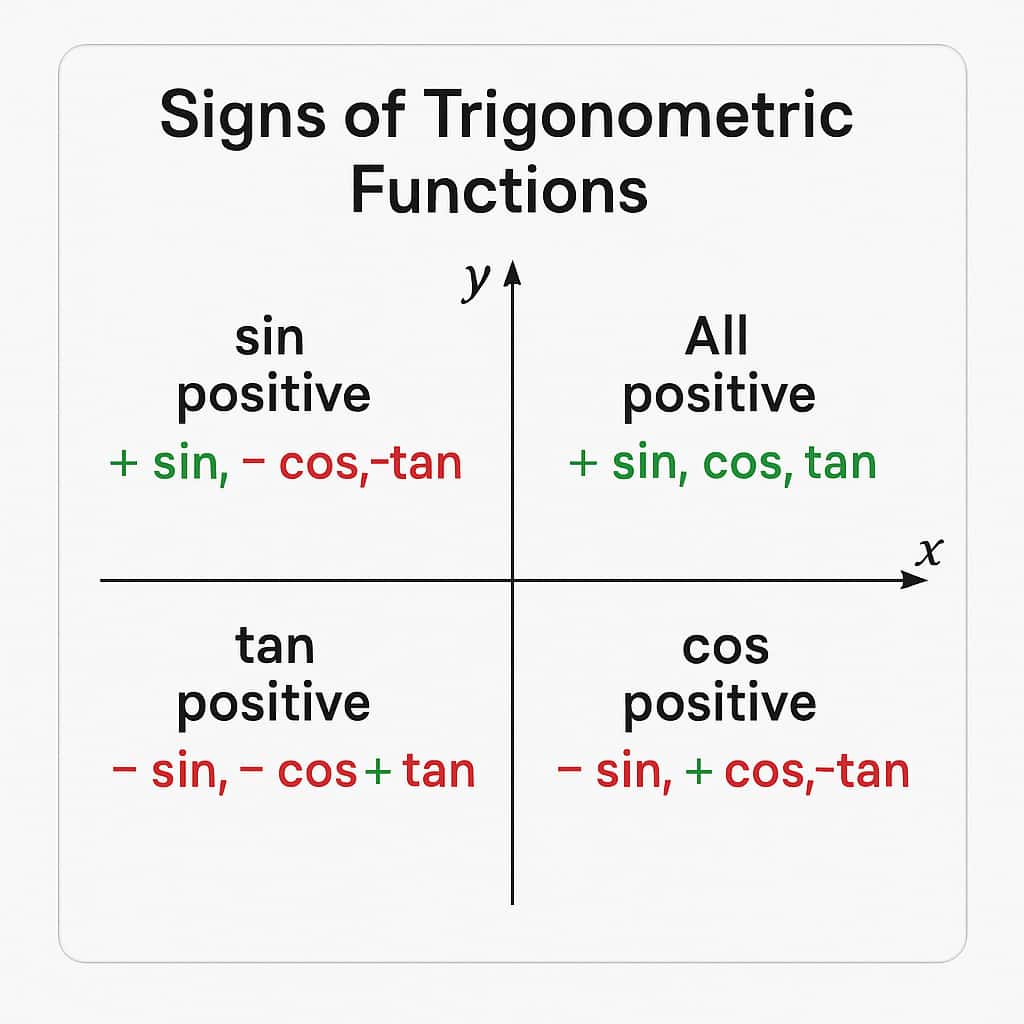
The ASTC rule in trigonometry—commonly remembered as “All Sugar To Coffee”—provides a quick way to identify which trigonometric functions are positive in each quadrant. Using a trigonometric functions sign table or a quadrant-wise trigonometry sign chart makes it easier to remember these rules and apply them efficiently in geometry, calculus, physics, and competitive exams.
Definition of Basic Trigonometric Functions (Sine, Cosine, Tangent)
The three primary trigonometric functions are sine ($\sin$), cosine ($\cos$), and tangent ($\tan$). These functions can be defined using a right-angled triangle or extended using the coordinate plane and unit circle.
Trigonometric Functions in a Right-Angled Triangle
For an acute angle $\theta$ in a right-angled triangle:
$\sin \theta = \dfrac{\text{Opposite side}}{\text{Hypotenuse}}$
$\cos \theta = \dfrac{\text{Adjacent side}}{\text{Hypotenuse}}$
$\tan \theta = \dfrac{\text{Opposite side}}{\text{Adjacent side}}$
These definitions form the foundation of trigonometric ratios taught at the school level.
Trigonometric Functions on the Coordinate Plane
When trigonometric functions are extended beyond acute angles, the coordinate plane is used.
If the terminal side of an angle $\theta$ passes through a point $(x, y)$ and the distance from the origin is
$r = \sqrt{x^2 + y^2}$, then:
$\sin \theta = \dfrac{y}{r}$
$\cos \theta = \dfrac{x}{r}$
$\tan \theta = \dfrac{y}{x}$
From these expressions, it becomes clear that the signs of $\sin \theta$, $\cos \theta$, and $\tan \theta$ depend on the signs of $x$, $y$, and $r$, which vary across different quadrants.
Signs of Trigonometric Functions
The sign of trigonometric ratios of an angle depends on the quadrant in which the terminal side of the angle lies. We always take $OP = r$ as positive. Thus, the sign of trigonometric functions depends on the sign of $x and y$.
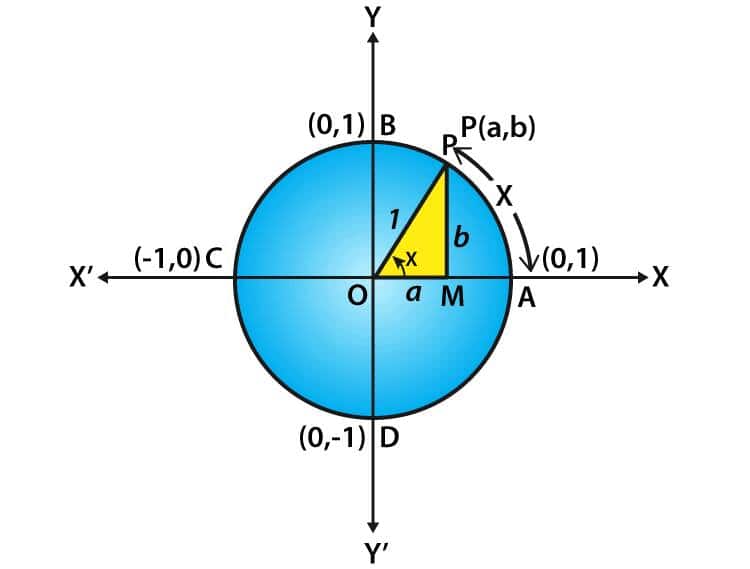
Assume $r = 1$, since this is a unit circle.
Let $P(a, b)$ be any point on the circle with angle $\angle AOP = x$ radians, i.e., the length of arc $AP = x$.
Clearly,
$\cos x = a$
$\sin x = b$
In the right triangle $OMP$ (with $O$ as the origin):
$OM^2 + MP^2 = OP^2$
$x^2 + y^2 = 1$
Thus, for every point on the unit circle:
$x^2 + y^2 = 1$
$\cos^2 x + \sin^2 x = 1$
Since one complete revolution subtends an angle of $2\pi$ radians at the center of the circle:
$\angle AOB = \dfrac{\pi}{2}$
$\angle AOC = \pi$
$\angle AOD = \dfrac{3\pi}{2}$
All angles which are integral multiples of $\dfrac{\pi}{2}$ are called quadrantal angles.
For these quadrantal angles, we have:
$\cos 0 = 1$
$\sin 0 = 0$
$\cos \dfrac{\pi}{2} = 0$
$\sin \dfrac{\pi}{2} = 1$
Now, if we take one complete revolution from point $P$, we return to the same point $P$ again.
Thus, we also observe that if $x$ increases or decreases by an integral multiple of $2\pi$, the values of sine and cosine functions remain unchanged:
$\sin(x + 2\pi) = \sin x$
$\cos(x + 2\pi) = \cos x$
Variation in the Values of Trigonometric Functions in Different Quadrants
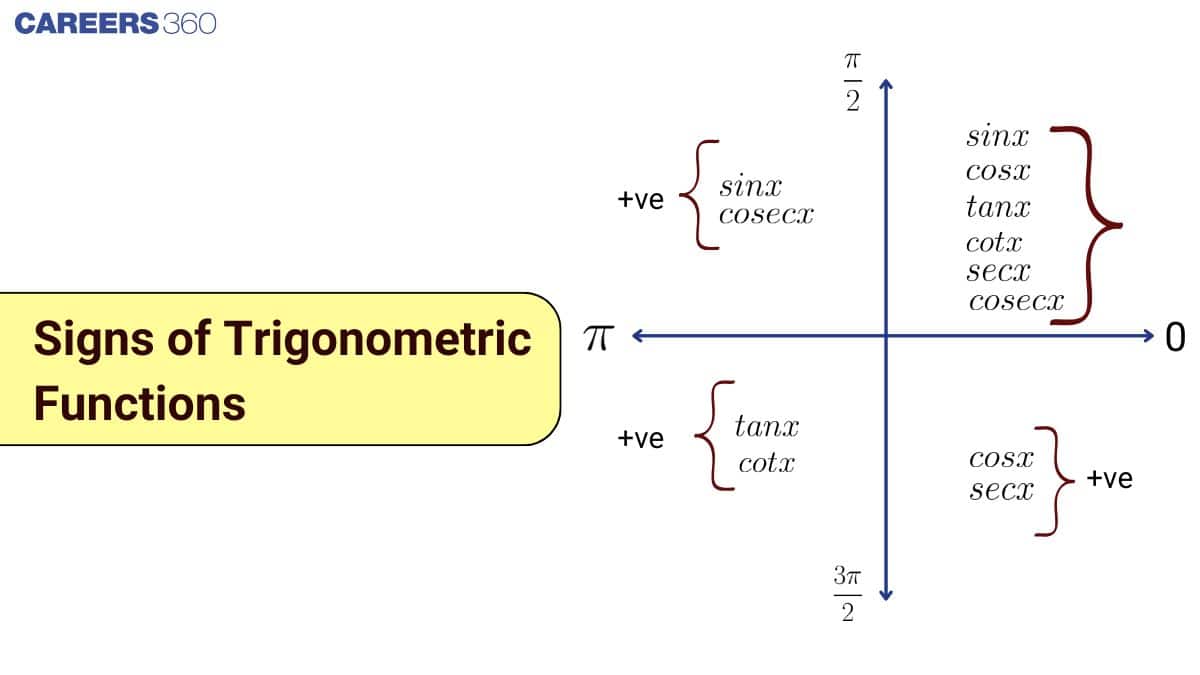
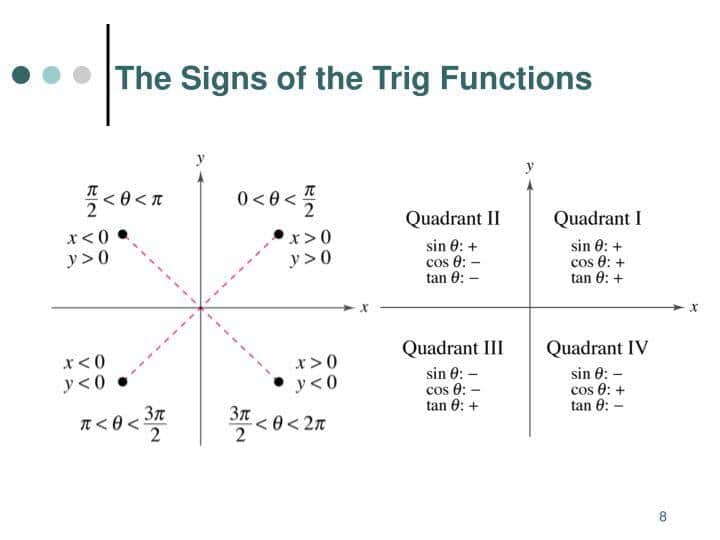
Understanding how trigonometric functions behave in different quadrants of the coordinate plane is crucial for solving a wide range of trigonometry problems involving angles beyond $90^\circ$. As the angle $x$ increases from $0$ to $2\pi$, the values and signs of sine, cosine, tangent, and their reciprocals change depending on the quadrant. Below is a quadrant-wise analysis of this variation, along with the commonly used mnemonic rule "Add Sugar To Coffee" (ASTC).
First Quadrant: $0 < x < \dfrac{\pi}{2}$
Which trignometric ratios is positive in first quadrant? In the first quadrant $\sin \theta, \cos \theta, \tan \theta, \sec \theta, cosec \theta$, and $\cot \theta$ are all positive.
As $x$ increases from $0$ to $\dfrac{\pi}{2}$:
- $\sin x$ increases from $0$ to $1$
- $\cos x$ decreases from $1$ to $0$
- $\tan x$ increases from $0$ to $\infty$
- $\cot x$ decreases from $\infty$ to $0$
- $\sec x$ increases from $1$ to $\infty$
- $cosec x$ decreases from $\infty$ to $1$
Since both $x > 0$ and $y > 0$ in this quadrant, all trigonometric functions are positive.
Second Quadrant: $\dfrac{\pi}{2} < x < \pi$
As $x$ increases from $\dfrac{\pi}{2}$ to $\pi$:
- $\sin x$ decreases from $1$ to $0$
- $\cos x$ decreases from $0$ to $-1$
- $\tan x$ decreases from $\infty$ to $0$ (and is undefined at $\dfrac{\pi}{2}$)
- $\cot x$ increases from $0$ to $-\infty$
- $\sec x$ decreases from $\infty$ to $-1$
- $cosec x$ increases from $1$ to $\infty$
In this quadrant, $x < 0$ and $y > 0$, so only $\sin \theta$ and $cosec \theta$ are positive.
Third Quadrant: $\pi < x < \dfrac{3\pi}{2}$
Here, both $x < 0$ and $y < 0$. So:
- $\sin x < 0$
- $\cos x < 0$
- $\tan x > 0$
- $\cot x > 0$
- $\sec x < 0$
- $cosec x < 0$
Thus, only $\tan \theta$ and $\cot \theta$ are positive in the third quadrant.
Fourth Quadrant: $\dfrac{3\pi}{2} < x < 2\pi$
In this quadrant:
- $x > 0$ and $y < 0$
- $\cos x > 0$
- $\sec x > 0$
- All other trigonometric functions are negative
So, only $\cos \theta$ and $\sec \theta$ are positive here.

Quadrant-Wise Positivity of Trigonometric Functions
- First Quadrant: All six functions are positive
$\sin \theta > 0,\ \cos \theta > 0,\ \tan \theta > 0,\ cosec \theta > 0,\ \sec \theta > 0,\ \cot \theta > 0$ - Second Quadrant: Only sine and cosecant are positive
$\sin \theta > 0,\ cosec \theta > 0$ - Third Quadrant: Only tangent and cotangent are positive
$\tan \theta > 0,\ \cot \theta > 0$ - Fourth Quadrant: Only cosine and secant are positive
$\cos \theta > 0,\ \sec \theta > 0$
How do we decide the sign of the trigonometric ratios? The sign of trigonometric ratios of an angle depends on the quadrant in which the terminal side of the angle lies.
Mnemonic: Add Sugar To Coffee (ASTC Rule)
To easily remember which trigonometric functions are positive (when rotated counter clockwise) in which quadrant, use the mnemonic:
- A (Add) – All functions positive in Quadrant I
- S (Sugar) – Only Sine and Cosecant are positive in Quadrant II
- T (To) – Only Tangent and Cotangent are positive in Quadrant III
- C (Coffee) – Only Cosine and Secant are positive in Quadrant IV
Depending on the signs of $x$ and $y$, the various trigonometric ratios will have different signs.
Table of Signs of Trigonometric Functions
The Table of Signs of Trigonometric Functions helps you quickly determine whether sine, cosine, tangent, and their reciprocals are positive or negative in each quadrant. Using the ASTC rule ("Add Sugar To Coffee"), this chart simplifies how to remember the signs of trig functions and is essential for solving trigonometry problems accurately.
| Quadrant | Sine ($\sin$) | Cosine ($\cos$) | Tangent ($\tan$) | Cosecant ($\csc$) | Secant ($\sec$) | Cotangent ($\cot$) |
|---|---|---|---|---|---|---|
| I (0° to 90°) | + | + | + | + | + | + |
| II (90° to 180°) | + | – | – | + | – | – |
| III (180° to 270°) | – | – | + | – | – | + |
| IV (270° to 360°) | – | + | – | – | + | – |
Signs of Trigonometric Functions for Negative Angles
In trigonometry, angles are not restricted to positive values. Angles measured in the clockwise direction from the positive x-axis are called negative angles. Understanding the signs of trigonometric functions for negative angles is essential for correctly evaluating expressions, solving equations, and working with graphs and identities.
Negative angles follow specific sign rules that are directly connected to the even–odd nature of trigonometric functions.
Even and Odd Trigonometric Functions
The behavior of trigonometric functions for negative angles depends on whether the function is even or odd.
Even functions satisfy $f(-\theta) = f(\theta)$
Odd functions satisfy $f(-\theta) = -f(\theta)$
This property determines whether the sign changes or remains the same when the angle becomes negative.
Signs of Sine and Cosecant for Negative Angles
Sine and cosecant are odd trigonometric functions, which means their signs change for negative angles.
$\sin(-\theta) = -\sin \theta$
$\csc(-\theta) = -\csc \theta$
So, if $\sin \theta$ is positive, then $\sin(-\theta)$ will be negative, and vice versa.
Signs of Cosine and Secant for Negative Angles
Cosine and secant are even trigonometric functions, so their signs remain unchanged for negative angles.
$\cos(-\theta) = \cos \theta$
$\sec(-\theta) = \sec \theta$
This means cosine and secant have the same sign for both $\theta$ and $-\theta$.
Signs of Tangent and Cotangent for Negative Angles
Tangent and cotangent are odd functions, so their signs reverse for negative angles.
$\tan(-\theta) = -\tan \theta$
$\cot(-\theta) = -\cot \theta$
This property is especially useful when simplifying trigonometric expressions and identities.
Why These Sign Rules Matter
Knowing the signs of trigonometric functions for negative angles helps in:
Evaluating trigonometric ratios correctly
Solving trigonometric equations with negative solutions
Drawing accurate graphs of trigonometric functions
Applying identities in calculus and physics
These rules are frequently tested in CBSE Class 11 and 12, JEE, and other competitive exams.
Domain and Range of Trigonometric Functions
Understanding the domain and range of trigonometric functions is essential for solving equations and evaluating expressions involving $\sin x$, $\cos x$, $\tan x$, and their reciprocals. These definitions come from how the functions behave on the unit circle and their algebraic relationships.
Domain of Trigonometric Functions
We observe that the point $P(a, b)$ on the unit circle can be obtained by rotating the terminal ray $OP$ any number of times—clockwise or anticlockwise. Therefore, the functions $\sin x$ and $\cos x$ are defined for all real values of $x$.
So, Domain of $\sin x$ and $\cos x$: $\mathbb{R}$
However, the function $\tan x$ is undefined where $\cos x = 0$ because:
$\tan x = \dfrac{\sin x}{\cos x}$
$\cos x = 0$ at $x = \dfrac{(2n+1)\pi}{2}$, where $n \in \mathbb{Z}$
So, Domain of $\tan x$ and $\sec x$:
$\mathbb{R} - \left\{ \dfrac{(2n+1)\pi}{2} \mid n \in \mathbb{Z} \right\}$
Similarly, $\cot x$ and $cosec x$ are undefined when $\sin x = 0$ because:
$\cot x = \dfrac{\cos x}{\sin x}$, and $cosec x = \dfrac{1}{\sin x}$
$\sin x = 0$ at $x = n\pi$, where $n \in \mathbb{Z}$
So, Domain of $\cot x$ and $cosec x$:
$\mathbb{R} - \left\{ n\pi \mid n \in \mathbb{Z} \right\}$
Range of Trigonometric Functions
Since the point $P(a, b)$ lies on the unit circle, the values of $a$ and $b$ are limited:
- $-1 \leq \cos x \leq 1$
- $-1 \leq \sin x \leq 1$
Thus, Range of $\sin x$ and $\cos x$:
$[-1, 1]$
The other functions are unbounded (except at points of discontinuity), so their ranges are:
- Range of $\tan x$ and $\cot x$:
$\mathbb{R}$ - Range of $\sec x$ and $cosec x$:
$(-\infty, -1] \cup [1, \infty)$
Domain and Range Table of Trigonometric Functions
Here’s a clear reference table for all six standard trigonometric ratios, it also helps in understanding the table of signs of trigonometric functions:
Trigonometric Function | Domain | Range |
$\sin x$ | $\mathbb{R}$ | $[-1, 1]$ |
$\cos x$ | $\mathbb{R}$ | $[-1, 1]$ |
$\tan x$ | $\mathbb{R} - \left\{ \dfrac{(2n+1)\pi}{2} \mid n \in \mathbb{Z} \right\}$ | $\mathbb{R}$ |
$\cot x$ | $\mathbb{R} - \left\{ n\pi \mid n \in \mathbb{Z} \right\}$ | $\mathbb{R}$ |
$\sec x$ | $\mathbb{R} - \left\{ \dfrac{(2n+1)\pi}{2} \mid n \in \mathbb{Z} \right\}$ | $(-\infty, -1] \cup [1, \infty)$ |
$cosec x$ | $\mathbb{R} - \left\{ n\pi \mid n \in \mathbb{Z} \right\}$ | $(-\infty, -1] \cup [1, \infty)$ |
Real-Life Applications of Trigonometric Sign Rules
Understanding positive and negative trig functions is not just important in exams, it has real-world uses too. For instance:
- In navigation and GPS, directions and angles are calculated using trigonometric functions signs to determine north-south or east-west components.
- In engineering, the behavior of rotating objects is modeled using sine and cosine functions, with their signs indicating direction of rotation.
- In physics, especially in projectile motion or oscillation problems, applying the correct sign to $\sin \theta$ or $\cos \theta$ ensures accurate modeling.
So whether you're calculating trig function signs in each quadrant or applying the ASTC rule in trigonometry, these sign rules have strong value both in theory and in real-life problem solving.
Solved Examples Based on Sign of Trigonometric Functions
Example 1: If $ABCD$ is a convex quadrilateral such that $4 \sec A + 5 = 0$, then the quadratic equation whose roots are $\tan A$ and $cosec A$ is:
Solution: Given: $4 \sec A + 5 = 0$
$\Rightarrow \sec A = -\dfrac{5}{4}$
Since $ABCD$ is a convex quadrilateral, angle $A$ lies between $\dfrac{\pi}{2}$ and $\pi$ (i.e., second quadrant), where:
$\cos A < 0$
$\sin A > 0$
$\tan A < 0$
Now, $\sec A = \dfrac{1}{\cos A} = -\dfrac{5}{4}$
$\Rightarrow \cos A = -\dfrac{4}{5}$
Using identity: $\sin^2 A + \cos^2 A = 1$
$\Rightarrow \sin^2 A = 1 - \left(-\dfrac{4}{5}\right)^2 = 1 - \dfrac{16}{25} = \dfrac{9}{25}$
$\Rightarrow \sin A = \dfrac{3}{5}$ (positive in second quadrant)
Now, $\tan A = \dfrac{\sin A}{\cos A} = \dfrac{\dfrac{3}{5}}{-\dfrac{4}{5}} = -\dfrac{3}{4}$
$cosec A = \dfrac{1}{\sin A} = \dfrac{5}{3}$
Now, let the quadratic equation with roots $\tan A$ and $cosec A$ be:
$(x - \tan A)(x - cosec A) = 0$
Substitute values: $\left(x + \dfrac{3}{4}\right)\left(x - \dfrac{5}{3}\right) = 0$
Multiply: $x^2 - \dfrac{5}{3}x + \dfrac{3}{4}x - \dfrac{15}{12} = 0$
Combine terms: $x^2 - \left(\dfrac{5}{3} - \dfrac{3}{4}\right)x - \dfrac{15}{12} = 0$
$\Rightarrow x^2 - \dfrac{11}{12}x - \dfrac{15}{12} = 0$
Multiply throughout by 12 to remove denominators:
$12x^2 - 11x - 15 = 0$
Example 2: Find the range of function $f(x) = \dfrac{1}{2 \sin x - 3}$.
Solution: We know that $-1 \leq \sin x \leq 1$
Multiplying the entire inequality by $2$:
$-2 \leq 2 \sin x \leq 2$
Subtracting $3$ from all parts: $-5 \leq 2 \sin x - 3 \leq -1$
So, the denominator $2 \sin x - 3$ lies in the interval $[-5, -1]$
Therefore, $f(x) = \dfrac{1}{2 \sin x - 3} \in \left( \dfrac{1}{-1}, \dfrac{1}{-5} \right) = (-1, -\dfrac{1}{5})$
Hence, the range of $f(x)$ is: ${(-1,\ -\dfrac{1}{5})$
Example 3: If $\dfrac{3\pi}{4} < \alpha < \pi$, then what is the value of $\sqrt{cosec^2 \alpha + 2 \cot \alpha}$?
Solution: We start with:
$\sqrt{cosec^2 \alpha + 2 \cot \alpha}$
Using the identity $cosec^2 \alpha = 1 + \cot^2 \alpha$, we get:
$= \sqrt{1 + \cot^2 \alpha + 2 \cot \alpha}$
This simplifies to:
$= \sqrt{(\cot \alpha + 1)^2}$
Which gives: $= |1 + \cot \alpha|$
Now, since $\dfrac{3\pi}{4} < \alpha < \pi$, $\alpha$ lies in the second quadrant.
In the second quadrant:
$\cot \alpha < 0 \Rightarrow 1 + \cot \alpha < 1$
So: $|1 + \cot \alpha| = -(1 + \cot \alpha)$
Therefore, the final answer is:
$-1 - \cot \alpha$
Example 4: If $x$ lies in the third quadrant, then evaluate the expression $\sqrt{3 - \sqrt{\dfrac{1}{1 + \cot^2 x}}}$.
Solution: We start with: $\sqrt{3 - \sqrt{\dfrac{1}{1 + \cot^2 x}}}$
Using the identity $1 + \cot^2 x = cosec^2 x$, we get:
$= \sqrt{3 - \sqrt{\dfrac{1}{cosec^2 x}}}$
Now, since $\dfrac{1}{cosec^2 x} = \sin^2 x$, we get:
$= \sqrt{3 - |\sin x|}$
Since $x$ lies in the third quadrant, $\sin x < 0$, so:
$|\sin x| = -\sin x$
Therefore: $= \sqrt{3 + \sin x}$
Example 5: Find the value of the trigonometric function $cosec(-1350^\circ)$.
Solution: We know that trigonometric functions are periodic, and for $cosec x$, the period is $360^\circ$. So:
$cosec(-1350^\circ) = cosec(-1350^\circ + 4 \times 360^\circ)$
Now: $= cosec(-1350^\circ + 1440^\circ)$
$= cosec(90^\circ)$
Using standard values:
$cosec(90^\circ) = 1$
List of Topics Related to the Trigonometric Functions
To truly master trigonometric identities and their applications, students must first gain clarity on the foundational topics that support them. This section outlines all key concepts related to trigonometric functions—ranging from basic ratios and quadrant sign rules to advanced identities, transformations, and real-world applications.
NCERT Resources
To score well in Class 11 Maths and build a strong base for competitive exams, mastering NCERT Chapter 3 – Trigonometric Functions is crucial. This section provides all essential NCERT study materials, including detailed notes, solved exercises, and exemplar problems. These CBSE-aligned resources help clarify core trigonometric concepts like identities, formulas, and ratios through structured explanations and accurate solutions.
NCERT Class 11 Chapter 3 Trigonometric Functions Notes
Practice Questions on Signs of Trigonometric Functions
Consistent problem-solving is essential to fully understand the signs of trigonometric functions in different quadrants. This section features a curated collection of practice questions covering the signs of sine, cosine, tangent, and other trigonometric ratios. Designed for Class 11 students and competitive exam aspirants, these questions range from fundamental to advanced levels, understanding both conceptual clarity and exam readiness.
Sign Of Trigonometric Functions - Practice Question MCQ
We have provided the list of practice questions based on the next topics below:
Frequently Asked Questions (FAQs)
The sign of trigonometric ratios of an angle depends on the quadrant in which the terminal side of the angle lies
In the first Quadrant and second quadrant sin is positive. In the third quadrant and fourth quadrant, sin is negative.
In the first quadrant sinθ,cosθ,tanθ,secθ,cscθ, and cotθ are all positive.
The range of each sinx and cos x is [−1,1].
In the third quadrant, so only tanθ and cotθ are positive, sinθ,cosθ,secθ, and cscθ are negative.
Sine is an odd function, so its value changes sign when the angle changes from $\theta$ to $-\theta$. This happens due to symmetry about the origin on the coordinate plane.