


Online Higher Education Boom: NEP 2020, UGC Regulations, Trends & Future Outlook
Higher education in India has grown beyond the brick-and-mortar classrooms with online, flexible learning. From correspondence courses to distance learning and now the technology-driven online ecosystem, higher education has evolved significantly. This boom is structural, facilitated by the National Education Policy (NEP) 2020 and robust UGC regulations.
This Story also Contains
- NEP 2020 and Online Higher Education
- UGC Regulations For Online Higher Education
- Online Education Market Explosion
- Multiple Entry/Exit Options
- Success Story
- ROI of Online Higher Education
- Role of Work Integrated Learning Programmes (WILP)
- Challenges of Online Higher Education
- The Way Forward
The number of Higher Education Institutions (HEIs) entitled to offer online degrees has nearly doubled, growing from 56 in 2021-22 to 113 in 2025-26. Additionally, the catalogue of online programmes has expanded by over 2.2 times to 756 courses and the approved intake has increased from 94,670 (2021-22) to 3,65,980 (2025-26).
However, the lack of digital infrastructure and networking opportunities, and skepticism regarding quality pose critical challenges. Online higher education has evolved as a mainstream option for upskilling, recognised by employers and regulators alike.
NEP 2020 and Online Higher Education
Given the recent global pandemic and the need to expand access, the National Education Policy (NEP) 2020 explicitly recognises the necessity of alternative modes of quality education. For the online higher education system, the policy outlines a roadmap that balances technological integration with quality assurance.
Equivalence and Quality Assurance: The NEP 2020 mandates that ODL programmes aim to be equivalent to the highest quality on-campus programmes available. To ensure this, norms, standards, and guidelines for the regulation and accreditation of ODL will be prepared, ensuring that ODL degrees carry the same weight as traditional ones.
Institutional Autonomy and Expansion: To boost the Gross Enrolment Ratio (GER) to 50% by 2035, the policy encourages HEIs to offer ODL and online programmes. However, they must have accreditation and only institutions that are specifically accredited to do so can run these courses.
Digital Infrastructure and Public Platforms: The policy envisions a need to invest in open, interoperable, and evolvable public digital infrastructure to prevent technology lock-in.
Expansion of Online Teaching Platforms: Existing platforms like SWAYAM and DIKSHA will be extended to provide teachers with structured, user-friendly tools, including two-way video and audio interfaces for conducting online classes.
Virtual Labs: To ease the limitations of online education in practical subjects, existing e-learning platforms must be leveraged to create virtual labs, ensuring students have equal access to hands-on experiment-based learning.
Blended Learning: While encouraging digital growth, the NEP 2020 emphasises that online education cannot entirely replace in-person learning. It advocates for identifying and replicating effective models of blended learning, which combines digital content with face-to-face interaction, across different subjects.
UGC Regulations For Online Higher Education
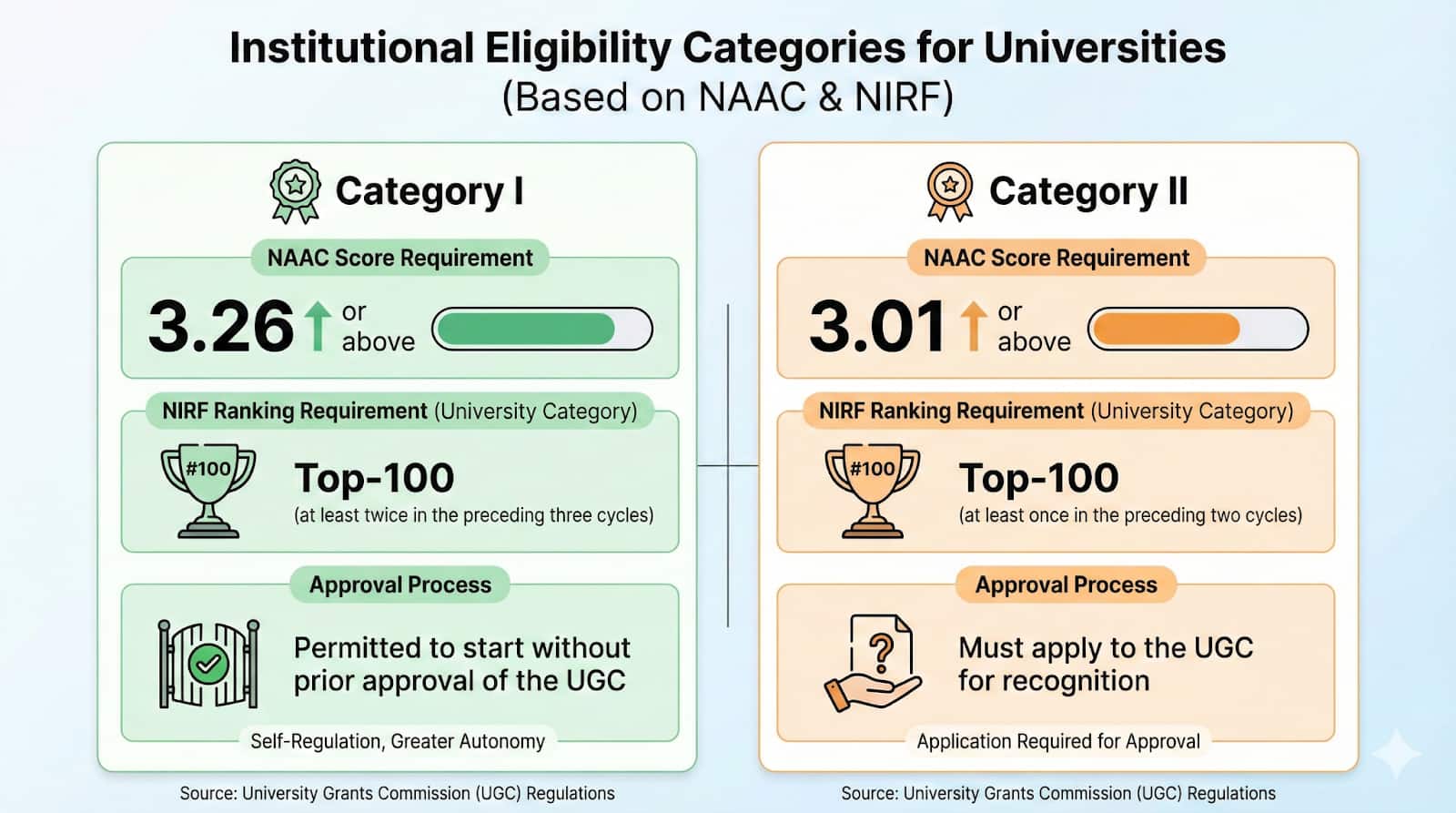
The University Grants Commission (UGC) plays an important role in ensuring the credibility and standardisation of the degrees at the undergraduate and postgraduate levels, and grant of post graduate diploma in ODL and online mode. The UGC Regulations 2020 and subsequent amendments in 2021, 2022 and 2024 defined the eligibility for HEIs to offer online degrees based on NAAC scores and NIRF rankings.
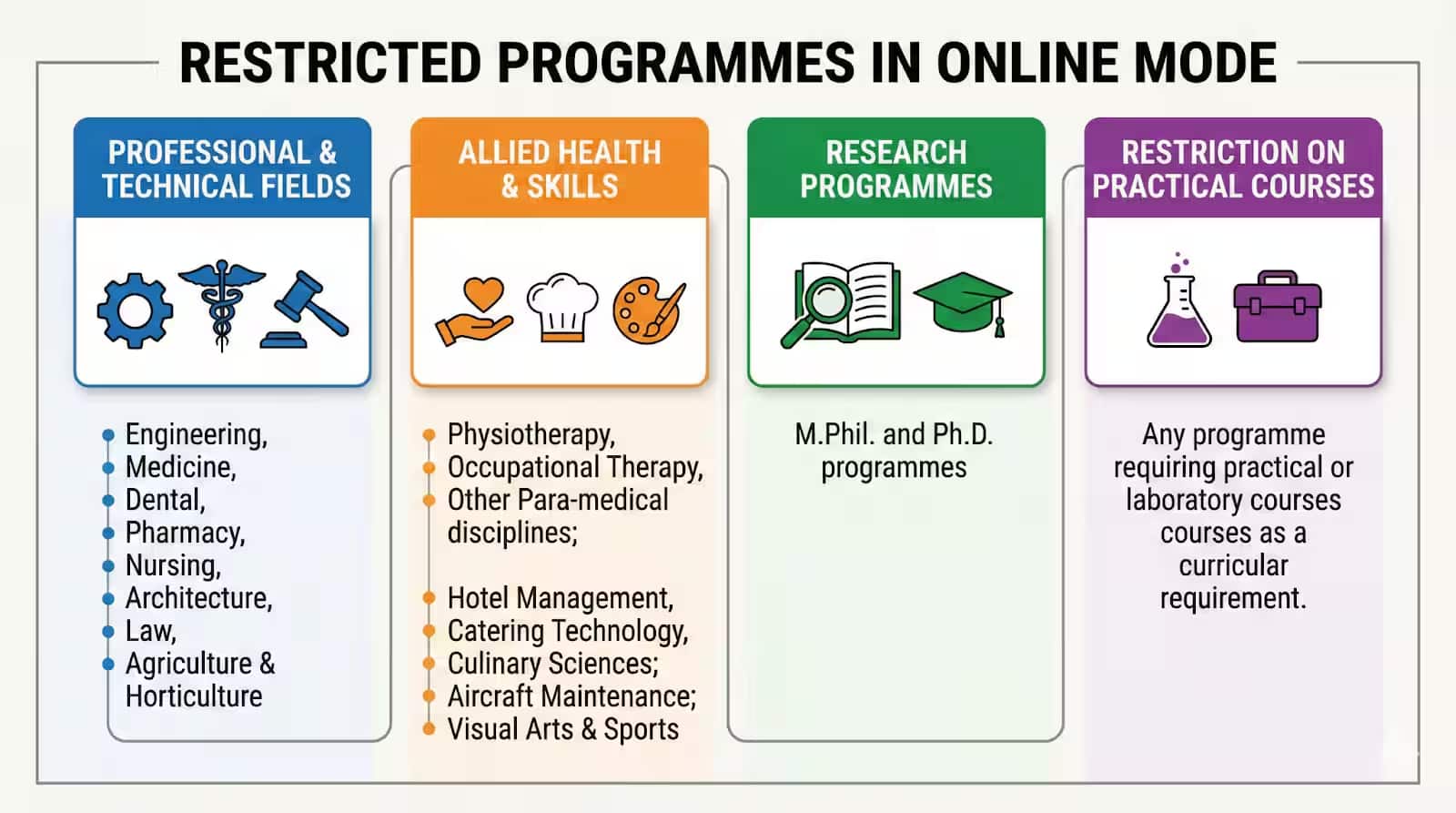
Limitations on Disciplines
While the scope is vast, the UGC prohibits online programmes in disciplines that require hands-on practical or laboratory courses to preserve the integrity of skills-based education.
Read More About Online Programs That Could Be a Waste of Your Time and Money
Online Education Market Explosion
The online education market in India has witnessed exponential growth, driven by internet penetration and the demand for upskilling.
Market Growth: The market has reached USD 3.6 billion in 2025 and is estimated to grow at a CAGR of 23.28% to reach USD 23.9 billion by 2034 (as per the market report by IMARC Group).
Institutional Growth and Programme Expansion
The number of HEIs entitled to offer online programmes has nearly doubled, rising from 56 (2021–22) to 113 (2025–26). The number of online programmes has grown from 334 to 756.
| Metric | 2021–22 | 2025–26 | Growth Trend |
|---|---|---|---|
Number of HEIs Entitled | 56 | 113 | Nearly 2x increase |
Total Online Programmes | 334 | 756 | ~2.2x increase |
Enrollment Surge: Online and ODL Programmes
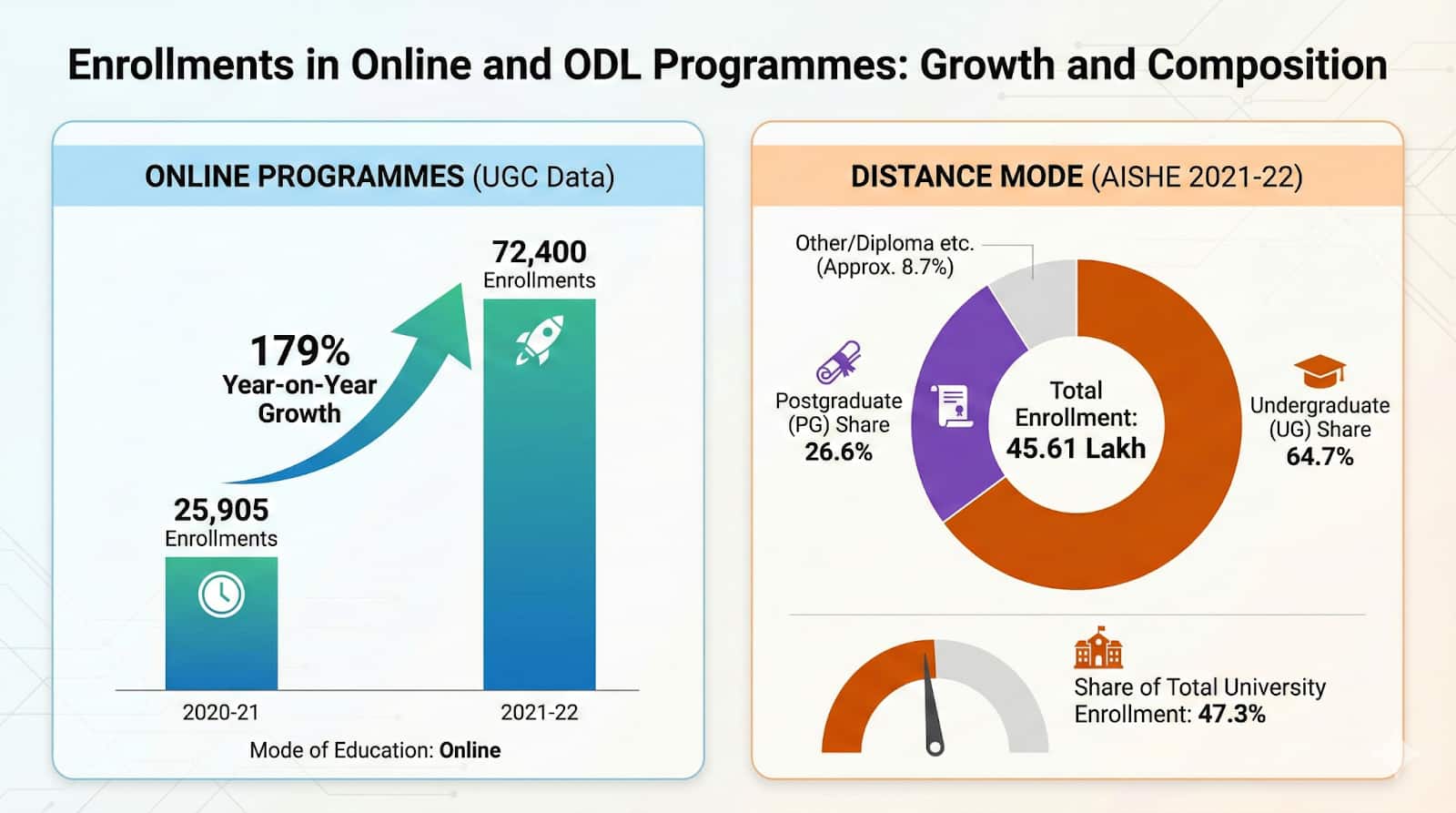
Enrollments in online programmes jumped by 179% between 2020-21 and 2021-22, as per the UGC’s former Chairman Mamidala Jagadesh Kumar.
On the other hand, 45.61 lakh students were enrolled through distance mode in higher education at different levels, as per AISHE Report 2021-22. Highest percentage of distance enrolment was in undergraduate level with 64.7% of the total distance enrolment. PG level holds 26.6% of the total distance enrolment. Rest enrolments are in PG Diploma, Diploma, Certificate, and Integrated programmes. Around 47.3% of the total University enrolment was through distance mode.
Multiple Entry/Exit Options
The NEP 2020 establishes a framework where rigid boundaries are removed, creating room for multiple entry and exit options and new opportunities for lifelong learning.
Entry and Exit Options (3 or 4-year duration)
| Duration of Study | Qualification Awarded | Description |
|---|---|---|
Exit after 1 Year | Certificate | Awarded to students who complete one year in a discipline or field, including vocational or professional areas. |
Exit after 2 Years | Diploma | Awarded to students who complete two years of study. |
Exit after 3 Years | Bachelor’s Degree | Awarded upon the completion of a standard 3-year undergraduate programme. |
Completion of 4 Years | Multidisciplinary Bachelor's with Research | A preferred option that allows for rigorous specialisation and research work, often a gateway to direct PhD entry. |
Academic Bank of Credits (ABC)
The critical component of the NEP 2020 is the Academic Bank of Credits (ABC). This is a digital repository allowing students to accumulate credits earned from different HEIs (online or offline) and transfer them seamlessly towards a degree or diploma, even if it is offered by different institutions.
The Academic Bank of Credits (ABC) operationalises the multiple entry and exit option. For instance, a student can drop out after a year with a certificate, store their credits in the ABC, and redeem them years later to complete their degree at a different university. This flexibility serves as the backbone of lifelong learning.
Success Story
IIT Madras BS Degree in Data Science and Applications is an online technical degree programme in India that has 38,534 active students. The programme offers multiple entry and exit options at Foundation, Diploma (DP and DDS), BSc Degree and BS Degree levels.
Enrollment & Progress (April 2025 Report)
| Particulars | Details |
|---|---|
Total Applications | 168,740 (First applications, Jan 2021 – Jan 2025) |
Qualified Candidates For Foundation Level | 63,143 (37.42% of applications received) |
Number of Students Started Programme | 52,144 (82.5% of qualified candidates) |
Active Students | 38,534 (73% of those who started the programme) |
Gender Distribution | Male: 72.7% Female: 27.3% |
Student Type | Dual Degree: 12,561 (Foundation level) Standalone: 7,980 (Foundation level) Working Professionals: 2,025 (Foundation level) Others: 2,050 (Foundation level) |
Completions | Foundation: 14,900 completed Diploma: 831 (DDS), 440 (DP), 823 (Both) completed BS Degree: 197 completed |
Career Choice & Higher Education (April 2025 Report)
| Particulars | Value |
|---|---|
Self-Secured Opportunities | Internships: 1,134 (May 2024); 1,237 (September 2024); 862 (January 2025) Jobs: 358 (May 2024); 567 (September 2024); 471 (January 2025) |
Placements Through IIC | Internships: 40 (May 2024); 49 (September 2024); 29 (January 2025) Jobs: 5 (May 2024); 3 September 2024; 8 January 2025 |
Salary for Jobs (Through IIC) | Minimum: Rs 3.6 LPA Median: Rs 8.09 LPA Highest: Rs 15 LPA |
Salary for Jobs (Self-secured) | Minimum: Rs <5 LPA Highest: Rs >20 LPA |
Higher Education Opportunities | Students have secured admission to outside India, and IITs/IISc. |
GATE Performance (Data Science and AI paper) | 2024 Top Rank: 8, 11, 15, 17, 29, 79, 94 2025 Top Rank: 1, 7, 10, 29, 38, 56, 76 |
Read Complete Details about IIT Madras BS in Data Science: Salaries, Career Growth for 2024 & 2025 Job Outcomes
ROI of Online Higher Education
Students are always concerned about the ROI of their online programmes. While the cost of online programmes is typically more affordable than on-campus programmes, the financial equation (scholarships, education loans, and employment opportunities and placements) still persists.
For online students, institutes in India provide career support and placements through interview preparation sessions, industry expert guest lectures, and tailored support and resources to accomplish their career aspirations. For example, the highest Online MBA placement package offered has been Rs 18 LPA, with an average package of Rs 5.5 LPA, as per the Online Manipal's Launchpad 2025.
Also Read: Online MBA Placement 2026: Highest Salary Packages, Top Recruiters
Role of Work Integrated Learning Programmes (WILP)
Work Integrated Learning Programmes (WILP) represent a more specialised system in higher education that distinguishes itself from standard online degrees by specifically targeting working professionals. Offered by institutions like BITS Pilani, these programmes combine academic study with the professional work the student is already doing.
Curriculum: The coursework of WILP often requires participants to apply theoretical concepts to real-world projects in their workplaces.
Regulatory Status: Work Integrated Learning Programmes (WILP) do not always fall under the standard ODL methodology. Instead, it often operates through specific institutions like BITS Pilani (an Institute of Eminence) or via the emerging Skill University framework sanctioned by state acts and recognised by the UGC and AICTE.
Corporate Sponsorship: The growth of WILP is majorly driven by B2B adoption. Employers increasingly sponsor these programmes to retain talent and upskill employees in niche areas such as Data Science, IoT, and FinTech.
Virtual Labs: Institutes like BITS Pilani offer cloud-based remote labs that enable engineering and management students to access hardware and software environments remotely.
Challenges of Online Higher Education
Online higher education faces challenges like the perception gap between online and on-campus programmes in terms of quality and credibility for employability and further higher education. The digital divide between Tier 1 and Tier 2 and 3 cities, as well as concerns about the recognition and validity of online degrees, presents significant perceptual hurdles, despite UGC regulations that provide equivalent status to online programmes.
Students in Tier-2 and Tier-3 cities often struggle with unstable internet bandwidth and a lack of dedicated learning devices. This disparity creates an uneven scenario, where online education risks becoming a privilege rather than a right. Furthermore, while AI-proctored exams have improved, concerns regarding academic integrity also pose a challenge.
Lack of networking opportunities is another critical challenge of online higher education. Most students report networking as a crucial concern when they think of pursuing an online degree programme.
Additionally, many employers accept online degrees but top-tier legacy companies still occasionally view online degrees with skepticism compared to full-time, on-campus credentials. This also creates doubts regarding the future career among students about whether to pursue an online degree.
The Way Forward
The future of online education lies in flexibility, technology, and adaptive learning. With UGC and AICTE-approved programmes, global recognition, and wide industry acceptance, online higher education has proven its worth.
The rise in the number of higher educational institutions (from 56 in 2021-22 to 113 in 2025-26) to offer full-fledged online programmes showcases growing interest in online education. However, there is a need to improve quality and reputation, digital infrastructure, and equivalence and quality assurance.
Furthermore, the NEP 2020 noted that the benefits of online or digital education cannot be leveraged unless the digital divide is eliminated through concerted efforts, such as the Digital India campaign and the availability of affordable computing devices.
In essence, the future of online higher education in India is not just about digital classrooms; it is about democratising aspiration and lifelong learning through high-quality online degree courses.