


Prime Number Program in Java: How to Print Prime Numbers from 1 to N in Java
Primes are like mathematical gems, and understanding how to work with them is a valuable skill. In this guide, we will explore the realm of prime numbers through a comprehensive Java program. We will decipher the prime no code in Java, learn the Java program to print prime numbers from 1 to 100, and uncover the beauty of the prime number program in JavaScript.
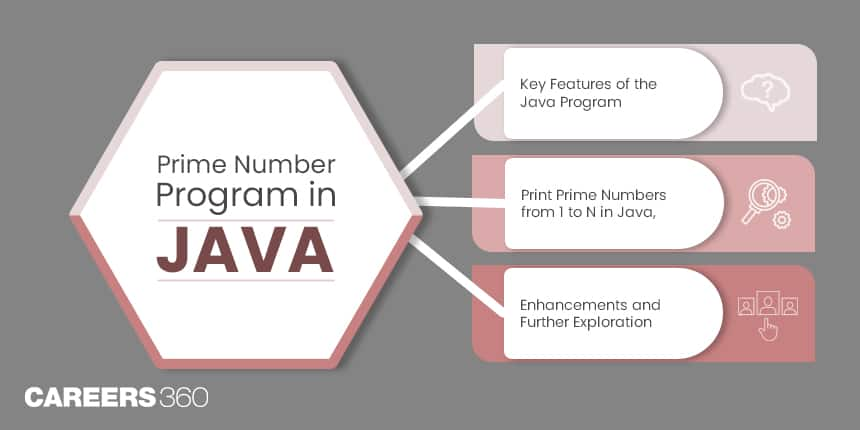
The prime number program in Java is an excellent example of how programming can simplify complex mathematical concepts. A prime number is a whole number greater than 1 that has no positive divisors other than 1 and itself. These unique numbers have fascinated mathematicians for centuries. If you are further interested in gaining knowledge in this field you can have a look at the Online Java Courses and Certifications listed on our website.
Also Read:
Prime Program in Java
The Prime Number Java program will not only help you find prime numbers but also give you a taste of coding in this popular language. The code is designed to be straightforward and beginner-friendly.
Prime Number Program in Java Using Scanner
Here is a simple prime number program in Java to find prime numbers within a specified range:
import java.util.Scanner;
public class PrimeNumbers {
// Main function to find prime numbers till n
public static void main(String[] args) {
int n;
System.out.print("Enter a number: ");
Scanner scanner = new Scanner(System.in);
n = scanner.nextInt();
System.out.println("Prime numbers from 1 to " + n + " are:");
// Looping and checking if the number is divisible
for (int i = 2; i <= n; i++) {
boolean isPrime = true;
for (int j = 2; j <= Math.sqrt(i); j++) {
if (i % j == 0) {
isPrime = false;
break;
}
}
if (isPrime) {
System.out.print(i + " ");
}
}
}
}
Also Read:
Key Features of the Java Program
User Input: The program begins by prompting the user to enter a number, denoted as 'n.' This number defines the range within which the program will find prime numbers.
Nested Loops: The code employs two nested 'for' loops to iterate through numbers from 2 to 'n.' The outer loop (index 'i') represents the number currently being evaluated for primality.
Primality Check: The inner loop (index 'j') checks for factors of the current number 'i.' If a factor is found, the 'isPrime' flag is set to 'false,' and the loop breaks.
Output: If the 'isPrime' flag remains 'true' after the inner loop completes, the number 'i' is a prime number, and it is printed to the screen.
Print Prime Numbers from 1 to N in Java
Once the program is executed, it will provide a list of prime numbers from 1 to the specified value of 'n.' It is a simple yet effective way to visualise and understand prime numbers within a given range.
Also Read:
Enhancements and Further Exploration
While the code we have provided offers a basic understanding of prime numbers, there are numerous ways to enhance and explore this concept further. Some suggestions for expanding your exploration include:
Implementing a program to check whether the given number is prime or not.
Experimenting with different algorithms for finding prime numbers.
Investigating the distribution of prime numbers and their applications in cryptography and number theory.
Related: Java Certification Courses by Top Providers
Conclusion
The prime number program in Java is a powerful tool for exploring the world of prime numbers. It not only helps you find prime numbers within a specified range but also serves as an entry point into the exciting world of programming.
As you explore the concept of prime numbers, you will gain a deeper appreciation for the elegance and mystery of these unique numerical entities. Whether you are a beginner in the world of programming or a math enthusiast, this Java program is a wonderful starting point for your journey into the world of prime numbers.
Frequently Asked Questions (FAQs)
Prime numbers are used in cryptography, hashing functions, and data validation. They play a crucial role in ensuring data security and integrity in software applications.
Yes, there are various algorithms and approaches to find prime numbers. Some methods are more efficient for large numbers, such as the Sieve of Eratosthenes.
Yes, you can easily modify the program by changing the value of 'n' to define the desired range. The program will find prime numbers within that new range.
The Java program uses nested loops to check the primality of numbers within the specified range. It tests each number for divisibility by all numbers from 2 to the square root of the number.
A prime number is a whole number greater than 1 that has no divisors other than 1 and itself. They are important in various fields, including cryptography and data security.
