NIELIT University(Govt. of India Institution) 2026
Campuses in Ropar, Agartala, Aizawl, Ajmer, Aurangabad, Calicut, Imphal, Itanagar, Kohima, Gorakhpur, Patna & Srinagar


An online master of science (M.Sc) is a two-year online master's degree designed for learners looking for a flexible learning option. The Online MSc degree helps students develop knowledge and research skills in science and technology. With more than 30 UGC-approved colleges in India offering online M.Sc., aspiring students must meet the eligibility criteria before applying.
This Story also Contains
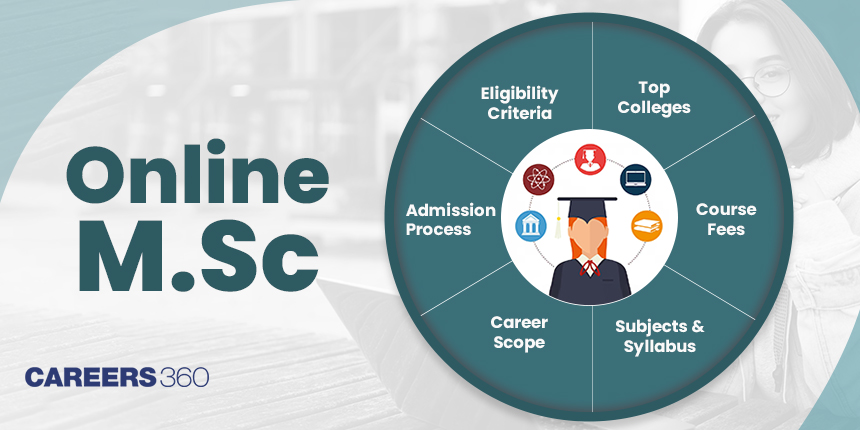
Admission to online MSc courses is made based on the academic merit, application, and document verification. The minimum eligibility to apply for Online MSc admission 2026 is a bachelor's degree (BSc, B.E. or B.Tech) or equivalent from a recognised university. An Online MSc degree is available in diverse specialisations, such as Mathematics, Economics, Business Analytics, Data Science, and Statistics. These Online MSc specialisations allow students to specialise in their desired field.
The fee of Online M.Sc in India can range from Rs 8,000 to Rs 2,50,000, depending on the institute. Online M.Sc is delivered using a combination of live lectures, pre-recorded videos, and interactive discussion forums. This online master's degree opens a variety of career opportunities upon completing. Some of the popular career opportunities after Online MSc include in IT and ITeS, Education, Research and development, Financial services and banking.
Campuses in Ropar, Agartala, Aizawl, Ajmer, Aurangabad, Calicut, Imphal, Itanagar, Kohima, Gorakhpur, Patna & Srinagar
NAAC A Grade | 27+ Years of Excellence in Education | Affiliated to RGUHS | INC Approved | Scholarships upto 100%
The popular job roles include include Data Scientist, Research Analyst, Mathematician, and Lecturer. The average salary for an M.Sc graduate can range between Rs 4 LPA to Rs 11 LPA, depending on the experience, specialisation chosen, employer, and location.
The following table highlights the online M.Sc course details, such as minimum eligibility criteria, fees, potential job roles, average salary, and top colleges.
Particulars | Details |
|---|---|
Programme Name | Online M.Sc (Master of Science) |
| Approval | UGC-DEB |
Level | Master's |
Type | Degree |
Duration | 2 Years (4 Semesters) |
Programme Offerings | Live classes, Recorded lectures, Doubt clearing sessions, Personalised learning, Placement assistance, Interactive projects and assignments |
Minimum Eligibility | Bachelor’s Degree (BSc/ B.E./ B.Tech) with minimum 50% marks |
Average Fees | Rs 8,000 to Rs 2,50,000 |
Admission Process | Merit-Based |
Top Specialisations | Data Science, Economics, Mathematics, Business Analytics, Statistics |
Top Colleges | Symbiosis Online, Amity Online, MAHE Online, LPU Online, Chandigarh University Online |
Career Options | Mathematician, Research Scientist, Lecturer, Statistician |
Average Salary (annually) | Rs 4 LPA to Rs 11 LPA |
An online Master of Science (MSc) programme enables students to delve deeper into theoretical and practical understanding of scientific concepts. Students are provided with the flexibility to learn at their own pace through the online MSc classes. The following are the reasons why a candidate should prefer taking the online M.Sc degree:
The eligibility criteria for the online M.Sc degree can vary depending on the institute. Students must visit the official website of their desired college to enrol. The common online M.Sc qualification is as follows:
Particulars | Values |
|---|---|
Educational Qualification | Candidates must have completed a bachelor's degree in science with from a recognised university. |
| Marks | Minimum 50% marks in aggregate (45% for reserved category students) |
| Work Experience | Not mandatory |
| Age Limit | No Age Limit Required |
The online M.Sc admission usually follows a direct process. Candidates who meet the qualifications can apply for admission to the course. They are also required to review the eligibility criteria for their desired colleges to apply for the M.Sc online admission.
How to apply for online M.Sc admission 2026:
Step 1: Online Registration
Apply for B.E./B.Tech in CS from upGrad School of Technology
Step 2: Online Application Form
Step 3: Document Submission
Step 4: Application Fees
Pay the online M.Sc application fees to complete the M.Sc admission online.
Step 5: Final Selection
Also Read: Online Degrees vs Short-Term Online Courses: What Should You Choose?
The online M.Sc course fees vary from institution to institution, ranging from Rs 8,000 to Rs 2,80,000 for the entire course. Candidates need to pay the tuition fees, examination fees, and additional expenses covered in an online M.Sc degree. Students have the flexibility to make course fee payments in installments, and in semester-wise.
Explore
Several top colleges in India offer online M.Sc programmes. These institutions offer programmes with diverse specialisations, enabling students to select subjects based on their interests. The following table outlines some of the top online M.Sc colleges in India and their fees.
Online MSc Colleges | Online MSc Course Fees |
|---|---|
| Online Manipal | Rs 80,000 |
| Chandigarh University Online | Rs 1,00,000 - Rs 1,46,668 |
| LPU Online | Rs 80,000 |
| SASTRA Online | Rs 2,00,000 |
| Symbiosis Online | Rs 1,40,000 |
| Amity Online | Rs 2,50,000 |
| Sathyabama University Online | Rs 18,000 |
| Madurai Kamaraj University | Rs 8,000 |
Rs 60,000 | |
Rs 1,00,000 | |
| Vivekananda University Online | Rs 72,000 |
The online M.Sc syllabus varies from one university to another. The curriculum focuses on theoretical as well as practical concepts, equipping learners with skills essential to entering the science and technology fields. It is divided into four semesters over two years, covering various core online M.Sc subjects. Below is the detailed syllabus of Chandigarh University Online M.Sc Data Science:
Online M.Sc 1st Year Syllabus | ||
Semester 1 | ||
Python Programming | Applied Probability and Statistics | |
Communication and Soft Skills | SQL Programming | |
Advanced Database Management Systems | - | |
Semester 2 | ||
Calculus and Linear Algebra for Data Scientists | Data Analysis and Visualization | |
Machine Learning | Advanced Machine Learning | |
Deep Learning | - | |
Online M.Sc 2nd Year Syllabus | ||
Semester 3 | ||
Optimization | Java Programming | |
Data Structures and Algorithms | Web Technologies | |
Cloud Native Development | Minor Project (Software Dev) | |
Semester 4 | ||
Natural Language Processing | Data Engineering | |
Data Mining and Warehousing | Applied Business Analytics | |
Major Project | - | |
There are various specialisations offered in an online M.Sc programme that students can choose and pursue based on their area of interest. Based on their chosen specialisations, students will be able to make career choices and improve their career prospects. Mentioned below is the list of some popular online MSc specialisations.
Specialisation | Focus Area | Career Opportunities |
|---|---|---|
Operations Research, Complex Analysis, Functional Analysis, Mathematical Statistics | Data Analysts, Operations Research Analyst, Financial Analyst, Data Scientist | |
Machine Learning, Statistics, Data Management, Data Mining | Data Scientist, Data Analyst, Machine Learning Engineer, and Data Engineer | |
Applied Statistics, Probability Theory, Econometrics, Actuarial Statistics | Risk Analyst, Statistician, Business Analyst, Mathematician, Data Engineer | |
Data Visualization, Predictive Analytics, Business Econometrics, Database Management | Business Development Manager, Business Systems Analyst, Data Architect, Consultant | |
Applied Machine Learning, Cloud Computing, Cybersecurity, Data Mining | Database Developer, Solutions Specialist, Systems Analyst, Database Programmer |
An online M.Sc course opens doors to several career options in the IT and scientific world. Graduates can land careers in diverse fields based on their area of interest. They can pursue careers in industries such as research, academics, and software development.
Some of the popular job roles after online M.Sc are as follows:
Online M.Sc graduates in India can land job options with great salary potential. The salary of an individual can vary depending on factors such as experience level, job profile, industry type, employer, and job location.
The table below shows the online M.Sc salary in India based on different job profiles.
Job Profiles | Average Salary Range |
|---|---|
Mathematician | Rs 8 - Rs 11.0 LPA |
Research Scientist | Rs 9.7 - Rs 10.7 LPA |
Actuary | Rs 5.0 - 25.0 LPA |
Data Analyst | Rs 6.6 - Rs 7.3 LPA |
Content Writer | Rs 3.7 - 4.1 LPA |
The table below showcases the difference between online M.Sc, regular M.Sc, and distance M.Sc programmes:
Particulars | Online M.Sc | Regular M.Sc | Distance M.Sc |
|---|---|---|---|
Mode of Delivery | Fully Online | Offline | Mixed (self-study with weekend classes) |
Flexibility | Maximum flexibility | No flexibility | Maximum flexibility |
Interaction Level | Moderate | High | Low |
Ideal For | Working professionals | Full-time students | Graduates & working professionals |
Pursuing an online M.Sc course offers a dynamic pathway for aspiring candidates. The course equips students with essential scientific and technological concepts. After completing an online master of science degree, students can apply for jobs in both private and public sectors. They must visit the official website of the institute to confirm the eligibility criteria and admission process.
Frequently Asked Questions (FAQs)
Earning an M.Sc degree online from a UGC recognised university holds a value equivalent to a degree in the regular mode.
The fee of the course varies depending on the institute. It ranges from Rs. 8,000 to Rs. 2,80,000 or more for the entire course.
Candidates can work full-time while pursuing this online degree programme. Since the programme is delivered in completely online mode, working professionals can pursue it from anywhere and at their own pace.
Pursuing an online M.Sc degree equips learners with fundamental scientific knowledge and skills. Students can pursue career opportunities in research, technology, and academic domains.
After completing the programme, you can either explore job opportunities or opt for higher studies such as PhD in your preferred domain.
Graduates can work as research scientists, data analysts, educators, biotechnologists, IT professionals.
Several Indian universities accept international students, provided they meet eligibility criteria and visa requirements.
Students are provided with academic mentoring, discussion forums, doubt-clearing sessions, career counselling, and technical support from the university.
Popular online M.Sc specialisations include Mathematics, Economics, Data Science, and Computer Science, depending on the university’s offerings.
Universities such as Amity Online, Manipal Online, among others, provide placement assistance, virtual career fairs, and industry tie-ups, depending on the student’s skills, performance, and chosen specialisation.

On Question asked by student community
The application status depends on the university or institute offering the M.Sc Medical Physics programme. Different institutions follow different admission calendars, and some may conduct entrance examinations while others may admit students based on qualifying examination marks.
You should check the admission notification for the specific university/institute you are interested
The previous year's papers for AMU MSc Zoology are not currently available on Careers360.
You can check the given resource:
Hello, JMI accepted GAT-B scores for admission to M.Sc Biotechnology for the 2026-27 session. The admission details for the 2027-28 session are yet to be announced. You can find the JMI M.Sc Biotechnology course and admission-related information here: https://www.careers360.com/university/jamia-millia-islamia-new-delhi/msc-biotechnology-course
Hello Student,
Yes, your sister’s M.Sc. Computer Science course does not automatically prevent you from getting First Graduate status. However, eligibility depends on the rules of the particular First Graduate scheme and whether any family member has already received the benefit.
Since you have not mentioned the state or scheme,
B.Pharm ke baad MSc karna possible hai, lekin government school mein professor nahi, generally school teacher/PGT ke posts hote hain. PGT ke liye usually relevant subject mein postgraduate degree along with B.Ed . and the required teacher eligibility/recruitment exam is needed. B.Pharm + MSc ke combination se eligibility university aur

10000+ Alumni across the globe | Scholarships available
NAAC Accredited | #7 by IIRF in Uttar Pradesh | Scholarships Available
Get Job Ready in Healthcare | Employability-Focused Programs
Applications fee waiver for all prgrammes | B.Sc (Hons) Admissions 2026 Now Open | Ranked Among the Top 100 Universities in the World by QS World University Rankings 2025
100+ Recruiters | 1200+ Placements of 2026 Batch | NBA & NAAC A Accredited | Highest CTC 37 LPA
100+ Recruiters | 100+ Placements of 2026 Batch | NBA & NAAC Accredited | Highest CTC 37 LPA