KCC Institute of Legal and Higher Education, Greater Noida
Law Admissions 2026 Open | Avail Merit-Based Scholarships


Imagine measuring something that keeps changing smoothly, like the distance covered by a car when its speed is constantly varying. Adding up all those tiny changes may seem impossible, but mathematics gives us a powerful concept to do exactly that, which is integrals. In Class 12 Mathematics, integrals are defined as the inverse process of differentiation and are mainly used to find the total effect of a rate of change. Simply, we can say that integration helps in calculating areas, volumes, and accumulated quantities by summing infinitely small parts. A common real-life example is finding the total distance travelled when speed is known at every moment, or calculating the area of irregular shapes like land plots or riverbeds.
This Story also Contains
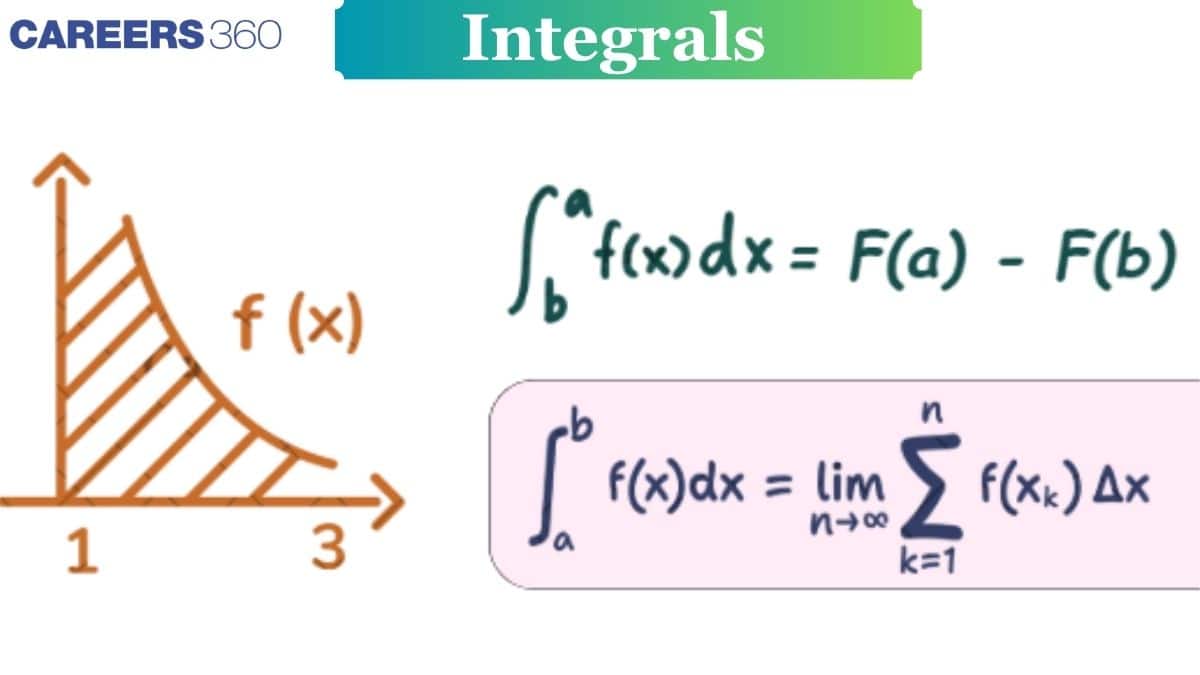
In the Integrals Class 12 chapter, students learn indefinite integrals, definite integrals, properties of definite integrals, and standard integrals formulas. This chapter also introduces the applications of integrals, such as finding the area under curves, which have practical uses in physics, engineering, economics, and statistics. In this article, we cover integrals class 12 concepts, formulas, properties, solved examples, and practice questions to help students understand integration clearly and score well in board exams and competitive exams like JEE.
Integrals are a way to add up small pieces to find the whole. For example, if you want to know how much water fills a pool or how much area is under a curve, integrals help you do that. It’s like taking tiny slices of a shape and adding them together to get the full picture. In math, when you know how something changes (its derivative), you can use integrals to find the original quantity or function.
Law Admissions 2026 Open | Avail Merit-Based Scholarships
BBA/MBA/PGDM Early Bird Applications Deadline 19th Oct '26. Apply now using coupon code CAREER250 and get ₹250 off the application fee
Integrals are everywhere – from calculating distance travelled, to figuring out areas, and even in science and engineering problems. Once you understand how they work, you’ll see how useful they are in real-life situations!
Integral calculus is mainly divided into indefinite integrals and definite integrals.
Indefinite integrals are a way to find the original function when you know how it’s changing. It’s like working backwards from the derivative to get the function itself. This process is called indefinite integration, and it forms the basic definition of integration or antiderivatives.
If $\frac{d}{dx} F(x) = f(x)$, then we write: $\int f(x)dx = F(x) + C$
Here, $C$ is the constant of integration, and it shows that there are infinitely many solutions because you can choose any value for $C$. All these functions differ only by that constant.
(i) Inverse Relationship
Differentiation and integration are opposite processes:
$\frac{d}{dx}\int f(x)dx = f(x)$
$\int f'(x)dx = f(x) + C$
(ii) Family of Curves
Different integrals with the same derivative represent a group of curves that differ only by a constant. So, if two functions have the same derivative, their integrals are considered equivalent.
(iii) Sum Rule
You can break an integral of a sum into the sum of integrals:
$\int (f(x) + g(x))dx = \int f(x)dx + \int g(x)dx$
(iv) Constant Factor Rule
A constant can be taken out of the integral:
$\int a f(x)dx = a \int f(x)dx$
where $a$ is a constant.
While indefinite integrals give us a general solution, definite integrals help calculate the exact value of a function between two points. This is very useful in real-world problems where you need precise answers.
Let’s say $f(x)$ is a function defined on the interval $[a, b]$ and $F(x)$ is its antiderivative such that $\frac{d}{dx}F(x) = f(x)$. The definite integral is written as: $\int_a^b f(x)dx = F(b) - F(a)$
Here, $a$ is the lower limit and $b$ is the upper limit. This formula helps in calculating things like area under a curve or the total accumulated change in a quantity.
Inequalities are useful to compare two functions, especially when solving problems related to application of integrals class 12.
If $m \leq f(x) \leq M$ for all $x$ in $[a, b]$, then: $m(b-a) \leq \int_a^b f(x)dx \leq M(b-a)$
If $f(x)$ is continuous on $[a, b]$, then there’s at least one $c \in [a, b]$ where: $f(c) = \frac{1}{b-a} \int_a^b f(x)dx$
If $f(x) \geq g(x)$ for all $x \in [a, b]$, then: $\int_a^b f(x)dx \geq \int_a^b g(x)dx$
For convex functions $\phi(x)$ and a probability distribution: $\phi\left(\int_a^b f(x)dx\right) \leq \int_a^b \phi(f(x))dx$
For functions in $L^p$ space: $\left(\int_a^b |f(x)+g(x)|^p dx\right)^{1/p} \leq \left(\int_a^b |f(x)|^p dx\right)^{1/p} + \left(\int_a^b |g(x)|^p dx\right)^{1/p}$
The properties of definite integrals make it easier to solve problems in integrals class 12 and understand the behavior of functions across intervals.
$\int_a^b f(x)dx = \int_a^b f(t)dt$
$\int_a^b f(x)dx = -\int_b^a f(x)dx$ and $\int_a^a f(x)dx = 0$
$\int_a^b f(x)dx = \int_a^c f(x)dx + \int_c^b f(x)dx$
$\int_a^b f(x)dx = \int_a^b f(a+b-x)dx$
$\int_0^a f(x)dx = \int_0^a f(a-x)dx$
$\int_0^{2a} f(x)dx = \int_0^a f(x)dx + \int_0^a f(2a-x)dx$
These properties are not just theoretical; they’re applied in many problems when working through class 12 integrals solutions or solving real-life problems using the application of integrals class 12.
| Aspect | Definite Integrals | Indefinite Integrals |
|---|---|---|
| Definition | Finds the exact area or value between two points | Finds the general form of the original function |
| Limits | Has upper and lower limits (e.g., from $a$ to $b$) | No limits or boundaries |
| Result | Gives a numerical value | Gives a function with a constant $C$ |
| Application | Used to calculate area, volume, work, etc. | Used to find all possible antiderivatives |
| Example | $\int_a^b f(x)dx$ | $\int f(x)dx$ |
| Dependence on boundaries | Depends on the specific limits provided | Does not depend on limits |
| Interpretation | Represents accumulation or total change over an interval | Represents a family of functions differing by a constant |
This section provides all the important formulas of integrals, including basic functions and rules, to help you solve problems easily and strengthen your understanding of integrals. These formulas are essential for both theory and practice in exams like JEE Main.
We have provided below a list of important Indefinite Integral Formulas:
| Category | Function | Integral Formula |
|---|---|---|
| Algebraic Functions | $\int 0 ,dx$ | $c$, where $c$ is a constant |
| $\int k ,dx$ | $kx + c$, where $k$ is a constant | |
| $\int x^n ,dx$ | $\frac{x^{n+1}}{n+1} + c,\quad n \neq -1$ | |
| $\int \frac{1}{x} ,dx$ | $\log x$ | |
| Trigonometric Integrals | $\int \sin x ,dx$ | $-\cos x + c$ |
| $\int \cos x ,dx$ | $\sin x + c$ | |
| $\int \sec^2 x ,dx$ | $\tan x + c$ | |
| $\int \csc^2 x ,dx$ | $-\cot x + c$ | |
| $\int \sec x \tan x ,dx$ | $\sec x + c$ | |
| $\int \csc x \cot x ,dx$ | $-\csc x + c$ | |
| Exponential Functions | $\int e^x ,dx$ | $e^x + c$ |
| $\int a^x ,dx$ | $\frac{a^x}{\log a} + c$ | |
| Logarithmic Functions | $\int \frac{1}{x} ,dx$ | $\log x$ |
| Inverse Trigonometric Functions | $\int \frac{1}{\sqrt{1-x^2}} ,dx$ | $\sin^{-1}x + c$ |
| $\int \frac{1}{1+x^2} ,dx$ | $\tan^{-1}x + c$ |
We have provided the formulae for definite integrals:
| Function / Rule | Definite Integral Formula |
|---|---|
| Constant function | $\int_a^b k ,dx = k(b - a)$ |
| Power function | $\int_a^b x^n ,dx = \frac{b^{n+1} - a^{n+1}}{n+1}, \quad n \neq -1$ |
| Reciprocal function | $\int_a^b \frac{1}{x} ,dx = \log \left |
| Sine function | $\int_a^b \sin x ,dx = -\cos b + \cos a$ |
| Cosine function | $\int_a^b \cos x ,dx = \sin b - \sin a$ |
| Secant squared function | $\int_a^b \sec^2 x ,dx = \tan b - \tan a$ |
| Cosecant squared function | $\int_a^b \csc^2 x ,dx = -\cot b + \cot a$ |
| Secant times tangent | $\int_a^b \sec x \tan x ,dx = \sec b - \sec a$ |
| Cosecant times cotangent | $\int_a^b \csc x \cot x ,dx = -\csc b + \csc a$ |
| Exponential function | $\int_a^b e^x ,dx = e^b - e^a$ |
| Exponential base $a$ | $\int_a^b a^x ,dx = \frac{a^b - a^a}{\log a}$ |
| Inverse square root | $\int_a^b \frac{1}{\sqrt{1-x^2}} ,dx = \sin^{-1} b - \sin^{-1} a$ |
| Inverse quadratic | $\int_a^b \frac{1}{1+x^2} ,dx = \tan^{-1} b - \tan^{-1} a$ |
| Property | Formula |
|---|---|
| Change of variable name | $\int_a^b f(x) ,dx = \int_a^b f(t) ,dt$ |
| Reversing limits | $\int_a^b f(x) ,dx = -\int_b^a f(x) ,dx$ |
| Integral over same limits | $\int_a^a f(x) ,dx = 0$ |
| Breaking into parts | $\int_a^b f(x) ,dx = \int_a^c f(x) ,dx + \int_c^b f(x) ,dx$ |
| Symmetry rule | $\int_a^b f(x) ,dx = \int_a^b f(a+b-x) ,dx$ |
| Even function rule | $\int_{-a}^a f(x) ,dx = 2\int_0^a f(x) ,dx,\quad$ if $f(-x) = f(x)$ |
| Odd function rule | $\int_{-a}^a f(x) ,dx = 0,\quad$ if $f(-x) = -f(x)$ |
In addition to memorising formulas, understanding the rules of integration helps simplify problems and work with complex functions.
If $f(x)$ has an antiderivative, then multiplying it by a constant $k$ gives:
$\int kf(x)dx = k\int f(x)dx$
You can split the integral of a sum into the sum of integrals:
$\int (f(x) + g(x))dx = \int f(x)dx + \int g(x)dx$
Similarly, the difference between functions can be split:
$\int (f(x) - g(x))dx = \int f(x)dx - \int g(x)dx$
Integration by Parts Formula: Sometimes you’ll need to integrate products of functions. For this, we use integration by parts, a powerful technique in the application of integrals class 12.
If two functions, $u(x)$ and $v(x)$, are given, then:
$\int u v ,dx = u \times \int v ,dx - \int \left(\frac{du}{dx} \times \int v ,dx \right)dx$
This method helps when simple formulas aren’t enough, especially in problems involving products of algebraic, logarithmic, or trigonometric functions.
When selecting which function to assign as $u$, we use the ILATE rule:
Inverse > Logarithmic > Algebraic > Trigonometric > Exponential
For example, if your integral includes both a logarithmic and an algebraic function, choose the logarithmic function as $u$ because it comes first in ILATE.
Integrals are more than just formulas — they are essential tools that help solve real problems in mathematics. Below are some of the key areas where integrals are used, along with simple explanations to help you understand their importance.
This is one of the most common uses of integrals. With definite integrals, you can calculate the exact area between a curve and the x-axis over a given interval.
For example, to find the area under the curve defined by the function $y = x^2$ from $x = 1$ to $x = 3$, you would calculate: $\int_1^3 x^2 dx$
This method is widely applied in geometry and algebra problems.
Integrals help you find the volume of 3D objects created by rotating a curve around an axis.
For example, the volume of a solid formed by rotating $y = f(x)$ around the x-axis from $x = a$ to $x = b$ is: $V = \pi \int_a^b [f(x)]^2 dx$
This is useful in geometry and engineering applications.
Integrals are used to calculate the length of a curve between two points, which helps in areas like design, architecture, and engineering.
The formula for the length of a curve is: $L = \int_a^b \sqrt{1 + \left(\frac{dy}{dx}\right)^2} dx$
In mathematics, integrals are used to find the total work done when a force varies across a distance.
For example: $W = \int_a^b F(x) dx$
This application connects mathematics with physics and engineering.
Integrals can be used to find the average value of a function over an interval, which is useful in statistics and analysis.
The formula is: $\text{Average} = \frac{1}{b-a} \int_a^b f(x) dx$
Integrals help in finding solutions to equations that describe how quantities change. These are known as differential equations.
For example, if $\frac{dy}{dx} = f(x)$, then the solution is: $y = \int f(x) dx + c$
This is widely applied in mathematical modelling and real-world problems.
Integrals are used to calculate the centre of mass or centroid of an object by integrating over its shape.
For example: $M_x = \int y f(x) dx$
$M_y = \int x f(x) dx$
These calculations are important in mechanics and geometry.
Integrals are used to calculate probabilities when dealing with continuous random variables by integrating probability density functions.
For example: $P(a \leq x \leq b) = \int_a^b f(x) dx$
This forms the mathematical foundation for probability and statistical analysis.
Integrals are used wherever you need to calculate accumulated quantities like distance, growth, or decay over time.
By reversing the process of differentiation, integrals allow you to find the total amount of something from its rate of change.
Integrals help you solve real-world problems in geometry, physics, engineering, economics, and more.
They provide exact answers rather than approximations.
They form the basis for advanced mathematical techniques like differential equations and statistical analysis.
Mastering integrals allows you to understand how mathematical principles apply to everyday situations.
Question 1:
$4 \int_{0}^{1}\left(\frac{1}{\sqrt{3+\mathrm{x}^{2}}+\sqrt{1+\mathrm{x}^{2}}}\right) \mathrm{dx}-3 \log _{\mathrm{e}}(\sqrt{3})$ is equal to:
Solution:
Given the expression:
$4 \int_0^1 \frac{1}{\sqrt{3 + x^2} + \sqrt{1 + x^2}} \, dx - 3 \log_e(\sqrt{3})$
First, rationalize the denominator inside the integral by multiplying numerator and denominator by
$\sqrt{3 + x^2} - \sqrt{1 + x^2}$
This gives:
$\int_0^1 \frac{\sqrt{3 + x^2} - \sqrt{1 + x^2}}{(\sqrt{3 + x^2})^2 - (\sqrt{1 + x^2})^2} \, dx$
Since
$(\sqrt{3 + x^2})^2 - (\sqrt{1 + x^2})^2 = (3 + x^2) - (1 + x^2) = 2$
the integral becomes
$\int_0^1 \frac{\sqrt{3 + x^2} - \sqrt{1 + x^2}}{2} \, dx = \frac{1}{2} \int_0^1 \left(\sqrt{3 + x^2} - \sqrt{1 + x^2}\right) dx$
Therefore, the original expression is
$4 \times \frac{1}{2} \int_0^1 \left(\sqrt{3 + x^2} - \sqrt{1 + x^2}\right) dx - 3 \log_e(\sqrt{3}) = 2 \int_0^1 \left(\sqrt{3 + x^2} - \sqrt{1 + x^2}\right) dx - \frac{3}{2} \log_e 3$
Split the integral:
$2 \left[ \int_0^1 \sqrt{3 + x^2} \, dx - \int_0^1 \sqrt{1 + x^2} \, dx \right] - \frac{3}{2} \log_e 3$
Recall the integral formula
$\int \sqrt{x^2 + c} \, dx = \frac{x}{2} \sqrt{x^2 + c} + \frac{c}{2} \ln \left( x + \sqrt{x^2 + c} \right) + C$
Apply for $c=3$:
$\int_0^1 \sqrt{3 + x^2} \, dx = \left[ \frac{x}{2} \sqrt{x^2 + 3} + \frac{3}{2} \ln \left( x + \sqrt{x^2 + 3} \right) \right]_0^1$
Evaluate at limits:
$= \frac{1}{2} \sqrt{4} + \frac{3}{2} \ln (1 + 2) - \left( 0 + \frac{3}{2} \ln \sqrt{3} \right) = 1 + \frac{3}{2} \ln 3 - \frac{3}{4} \ln 3 = 1 + \frac{3}{4} \ln 3$
Similarly for $c=1$:
$\int_0^1 \sqrt{1 + x^2} \, dx = \left[ \frac{x}{2} \sqrt{x^2 + 1} + \frac{1}{2} \ln \left( x + \sqrt{x^2 + 1} \right) \right]_0^1$
Evaluate at limits:
$= \frac{1}{2} \sqrt{2} + \frac{1}{2} \ln (1 + \sqrt{2}) - 0 = \frac{\sqrt{2}}{2} + \frac{1}{2} \ln (1 + \sqrt{2})$
Substitute back:
$2 \left( 1 + \frac{3}{4} \ln 3 - \frac{\sqrt{2}}{2} - \frac{1}{2} \ln (1 + \sqrt{2}) \right) - \frac{3}{2} \ln 3$
Simplify:
$= 2 - \sqrt{2} + \frac{3}{2} \ln 3 - \ln (1 + \sqrt{2}) - \frac{3}{2} \ln 3 = 2 - \sqrt{2} - \ln (1 + \sqrt{2})$
Hence, the value of the original expression is
$2 - \sqrt{2} - \ln (1 + \sqrt{2})=2-\sqrt{2}-\log _{\mathrm{e}}(1+\sqrt{2})$
Hence, the correct answer is $2-\sqrt{2}-\log _{\mathrm{e}}(1+\sqrt{2})$.
Question 2:
The integral $\int_0^\pi \frac{(x+3) \sin x}{1+3 \cos ^2 x} d x$ is equal to:
Solution:
$
I = \int_0^\pi \frac{(x+3) \sin x}{1 + 3 \cos^2 x} \, dx
$
Let $I = \int_0^\pi \frac{x \sin x}{1 + 3 \cos^2 x} \, dx + 3 \int_0^\pi \frac{\sin x}{1 + 3 \cos^2 x} \, dx
$
$
I = I_1 + 3 I_2
$
$
I_1 = \int_0^\pi \frac{x \sin x}{1 + 3 \cos^2 x} \, dx
$
Use substitution $t = \pi - x \implies dt = -dx
$
$
\cos x = \cos(\pi - t) = -\cos t, \quad \sin x = \sin(\pi - t) = \sin t
$
$
I_1 = \int_\pi^0 \frac{(\pi - t) \sin t}{1 + 3 \cos^2 t} (-dt) = \int_0^\pi \frac{(\pi - t) \sin t}{1 + 3 \cos^2 t} \, dt
$
$
\Rightarrow I_1 = \int_0^\pi \frac{\pi \sin t}{1 + 3 \cos^2 t} \, dt - \int_0^\pi \frac{t \sin t}{1 + 3 \cos^2 t} \, dt
$
$
I_1 = \pi I_2 - I_1
$
$
2 I_1 = \pi I_2 \implies I_1 = \frac{\pi}{2} I_2
$
Now evaluate $I_2 = \int_0^\pi \frac{\sin x}{1 + 3 \cos^2 x} \, dx
$
Substitute $t = \cos x \implies dt$
$= -\sin x \, dx \implies -dt = \sin x \, dx
$
$
I_2 = \int_{\cos 0}^{\cos \pi} \frac{-dt}{1 + 3 t^2}$
$= \int_1^{-1} \frac{-dt}{1 + 3 t^2} = \int_{-1}^1 \frac{dt}{1 + 3 t^2}
$
$
I_2 = \int_{-1}^1 \frac{dt}{1 + 3 t^2}
$
Since the integrand is even, $I_2 = 2 \int_0^1 \frac{dt}{1 + 3 t^2}
$
$
\int \frac{dt}{1 + a^2 t^2} = \frac{1}{a} \tan^{-1}(a t)
$
$
I_2 = 2 \cdot \frac{1}{\sqrt{3}} \left[ \tan^{-1}(\sqrt{3} t) \right]_0^1 = \frac{2}{\sqrt{3}} \tan^{-1}(\sqrt{3})
$
$
\tan^{-1}(\sqrt{3}) = \frac{\pi}{3}
$
$
I_2 = \frac{2}{\sqrt{3}} \cdot \frac{\pi}{3} = \frac{2 \pi}{3 \sqrt{3}}
$
$
I_1 = \frac{\pi}{2} \times \frac{2 \pi}{3 \sqrt{3}} = \frac{\pi^2}{3 \sqrt{3}}
$
$
I = I_1 + 3 I_2 = \frac{\pi^2}{3 \sqrt{3}} + 3 \times \frac{2 \pi}{3 \sqrt{3}}$
$= \frac{\pi^2}{3 \sqrt{3}} + \frac{2 \pi}{\sqrt{3}} = \frac{\pi^2 + 6 \pi}{3 \sqrt{3}}$
$=\frac{\pi}{3 \sqrt{3}}(\pi+6)
$
Hence, the correct answer is $\frac{\pi}{3 \sqrt{3}}(\pi+6)$.
Question 3:
The integral $\int_0^\pi \frac{8 x d x}{4 \cos ^2 x+\sin ^2 x}$ is equal to:
Solution:
$
I=\int_0^\pi \frac{8 x d x}{4 \cos ^2 x+\sin ^2 x}
$
Apply property
$
I=\int_0^\pi \frac{8(\pi-x) d x}{4 \cos ^2 x+\sin ^2 x}
$
Add
$
\begin{aligned}
& 2 I=\int_0^\pi \frac{8 \pi}{4 \cos ^2 x+\sin x} d x \\
& I=4 \pi \int_0^\pi \frac{1}{4 \cos ^2 x+\sin ^2 x}
\end{aligned}$
$\begin{aligned} & \because \frac{1}{4 \cos ^2 x+\sin ^2 x}=\frac{1}{4 \cos ^2(\pi-x)+\sin ^2(\pi-x)} \\ & \therefore I=4 \pi \times 2 \int_0^{\pi / 2} \frac{1}{4 \cos ^2 x+\sin ^2 x} d x \\ & =8 \pi \int_0^{\pi / 2} \frac{\sec ^2 x d x}{4+\tan ^2 x} \\ & \text { let } \tan x=t \\ & \sec ^2 x d x=d t \\ & =8 \pi \int_0^{\infty} \frac{d t}{4+t^2} \\ & =\frac{8 \pi}{2}\left[\tan ^{-1} t\right]_0^{\infty} \\ & \Rightarrow \frac{8 \pi}{2}(\pi / 2-0) \\ & \Rightarrow \frac{4 \pi^2}{2} \Rightarrow 2 \pi^2\end{aligned}$
Hence, the correct answer is $2 \pi^2$.
Question 4:
The integral $80 \int_0^{\frac{\pi}{4}}\left(\frac{\sin \theta+\cos \theta}{9+16 \sin 2 \theta}\right) d \theta$ is equal to:
Solution:
Simplify the denominator using the identity,
$
\begin{aligned}
& \sin 2 \theta=2 \sin \theta \cos \theta \\
& 9+16 \sin 2 \theta=9+16(2 \sin \theta \cos \theta) \\
& 9+16 \sin 2 \theta=25-16(1-2 \sin \theta \cos \theta) \\
& 9+16 \sin 2 \theta=25-16\left(\sin ^2 \theta+\cos ^2 \theta-2 \sin \theta \cos \theta\right) \\
& 9+16 \sin 2 \theta=25-16(\sin \theta-\cos \theta)^2
\end{aligned}
$
Substitute $u=\sin \theta-\cos \theta$
$
d u=(\cos \theta+\sin \theta) d \theta
$
When $\theta=0, u=\sin 0-\cos 0=-1$
When $\theta=\frac{\pi}{4}, u=\sin \frac{\pi}{4}-\cos \frac{\pi}{4}=0$
The integral becomes $80 \int_{-1}^0 \frac{1}{25-16 u^2} d u$
Simplify the integral
$
\begin{aligned}
& 80 \int_{-1}^0 \frac{1}{25-16 u^2} d u=80 \int_{-1}^0 \frac{1}{5^2-(4 u)^2} d u \\
& 80 \int_{-1}^0 \frac{1}{5^2-(4 u)^2} d u=80 \cdot \frac{1}{4} \int_{-1}^0 \frac{1}{5^2-(4 u)^2} d(4 u) \\
& 20 \int_{-1}^0 \frac{1}{5^2-(4 u)^2} d(4 u)=\left.20 \cdot \frac{1}{2 \cdot 5} \ln \left|\frac{5+4 u}{5-4 u}\right|\right|_{-1} ^0 \\
& \left.2 \ln \left|\frac{5+4 u}{5-4 u}\right|\right|_{-1} ^0=2\left(\ln \left|\frac{5}{5}\right|-\ln \left|\frac{1}{9}\right|\right) \\
& 2\left(\ln 1-\ln \frac{1}{9}\right)=2\left(0-\ln \frac{1}{9}\right)=-2 \ln \frac{1}{9}=2 \ln 9 \\
& 2 \ln 9=2 \ln 3^2=4 \ln 3
\end{aligned}
$
Hence, the correct answer is $4 \log _e 3$.
Question 5:
The value of $\int_{e^2}^{e^4} \frac{1}{x}\left(\frac{e^{\left(\left(\log _e x\right)^2+1\right)^{-1}}}{e^{\left(\left(\log _e x\right)^2+1\right)^{-1}}+e^{\left(\left(6-\log _{\mathrm{e}} x\right)^2+1\right)^{-1}}}\right) d x$ is:
Solution:
Let us make the substitution:
$
\ln x = t \implies \frac{dx}{x} = dt
$
Given the integral:
$
I = \int_2^4 \frac{e^{\frac{1}{1+t^2}}}{e^{\frac{1}{1+t^2}} + e^{\frac{1}{1+(6 - t)^2}}} \, dt
$
Observe that the denominator is symmetric in \( t \) and \( 6 - t \). Therefore, consider the integral:
$
I = \int_2^4 \frac{e^{\frac{1}{1+t^2}}}{e^{\frac{1}{1+t^2}} + e^{\frac{1}{1+(6 - t)^2}}} \, dt
$
Now define a new integral by changing the variable inside the integral:
$
J = \int_2^4 \frac{e^{\frac{1}{1+(6 - t)^2}}}{e^{\frac{1}{1+t^2}} + e^{\frac{1}{1+(6 - t)^2}}} \, dt
$
Adding the two integrals, we get:
$
I + J = \int_2^4 \frac{e^{\frac{1}{1+t^2}} + e^{\frac{1}{1+(6 - t)^2}}}{e^{\frac{1}{1+t^2}} + e^{\frac{1}{1+(6 - t)^2}}} \, dt = \int_2^4 1 \, dt = 4 - 2 = 2
$
But by substituting \( u = 6 - t \), the limits of \( J \) also change from \( t=2 \) to \( 4 \) to \( u=4 \) to \( 2 \), so:
$
J = \int_4^2 \frac{e^{\frac{1}{1+u^2}}}{e^{\frac{1}{1+(6 - u)^2}} + e^{\frac{1}{1+u^2}}} \, (-du) = \int_2^4 \frac{e^{\frac{1}{1+u^2}}}{e^{\frac{1}{1+u^2}} + e^{\frac{1}{1+(6 - u)^2}}} \, du = I
$
Therefore, \( J = I \).
From the sum,
$
I + J = 2I = 2 \implies I = 1
$
Hence, the correct answer is 1.
Integrals are an important part of Class 12 Mathematics and are asked in various school and competitive examinations. The level of questions varies from basic formula-based problems to application-oriented and analytical questions, depending on the exam.
| Exam Name | Focus Area | Common Topics Asked | Preparation Tips |
|---|---|---|---|
| CBSE Board | Conceptual understanding & problem-solving | Indefinite integrals, definite integrals, properties of definite integrals, applications of integrals | Thorough NCERT reading + practice solved examples |
| JEE Main | Speed & accuracy | Standard integrals, substitution method, definite integrals, area under curves | Practice formula-based MCQs regularly |
| JEE Advanced | Analytical thinking | Properties of definite integrals, symmetry, area between curves | Solve previous years’ advanced-level questions |
| NEET | Basics & formula application | Indefinite integrals, basic definite integrals | Focus on standard formulas and quick methods |
| State Board Exams (ICSE, UP Board, RBSE, etc) | Theory + numericals | Integration formulas, definite integrals, simple applications | Revise textbook problems and examples |
| Mathematics Olympiads | Concept application | Definite integrals, advanced properties, and graphical interpretation | Strengthen fundamentals and practice conceptual problems |
This section covers all the important topics on integrals that are part of the NCERT syllabus and frequently appear in the JEE Main exam.
Here, you’ll find recommended books and study materials that help build a strong understanding of integrals and prepare effectively for exams.
| Book Title | Author / Publisher | Description |
|---|---|---|
| NCERT Class 12 Mathematics | NCERT | Official textbook with fundamental theory and exercises on integrals. |
| Mathematics for Class 12 | R.D. Sharma | Detailed explanations, solved examples, and practice on integration techniques. |
| Objective Mathematics | R.S. Aggarwal | Provides practice problems and objective questions on integrals. |
| Arihant All-In-One Mathematics | Arihant | Comprehensive theory and unsolved/specially solved integration problems for JEE and board exams. |
| Integral Calculus | M.L. Khanna | An advanced textbook covering integral calculus concepts and applications. |
This section lists NCERT textbooks and reference materials that explain integrals clearly and form the foundation for solving related problems.
Explore subject-wise NCERT resources that cover different study materials such as notes, solutions and exemplar problems to support your preparation in a structured way.
| Subject | NCERT Notes Link | NCERT Solutions Link | NCERT Exemplar Link |
|---|---|---|---|
| Mathematics | NCERT Notes Class 12 Maths | NCERT Solutions for Class 12 Mathematics | NCERT Exemplar Class 12 Maths |
| Physics | NCERT Notes Class 12 Physics | NCERT Solutions for Class 12 Physics | NCERT Exemplar Class 12 Physics |
| Chemistry | NCERT Notes Class 12 Chemistry | NCERT Solutions for Class 12 Chemistry | NCERT Exemplar Class 12 Chemistry |
This section includes important practice questions and problems based on integrals to help you test your understanding and improve problem-solving skills.
The Integrals chapter builds a strong foundation for higher mathematics and helps in understanding real-life problems involving area, volume, and accumulation. By practising standard formulas, properties of definite integrals, and application-based questions, students can gain confidence and perform well in board exams as well as competitive exams like JEE Main and Advanced.
Frequently Asked Questions (FAQs)
The constant of integration (
An integral is a mathematical concept that helps you find the area under a curve, total quantity from rates of change, and solve problems involving accumulation. It’s important because it’s widely used in physics, engineering, economics, and other fields.
A definite integral gives you a numerical value representing area or total change between two points, while an indefinite integral gives you a general formula or family of functions, including a constant of integration.
Integrals are the reverse process of derivatives. If differentiation finds how a quantity changes, integration helps to find the original quantity from its rate of change.
When a function f(x) is integrated, you obtain antiderivative F(x). You may also acquire the area under the curve by evaluating the anti-derivative over a given domain [a, b].

Law Admissions 2026 Open | Avail Merit-Based Scholarships
BBA/MBA/PGDM Early Bird Applications Deadline 19th Oct '26. Apply now using coupon code CAREER250 and get ₹250 off the application fee
Ranked #36 amongst institutions in Management by NIRF | 100% Placement
Globally Recognized by AACSB (US) & AMBA (UK) | 18 LPA Avg. CTC for PGPM 2026
Leading Design College | 95% Placement Record | Merit-cum-Means Scholarships for Deserving Students
NEET PG All India & State College Predictor with Admission Process Guide