


Evaluation of Definite Integrals by Substitution
Sometimes when you’re trying to solve a definite integral, it feels a bit like trying to untangle a set of earphones—everything looks twisted, but once you find the right way to pull, it all falls into place. That “right pull” in integration is often the substitution method. By cleverly changing the variable, we can turn a complicated definite integral into a clean, workable expression that follows a simple pattern. This article walks you through how substitution works for definite integrals, how limits transform, and the step-by-step process you’ll use in exams and real mathematics problem-solving.
This Story also Contains
- Evaluation of Definite Integrals by Substitution
- Solved Examples Based on Evaluation Of Definite Integrals By Substitution
- List of Topics Related to Definite Integrals by Substitution
- NCERT Resources
- Practice Questions based on Definite Integral by Substitution
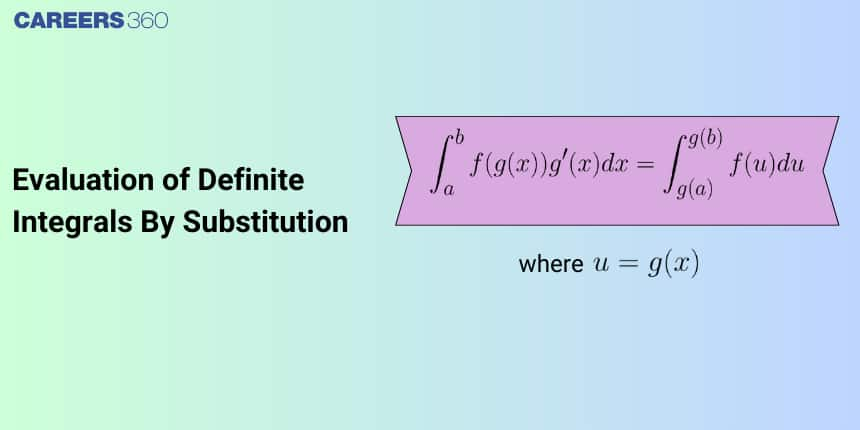
Evaluation of Definite Integrals by Substitution
Integration is the reverse process of differentiation. In integration, we find the function whose differential coefficient is given. The rate of change of a quantity y concerning another quantity x is called the derivative or differential coefficient of y about x. Geometrically, the Differentiation of a function at a point represents the slope of the tangent to the graph of the function at that point.
Substitution is one of the basic methods for calculating indefinite integrals. This technique transforms a complex integral into a simpler one by changing the variable of integration. It is especially useful for integrals involving composite functions where a direct integration approach is difficult.
We have already learned to find Indefinite Integration by using the substitution method. But in the case of definite integration, we also need to change the limits of integration 'a' and 'b'. If we substitute x = g(t), then g(t) must be continuous in the interval [a, b].
Definite integration calculates the area under a curve between two specific points on the x-axis.
Let f be a function of x defined on the closed interval [a, b] and F be another function such that $\frac{d}{d x}(F(x))=f(x)$ for all x in the domain of f, then $\int_a^b f(x) d x=[F(x)+c]_a^b=F(b)-F(a)$is called the definite integral of the function f(x) over the interval [a, b], where a is called the lower limit of the integral and b is called the upper limit of the integral.
Let's see some examples to see how such questions are solved.
Example 1
Compute the integral $\int_0^{\pi / 2} \frac{d x}{a^2 \cos ^2 x+b^2 \sin ^2 x}$
Let $\quad I=\int_{x=0}^{x=\pi / 2} \frac{d x}{a^2 \cos ^2 x+b^2 \sin ^2 x}$
Divide numerator and denominator by $\cos ^2 x$
$
=\int_{x=0}^{x=\pi / 2} \frac{\sec ^2 x d x}{a^2+b^2 \tan ^2 x}
$
Put $\quad \tan x=t \Rightarrow \sec ^2 x d x=d t$
$
\therefore \quad I=\int_{t=0}^{t=\infty} \frac{d t}{a^2+b^2 t^2}
$
We find the new limits of integration $t=\tan x \Rightarrow t=0$ when $x=0$ and $t=\infty$ when $x=\pi / 2$
\begin{aligned}
\Rightarrow \quad I & =\frac{1}{b^2} \int_0^{\infty} \frac{d t}{\left(\frac{a}{b}\right)^2+t^2}=\frac{1}{b^2} \cdot \frac{1}{a / b}\left[\tan ^{-1} \frac{b t}{a}\right]_0^{\infty} \\
& =\frac{1}{a b}\left[\frac{\pi}{2}-0\right]=\frac{\pi}{2 a b}
\end{aligned}
Solved Examples Based on Evaluation Of Definite Integrals By Substitution
Example 1: The integral $\int_1^2 e^x \cdot x^x\left(2+\log _e x\right) d x$equals:
1) $e(4 e+1)$
2) $4 e^2-1$
3) ${ }^{e(4 e-1)}$
4) $e(2 e-1)$
Solution
$\begin{aligned} & \int_1^2 e^x \cdot x^x\left(2+\log _e x\right) d x \\ & \int_1^2 e^x\left(2 x^x+x^x \log _e x\right) d x \\ & \int_1^2 e^x(\underbrace{x^x}_{f(x)}+\underbrace{x^x\left(1+\log _e x\right)}_{f^{\prime}(x)}) d x \\ & \left(e^x \cdot x^x\right)_1^2=4 e^2-e\end{aligned}$
Hence, the answer is the option 3.
Example 2: Let f be a twice differentiable function defined on R such that $f(0)=1, f^{\prime}(0)=2$ and $f^{\prime}(x) \neq 0$ for all$x \in R$. If $\left|\begin{array}{cc}f(x) & f^{\prime}(x) \\ f^{\prime}(x) & f^{\prime \prime}(x)\end{array}\right|=0$ for all $x \in R$ then the value of $f(1)$ lies in the interval:
1) $(0,3)$
2) $(9,12)$
3) $(6,9)$
4) $(3,6)$
Solution
$\begin{array}{ll}f(x) & f^{\prime}(x) \\ f^{\prime}(x) & f^{\prime \prime}(x)\end{array}=0$
$\begin{aligned} & f(x) f^{\prime \prime}(x)-\left(f^{\prime}(x)\right)^2=0 \\ & \frac{f^{\prime \prime}(x)}{f^{\prime}(x)}=\frac{f^{\prime}(x)}{f(x)} \\ & \ln \left(f^{\prime}(x)\right)=\ln f(x)+\ln c\end{aligned}$
$\begin{aligned} & f^{\prime}(x)=c f(x) \\ & \frac{f^{\prime}(x)}{f(x)}=c \\ & \ln f(x)=c x+k\end{aligned}$
$\begin{aligned} & f(x)=k e^{c x} \\ & f(0)=1=k \\ & f^{\prime}(0)=c=2 \\ & f(x)=e^{2 x} \\ & f(1)=e^2 \in(6,9)\end{aligned}$
Hence, the answer is the option 3.
Example 3: For x>0 , if $f(x)=\int_1^x \frac{\log _e t}{1+t} d t$, then $f(e)+f\left(\frac{1}{e}\right)$ is equal to
1) 1
2) -1
3) $\frac{1}{2}$
4) 0
Solution
$\begin{aligned} & f(x)=\int_1^x \frac{\log _e t}{(1+t)} d t \\ & f\left(\frac{1}{x}\right)=\int_1^{1 / x} \frac{\log _e t}{1+t} d t \\ & \operatorname{let} t=\frac{1}{y}\end{aligned}$
$\begin{aligned} & =\int_1^x \frac{\log _e y}{1+y} \cdot \frac{y}{y^2} d y \\ & =\int_1^x \frac{\log _e y}{y(1+y)} d y\end{aligned}$
Hence,
$f(x)+f\left(\frac{1}{x}\right)=\int_1^x \frac{(1+t) \log _c t}{t(1+t)} d t=\int_1^x \frac{\log _e t}{t} d t$
put $u=\log _{\mathrm{c}} t \Rightarrow \frac{d u}{d t}=\frac{1}{t}$
$\begin{gathered}=\frac{1}{2} \log _{\mathrm{e}}^2(\mathrm{x}) \\ \text { so } f(\mathrm{e})+f\left(\frac{1}{\mathrm{e}}\right)=\frac{1}{2}\end{gathered}$
Hence, the answer is the option 3.
Example 4: Let $f(x)=\int_0^x e^t f(t) d t+e^x$ be a differentiable function for all $x \in R$. Then f(x) equals:
1) $
2 e^{\left(\mathrm{e}^x-1\right)}-1
$
2) $e^{\left(e^x-1\right)}$
3) $e^{e^x}-1$
4) $2 e^{e^x}-1$
Solution
$f(\mathrm{x})=\int_0^{\mathrm{x}} \mathrm{e}^{\mathrm{t}} f(\mathrm{t}) \mathrm{dt}+\mathrm{e}^{\mathrm{x}} \Rightarrow f(0)=1$
differentiating with respect to x
$\begin{aligned} & f(x)=e^x f(x)+e^x \\ & f^{\prime}(x)=e^x(f(x)+1) \\ & \int_0^x \frac{f^{\prime}(x)}{f(x)+1} d x=\int_0^x e^x d x \\ & \left.\ln (f(x)+1)\right|_0 ^x=\left.e^x\right|_0 ^x\end{aligned}$
$\begin{aligned} & n(f(x)+1)-\ln (f(0)+1)=e^2-1 \\ & \ln \left(\frac{f(x)+1}{2}\right)-e^x-1 \quad(\text { as } f(0)=1) \\ & f(x)=2 e^{\left(c^2-1\right)}-1\end{aligned}$
Hence, the answer is the option 1.
Example 5: If $I=\int_0^{\pi / 2} \frac{\cos x}{1+\sin x} d x$ . Then find the value of $\mathrm{I}$
1) $2 \ln 2$
2) $\ln 2$
3) $2 \ln \frac{\pi}{2}$
4) $\ln \frac{\pi}{2}$
Solution
Let $u=1+\sin x$
$d u=\cos x d x$
When $x=0, u=1+\sin (0)=1$
When $x=\pi / 2, \quad u=1+\sin \left(\frac{\pi}{2}\right)=2$
Then
$\int_0^{\pi / 2} \frac{\cos x}{1+\sin x}=\int_1^2 u^{-1} d u=\ln |u|_1^2=[\ln 2-\ln 1]-\ln 2$
Hence, the answer is the option 2.
List of Topics Related to Definite Integrals by Substitution
Explore important topics related to definite integrals by substitution, including applications of integrals, integrals of particular functions, indefinite integrals, integration by parts, and inequalities in definite integration. Mastery of these interconnected concepts will enhance your integral calculus skills and problem-solving ability.
Integral of Particular Functions
NCERT Resources
Access comprehensive NCERT resources for Class 12 Maths Chapter 7 on Integrals, including detailed notes, complete solutions, and exemplar problem sets. These resources are designed to help students strengthen their understanding and excel in their board and competitive exams.
NCERT Class 12 Maths Notes for Chapter 7 - Integrals
NCERT Class 12 Maths Solutions for Chapter 7 - Integrals
NCERT Class 12 Maths Exemplar Solutions for Chapter 7 - Integrals
Practice Questions based on Definite Integral by Substitution
Sharpen your calculus skills with practice questions focused on definite integrals solved using substitution. These exercises will help reinforce key concepts and improve problem-solving speed for exams like JEE Main and board tests.
Evaluation Of Definite Integrals By Substitution- Practice Question MCQ
We have provided below the practice questions related to different concepts of integration to improve your understanding:
Frequently Asked Questions (FAQs)
Use substitution when the integral contains a composite function and the derivative of the inner function is present, allowing the integral to be rewritten in simpler terms.
Integration by substitution is a technique where one replaces a complex part of the integrand with a new variable to simplify the integral and make it easier to evaluate.
Definite integrals model physical quantities like area, distance, volume, work done, and probability, making them essential resources in physics, engineering, economics, and statistics.
Break the interval at the points where the function crosses the x-axis and compute the integral piecewise, considering the sign of the function in each subinterval.
Common methods include substitution, integration by parts, partial fractions, and symmetry properties to simplify and compute integrals.

Popular Questions
Arrange the following Cobalt complexes in the order of incresing Crystal Field Stabilization Energy (CFSE) value. Complexes :
Choose the correct option :
Option: 1
Option: 2
Option: 3
Option: 4
Option: 1
Option: 2
Option: 3
Option: 4
Option: 5
Option: 6
Option: 7
Option: 8
Option: 9
Option: 10
Option: 11
Option: 12
Option: 13
Option: 14
Option: 15
Option: 16
Option: 1
Option: 2
Option: 3
Option: 4
Option: 5
Option: 6
Option: 7
Option: 8
Option: 9
Option: 10
Option: 11
Option: 12
Option: 13
Option: 14
Option: 15
Option: 16
Option: 1 4.89
Option: 2 4.89
Option: 3 4.89
Option: 4 4.89
Option: 5 2.82
Option: 6 2.82
Option: 7 2.82
Option: 8 2.82
Option: 9 0
Option: 10
3 moles of metal complex with formula gives 3 moles of silver chloride on treatment with excess of silver nitrate. The secondary valency of CO in the complex is_______.
(Round off to the nearest integer)
The overall stability constant of the complex ion is
. The overall dissociation constant is
. Then
is ___________(Nearest integer)