


Integration by Partial Fractions - Definition, Formulas, Steps and Examples
Imagine you’re trying to untangle a long pair of earphones - everything looks messy at first, but once you separate the knots one by one, it suddenly becomes easy to manage. Integration by Partial Fractions works the same way: when a rational function looks complicated, we break it into simpler fractions that are much easier to integrate. In this article, you’ll understand the definition of partial fractions, learn the standard formulas and decomposition rules, explore the step-by-step process, and walk through clear examples that show how to apply the method confidently in math exams.
This Story also Contains
- Meaning of Integration and Rational Functions
- When Degree of Numerator ≥ Degree of Denominator
- Case 1: Denominator with Non-Repeated Linear Factors
- Case 2: Denominator with Repeated Linear Factors
- Case 3: Denominator with Irreducible Quadratic Factors
- Steps to Resolve an Expression into Partial Fractions
- Integration by Partial Fractions – Formula and Method
- Solving Integrals Using Partial Fractions (Step-by-Step)
- Solved Examples Based On Integration using Partial Function:
- List of Topics Related to Integration by Partial fractions
- NCERT Resources
- Practice Questions based on Integration by Partial fractions
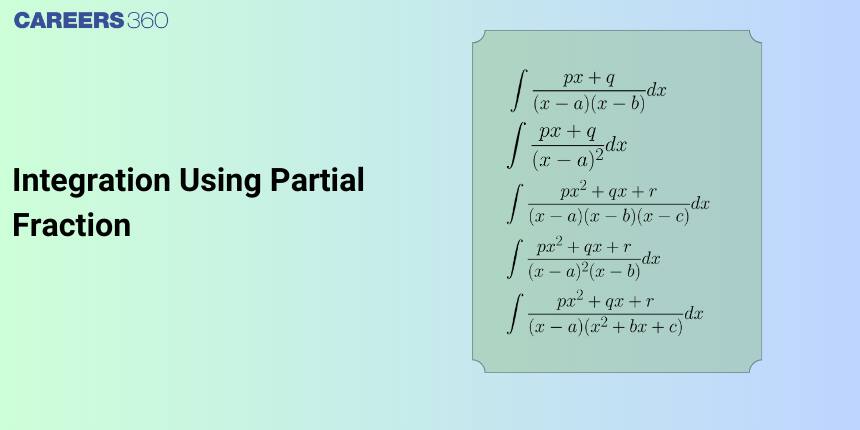
Meaning of Integration and Rational Functions
Integration is the reverse of differentiation. When you integrate a function, you’re finding the original expression whose rate of change is given. If $y$ changes with respect to $x$, then its derivative represents the slope of the tangent at any point.
A rational function is a function of the form
$ \frac{P(x)}{Q(x)} $,
where $P(x)$ and $Q(x)$ are polynomials and $Q(x) \neq 0$.
Partial fractions are used only when a rational function can be broken into simpler fractions.
The expression $ \frac{P(x)}{Q(x)} $ is decomposed into simpler rational expressions whose integrals are easy to compute. This breakdown is called partial fraction decomposition.
This method applies only when $ \deg(P(x)) < \deg(Q(x)) $. If the function is improper (degree of numerator ≥ degree of denominator), we begin by performing long division.
When Degree of Numerator ≥ Degree of Denominator
To integrate expressions where $ \deg(P(x)) \geq \deg(Q(x)) $, divide first.
Example:
Evaluate
$ \int \frac{x^2 + 3x + 5}{x + 1} , dx $
Since $ \deg(x^2 + 3x + 5) \geq \deg(x+1) $, perform long division:
$ \frac{x^2 + 3x + 5}{x+1} = x + 2 + \frac{3}{x+1} $
Now integrate:
$ \int \left( x + 2 + \frac{3}{x+1} \right) dx
= \frac{1}{2}x^2 + 2x + 3 \ln|x+1| + C $
Case 1: Denominator with Non-Repeated Linear Factors
If the denominator splits like
$ Q(x) = (x - a_1)(x - a_2)(x - a_3)\cdots(x - a_n) $,
then the decomposition is:
$ \frac{P(x)}{Q(x)} =
\frac{A_1}{x - a_1} + \frac{A_2}{x - a_2} + \cdots + \frac{A_n}{x - a_n} $
The constants $A_1, A_2, \ldots, A_n$ are determined by:
equating numerators, or
substituting $x = a_1, a_2, \ldots, a_n$ (shortcut method)
Shortcut Example
$ \frac{x^2 + 2}{x(x-1)(x-2)} = \frac{A}{x} + \frac{B}{x-1} + \frac{C}{x-2} $
Put $x=0,1,2$ to get $A,B,C$ quickly.
Illustration 1
Evaluate
$ \int \frac{3x + 2}{x^3 - x^2 - 2x} , dx $
Factor the denominator:
$ x^3 - x^2 - 2x = x(x-2)(x+1) $
So,
$ \frac{3x+2}{x(x-2)(x+1)}
= \frac{A}{x} + \frac{B}{x-2} + \frac{C}{x+1} $
Cross-multiplying:
$ 3x + 2 = A(x-2)(x+1) + Bx(x+1) + Cx(x-2) $
Now substitute:
$x = 0 \Rightarrow A = -1$
$x = 2 \Rightarrow B = \frac{4}{3}$
$x = -1 \Rightarrow C = -\frac{1}{3}$
Rewrite the integral:
$ \int \left( -\frac{1}{x} + \frac{4}{3} \cdot \frac{1}{x-2} - \frac{1}{3} \cdot \frac{1}{x+1} \right) dx $
Integrating:
$ -\ln|x| + \frac{4}{3} \ln|x-2| - \frac{1}{3}\ln|x+1| + C $
Case 2: Denominator with Repeated Linear Factors
If
$ Q(x) = (x-a)^k(x-a_1)(x-a_2)\cdots(x-a_n) $,
the decomposition becomes:
$
\frac{P(x)}{Q(x)} =
\frac{A_1}{x-a} + \frac{A_2}{(x-a)^2} + \cdots + \frac{A_k}{(x-a)^k}
\frac{B_1}{x - a_1} + \frac{B_2}{x - a_2} + \cdots + \frac{B_n}{x - a_n}
$
Each term is integrated separately.
Case 3: Denominator with Irreducible Quadratic Factors
For each quadratic factor
$ ax^2 + bx + c $
(of the type that cannot be factored further), assume:
$ \frac{Ax + B}{ax^2 + bx + c} $
These integrate using substitution or logarithm/arctan rules.
Steps to Resolve an Expression into Partial Fractions
Integration by partial fractions is used when the integrand is a rational function, i.e., a ratio of two polynomials.
Step 1: Ensure the Rational Function Is Proper
Check the degree of numerator and denominator.
If degree of numerator < degree of denominator → proceed
If degree of numerator ≥ degree of denominator → first perform long division
Step 2: Factor the Denominator Completely
Factor the denominator into linear and/or quadratic factors.
Examples:
$(x+1)(x+2)$
$(x-1)^2$
$(x^2+1)$
Step 3: Write Partial Fractions Based on Factor Type
Use standard forms:
For distinct linear factors:
$\dfrac{A}{x-a} + \dfrac{B}{x-b}$
For repeated linear factors:
$\dfrac{A}{x-a} + \dfrac{B}{(x-a)^2}$
For irreducible quadratic factors:
$\dfrac{Ax+B}{x^2+ax+b}$
Step 4: Find the Constants
Multiply both sides by the denominator and compare coefficients or substitute suitable values of $x$ to find constants like $A$, $B$, etc.
Integration by Partial Fractions – Formula and Method
Once the expression is resolved into partial fractions, integrate each term separately using standard integration formulas.
If
$\dfrac{P(x)}{Q(x)} = \dfrac{A}{x-a} + \dfrac{B}{x-b}$
then
$\int \dfrac{P(x)}{Q(x)} dx = \int \dfrac{A}{x-a} dx + \int \dfrac{B}{x-b} dx$
This method simplifies complex rational expressions and is widely used in Class 12 board exams and competitive exams.
Solving Integrals Using Partial Fractions (Step-by-Step)
We have given below the step by step method to solve the integrals by using partial fractions:
Step 1: Express the Integral in Rational Form
Write the given integral as
$\int \dfrac{P(x)}{Q(x)} dx$
Step 2: Resolve into Partial Fractions
Decompose the rational function using the steps discussed earlier.
Step 3: Integrate Each Term Separately
Apply basic integration formulas such as:
$\int \dfrac{1}{x-a} dx = \ln|x-a|$
$\int \dfrac{1}{x^2+a^2} dx = \dfrac{1}{a}\tan^{-1}\left(\dfrac{x}{a}\right)$
Step 4: Add Constant of Integration
For indefinite integrals, always write $+ C$
Solved Examples Based On Integration using Partial Function:
Example 1: Integrate $\int \frac{x^3-x}{x^2+1} d x$
1) ${x+\ln \left(x^2+1\right)+C}$
2) $\frac{x^2}{2}+\ln \left(x^2+1\right)+C$
3) $x-\ln \left(x^2+1\right)+C$
4) $\frac{x^2}{2}-\ln \left(x^2+1\right)+C$
Solution
$\begin{aligned}
& \int \frac{x\left(x^2-1\right) d x}{x^2+1} \\
& \begin{aligned}
\Rightarrow \int \frac{x\left(x^2+1\right)-2 x}{x^2+1} d x & =\int x d x-\int \frac{2 x}{x^2+1} d x \\
& =\frac{x^2}{2}-\ln \left(x^2+1\right)+C
\end{aligned}
\end{aligned}$
Hence, the answer is the option (4).
Example 2:Integrate $\int \frac{x^3+x^3+x}{x^2+1} d x$
1) $\frac{x^3}{3}+\ln \left(x^2+1\right)+C$
2) $\frac{x^4}{3}+\ln \left(x^2+1\right)+C$
3) $\frac{x^4}{4}+\frac{1}{2} \ln \left(x^2+1\right)+C$
4) none of these
Solution
$\begin{aligned}
\int \frac{x^5+x^3+x}{x^2+1} d x= & \int \frac{x^3\left(x^2+1\right)}{x^2+1} d x+\int \frac{x}{x^2+1} d x \\
& =\frac{x^4}{4}+\frac{1}{2} \ln \left(x^2+1\right)+C
\end{aligned}$
Hence, the answer is the option (3).
Example 3: If $f\left(\frac{3 x-4}{3 x+4}\right)=x+2, x \neq-\frac{4}{3}$ and $\int f(x) d x=A \log |1-x|+B x+C$ then the ordered pair (A, B ) is equal to: (where C is a constant of integration)
1) $\left(\frac{8}{3}, \frac{2}{3}\right)$
2) $\left(-\frac{8}{3}, \frac{2}{3}\right)$
3) $\left(-\frac{8}{3},-\frac{2}{3}\right)$
4) $\left(\frac{8}{3},-\frac{2}{3}\right)$
Solution
As learned in the concept
Rule of integration by Partial fraction -
Linear and non-repeated:
$\begin{aligned}
& \frac{P(x)}{Q(x)}=\frac{P(x)}{\left(x-\alpha_1\right)\left(x-\alpha_2\right) \cdots\left(x-\alpha_n\right)} \\
& \text { Let } \frac{P(x)}{Q(x)}=\frac{A}{\left(x-\alpha_1\right)}+\frac{B}{\left(x-\alpha_2\right)} \cdots
\end{aligned}$
Find $A, B \ldots$
By comparing $N^r$ and $P(x)$
$f\left(\frac{3 x-4}{3 x+4}\right)=x+2$
Put $\frac{3 x-4}{3 x+4}=y$
$\begin{aligned}
& =>3 x y+4 y=3 x-4 \\
& x=\frac{-4(y+1)}{3(y-1)} \\
& x=\frac{4(1+y)}{3(1-y)} \\
& f(y)=\frac{4(1+y)}{3(1-y)}+2 \\
& =\frac{10-2 y}{3(1-y)}
\end{aligned}$
$\begin{aligned}
& \therefore f(x)=\frac{2(5-x)}{3(1-x)} \\
& \therefore \frac{2}{3} \int\left(\frac{5-x}{1-x}\right) d x=\frac{2}{3} \int \frac{1-x+4}{(1-x)} d x \\
& =\frac{2}{3} x+\frac{8}{3} \ln |1-x|+C
\end{aligned}$
So, $A=8 / 3$ and $B=2 / 3$
Hence, the answer is the option 1.
Example 4: Find $\int \frac{6}{(x-1)(x+1)} d x$ :
1) $3 \ln (x+1)(x-1)+C$
2) $3 \ln (x+1) /(x-1)+C$
3) $3 \ln (x-1)-3 \ln (x+1)+C$
4) none of these
Solution
As we have learned
Rule of integration by Partial fraction -
Linear and non-repeated:
$
\begin{aligned}
& \frac{P(x)}{Q(x)}=\frac{P(x)}{\left(x-\alpha_1\right)\left(x-\alpha_2\right) \cdots\left(x-\alpha_n\right)} \\
& \text { Let } \frac{P(x)}{Q(x)}=\frac{A}{\left(x-\alpha_1\right)}+\frac{B}{\left(x-\alpha_2\right)} \cdots
\end{aligned}
$
Find $A, B$...
By comparing $N^x$ and $P(x)$
$I=\int \frac{6 d x}{(x-1)(x+1)}=\int\left(\frac{A}{(x-1)}+\frac{B}{(x+1)}\right) d x$
Thus $6=A(x+1)+B(x-1)$
On calculating $A=3, B=-3$
Thus $I=3 \ln (x-1)-3 \ln (x+1)+C$
Hence, the answer is the option (3).
Example 5: Find $\int \frac{d x}{x^2-4}$ :
1) $\ln \frac{x+2}{x-2}+C$
2) $1 / 2 \ln \frac{x-2}{x+2}+C$
3) $\frac{1}{4} \ln \left|\frac{x-2}{x+2}\right|+C$
4) none of these
Solution
As we have learned
Rule of integration by Partial fraction -
Linear and non-repeated:
$\frac{P(x)}{Q(x)}=\frac{P(x)}{\left(x-\alpha_1\right)\left(x-\alpha_2\right) \cdots\left(x-\alpha_n\right)}$
Let $\frac{P(x)}{Q(x)}=\frac{A}{\left(x-\alpha_1\right)}+\frac{B}{\left(x-\alpha_2\right)} \cdots$
Find $A, B$...
By comparing $N^x$ and $P(x)$
$\begin{aligned}
& I=\int \frac{d x}{x^2-4}=\int \frac{d x}{(x-2)(x+2)} \\
& =-\frac{\ln (|x+2|)-\ln (|x-2|)}{4}+C \\
& =\frac{1}{4} \ln \left|\frac{x-2}{x+2}\right|+C
\end{aligned}$
Hence, the answer is the option (3).
List of Topics Related to Integration by Partial fractions
This section highlights related topics that strengthen your understanding of integration as a whole-from basic indefinite integrals to specific applications in inequalities and irrational functions. Explore each link to see how these concepts build upon one another to form a complete picture of integral calculus.
Integral of Particular Functions
Integration of irrational functions
NCERT Resources
This section gathers all the essential NCERT study materials to help you master Chapter 7 – Integrals. From concise notes to detailed solutions and exemplar problems, it provides everything you need in one place for organized and effective exam preparation.
NCERT Class 12 Maths Notes for Chapter 7 - Integrals
NCERT Class 12 Maths Solutions for Chapter 7 - Integrals
NCERT Class 12 Maths Exemplar Solutions for Chapter 7 - Integrals
Practice Questions based on Integration by Partial fractions
This section offers practice questions focused on Integration by Partial Fractions to help reinforce your understanding and application of the method. These problems provide valuable hands-on experience, boosting your confidence in solving various integration concepts effectively.
Integration Using Partial Fraction- Practice Question MCQ
We have provided below the practice questions related to different concepts of integration to improve your understanding:
Frequently Asked Questions (FAQs)
The rate of change of a quantity y concerning another quantity x is called the derivative or differential coefficient of y concerning x.
The other name of integration is antiderivative.
The partial fraction method is used to integrate rational functions.
A rational function is of the form P(x) / Q(x), where P(x) and Q(x) are polynomial functions and Q(x) ≠ 0.
Integration is the reverse process of differentiation.
Popular Questions
Arrange the following Cobalt complexes in the order of incresing Crystal Field Stabilization Energy (CFSE) value. Complexes :
Choose the correct option :
Option: 1
Option: 2
Option: 3
Option: 4
Option: 1
Option: 2
Option: 3
Option: 4
Option: 5
Option: 6
Option: 7
Option: 8
Option: 9
Option: 10
Option: 11
Option: 12
Option: 13
Option: 14
Option: 15
Option: 16
Option: 1
Option: 2
Option: 3
Option: 4
Option: 5
Option: 6
Option: 7
Option: 8
Option: 9
Option: 10
Option: 11
Option: 12
Option: 13
Option: 14
Option: 15
Option: 16
Option: 1 4.89
Option: 2 4.89
Option: 3 4.89
Option: 4 4.89
Option: 5 2.82
Option: 6 2.82
Option: 7 2.82
Option: 8 2.82
Option: 9 0
Option: 10
3 moles of metal complex with formula gives 3 moles of silver chloride on treatment with excess of silver nitrate. The secondary valency of CO in the complex is_______.
(Round off to the nearest integer)
The overall stability constant of the complex ion is
. The overall dissociation constant is
. Then
is ___________(Nearest integer)