ISBR Business School PGDM Admissions 2027
400+ Recruiters | Highest CTC 17.2 LPA | Average CTC 8 LPA | 92% Avg. Placements | Ranked as Platinum Institute | Awarded Best Business School of the Year


A Bachelor of Laws (LLB) degree serves as the gateway to a wide range of rewarding and prestigious career paths in the legal field. Law graduates are not confined to traditional litigation alone but can explore diverse opportunities in corporate law, judiciary, legal consultancy, public service, and international law firms. With the growing demand for legal professionals across sectors like finance, technology, policy, and human rights, an LLB offers both stability and growth. In this article, we highlight the 10 best jobs after LLB that can help you build a successful and fulfilling law career.

Also Read: Online Law Courses & Certifications
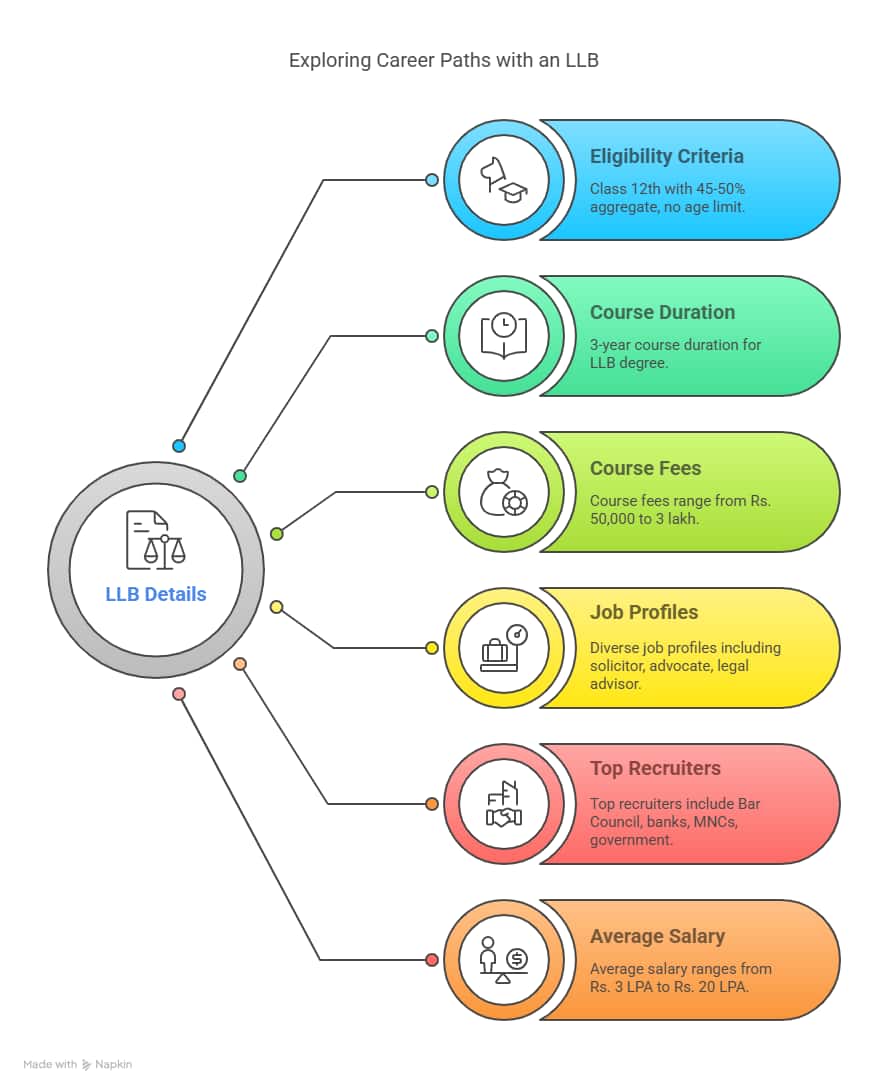
Particulars | Details |
LLB Full Form | Bachelor of Legislative Law |
Eligibility Criteria | Class 12th with a minimum aggregate of 45 to 50 per cent No age limit |
Course Duration | 3 years |
Course Fees | Rs. 50,000 - 3 lakh |
Job Profiles | Solicitor, Advocate, Legal Advisor, Law Officer, Legal Manager, Corporate counsellor, Public Prosecutor and many others |
Average Salary | Rs. 3 LPA to Rs. 20 LPA (based on the experience) |
Top Recruiters | Bar Council of India, Public and Private Sector banks, multinational companies, legal companies, outsourcing, government departments, and others |
There are plenty of options after LLB. One can choose to pursue a successful law career in India. However, students can check the top 10 best jobs after LLB below.
This is one of the most common LLB jobs, graduates choose to become by going into legal practice under a senior advocate or working in law firms. They are responsible for representing clients in the courtroom, drafting legal documents and giving legal advice to their clients. To become a successful and recognised advocate, one needs to have strong oratory skills, in-depth research skills and knowledge of legal procedure.
Salary in India: The salary of advocates in India is based on the experience and recognition they have. The salary of an advocate ranges from Rs. 2 LPA to Rs. 10 LPA. (Source: Ambitionbox)
Nowadays, corporate lawyers are in demand as of growing corporate sector tackles all the legal issues around the organisation. They are responsible for advising businesses on legal compliance, contracts, mergers, acquisitions, and dispute resolution to minimise legal risks.
Salary in India: In the beginning, corporate lawyers can earn from Rs. 6 LPA to Rs. 8 LPA, which increases up to Rs. 15 LPA to Rs. 20 LPA with experience. (Source: Glassdoor)
One of the best law jobs in India, most of the LLB graduates aim for judicial services to become judges or magistrates, as it is one of the prestigious career paths that comes with power and responsibility. They are responsible for presiding over court proceedings, interpreting laws, and ensuring justice. To pass the judicial services exam, students need to have in-depth legal knowledge and clarity to handle situations.
Salary in India: The salary of judicial officers ranges from Rs. 7 LPA to Rs. 12 LPA, depending on rank and experience. (Source: Government Salary Structures)
The role of legal advisor is especially suited for those who prefer advisory and consultancy-related work. Legal advisors mostly work with organisations such as banking, IT, and healthcare or individuals and offer legal advice to ensure legal compliance, adhering to rules and regulations. They are meant for risk management and legal documentation.
Salary in India: Rs. 5 LPA to Rs. 7 LPA for freshers and Rs. 12 LPA to Rs. 20 LPA for experienced advisors. (Source: Glassdoor)
This job profile is best suited for those who want to build their career in criminal law or public services. They are responsible for representing the state in criminal cases by investigating evidence, drafting charges and ensuring justice for the victims.
Salary in India: Starting salaries range from Rs. 4 LPA to Rs. 6 LPA, with experienced prosecutors earning Rs. 8 LPA to Rs. 12 LPA (Source: Payscale)
Also Read:
Someone who has a flair for writing or an interest in simplifying complex legal topics can choose to become a legal journalist, as this job profile requires skills of good understanding and writing to prepare the report on legal developments, judgments and policy changes by working with media houses, blogs, or legal publications.
Salary in India: Rs. 3 LPA to Rs. 5 LPA in starting, and goes up to Rs. 8 LPA to 12 LPA as a senior journalist (Source: Glassdoor)
Individuals having a higher education in law and an inclination towards teaching can choose to be law lecturers in top law colleges in India. As a lecturer, they are responsible for mentoring and teaching students about legal concepts and as researcher.
Salary in India: In India, law professors can earn Rs. 5 LPA to 8 LPA, whereas senior academicians earn Rs. 12 LPA to 15 LPA (Source: UGC Guidelines)
In opposition to the public prosecutor, a litigation lawyer is meant to represent clients in civil or criminal cases. Litigation lawyers are specialised in various areas, such as family law, criminal law, or property disputes.
Salary in India: Rs. 3 LPA to Rs. 20 LPA, depending on experience and clientele.
Also Check: Criminal Lawyer
The job profile of a legal analyst is good for those who are interested in using technology in the legal domain, as they have to evaluate legal data, interpret case laws, and assist companies or firms in decision-making by merging law with data analysis.
Salary in India: Rs. 4 LPA to Rs. 15 LPA based on the experience (Source: Glassdoor)
Individuals who want to work for social justice to make a difference in society can choose to be human rights lawyers. They advocate for fundamental rights protection by working with NGOs or international organisations.
Salary in India: In NGO, one can earn from Rs. 3 LPA to Rs. 5 LPA, while human rights lawyers working for international organisations can get from Rs. 10 LPA to Rs. 20 LPA. (Source: Glassdoor)
Explore More Jobs for Law Graduates:
400+ Recruiters | Highest CTC 17.2 LPA | Average CTC 8 LPA | 92% Avg. Placements | Ranked as Platinum Institute | Awarded Best Business School of the Year
Admissions open for B.A. LL.B. (Hons.), B.B.A. LL.B. (Hons.) and LL.B Program (3 Years) | School of Law, MRU ranked No. 1 in Law Schools of Excellence in India by GHRDC (2023)
1. LLM
Pursuing an LLM allows law graduates to specialise in a specific area of law, such as international law, human rights, or intellectual property. Specialisation can open doors to higher-level positions in law firms, academia, or international organisations. An LL.M. can also lead to a career in legal consulting, where specialised knowledge is highly valued.
2. MBA (Master of Business Administration)
For those interested in combining legal expertise with business acumen, an MBA is a logical next step. An MBA provides law graduates with the skills needed to manage businesses, understand financial markets, and lead organisations. This combination of skills is particularly valuable in corporate law, entrepreneurship, and management roles.
3 Diplomas and Certification Courses
Short-term courses and certifications in niche areas like cyber law, intellectual property rights, or international arbitration can enhance a law graduate's qualifications and open up specialised career opportunities. These courses offer focused training and can be completed alongside other professional commitments.
Those who want to shift their career in the law domain can also opt for a law certificate course. These law certification courses will also help the LLB graduates to gain knowledge regarding the changes in the field. Check the top providers of law certification courses.
An LLB degree offers a diverse range of career paths, each tailored to different interests and aspirations. Whether you aim to litigate, teach, or specialise in niche areas like intellectual property or arbitration, the legal field provides ample opportunities for growth and success. With the right skills, passion, and determination, you can build a rewarding career in law that not only provides financial stability but also allows you to contribute meaningfully to society.
Frequently Asked Questions (FAQs)
Depending on your area of interest, there are a variety of career options after LLB available in many industries like finance, healthcare management, entertainment and IT. You can also pursue many corporate or LLB govt jobs.
The salary scale of the career options after LLB will differ based on various factors like the job profile, experience, company and location. The jobs after LLB for freshers will have lesser remuneration than for the experienced.
Yes, you can enrol in LLB after the 12th. Also, most of the law schools in India offer 5-year integrated LLB programmes such as BA LLB, BBA LLB, BSc LLB, BCom LLB, BSW LLB and BLS LLB which can be taken after the 12th.
After LLB, the LLM (Master of Legislative Law) degree is the best programme if you want to do higher studies. Also, you can for law certificate courses to learn new aspects in a short duration and get certified.
Dual specialisation is always better for jobs after law degree. In the case of comparing CS+LLB and CS+CA, CS+LLB is more prominent a career option after law. Most companies look for individuals holding CS+LLB degrees. Hence, there are many LLB career options that candidates can pursue.

On Question asked by student community
Hello, please tell us the name of the law college so we can check and provide you with the hostel facility details.
Hi!
Check the links below for MHCET LLB Previous Year Question Papers:
https://law.careers360.com/articles/mh-cet-law-previous-year-question-paper
https://law.careers360.com/download/sample-papers/mh-cet-law-5-years-sample-paper-solutions
Hello Student,
You can download the MH CET Law previous year question papers from the Careers360 link below. It includes papers for both 3-year and 5-year LLB, along with solutions/memory-based papers for recent years.
MH CET Law Previous Year Question Papers – Last 5 Years
Hope this helps!
Hello Student, you can usually confirm it by logging into the official application portal and checking the application status, submitted form, payment status or confirmation page. Tell me the exam/course and application portal you used, and I can guide you on where to check.
Dear Student,
You can choose law if you meet the eligibility requirements of the programme. After Class 12, you can pursue an integrated 5-year law programme. Admission is done based on entrance examinations or merit, depending on the institution.
Explore : Law Courses in India

Globally Recognized by AACSB (US) & AMBA (UK) | 18 LPA Avg. CTC for PGPM 2026
Gateway to IBS Hyderabad & 8 other IBS campuses | Scholarships worth 10 CR
BBA 2027 Early Bird Applications Deadline 30th Sept'26. Apply now using coupon code CAREER250 and get ₹250 off the application fee | 100% Placements with 260+ Recruiters
Last Date to Apply: 17th August | QS I-Gauge Diamond Rated | NAAC A+ Accredited | 621 Recruitment Partners | INR 40 LPA Highest CTC | 4482 Job offers
Among top 6% B-Schools globally to be accredited by AACSB | Highest Package-35 LPA
10000+ Alumni across the globe | Scholarships available