


Integration of Irrational Algebraic Function
Imagine trying to untangle a messy pair of earbuds - that’s exactly how irrational algebraic functions feel at first glance. Expressions involving square roots like $\sqrt{ax + b}$ or $\sqrt{x^2 + a^2}$ look complicated, but with the right substitutions, they simplify beautifully. In this article, we’ll walk through the core ideas, standard substitutions, and step-by-step mathematics examples that make integrating irrational functions far more intuitive and exam-friendly.
This Story also Contains
- Integration of Irrational Algebraic Functions
- What Are Irrational Functions?
- Integrals Involving Linear Expressions Inside Square Roots
- Integrals Involving Quadratic Expressions Under Square Roots
- Step-by-Step Strategy for Irrational Integrals
- Standard Forms of Irrational Integrals
- Solved Examples Based On Integration Of Irrational Functions
- List of Topics Related to the Integration of Irrational Algebraic Functions
- NCERT Resources
- Practice Questions based on Integration of Irrational Algebraic Function
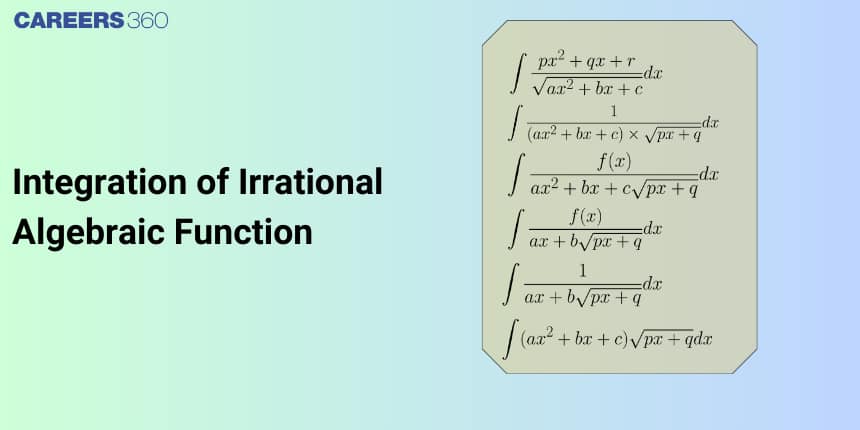
Integration of Irrational Algebraic Functions
When you first look at an integral involving a square root or a fractional exponent, it often feels messy — almost like trying to untangle a pair of tightly knotted headphones. These are what we call irrational algebraic functions, and they show up in many real mathematical problems, from geometry to physics. In this section, we break them down, learn the exact substitutions needed, and walk through step-by-step solved examples so the entire process feels smooth and predictable.
What Are Irrational Functions?
Irrational functions are those in which the variable appears inside a radical or inside a term with a fractional exponent.
For example:
$ \sqrt{x+3} $
$ \sqrt{ax^2 + bx + c} $
$ (x+1)^{\frac{1}{3}} $
Any function containing such expressions is considered an irrational algebraic function. Integrating them requires specific substitutions to simplify the radical and convert the integral into a standard form.
Integrals Involving Linear Expressions Inside Square Roots
These are integrals where the irrational part appears as $ \sqrt{px + q} $.
$ \int \frac{1}{(ax + b)\sqrt{px + q}} , dx $
$ \int \frac{ax + b}{\sqrt{px + q}} , dx $
$ \int \frac{\sqrt{px + q}}{ax + b} , dx $
$ \int \frac{1}{(ax^2 + bx + c)\sqrt{px + q}} , dx $
Standard Substitution
To simplify such integrals, use the substitution:
$ px + q = t^2 $
which gives
$ dx = \frac{2t}{p} , dt $
This removes the square root and transforms the integral into a rational function of $t$.
Solved Example:
Evaluate $ \int \frac{dx}{(x+1)\sqrt{x+2}} $
Let $ I = \int \frac{dx}{(x+1)\sqrt{x+2}} $
Put $ x + 2 = t^2 $
So, $ dx = 2t , dt $
and
$ x + 1 = t^2 - 1 $
Substitute:
$
I = \int \frac{2t , dt}{(t^2 - 1)\sqrt{t^2}}
$
Since $ \sqrt{t^2} = t $, the expression becomes:
$
I = 2 \int \frac{dt}{t^2 - 1}
$
Now integrate:
$
\int \frac{dt}{t^2 - 1} = \frac{1}{2} \ln \left| \frac{t - 1}{t + 1} \right| + C
$
So,
$
I = \ln \left| \frac{t - 1}{t + 1} \right| + C
$
Back-substitute $ t = \sqrt{x+2} $:
$
I = \ln \left| \frac{\sqrt{x+2} - 1}{\sqrt{x+2} + 1} \right| + C
$
Integrals Where the Linear Term Is in the Denominator
These integrals look tricky because they combine a linear expression in the denominator with a quadratic expression under a square root. Direct methods seldom work cleanly here, so a clever substitution becomes your best friend.
Form of the Integral
$ \int \frac{1}{(px + q)\sqrt{ax^2 + bx + c}} , dx $
The mix of a linear factor and a quadratic radical typically makes the integrand resistant to basic substitution or algebraic manipulation.
Standard Substitution to Use
Let $ px + q = \frac{1}{t} $
Then, $ x = \frac{1}{p}\left(\frac{1}{t} - q\right) $
and
$ dx = -\frac{1}{p t^2} , dt $
Once you substitute these into the integral, the linear denominator collapses beautifully into $t$, and the quadratic expression inside the square root transforms into a rational form involving $t$.
Why This Substitution Helps
This technique works well because:
It flips the linear denominator, converting a difficult term into a simple $t$.
The quadratic expression $ax^2 + bx + c$ becomes a rational function of $t$, removing the complexity of the square root.
The resulting integral often simplifies to a standard form involving logarithms or inverse trigonometric functions.
Integrals Involving Quadratic Expressions Under Square Roots
When the integrand includes a quadratic expression inside a square root along with another quadratic (or linear) term in the denominator, the expression can feel a bit heavy at first glance. A great way to ease the complexity is by flipping the variable through substitution.
Form of the Integral
$ \int \frac{1}{(a x^2 + b)\sqrt{p x^2 + q}} , dx $
This structure usually combines a rational term with a square-root expression, making direct integration pretty tough.
Substitution to Use
Let
$ x = \frac{1}{t} $
Then,
$ dx = -\frac{1}{t^2} dt $
This substitution turns the expression inside the square root into:
$ \sqrt{p x^2 + q} = \sqrt{\frac{p}{t^2} + q} = \frac{\sqrt{p + q t^2}}{t} $
Suddenly, the integrand becomes a rational function of $t$, which is much easier to manage.
Why This Substitution Works
Using $ x = \frac{1}{t} $ is particularly effective when:
The denominator involves $ax^2 + b$, which becomes $a/t^2 + b$—a more manageable rational form.
The radical involves $px^2 + q$, which simplifies beautifully after inversion.
The powers of $t$ line up neatly, allowing easy cancellations and resulting in a standard integral.
Step-by-Step Strategy for Irrational Integrals
This section walks you through a clear, methodical approach to breaking down irrational integrals, helping you choose the right substitution and simplify complex radicals with confidence.
1. Identify the Radical
Check whether the radical is linear, quadratic, or more complex.
2. Choose the Correct Substitution
For $ \sqrt{px + q} $, use $ px + q = t^2 $
For $ \sqrt{ax^2 + bx + c} $, consider completing the square
For reciprocal forms, use $ x = \frac{1}{t} $
3. Simplify the Integral
Convert everything to $t$ and reduce the integral to a rational form.
4. Integrate Using Standard Formulas
Logarithmic or inverse trigonometric forms often appear.
5. Substitute Back
Always express the final answer in terms of the original variable.
Standard Forms of Irrational Integrals
Irrational algebraic integrals involve expressions containing square roots of linear or quadratic polynomials. Some commonly used standard forms in Class 12 integration are:
$\int \sqrt{ax+b} , dx$
$\int \dfrac{1}{\sqrt{ax+b}} , dx$
$\int \sqrt{ax^2+bx+c} , dx$
$\int \dfrac{1}{\sqrt{ax^2+bx+c}} , dx$
Recognizing the correct form helps in choosing the appropriate substitution or trigonometric method.
Integration of $\sqrt{ax+b}$ Type Functions
For integrals involving a square root of a linear expression, use a simple substitution.
Let
$ax+b = t$
Then
$dx = \dfrac{dt}{a}$
This reduces the integral to a basic power form, making
$\int \sqrt{ax+b} , dx$
easy to evaluate.
This method is commonly tested in board-level problems.
Integration of $\sqrt{ax^2+bx+c}$ Type Functions
Integrals involving $\sqrt{ax^2+bx+c}$ are handled by completing the square.
Rewrite:
$ax^2+bx+c = a(x-h)^2 + k$
After simplification, the integral reduces to standard forms involving
$\sqrt{x^2 \pm a^2}$
These problems frequently appear in Class 12 examinations and require careful algebraic manipulation.
Integration Using Substitution Method for Irrational Functions
The substitution method is effective when the expression under the square root can be simplified.
Common substitutions include:
$ax+b = t$
$x^2+a^2 = t$
$x^2-a^2 = t$
This method converts irrational integrals into simple polynomial or rational integrals, reducing calculation time.
Trigonometric Substitution in Irrational Integrals
When algebraic substitution becomes lengthy, trigonometric substitution is used.
Standard substitutions include:
For $\sqrt{a^2-x^2}$
$x = a\sin\theta$
For $\sqrt{a^2+x^2}$
$x = a\tan\theta$
For $\sqrt{x^2-a^2}$
$x = a\sec\theta$
This method is especially useful in advanced board and entrance exam problems.
Important Identities Used in Integration of Irrational Algebraic Functions
Some frequently used identities include:
$\sin^2\theta + \cos^2\theta = 1$
$1 + \tan^2\theta = \sec^2\theta$
$\sec^2\theta - 1 = \tan^2\theta$
These identities help simplify integrals after trigonometric substitution, ensuring faster and more accurate solutions.
Solved Examples Based On Integration Of Irrational Functions
Example 1: Evaluate $\int \frac{d x}{(x-1) \sqrt{x^2+x+1}}, \mathrm{x}>1$.
1) $-\frac{1}{\sqrt{3}} \ln \left|\frac{1}{x-1}-\frac{1}{2}+\sqrt{\frac{12\left(\frac{1}{x-1}+\frac{1}{2}\right)^2+1}{12}}\right|+c$
2) $\frac{1}{\sqrt{3}} \ln \left|\frac{1}{x-1}-\frac{1}{2}+\sqrt{\frac{12\left(\frac{1}{x-1}+\frac{1}{2}\right)^2+1}{12}}\right|+c$
3) $\frac{1}{\sqrt{3}} \ln \left|\frac{1}{x-1}+\frac{1}{2}+\sqrt{\frac{12\left(\frac{1}{x-1}+\frac{1}{2}\right)^2+1}{12}}\right|+c$
4) $-\frac{1}{\sqrt{3}} \ln \left|\frac{1}{x-1}+\frac{1}{2}+\sqrt{\frac{12\left(\frac{1}{x-1}+\frac{1}{2}\right)^2+1}{12}}\right|+c$
Solution
The integration in the form
$\int_{\text {(i) }} \frac{d x}{(p x+q) \sqrt{a x^2+b x+c}}$
(ii) $\int \frac{d x}{(p x+q) \sqrt{a x+b}}$
$\int_{\text {(iii) }} \frac{(a+b x)^m}{(p+q x)^n} d x$
- wherein
Working rule.
$(\mathrm{i}) \rightarrow_{\text {put }}(p x+q)=\frac{1}{t}$
(ii) $\rightarrow$ put $(a x+b)=t^2$
(iii) $\rightarrow$ put $(p+q x)=t$
Put $\mathrm{x}-1=1 / \mathrm{t}$ and $d x=-1 / t^2 \mathrm{dt}$.
Invalid Equation
$=-\frac{1}{\sqrt{3}} \ln \left|(t+1 / 2)+\sqrt{\left(t+\frac{1}{2}\right)^2+\frac{1}{12}}\right|+c$
Invalid Equation
4) None of these
Example 2: $\int \frac{x}{(x-3) \sqrt{x+1}} d x$
1) $-2 \sqrt{x+1}-\frac{3}{2} \ln \left|\frac{\sqrt{x+1}-2}{\sqrt{x+1}+2}\right|+c$
2) $2 \sqrt{x+1}-\frac{3}{2} \ln \left|\frac{\sqrt{x+1}-2}{\sqrt{x+1}+2}\right|+c$
3) $2 \sqrt{x+1}+\frac{3}{2} \ln \left|\frac{\sqrt{x+1}-2}{\sqrt{x+1}+2}\right|+c$Solution
Solution
The working rule is
put $(a x+b)=t^2$
Put $x+1=t^2$. We get
$\begin{aligned}
& \int \frac{x}{(x-3) \sqrt{x+1}} d x \\
& \int \frac{x-3+3}{(x-3) \sqrt{x+1}} d x=\int \frac{x-3}{(x-3) \sqrt{x+1}} d x+3 \int \frac{1}{(x-3) \sqrt{x+1}} d x \\
& \int \frac{1}{\sqrt{x+1}} d x+3 \int \frac{1}{(x-3) \sqrt{x+1}} d x \\
& \int \frac{1}{\sqrt{x+1}} d x=2 \sqrt{x+1} \\
& (\text { put } x+1=t) \\
& 3 \int \frac{1}{(x-3) \sqrt{x+1}} d x=-\frac{3 \ln (\sqrt{x+1}+2)}{2}+\frac{3 \ln (\sqrt{x+1}-2)}{2} \\
& \left(\text { put } x+1=t^2\right) \\
& =-\frac{3 \ln (\sqrt{x+1}+2)}{2}+\frac{3 \ln (\sqrt{x+1}-2)}{2}+2 \sqrt{x+1} \\
& =2 \sqrt{x+1}+\frac{3}{2}\left(\log \frac{\sqrt{x+1}-2}{\sqrt{x+1}+2}\right)+c
\end{aligned}$
Hence, the answer is the option 3.
Example 3: $\int \frac{d x}{(2 x+3) \sqrt{4 x+5}}=$
1) $\tan ^{-1} \sqrt{4 x-5}+c$
2) $4 \tan ^{-1} \sqrt{4 x+5}+c$
3) $\tan ^{-1} \sqrt{5 x+4}+c$
4) $\tan ^{-1} \sqrt{5 x-4}+c$
Solution
Let $I=\int \frac{d x}{(2 x+3) \sqrt{4 x+5}}$
Put $4 \mathrm{x}+5=\mathrm{t}^2$
$\therefore x=\frac{t^2-5}{4}$
and
$\begin{aligned}
& d x=2 t \cdot d t \\
& \therefore I=\int \frac{2 t \cdot d t}{\left(2\left(\frac{t^2-5}{4}\right)+3\right) \cdot t} \\
& \therefore I=\int \frac{4 d t}{\left(t^2+1\right)} \\
& \therefore I=4 \tan ^{-1}(t)+c \\
& \therefore I=4 \tan ^{-1} \sqrt{4 x+5}+c
\end{aligned}$
Hence, the answer is the option 2.
Example 4: The integral $\int \frac{1}{\sqrt[4]{(x-1)^3(x+2)^5}} \mathrm{~d} x$ is equal to : (where $C$ is a constant of integration)
1) $\frac{3}{4}\left(\frac{x+2}{x-1}\right)^{\frac{5}{4}}+C$
2) $\frac{4}{3}\left(\frac{x-1}{x+2}\right)^{\frac{1}{4}}+C$
3) $\frac{4}{3}\left(\frac{x-1}{x+2}\right)^{\frac{5}{4}}+C$
4) $\frac{3}{4}\left(\frac{x+2}{x-1}\right)^{\frac{1}{4}}+C$
Solution
$\begin{gathered}
I=\int \frac{1}{(x-1)^{\frac{3}{4}}(x+2)^{\frac{5}{4}}} d x \\
I=\int \frac{1}{(x-1)^2\left(\frac{x+2}{x-1}\right)^{\frac{3}{4}}} d x
\end{gathered}$
Let $\frac{x+2}{x-1}=t \Rightarrow \frac{(x-1)-(x+2)}{(x-1)^2} d x=d t$
$\begin{aligned}
& \Rightarrow I=\frac{-1}{3} \int \frac{d t}{t^{\frac{5}{4}}}=\frac{-1}{3} \times \frac{t^{\frac{-5}{4}+1}}{-\frac{5}{4}+1}+c=\frac{4}{3} t^{\frac{-1}{4}}+c \\
& =\frac{4}{3} \times\left(\frac{x-1}{x+2}\right)^{\frac{1}{4}}+c
\end{aligned}$
option (2)
Example 5: Let $I(x)=\int \sqrt{\frac{x+7}{x}} d x$ and $I(9)=12+7 \log _e 7$. If $I(1)=\alpha+7 \log _e(1+$ Example $5: 2 \sqrt{2}$ ), then $\alpha^4$ is equal to
1) $64$
2) $23$
3) $43$
4) $21$
Solution
$\begin{aligned}
& \int \sqrt{\frac{x+7}{x}} d x \\
& \text { Put } x=t^2 \\
& \mathrm{dx}=2 \mathrm{tdt} \\
& \int 2 \sqrt{\mathrm{t}^2+7} \mathrm{dt}=2 \int \sqrt{\mathrm{t}^2+\sqrt{7^2}} \mathrm{dt} \\
& \mathrm{I}(\mathrm{t})=2\left[\frac{\mathrm{t}}{2} \sqrt{\mathrm{t}^2+7}+\frac{7}{2} \ln \left|\sqrt{\mathrm{t}^2+7}\right|\right]+\mathrm{C} \\
& \mathrm{I}(\mathrm{x})=\sqrt{\mathrm{x}} \sqrt{\mathrm{x}+7}+7 \ln |\sqrt{\mathrm{x}}+\sqrt{\mathrm{x}+7}|+\mathrm{C} \\
& \mathrm{I}(9)=12+7 \ln 7=12+7(\ln (3+4))+\mathrm{C} \\
& \Rightarrow \mathrm{C}=0 \\
& \mathrm{I}(\mathrm{x})=\sqrt{\mathrm{x}} \sqrt{\mathrm{x}+7}+7 \ln (\sqrt{\mathrm{x}}+\sqrt{\mathrm{x}+7}) \\
& \mathrm{I}(1)=1 \sqrt{8}+7 \ln (1+\sqrt{8}) \\
& \mathrm{I}(1)=\sqrt{8}+7 \ln (1+2 \sqrt{2}) \\
& \alpha=\sqrt{8} \\
& \alpha^4=\left(8^{1 / 2}\right)^4 \\
& \alpha^4=8^2=64
\end{aligned}$
Hence, the answer is (64).
List of Topics Related to the Integration of Irrational Algebraic Functions
This section introduces key topics related to the integration of irrational algebraic functions, focusing on methods that simplify complex expressions involving radicals and fractional powers.
Integral of Particular Functions
NCERT Resources
This section gathers all the essential NCERT study materials for Chapter 7 – Integrals, providing a comprehensive resource to support your learning and exam preparation. It includes concise notes, detailed solutions, and exemplar problems that cover fundamental integration methods such as substitution, partial fractions, and integration by parts. With these materials, you can study systematically, strengthen your understanding, and boost your confidence for board exams and competitive tests.
NCERT Class 12 Maths Notes for Chapter 7 - Integrals
NCERT Class 12 Maths Solutions for Chapter 7 - Integrals
NCERT Class 12 Maths Exemplar Solutions for Chapter 7 - Integrals
Practice Questions based on Integration of Irrational Algebraic Function
This section provides targeted practice questions on integrating irrational algebraic functions, helping you strengthen your problem-solving skills and mastery through focused exercises. These questions are designed to build confidence and improve your application of integration techniques effectively.
Integration Of Irrational Algebraic Function- Practice Question MCQ
We have provided below the practice questions related to different concepts of integration to improve your understanding:

Popular Questions
Arrange the following Cobalt complexes in the order of incresing Crystal Field Stabilization Energy (CFSE) value. Complexes :
Choose the correct option :
Option: 1
Option: 2
Option: 3
Option: 4
Option: 1
Option: 2
Option: 3
Option: 4
Option: 5
Option: 6
Option: 7
Option: 8
Option: 9
Option: 10
Option: 11
Option: 12
Option: 13
Option: 14
Option: 15
Option: 16
Option: 1
Option: 2
Option: 3
Option: 4
Option: 5
Option: 6
Option: 7
Option: 8
Option: 9
Option: 10
Option: 11
Option: 12
Option: 13
Option: 14
Option: 15
Option: 16
Option: 1 4.89
Option: 2 4.89
Option: 3 4.89
Option: 4 4.89
Option: 5 2.82
Option: 6 2.82
Option: 7 2.82
Option: 8 2.82
Option: 9 0
Option: 10
3 moles of metal complex with formula gives 3 moles of silver chloride on treatment with excess of silver nitrate. The secondary valency of CO in the complex is_______.
(Round off to the nearest integer)
The overall stability constant of the complex ion is
. The overall dissociation constant is
. Then
is ___________(Nearest integer)