


Seating Arrangement: Meaning, Reasoning Questions with Answers, Tricks
Imagine you and your friends are sitting around a table, and someone tells you that A is sitting to the left of B, C is opposite D, and E is between A and C—suddenly, figuring out everyone’s exact position becomes a fun puzzle. This is exactly what seating arrangement logical reasoning questions are all about. These questions test your ability to understand positions, directions, and relationships between people or objects. Seating arrangement is a key topic in logical reasoning and is frequently asked in competitive exams like SSC, banking exams, MBA entrance tests, and defence exams. In this article, you will learn the meaning of seating arrangement, different types of questions, step-by-step solving methods, shortcut tricks, and practice questions with answers to help you master this topic effectively.
This Story also Contains
- What is Seating Arrangement in Reasoning?
- Types of Seating Arrangement Questions in Reasoning (Complete Guide for Exams)
- Table-Based Puzzle
- Linear/Circular Arrangement
- Best Books for Seating Arrangement Reasoning Preparation
- Rectangle or Square-based Arrangement
- Overview of Rectangle/Square-based Arrangements
- Step-by-Step Approach to Solve Circular Seating Arrangement Questions
- Verbal Reasoning Topics
- Solved examples of Seating Arrangement
- Tricks to solve Seating Arrangements
- Important Rules and Concepts for Seating Arrangement (Quick Revision Table)
- Common Mistakes in Seating Arrangement Questions
- Tricks and Shortcuts to Solve Seating Arrangement Questions Quickly
- How to Prepare for Seating Arrangement Questions in Exams
- Non-Verbal Reasoning Topics

What is Seating Arrangement in Reasoning?
Seating arrangement is a key topic in logical reasoning that involves arranging people or objects based on given conditions such as position, direction, and relationships. These questions test your ability to analyze information, interpret clues, and logically place individuals in the correct order or pattern. Seating arrangement questions are widely asked in competitive exams and are known for testing both accuracy and thinking ability.
Definition of Seating Arrangement Reasoning
Seating arrangement reasoning refers to a type of puzzle where a group of people is seated in a particular order, and you are given certain clues to determine their exact positions.
- These questions involve conditions like left, right, opposite, and adjacent
- You need to arrange people based on given statements
- It may include additional information such as professions, colors, or preferences
- The goal is to create a complete and correct arrangement
This makes seating arrangement an important part of reasoning-based problem-solving.
Importance in Logical Reasoning Section
Seating arrangement holds a significant place in the logical reasoning section of competitive exams.
- It tests analytical thinking and problem-solving skills
- Helps evaluate how well you can interpret multiple conditions together
- Improves logical structuring and visualization ability
- Often appears as a set of questions, increasing its overall weightage
Because of its importance, mastering this topic can greatly improve your reasoning score.
Why Seating Arrangement Questions Are Asked in Exams
These questions are designed to assess real-life decision-making and logical thinking skills.
- They check your ability to process multiple pieces of information at once
- Test how efficiently you can organize and connect data
- Measure your attention to detail and accuracy
- Evaluate your ability to solve complex problems under time pressure
This is why seating arrangement puzzles are commonly included in competitive exams.
Scoring Potential in Competitive Exams
Seating arrangement is considered a high-scoring topic if prepared properly.
- Usually comes in sets of 3–5 questions based on one puzzle
- Solving one puzzle correctly can give multiple correct answers
- Concepts are fixed, so practice improves performance significantly
- With the right approach, questions can be solved quickly and accurately
Consistent practice and understanding of concepts can make seating arrangement one of the strongest areas in the reasoning section.
Types of Seating Arrangement Questions in Reasoning (Complete Guide for Exams)
Seating arrangement is one of the most important topics in logical reasoning for competitive exams, especially in SSC, banking, MBA entrance, and defence exams. Questions are designed in different formats to test your analytical thinking, positioning skills, and direction sense. Understanding the types of seating arrangement reasoning questions helps you solve them faster and more accurately.
Table-Based Seating Arrangement Questions
Table-based arrangements are one of the most commonly asked seating arrangement questions in reasoning.
- People are seated around a table, which can be circular, square, or rectangular
- Questions involve positions like left, right, opposite, and adjacent
- Candidates must track relative positions and facing directions
- Often combined with conditions like professions or colors
These are frequently seen in banking and MBA entrance exams, making them important for practice.
Linear Seating Arrangement Questions
Linear arrangement is the simplest and most scoring type of seating arrangement reasoning questions.
- People are seated in a straight line (row)
- Can be single row or double row (facing each other)
- Questions focus on left and right positions
- Direction (facing north or south) plays a key role
These are commonly asked in SSC and banking exams and are ideal for beginners.
Circular Seating Arrangement Questions
Circular arrangement questions are widely asked in logical reasoning puzzles.
- People are seated in a circle, facing inside or outside
- The concept of left and right changes based on facing direction
- Opposite and adjacent positions are important
- Requires strong visualization skills
These are considered slightly tricky but are very common in bank PO and CAT exams.
Rectangle and Square-Based Seating Arrangement Questions
These are advanced types of seating arrangement puzzles for competitive exams.
- People are seated along the sides of a rectangle or square
- Positions include corners and sides
- Corner positions often have special conditions
- May include people facing inside or outside
These questions test both logical reasoning and spatial arrangement skills.
Triangle-Based Seating Arrangement Questions
Triangle-based arrangements are less common but important for advanced reasoning practice.
- People are seated at the corners or sides of a triangle
- Includes both equilateral and irregular triangle setups
- Questions involve relative positioning and direction
- Requires careful interpretation of conditions
These are mostly asked in high-level reasoning sections of exams.
Let's discuss each type in detail:
Table-Based Puzzle
Table-based puzzle questions are asked in almost every government exam. In table-based puzzles, you have to extract the data from the given information to arrange the persons/ things accordingly. These puzzles are also based on the seating arrangement. You have to arrange the data either in the form of rows or in the form of columns.
Understanding Table-based Arrangements
To understand the table-based arrangements you should be good at analysing and extracting the data from the given information. Table-based arrangements play an important role in the logical reasoning section as one table consists of a set of 4-5 questions and you can score well in the exam after solving one table.
Strategies for Solving Table-Based Puzzles
1) First of all, don’t read the complete information given in the question. Start from the beginning and start writing notes to record minute information as well which helps you further in creating a table or solving the puzzle easily.
2) After reading some of the information you have to decide how to arrange the persons or objects either in rows or in columns this helps to solve the puzzle easily and in less time.
3) Practice is key to success. Practising a variety of table-based puzzles helps you to understand better and you can extract the data easily from the given information.
Example:
Directions: Five friends K, L, M, N, and O play one of five different sports Cricket, Football, Hockey, Badminton, and Volleyball. Each friend plays only one sport. L and M do not play Hockey and Badminton. K plays Cricket. M does not play Volleyball. O does not play Badminton. Who plays Volleyball?
1) L
2) Either L or O
3) N
4) Either L or N
Solution:
Given:
I. L and M do not play Hockey and Badminton.
II. K plays Cricket. M does not play Volleyball.
III. O does not play Badminton.
According to the given instructions figure is given below.
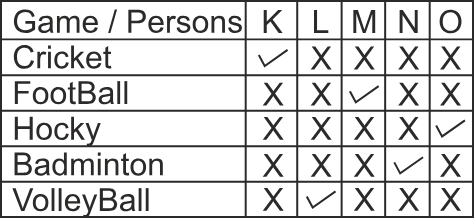
So, L plays Volleyball. Hence, the first option is correct.
Example:
Directions: Each of A, B, C, D, E, F and G has an exam on a different day of the week starting on Monday and ending on Sunday of the same week. A has an exam on Wednesday. Only one person has an exam between A and B. D has an exam on the day immediately before B. Only one person has an exam between F and B. G’s exam is on one of the days before A but on one of the days after C. On which day does G have an exam?
1) Friday
2) Tuesday
3) Monday
4) Wednesday
Solution:
Given:
A has an exam on Wednesday. Only one person has an exam between A and B. D has an exam on the day immediately before B. Only one person has an exam between F and B. G’s exam is on one of the days before A but on one of the days after C.
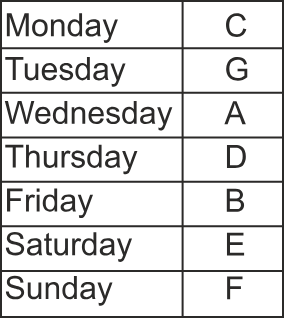
From the final arrangement, G has the exam on Tuesday. Hence, the second option is correct.
Linear/Circular Arrangement
Linear and circular arrangements are both different types of arrangements. In linear arrangements, persons/ objects/ elements are arranged in rows or columns facing directions such as North, South, East, and West. In the circular arrangement, persons are arranged in a circular table facing towards the centre or facing away from the centre it may be any number of persons according to the exam's trend minimum arrangement of six persons is given and a maximum twelve number of persons is given.
Let’s understand the types of linear and circular arrangements.
Basics of Linear Arrangement
Linear Arrangements are basically of two types:-
1) Single-row linear arrangement:- In this type, persons are sitting in a single row facing a specific direction or persons facing opposite directions as mentioned in the given question.
2) Double-row linear arrangement:- In this type, persons are sitting in two rows facing the same direction or facing the opposite directions as mentioned in the given question.
Solving Techniques for Linear Arrangements
1) To solve linear arrangements first of all students should read the question carefully and then determine the rows that in how many rows they have to arrange the persons.
2) The students should be very clear about the left and the right sides of the row as it allows the students to arrange the persons in a row easily.
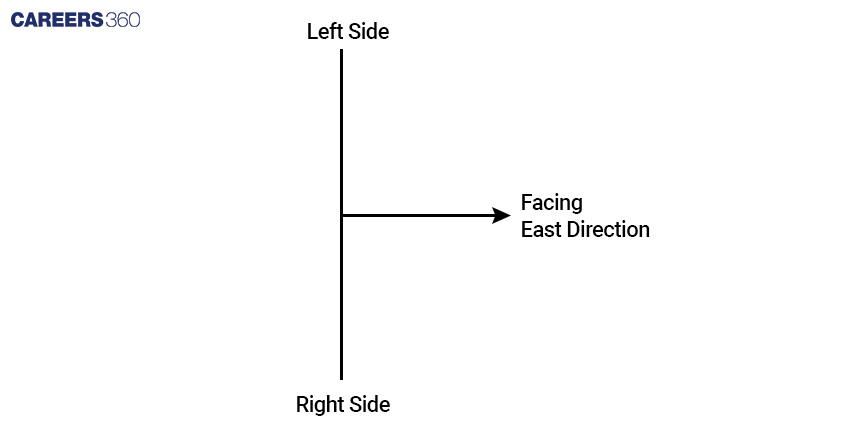
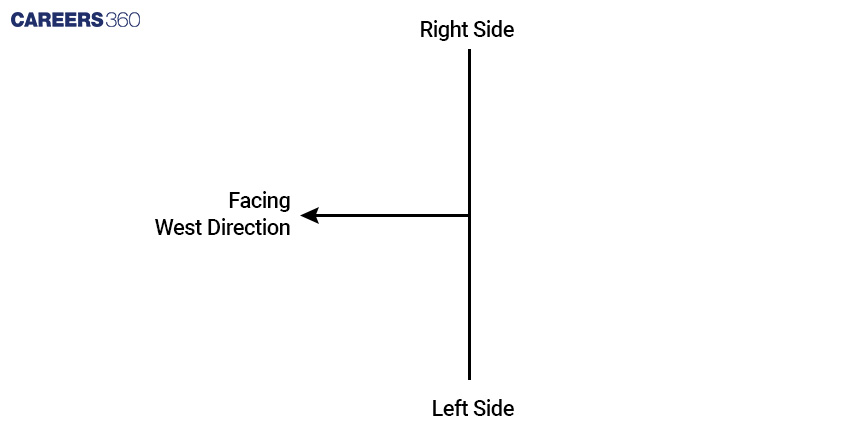
3) To arrange the persons in a row students should check the left and the right sides of the rows with their hands. For
Example:- The persons facing the north row the left side of the row is in the west direction and the right side of the row is in the east direction. Check the position of your hands. Similarly, when the person facing the south direction the left hand is in the east direction and the right hand is in the west direction of the south with the position of hands you can know about the left and right sides. As the sides play a vital role in the arrangement of persons.
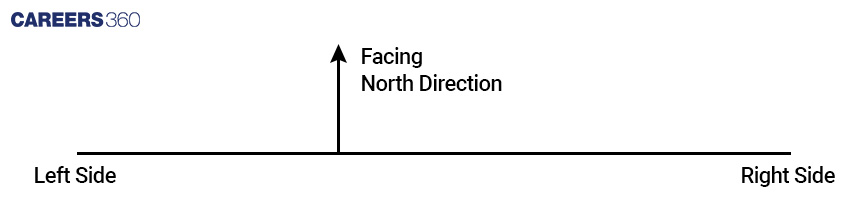
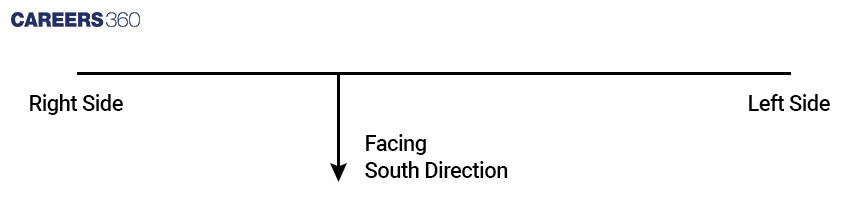
4) In the linear arrangement, if C is four people away from E, then 4 - 1 = 3 people will sit between them.
5) Practice is key to success. By practising more and more questions you can solve the simple linear arrangement questions visually.
Example:
Directions: Five houses K, L, M, N, and O are situated in a row, all facing the north. M is to the immediate left of L. K is between O and M. N is third to the right of K. Which house is exactly in the middle?
1) K
2) L
3) M
4) N
Solution:
Given:
I. M is to the immediate left of L.

II. K is between O and M. N is third to the right of K.

So, M is in the middle. Hence, the third option is correct.
Example:
Directions: Out of the six members of a panel sitting in row E is to the left of B but on the right of A. F is on the right of B but is on the left of G who is to the left of C. Find the members sitting right in the middle.
1) A E
2) B F
3) G C
4) F G
Solution
Arrange all the persons according to the instructions to determine their positions.
Given:
Let all the members face in the north direction.
(I) E is to the left of B but on the right of A.
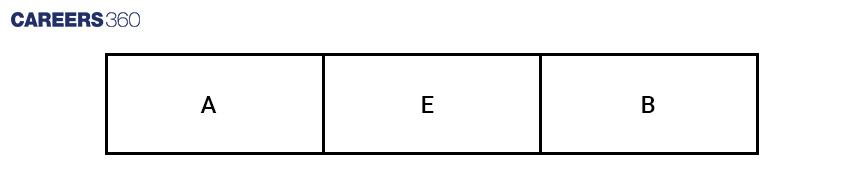
(II) F is on the right of B but is on the left of G who is to the left of C
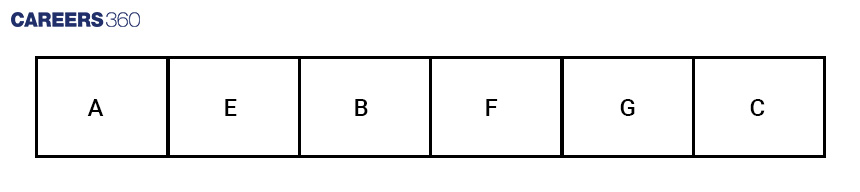
So, B and F are in the middle. Hence, the second option is correct.
Example:
Directions: Eight people are sitting in two parallel rows with 4 people each in such a way that there is equal distance between adjacent persons. P, Q, R, and S are seated in the same row facing south. L, M, N, and O are seated in the same row facing north. L sits to the extreme left of the row and faces R who sits exactly opposite him. P sits second to the left of R and is exactly opposite O. M sits at the extreme right of their row and is exactly opposite S. Who sits exactly opposite Q?
1) L
2) M
3) N
4) O
Solution:
Given:
(I) L sits to the extreme left of the row and faces R who sits exactly opposite him. P sits second to the left of R and is exactly opposite O.
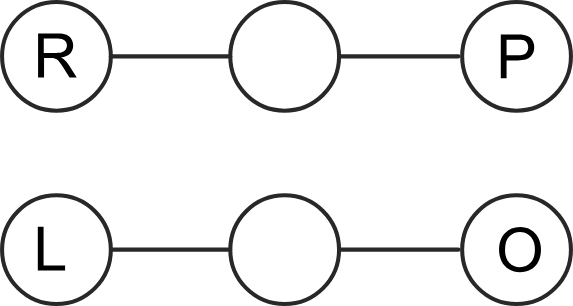
(II) M sits at the extreme right of their row and is exactly opposite S.
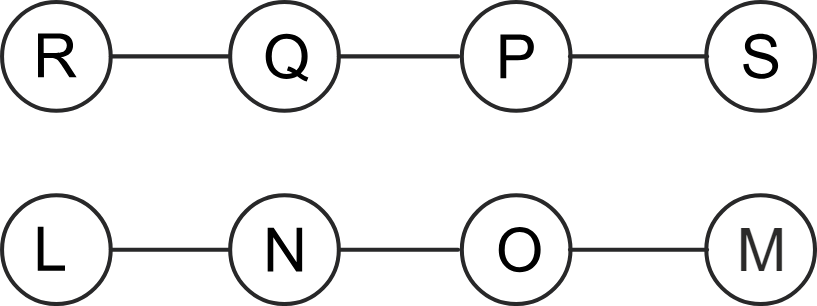
So, N sits exactly opposite Q. Hence, the third option is correct
Example:
Directions: Seven students A, B, C, D, X, Y and Z are sitting in their classroom facing in the southern direction. A and D do not sit together. Z sits second to the left of X. B does not sit with Z. X is fourth to the right of C. A and B are not sitting together. C sits in between D and Y Y sits second to the left of the one who sits second to the left of B. Who sits at the extreme ends?
1) B and D
2) C and Y
3) Z and X
4) A and B
Solution:
Given:
(I) Z sits second to the left of X. X is fourth to the right of C

(II) A and D do not sit together. B does not sit with Z. A and B are not sitting together. C sits in between D and Y. Y sits second to the left of the one who sits second to the left of B.

So, according to the arranged students B and D are at extreme ends. Hence, the first option is correct.
Understanding Circular Arrangement
The circular arrangement questions play a most important role in the logical reasoning section. It is seen in all examinations whether they are competitive exams or entrance exams. A circular arrangement is defined as an arrangement of persons/ objects/ elements in a circular form such as on a circular table or in a circle. It is basically of two types.
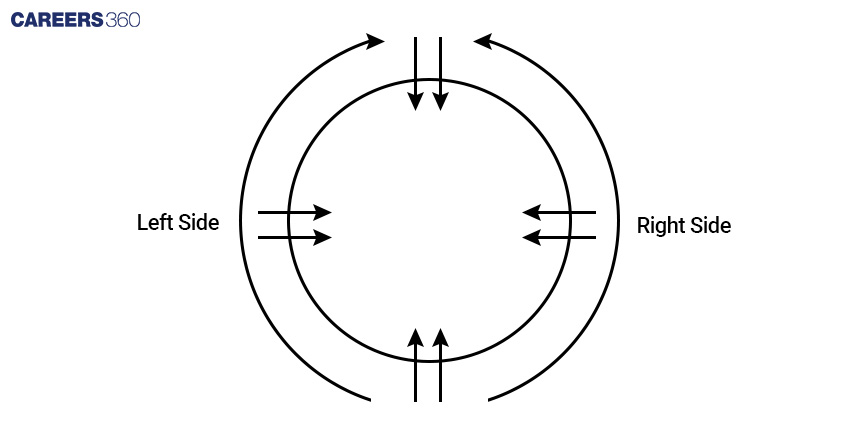
1) The persons facing towards the centre:- In this type, persons are sitting in a circular arrangement facing towards the centre. It is easy to solve as in this type of question the left side of the person is arranged in a clockwise direction and the right side of the person is arranged in an anticlockwise direction. You should check the left and right sides of the person according to your hands.
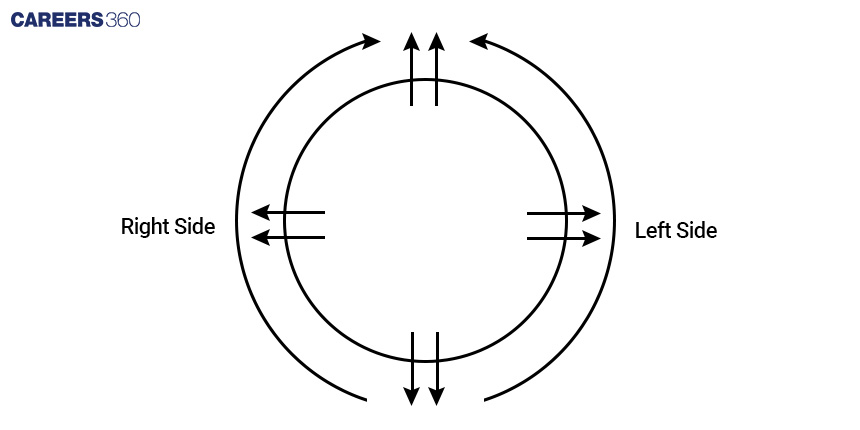
2) The persons facing away from the centre:- In this type, persons are sitting in a circular arrangement facing outside/away from the centre. It is easy to solve as in this type of question the left side of a person is arranged in an anticlockwise direction and the right side of a person is arranged in a clockwise direction. You should check the left and right sides of the person according to your hands.
Example:
Directions: A, B, C, D, E, and F are standing in a circle talking, facing the centre of the circle. E is standing immediately right of C. D is standing at the third position towards the left of C. A is standing at the second place towards the right of F. Who is standing to the immediate right of D?
1) B
2) E
3) C
4) A
Solution
Given:
(I) A, B, C, D, E, and F are standing in a circle talking, facing the centre of the circle.
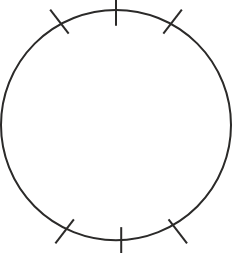
(II) E is standing immediately right of C. D is standing at the third position towards the left of C. A is standing at second place towards the right of F.
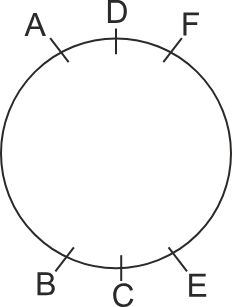
So, A is standing to the immediate right of D. Hence, the fourth option is correct.
Example
Directions: Five friends M, N, O, P and Q sit around a circular table facing away from the centre. O is sitting to the immediate left of P who sits third to the right of Q. M does not sit adjacent to P. Who sits to the immediate right of P?
1) N
2) Q
3) O
4) M
Solution
Given:
(I) Five friends M, N, O, P, and Q sit around a circular table facing away from the centre. O is sitting to the immediate left of P who sits third to the right of Q.
(II) M does not sit adjacent to P.
From the above-given information, the following seating arrangement can be drawn –
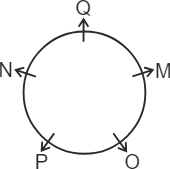
So, N sits to the immediate right of P. Hence, the first option is correct.
Best Books for Seating Arrangement Reasoning Preparation
Here is a well-structured table of the most recommended books to master seating arrangement reasoning questions, puzzles, and logical thinking for competitive exams:
| Book Name | Author | Key Features | Best For |
|---|---|---|---|
| A Modern Approach to Verbal & Non-Verbal Reasoning | R.S. Aggarwal | Covers all reasoning topics including seating arrangement with clear concepts and practice questions | Beginners and SSC aspirants |
| Analytical Reasoning | M.K. Pandey | Focuses on puzzle-based questions like seating arrangement with advanced level practice | Banking and MBA exams |
| A New Approach to Reasoning Verbal & Non-Verbal | B.S. Sijwali & Indu Sijwali | Includes detailed explanations and a wide variety of reasoning questions | Beginners to intermediate level |
| Logical Reasoning and Data Interpretation for CAT | Nishit K. Sinha | Covers high-level seating arrangement and puzzle-based reasoning | MBA entrance exams |
| How to Prepare for Logical Reasoning for CAT | Arun Sharma | Concept-based approach with complex seating arrangement sets | Advanced learners |
| Magical Book on Puzzles | K. Kundan | Special focus on puzzles and seating arrangement tricks and shortcuts | Speed improvement |
| SSC Reasoning Chapterwise Solved Papers | Kiran Publications | Previous year seating arrangement questions with solutions | SSC exam preparation |
| Reasoning Book for Competitive Examinations | Pearson | Includes a variety of reasoning topics with practice sets | All competitive exams |
Rectangle or Square-based Arrangement
Rectangle and square-based seating arrangements are among the most important seating arrangement topics in competitive and entrance exams. In these questions, people are seated around a rectangular or square table, and their facing direction plays a crucial role in determining correct positions.
There are two common types of rectangle or square seating arrangement questions:
Facing the Centre:
People are seated at the corners and at the centres of the sides, all facing towards the centre, where standard circular direction rules apply.Facing Away from the Centre:
People are seated at the corners and at the centres of the sides, but facing outside, which reverses the left–right direction rules.
Understanding these rectangle and square seating arrangement types helps solve questions faster and avoid direction-related mistakes in exams.
Overview of Rectangle/Square-based Arrangements
Rectangle- or square-based seating arrangements involve placing persons or objects around a rectangular or square table, a common pattern in seating arrangement reasoning questions. Typically, six or eight persons are seated, with some placed at the corners and others at the centres of the sides. These arrangements follow circular seating rules, but extra care is needed while handling corner and side-centre positions.
Solving Strategies
Read the entire question carefully and note all conditions before starting the arrangement.
Do not get intimidated by the length or language of the puzzle; break it into smaller clues.
List all possible arrangements based on the given information and use elimination to reach the final seating order.
Regular practice of rectangle and square seating arrangement questions is the key to improving speed and accuracy in competitive exams.
Example:
Directions: Four friends are playing carrom and sitting on the four sides of the carrom board. B is to the right of C. D is to the left of A. Who is sitting to the left of C?
1) Data is inadequate
2) A
3) D
4) B
Solution:
Given:
(I) Four friends are playing carrom and sitting on the four sides of the carrom board.
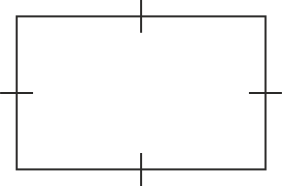
(II) B is to the right of C. D is to the left of A.
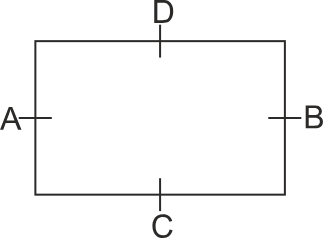
So, A sits immediately left of C. Hence, the second option is correct.
Example:
Directions: 6 boys B1, B2, B3, B4, B5, and B6 are sitting around a rectangular table facing toward the centre (not necessarily in the same order). Two boys are sitting on each longer side and one boy is sitting on each shorter side of the table. B1 sits second to the left of B6. B4 sits second to the left of B5. B5 is the immediate neighbour of B6 and B2. B5 is not sitting opposite to B4. B1 is not sitting on a shorter side.
Which pair of boys are sitting on the shorter side of the rectangular table?
1) B1 and B4
2) B4 and B2
3) B2 and B3
4) B6 and B3
Solution:
Given:
(I) 6 boys B1, B2, B3, B4, B5, and B6 are sitting around a rectangular table facing towards the centre (not necessarily in the same order). Two boys are sitting on each longer side and one boy is sitting on each shorter side of the table. B1 sits second to the left of B6.
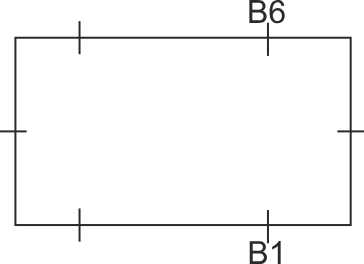
(II) B4 sits second to the left of B5. B5 is the immediate neighbour of B6 and B2.
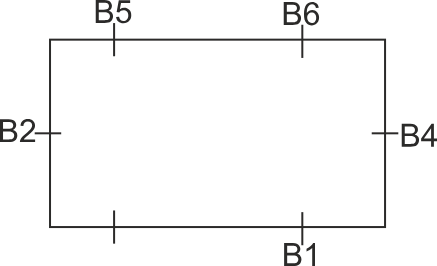
(III) B5 is not sitting opposite to B4. B1 is not sitting on a shorter side.
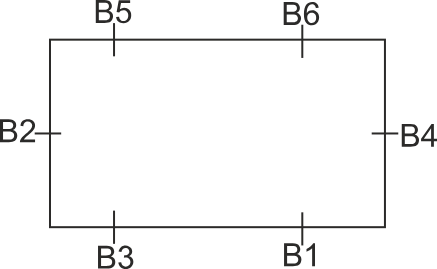
So, B2 and B4 sit on the shorter side. Hence, the second option is correct.
Triangle-Based Arrangement
In a triangle-based seating arrangement, people are seated around a triangular structure, either on the sides, corners, or both, depending on the question. These puzzles are common in seating arrangement reasoning and test direction sense and logical placement.
Facing the Centre:
When persons are seated around a triangle facing the centre, the right side corresponds to the anti-clockwise direction, while the left side corresponds to the clockwise direction.Facing Outside the Triangle:
When persons are seated facing outside the triangle, the directions get reversed—the right side becomes clockwise and the left side becomes anti-clockwise.
Practicing these direction rules for triangle seating arrangements helps solve complex puzzles quickly and accurately in competitive exams.
Introduction to Triangle-Based Puzzles
Triangle-based puzzles are a new trend puzzle are mostly seen in banking exams such as IBPS PO, Clerk, RRB, SBI PO etc. In this type, you have to arrange the persons in the triangular form either on the edges or on the sides or both edges and sides. It depends on the form of the question. Here, in triangle-based puzzles, the technique is the same as used in the circular or rectangle/ square-based puzzle arrangement. You have to consider the left and the right side of the person very carefully as mentioned above. The example below is similar to the questions for seating arrangement reasoning questions for the SBI PO exam.
Example:
Directions: Study the following information carefully and answer the below questions.
Q 1-3) Nine persons- A, B, C, D, E, F, G, H and I are sitting on the triangular table but not necessarily in the same order. Two of them sit on each side of the triangular table and three of them sit on the corner of the triangular table. The persons who sit in the corner are facing away from the centre of the table and the persons who sit in the middle of the table are facing towards the centre of the table. The consecutive alphabetically named persons are not sitting together. C sits second to the left of I. Only two persons sit between I and H. H sits immediately left of F, and vice versa. Not more than one person sits between I and F when counted from the right of F. B sits second to the left of E, and vice versa. The number of persons sitting between B and H is the same as the number of persons sitting between C and A when counted from the left of C and right of B. The number of persons sitting between D and F is the same as the number of persons sitting between G and D.
Q-1) If D is related to H and B is related to I in a certain way. Then who among the following is related to G?
1) C
2) E
3) The person who sits immediately right to A
4) The person who sits immediately left of F
Q-2) Who among the following people sits at the corner of the table?
1) C
2) One who sits to the immediate right of H
3) One who sits second to the left of I
4) G
5) A
Q-3) What is the position of A with respect to C?
1) Second to the left
2) Second to the Right
3) Third to the right
4) Fourth to the right
5) Immediate left
Solution:
There are two possibilities according to the above information:
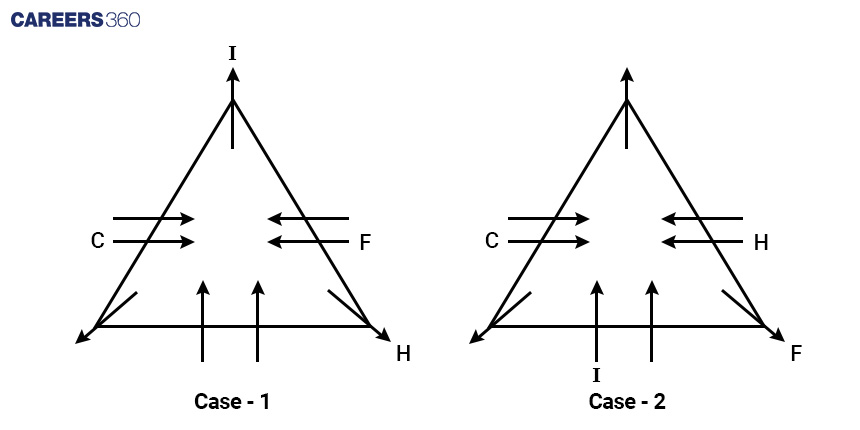
According to the information given above:
1) B sits second to the left of E and vice versa.
2) The number of persons sitting between B and H is the same as the number of persons sitting between C and A when counted from the left of C and right of B.
3)The number of persons sitting between D and F is the same as the number of persons sitting between G and D
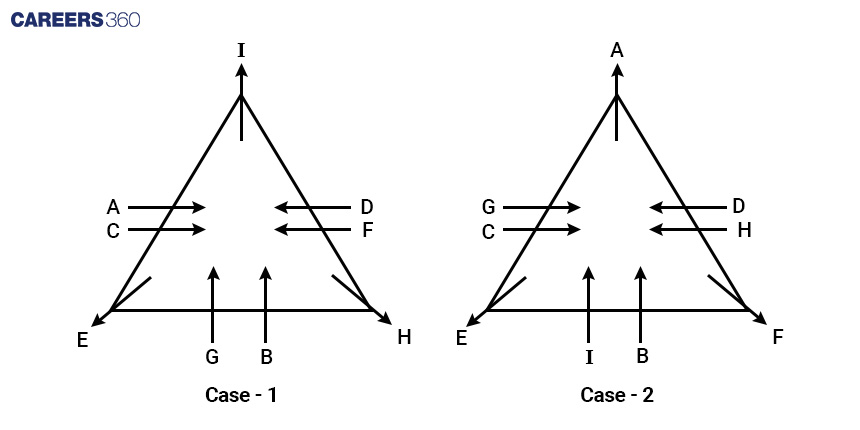 .
.
Therefore, case 1 doesn’t satisfy the above conditions. So, case 2 will be considered the final triangular arrangement.
Thus, the final arrangement is:
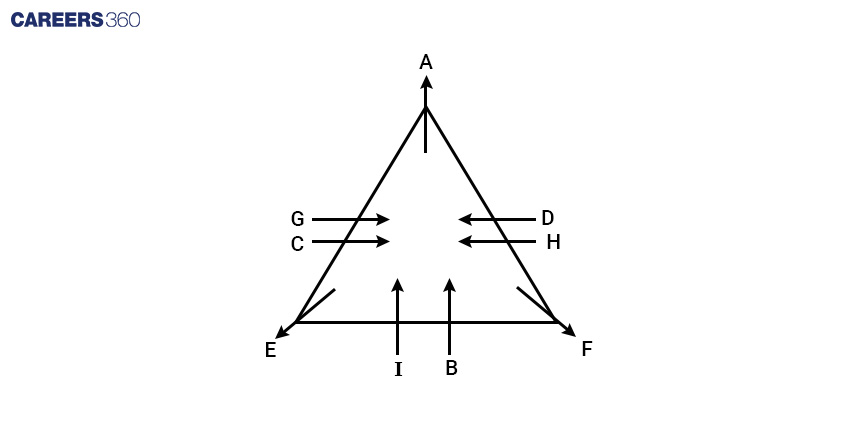
Answer:(1-3)
1) As D is related to H, B is related to I similarly, G is related to C. (Check the order of the alphabets in the clockwise direction. Hence, the first option is correct.
2) A sits at the corner of the table. Hence, the fourth option is correct.
3) As shown in the final arrangement A is at the second position from the left of C. Hence, the first option is correct.
Step-by-Step Approach to Solve Circular Seating Arrangement Questions
Circular seating arrangement is one of the most important and frequently asked topics in logical reasoning for competitive exams. To solve circular seating arrangement questions quickly and accurately, you need a clear and structured approach. Following the right method helps in avoiding confusion and improves speed in exams like SSC, banking, MBA entrance, and defence tests.
Read the Circular Arrangement Question Carefully and Identify Key Details
The first step in solving circular seating arrangement reasoning questions is to carefully read all the given information.
- Identify the total number of people involved in the arrangement
- Note important clues related to position, direction, and relationships
- Look for keywords like “left of”, “right of”, “opposite”, and “adjacent”
- Understand whether the arrangement is fixed or flexible
Once you know the number of persons, draw a rough circle with equal divisions. This helps in visualizing the arrangement clearly.
Identify Facing Direction (Inside or Outside) in Circular Arrangement
Understanding the facing direction is crucial in circular seating arrangement problems.
- If people are facing the centre, their left and right directions remain normal
- If people are facing outside, the left and right directions get reversed
- Always confirm the direction before placing any person
This step is essential for solving circular arrangement reasoning questions with accuracy, as many mistakes happen due to confusion in direction.
Mark Left and Right Directions Clearly to Avoid Confusion
To make solving easier, always mark directions on your diagram.
- Draw arrows indicating left and right at the top or bottom of the circle
- This helps maintain consistency throughout the solution
- Prevents errors when placing multiple people based on different conditions
This simple trick is highly effective in solving circular seating arrangement questions for competitive exams.
Follow a Systematic Approach to Solve Circular Arrangement Questions
A step-by-step and organized method is key to solving circular seating arrangement puzzles efficiently.
- Start with definite information such as fixed positions or direct relationships
- Place one person and build the arrangement around it
- Gradually fill remaining positions using given clues
- Avoid random placement and follow logical sequencing
- Cross-check all conditions once the arrangement is complete
A systematic approach not only improves accuracy but also helps in solving complex circular seating arrangement questions within time limits.
By following these steps and practicing regularly, you can master circular seating arrangement reasoning questions and significantly improve your performance in the reasoning section of competitive exams.
Verbal Reasoning Topics
The candidates who are preparing for the upcoming entrance and Government exams can also refer to the links given below and master the reasoning ability section:
Solved examples of Seating Arrangement
1) Directions: Five students are standing one behind the other in the playground facing the instructor. Malini is behind Anjana but in front of Gayathri. Meena is in front of Shena but behind Gayathri. What is the position of Meena?
1) Second from last
2) Extreme first
3) Extreme last
4) Second from first
Solution:
According to the given statement, Malini is behind Anjana but in front of Gayathri. So, the arrangement is –

Also, Meena is in front of Shena but behind Gayathri. So, the arrangement –

The final arrangement –
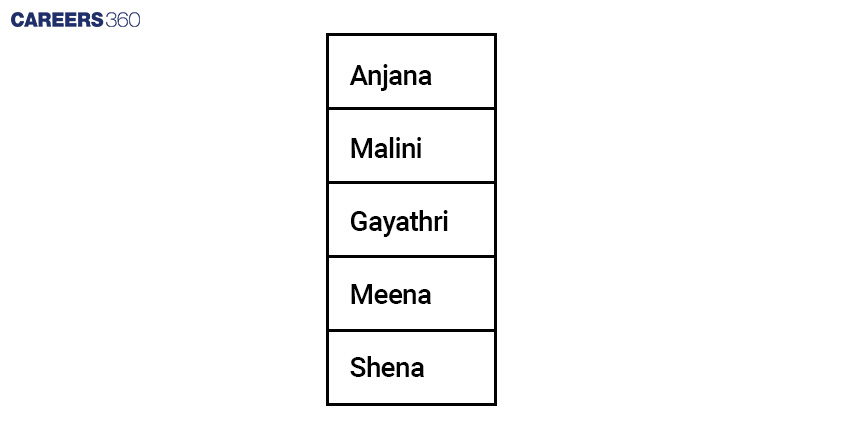
So, Meena is second from the last. Hence, the first option is correct.
2) Directions: Six persons are sitting in a circle. A is facing B, B is to the right of E, and left of C. C is to the left of D. F is to the right of A. Now D exchanges his seat with F and E with B. Who will be sitting to the left of D?
1) D
2) E
3) A
4) B
Solution:
Given:
(I) A is facing B, B is to the right of E and left of C.
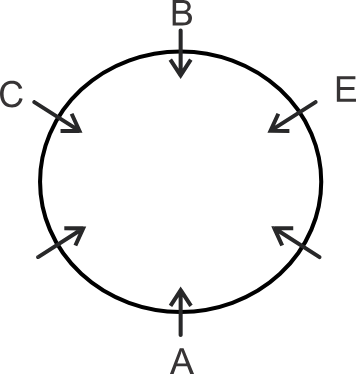
(II) C is to the left of D. F is to the right of A.
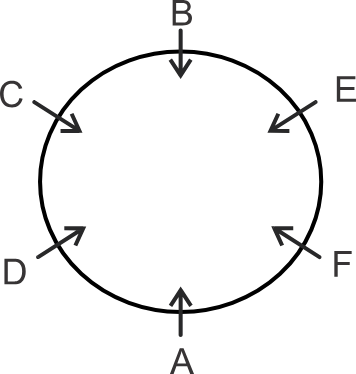
(III) Now, D exchanges his seat with F and E with B.
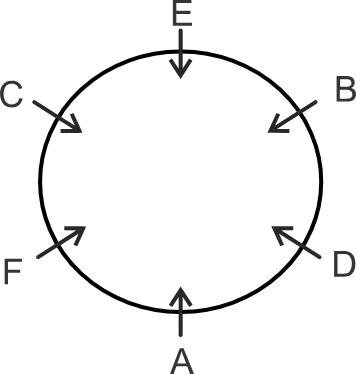
So, from the above, A is sitting to the left of D. Hence, the third option is correct.
3) Directions: Five girls are sitting in a row. A is on the right of B, E is on the left of B, but to the right of C. If A is on the left of D, who is sitting in the middle?
1) E
2) B
3) A
4) C
Solution:
Given:
Let all the girls face in the north direction.
(I) A is on the right of B, E is on the left of B, but to the right of C.

(II) A is on the left of D.

So, B is sitting in the middle of a row. Hence, the second option is correct.
4) Directions: Six friends are sitting in a circle and facing the centre of the circle. Runa, Charu, and Pari are females. Varun, Manu and Prakash are males. Manu is between Varun and Prakash, and Charu is between Pari and Runa. Varun and Pari are opposite to each other. The person sitting to the right of Runa is male. Who is sitting immediately right next to Prakash?
1) Manu
2) Charu
3) Pari
4) Varun
Solution:
Given:
(I) Runa, Charu, and Pari are females. Varun, Manu and Prakash are males. Charu is between Pari and Runa. Varun and Pari are opposite to each other. The person sitting to the right of Runa is male.
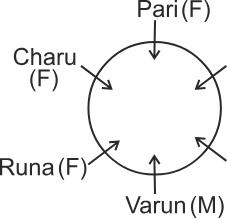
(II) Manu is between Varun and Prakash.
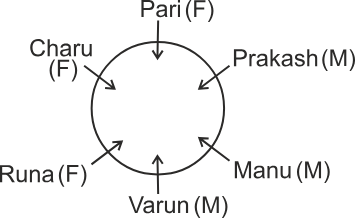
So, Pari is to the right of Prakash. Hence, the third option is correct.
5) Directions: If P is sitting second to the left of S and Q is sitting third to the right of R. T sits immediate right of S, Q is not on the immediate right or left of S. Who is sitting on the immediate right of R?
1) T
2) S
3) P
4) Q
Solution
Given:
Let all the members face north direction.
(I) P is sitting second to the left of S. T sits immediately right of S.

(II) Q is sitting third to the right of R. Q is not on the immediate right or left of S.

So, the immediate right of R is S. Hence, the second option is correct.
6) Directions: Four friends are playing carrom and sitting on the four sides of the carrom board. B is to the right of C. D is to the left of A. Who is sitting to the left of C?
1) Data is inadequate
2) A
3) D
4) B
Solution:
Given:
(I) Four friends are playing carrom and sitting on the four sides of the carrom board.
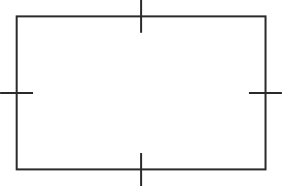
(II) B is to the right of C. D is to the left of A.
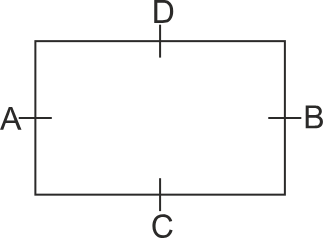
So, A sits immediately left of C. Hence, the second option is correct.
7) Directions: 6 boys, J, K, L, M, N, and P, are sitting around a rectangular table facing towards the centre (not necessarily in the same order). 4 boys are sitting in the corners, and 1 boy is sitting in the middle of each shorter side of the table. N is second to the right of K and second to the left of J. M is exactly opposite to N, and M is not sitting in the corner. Which of the following statements is definitely correct?
I. L and P are both next to N.
II. K is diagonally opposite to L.
1) Only II is correct
2) Neither I nor II is correct
3) Both I and II are correct
4) Only I is correct
Solution:
Given:
(I) N is second to the right of K and second to the left of J. M is exactly opposite to N, and M is not sitting in the corner.
According to the given statements –
I. L and P are both next to N – The position of L and P is not fixed but they both come next to N. So, this statement is correct.
II. K is diagonally opposite to L – As shown in the figure, the position of L is not defined. So, this statement is incorrect.
Therefore, only the first statement is correct. Hence, the fourth option is correct.
8) Directions: 8 boys G, H, I, J, K, L, M and N are sitting around a square table facing towards the centre (not necessarily in the same order). Four boys are sitting at the corners and four boys are sitting in the middle of the sides. J is the immediate neighbour of G and H and he is sitting at a corner. M is the immediate neighbour of N and K. L is sitting in the middle of the side. G is not sitting opposite L. N is towards the immediate right of H. Who is sitting diagonally opposite I?
1) L
2) K
3) N
4) J
Solution:
Given:
(I) 8 boys G, H, I, J, K, L, M and N are sitting around a square table facing towards the centre (not necessarily in the same order). Four boys are sitting at the corners and four boys are sitting in the middle of the sides.

(II) J is the immediate neighbour of G and H and he is sitting in a corner. M is the immediate neighbour of N and K. L is sitting in the middle of the side. G is not sitting opposite to L. N is towards the immediate right of H.

Therefore, N is sitting diagonally opposite to I. Hence, the third option is correct.
9) Directions: Eight people are sitting in two parallel rows with four people each in such a way that there is equal distance between adjacent persons. B, C, D, and E sit in the same row facing south. H, I, J, and K sit in the same row facing north. C sits at the extreme left end of their row and is exactly opposite I. H sits to the immediate left of I. K sits at the extreme left end of their row and is exactly opposite D. B sits between D and E. Who sits exactly opposite H?
1) E
2) B
3) D
4) C
Solution:
Given:
(I) C sits at the extreme left end of their row and is exactly opposite I. H sits to the immediate left of I.

(II) K sits at the extreme left end of their row and is exactly opposite D. B sits between D and E.

So, E sits exactly opposite H. Hence, the first option is correct.
10) Directions: Seven people P, Q, R, S, T, U, and V are sitting in a straight row, facing north. Exactly three people are sitting to the left of U. R is second to the left of U. Q and V are immediate neighbours of R, such that Q is not an immediate neighbour of U. T and P are not occupying either of the end seats. T is second to the left of S. If P and Q swap their seats, what will be the new position of Q?
1) Second to the right of R
2) Second to the left of V
3) Third to the left of U
4) Second to the right of U
Solution:
Given:
(I) Exactly three people are sitting to the left of U. R is second to the left of U. Q and V are immediate neighbours of R, such that Q is not an immediate neighbour of U.

(II) T and P are not occupying either of the end seats. T is second to the left of S.

If P and Q swap their seats –

So, Q is second to the right of U. Hence, the fourth option is correct.
11) Directions: Six friends A, C, D, E, F, and G are sitting in a straight row, facing north. They are waiting for their seventh friend B to join. Exactly three people are sitting to the left of A. C is occupying an end seat. F and D are immediate neighbours of G. If D is sitting to the immediate left of A, and E is second to the right of A, where will B sit?
1) Fourth to the right of F
2) Fifth to the right of G
3) To the immediate right of E
4) Third to the right of D
Solution:
Given:
(I) Exactly three people are sitting to the left of A. D is sitting to the immediate left of A and E is second to the right of A.

(II) C is occupying an end seat. F and D are immediate neighbours of G.

So, B is the fourth to the right of F. Hence, the first option is correct.
12) Directions: A, B, C, D, E, F, G, and H are sitting around a square table not facing the centre. Some of them are sitting at the corners while some are sitting at the exact centre of the sides. A is sitting to the immediate right of F and immediate left of E. C is sitting to the immediate right of E. G is sitting two places from the right of E. B is sitting to the immediate right of G. H is sitting to the immediate right of B and immediate left of D. D is sitting to the left of F. Who is sitting between A and D?
1) F
2) G
3) H
4) E
Solution:
Given:
(I) A is sitting to the immediate right of F and immediate left of E. C is sitting to the immediate right of E.
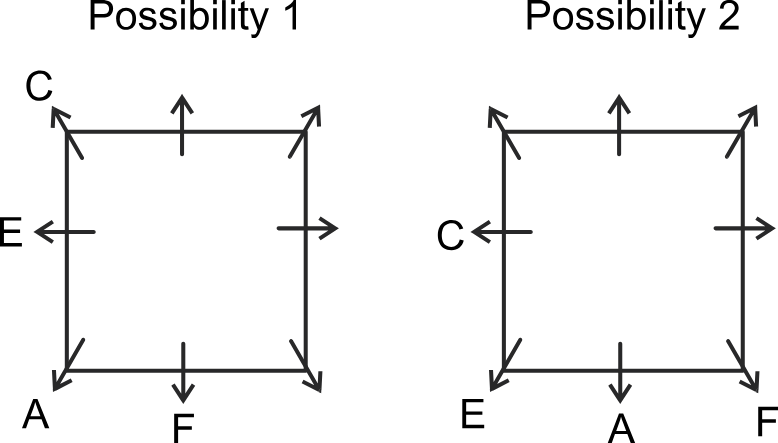
(II) G is sitting two places from the right of E. B is sitting to the immediate right of G. H is sitting to the immediate right of B and immediate left of D. D is sitting to the left of F.
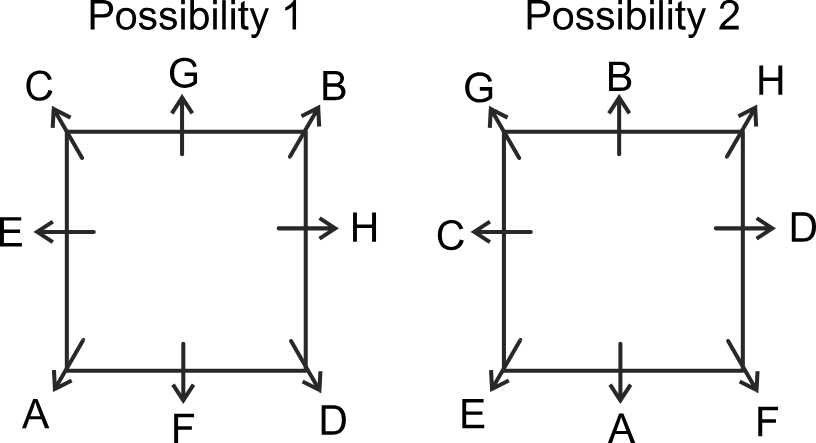
So, in both of the possibilities F is sitting between A and D. Hence, the first option is correct.
13) Directions: Seven people A, B, C, D, E, F and G are sitting in a straight row, facing north. Only two people sit to the right of E. Only two people sit between D and C. G has no neighbours on the left. D is the only neighbour of A. B sits third to the right of G. Who sits third to the right of G?
1) D
2) B
3) E
4) C
Solution:
Given:
(I) Only two people sit to the right of E. G has no neighbours on the left. B sits third to the right of G.

(II) Only two people sit between D and C. D is the only neighbour of A. Only one place is left so this place is assigned to F.

So, B sits to the third to the right of the G. Hence, the second option is correct.
14) Directions: Seven players Virat, Rahul, Rohit, Surya, Hardik, Risbabh, and Deepak are sitting around a circular table facing towards the centre (not necessarily in the same order). Rohit is second to the left of Virat. Virat is fourth to the right of Deepak. Hardik is to the immediate left of Deepak. Surya is not an immediate neighbour of Rohit. Rishabh is second to the right of Hardik. Who is fourth to the right of Hardik?
1) Surya
2) Deepak
3) Rahul
4) Virat
Solution:
Given:
(I) Rohit is second to the left of Virat. Virat is fourth to the right of Deepak. Hardik is to the immediate left of Deepak.
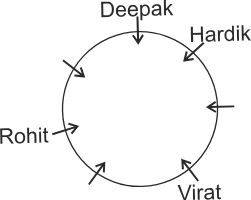
(II) Surya is not an immediate neighbour of Rohit. Rishabh is second to the right of Hardik.
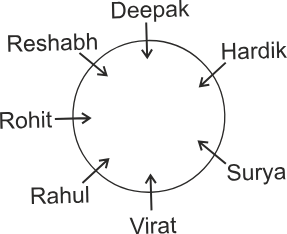
So, Rahul is fourth to the right of Hardik. Hence, the third option is correct.
15) Directions: Ram, Shyam, Pankaj, Tilak, and Gaurav are sitting in a straight line facing south. Tilak and Gaurav are sitting at the ends. Ram is sitting to the immediate left of Gaurav and the immediate right of Pankaj. Who is sitting to the immediate right of Tilak?
1) Shyam
2) Pankaj
3) Ram
4) Gaurav
Solution:
Given:
Tilak and Gaurav are sitting at the ends. Ram is sitting to the immediate left of Gaurav and the immediate right of Pankaj.

So, Shyam is sitting to the immediate right of Tilak. Hence, the first option is correct.
16) Directions: Anuj, Bala, Charanjit, Danish, Endrew, Farooq, Garvit, and Himesh are sitting around a square table facing the centre of the table. Four of them are sitting at each of the corners, while the other four are sitting at the exact centre of each of the sides. Endrew who sits middle of a side, sits to the fourth left of the Garvit. Only one person sits between Garvit and Farooq. Bala is an immediate neighbour of Endrew Only three people sit between Bala and Anuj. Bala is not a neighbour of Farooq. Himesh sits to the immediate left of Charanjit. Charanjit sits to the third right of Endrew. Who sits third to the right of Danish?
1) Himesh
2) Garvit
3) Bala
4) Charanjit
Solution:
Given:
(I) Anuj, Bala, Charanjit, Danish, Endrew, Farooq, Garvit, and Himesh are sitting around a square table facing the centre of the table. Four of them are sitting at each of the corners, while the other four are sitting at the exact centre of each of the sides.
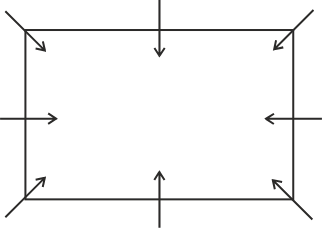
(II) Endrew who sits middle of a side, sits to the fourth left of the Garvit. Only one person sits between Garvit and Farooq. Bala is an immediate neighbour of Endrew
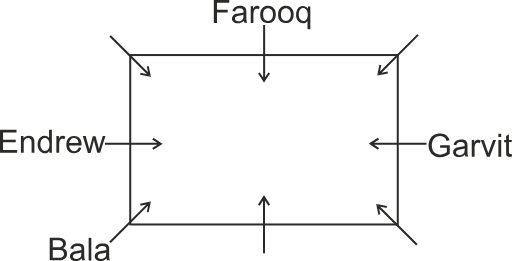
(III) Only three people sit between Bala and Anuj. Bala is not a neighbour of Farooq. Himesh sits to the immediate left of Charanjit. Charanjit sits to the third right of Endrew.
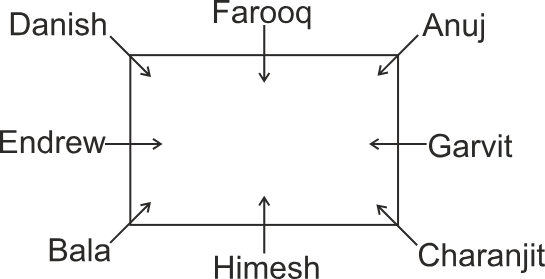
So, Himesh sits third to the right of Danish. Hence, the first option is correct.
17) Directions: In an examination ball seven students Ankit, Chotu, Jitin, Kajal, Nitu, Piyush, and Saksham are sitting in a row facing north but not necessarily in the same order. Chotu sits third to the right of Saksham. Ankit and Piyush are immediate neighbours of Chotu. More than two persons sit between Piyush and Saksham. Jitin is the only neighbour of Nitu. Jitin sits to the right of Ankit. What is the position of Nitu with respect to Kajal?
1) Fifth to the right
2) Fifth to the left
3) Third to the right
4) Third to the left
Solution:
Given:
1. Chotu sits third to the right of Saksham.
2. Ankit and Piyush are immediate neighbours of Chotu.
3. More than two persons sit between Piyush and Saksham.

4. Jitin is the only neighbour of Nitu. Jitin sits to the right of Ankit.
Therefore, the arrangement is as follows –

So, Nitu is fifth to the right of Kajal. Hence, the first option is correct.
18) Directions: A, B, C, D, E, F, G, and H are sitting around a square table facing outwards. Some of them are sitting at the corners while some are sitting at the exact centre of the sides. A is sitting to the immediate left of B and right of H. H is sitting between A and G. F is sitting to the immediate left of G and right of E. D is sitting between E and C. C is sitting to the immediate right of B. Who is sitting between C and E?
1) D
2) B
3) G
4) A
Solution:
Given:
(I) A is sitting to the immediate left of B and right of H. H is sitting between A and G. F is sitting to the immediate left of G and right of E.
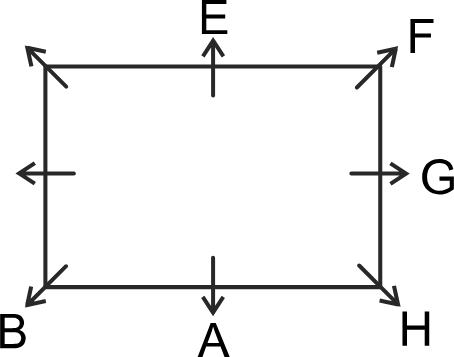
(II) D is sitting between E and C. C is sitting to the immediate right of B.
The final sitting arrangement is given below –
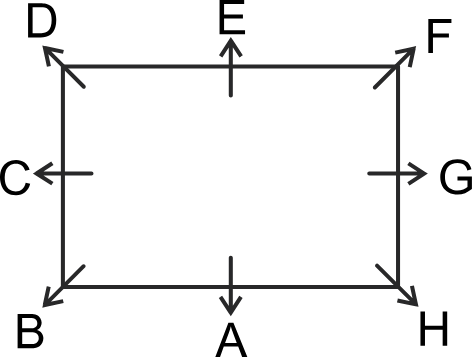
So, D is sitting between C and E. Hence, the first option is correct.
19) Directions: Seven girls A, B, C, D, E, F and G are sitting around a circular table facing opposite the centre (not necessarily in the same order). D is second to the right of G. G is third to the right of C. F is third to the right of B. A is not the immediate neighbour of C. E is the immediate neighbour of C. Who is second to the right of A?
1) G
2) C
3) E
4) F
Solution:
Given:
(I) D is second to the right of G. G is third to the right of C.
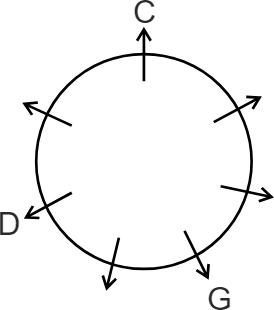
(II) F is third to the right of B. A is not the immediate neighbour of C. E is the immediate neighbour of C.
So, there are two possibilities –
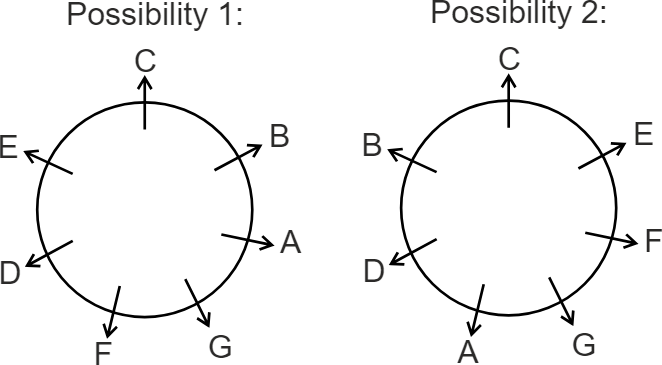
B and F are both second to the right of A. But in the option, only F is given.
Therefore, F is second to the right of A. Hence, the fourth option is correct.
20) Directions: Six people are sitting around a circular table facing the centre. Only D is between P and S. Only X is between M and L. S is sitting to the immediate right of M. Who is sitting immediately right to P?
1) S
2) M
3) L
4) D
Solution:
Given:
(I) Only D is between P and S. S is sitting to the immediate right of M.
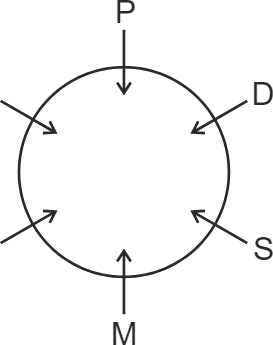
(II) Only X is between M and L.
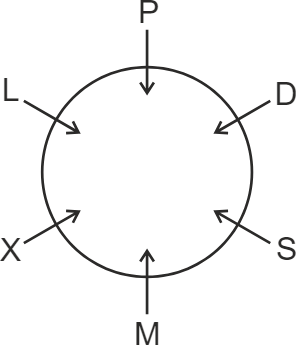
So, L is sitting immediately right next to P. Hence, the third option is correct.
Tricks to solve Seating Arrangements
We have provided below the tricks in order to solve the seating arrangements easily yet quickly.
| Seating Arrangement Type | Key Clues | Short Trick to Solve Quickly |
|---|---|---|
| Linear Arrangement | Left, right, immediate | Fix one reference person first, then place others |
| Circular Arrangement (Facing Center) | Left/right positions | Left = anticlockwise, right = clockwise |
| Circular Arrangement (Facing Outside) | Left/right reversed | Reverse directions: left = clockwise, right = anticlockwise |
| Unknown Facing Direction | Facing inside/outside | Decide facing before placing anyone |
| Row Arrangement | North/South/East/West | Fix direction first, then seat accordingly |
| Double Row | Facing each other | Opposite seats face each other directly |
| Rectangular/Square Arrangement | Corners, sides | Place corner people first, then fill sides |
| Conditional Clues | Not next to, between | Use elimination method to remove wrong positions |
| Distance-Based Clues | Second left, third right | Count positions carefully from the given reference |
| Mixed Information | Multiple statements | Solve certain clues first, then link others |
| Large Seating Sets | 8 or more people | Draw a rough diagram, not neat—speed matters |
Important Rules and Concepts for Seating Arrangement (Quick Revision Table)
Unlike quantitative topics, seating arrangement does not have mathematical formulas, but it follows a set of logical rules and standard patterns. Here is a quick-reference table of the most important concepts and tricks used in seating arrangement reasoning questions:
| Concept / Rule | Key Logic | Shortcut / Trick | Use Case |
|---|---|---|---|
| Left and Right Concept | Based on facing direction | Facing north → normal, facing south → reversed | Linear arrangement |
| Facing Direction (Circular) | Inside vs outside matters | Inside → normal, Outside → reverse left-right | Circular arrangement |
| Opposite Position | Person sits directly across | In circle → $n/2$ position away | Circular seating |
| Adjacent (Neighbors) | Immediate left or right | Check both sides carefully | All arrangements |
| Fixed Position | Certain person’s position is fixed | Start solving from fixed clue | Faster solving |
| Variable Position | Position not fixed initially | Try possibilities logically | Complex puzzles |
| Number of Positions | Total seats = number of persons | Draw equal divisions | All arrangements |
| Linear Arrangement | People in straight line | Draw row, mark directions | Basic questions |
| Circular Arrangement | People in circle | Start from any one point | Common in exams |
| Rectangular/Square | People at sides and corners | Corners are key positions | Advanced questions |
| Double Row Arrangement | Two rows facing each other | Reverse direction logic | Banking exams |
| Elimination Technique | Remove wrong options | Saves time in MCQs | Exam strategy |
| Definite Information | Direct placement clues | Solve first | Base of solution |
| Indirect Information | Needs interpretation | Use step-by-step logic | Advanced puzzles |
| Diagram Approach | Visual representation | Always draw rough diagram | Accuracy improvement |
Common Mistakes in Seating Arrangement Questions
Seating arrangement questions require careful reading and accurate placement, but many students make avoidable mistakes that lead to wrong answers and wasted time. Being aware of these mistakes can improve both speed and accuracy. Below are some common mistakes to watch out for while solving seating arrangement questions.
Ignoring Given Constraints or Conditions
Many candidates fail to carefully note instructions, such as “X sits to the left of Y” or “No two men sit together,” leading to incorrect answers in seating arrangement reasoning. Always read all constraints before starting.
Misplacing People or Objects in the Arrangement
Placing candidates or objects incorrectly without following the constraints can result in multiple errors. Visualizing each step helps avoid mistakes in both linear and circular seating arrangement problems.
Rushing Without Visualizing the Arrangement
Skipping the diagramming step often causes confusion. Drawing a simple visual layout, even for complex arrangements, can drastically improve accuracy in logical reasoning exams.
Confusing Circular and Linear Patterns
Circular and linear seating arrangements have different positional logics. Treat circular arrangements as a loop where first and last positions are adjacent, unlike linear arrangements.
Tricks and Shortcuts to Solve Seating Arrangement Questions Quickly
Seating arrangement questions can often be time-consuming, but with the right tricks and shortcuts, they can be solved much faster and with better accuracy. Learning quick methods helps in saving precious exam time while avoiding confusion. Below are some useful tricks and shortcuts to solve these questions quickly.
Step-by-Step Approach for Linear Seating Arrangements
Start by fixing individuals with the most constraints first, then fill in remaining seats logically. This method works well in SSC, CAT, and banking exams.
Visualizing Circular and Square Arrangements
Mentally rotate the arrangement if needed, and always check adjacency rules. Use clockwise and anticlockwise visualization for circular seating questions.
Using Elimination and Deduction Methods
Eliminate impossible options to narrow down possibilities. Deductive reasoning helps solve complex seating puzzles efficiently.
Time-Saving Tips for Competitive Exams
Practice with previous year questions and timed mock tests. Focus on patterns and repeated types of questions to improve speed and accuracy.
How to Prepare for Seating Arrangement Questions in Exams
Seating arrangement questions are a key part of reasoning sections in competitive exams as they test logical thinking, attention to detail, and arrangement skills. A clear approach with regular practice can make these questions easier to solve within time limits. Below are some simple tips to prepare effectively.
Recommended Books and PDFs for Practice
Books like A Modern Approach to Verbal & Non-Verbal Reasoning by R.S. Aggarwal and Rakesh Yadav’s SSC Reasoning provide extensive exercises for seating arrangement problems.
Solving Mock Tests and Previous Year Questions
Regular practice with mock tests and past exam papers for SSC, CAT, Banking, CUET, MAH MBA CET, and VITEEE helps familiarize with different seating patterns and tricky constraints.
Effective Practice Techniques for SSC, CAT, Banking, CUET, MAH MBA CET, and VITEEE
Focus on diagrammatic representation, identify recurring patterns, and time yourself. This improves both speed and accuracy for seating arrangement reasoning questions in competitive exams.
Non-Verbal Reasoning Topics
Non-verbal reasoning helps in testing logical thinking and problem-solving ability through figures, patterns, and visual concepts rather than text or numbers. It focuses on observation, analysis, and the ability to recognize relationships between shapes and images. Below are some important non-verbal reasoning topics that you should practice for better understanding.
Frequently Asked Questions (FAQs)
Seating Arrangement in reasoning is one of the most important topics in every competitive exam and entrance exam. It is defined as an arrangement of persons/ things in a circle, triangle, rectangle, square, row etc.
There are many types of seating arrangement questions such as linear, circular, square, rectangle, and triangle-based seating arrangements. In the above article, all types are mentioned with examples.
It comes in all competitive exams such as in Bank PO around 15 - 20 questions, in Bank Clerical around 10 - 15 questions, in SSC around 5 - 10 questions and in entrance exams around 2 - 5 questions.
There is only one method to ace the topic practice. So, practice as much as questions you can. If you can grab a technique of arranging the persons in any said type of seating arrangement you can solve any difficult puzzle as well.
As such there is no shortcut to solve the puzzles in the seating arrangement. You have to read the complete information, analyse the information, extract the data and arrange them accordingly to answer the question. You must practice several questions to learn the tricks to solve the seating arrangement.
The most common 3 seating arrangements are linear seating arrangement, circular seating arrangement and Polygonal seating arrangement.
