Can you decide if a conclusion is logically correct, without letting in any assumptions? That's what syllogism questions test. You get a few statements, then you have to pin down which conclusions definitely come out from logic alone. The tricky part is that these questions tend to follow fixed patterns, and they don’t need any calculations, so they are among the highest-scoring areas in exams like CAT, XAT, CMAT, SNAP, SSC, banking, and defence recruitment. In this guide, we cover the ideas, the rules, some shortcut methods, and then plenty of practice questions so you can solve syllogism questions fast, with good accuracy.
This Story also Contains
What is Syllogism in Reasoning?
Types of Syllogism in Reasoning
Statements of Syllogism
How to Solve Syllogism Questions
Verbal Reasoning Topics
Solved Syllogism Reasoning Questions with answers for Practice
Syllogism Practice Questions PDF Download
Syllogism Questions for VITEEE/ CUET
Syllogism Questions for KMAT/ SUAT/ JIPMAT/ MAT
Rules of Syllogism
Venn Diagram Method
Syllogism Questions for SSC/ RRB Exams
Syllogism Reasoning Questions for the CAT/ SBI PO exam
Syllogism Reasoning Questions for Bank exams/ Insurance exams
Logical Approach vs Venn Diagram Approach: Key Differences
Important Rules and Formulae for Syllogism (Quick Revision Table)
Syllogism a logical reasoning idea where you check whether a conclusion comes out of a set of given statements (premises). Those premises are taken as true, and you aren’t supposed to bring in any outside assumptions, even if they feel “obvious” in real life.
Basic Structure
In most syllogism questions you’ll see a mix of statements and conclusions, where the statements are treated as the only base, and then the conclusions have to be tested, strictly using that same information.
Statements (Premises): these are the given facts or conditions, what defines relationships between groups.
Conclusions: these are the inferences you have to verify, using nothing but the premises.
Why Syllogism is Important
Syllogism often scores well in exams because it follows fixed logical rules, and you don’t need heavy calculations. Most of the time people handle it quickly using Venn diagrams, and also a few shortcut techniques that reduce the effort. It also shows up fairly often in competitive examinations, so it’s a useful topic to practice.
Key Terms
Statements (Premises)
These are the given items that describe how different sets relate to each other.
Conclusions
These are the points that must be checked, and they have to be supported only by the given statements.
Universal and Particular Statements
Universal: applies to all members, like “All cats are animals.”
Particular: applies to some members, like “Some animals are black.”
Positive and Negative Statements
Positive: shows inclusion, for example “All A are B.”
Negative: shows exclusion, for example “No A is B.”
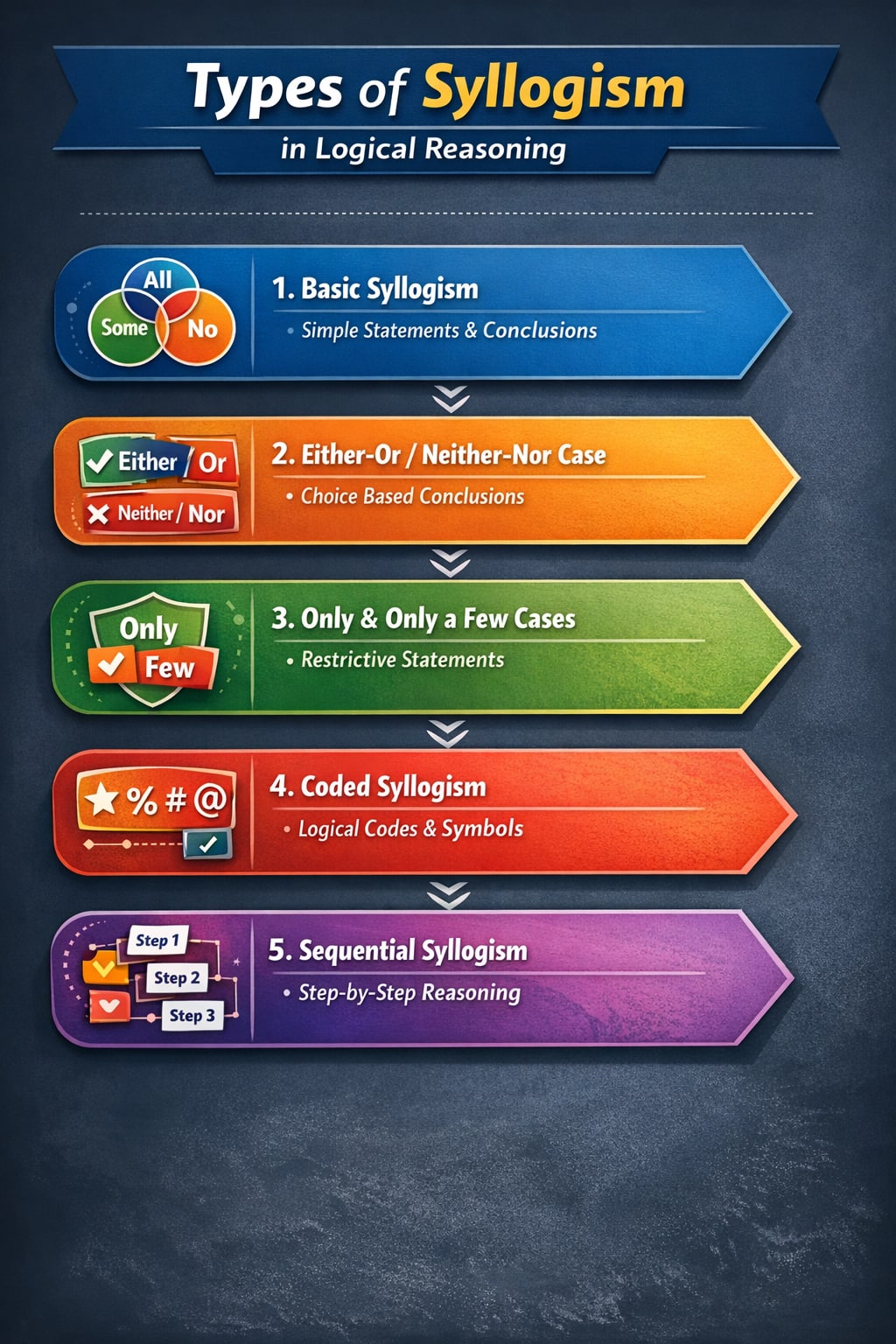
Types of Syllogism in Reasoning
Let’s discuss all the types of syllogism and syllogism reasoning tricks in detail -
1. Basic Syllogism
Basic syllogism questions usually have two or more statements, and you have to figure out which conclusion, logically follows. Just assume the given statements are true, even if it feels a bit counterintuitive. Then use Venn diagrams to check the conclusions in a accurate way, not just by “gut feeling”. If a conclusion doesn’t match the diagram, it doesn’t follow, period. Also, sometimes you’ll need to compare different sets in the diagram, and that can feel a little tedious at first, but it works.
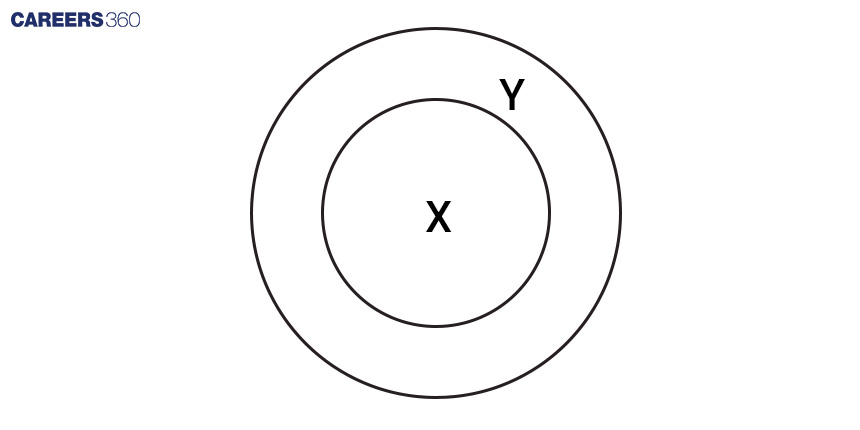
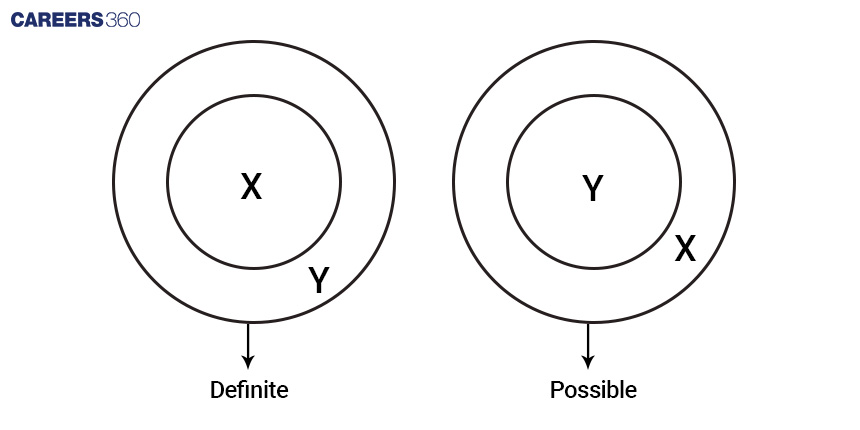
1) All X are Y
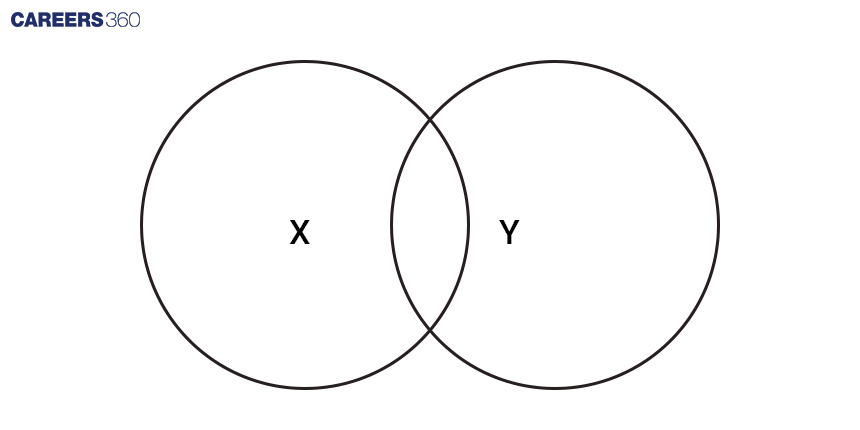
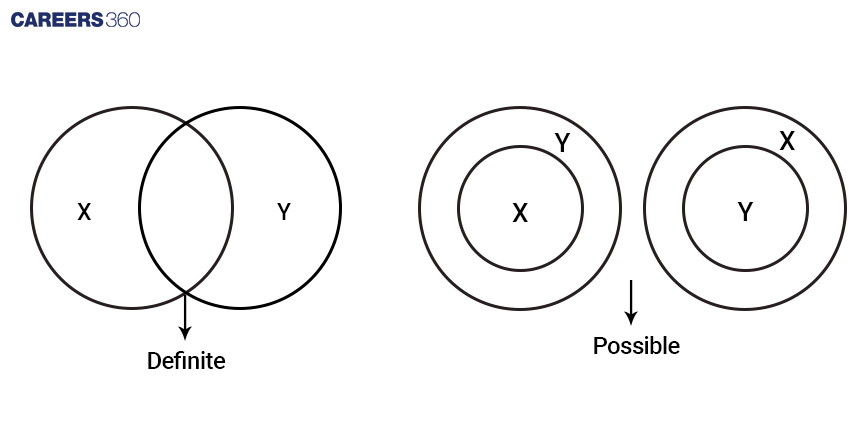
2) Some X are Y
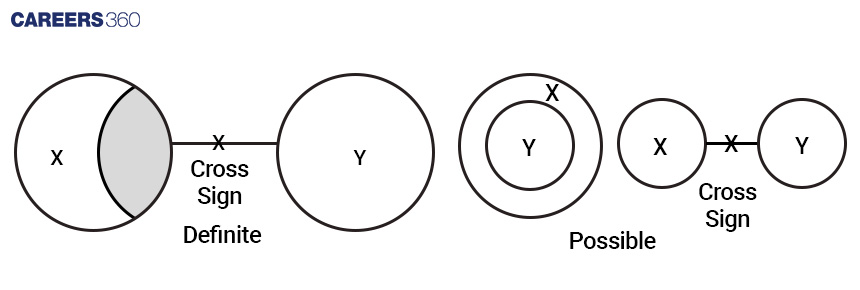
3) Some X are not Y
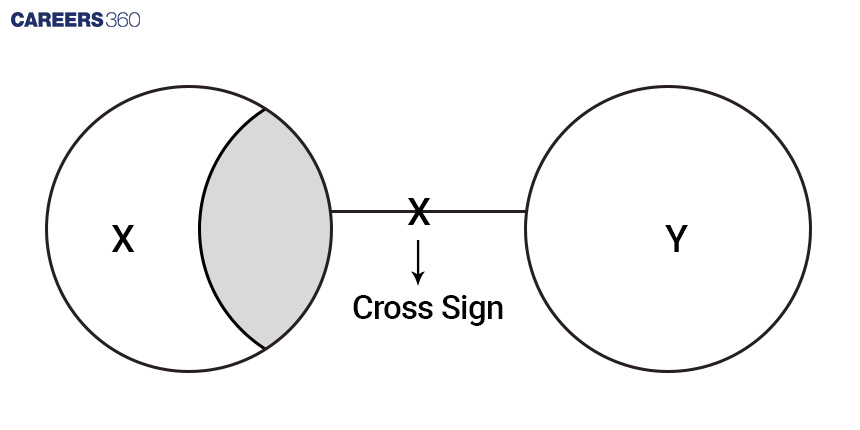
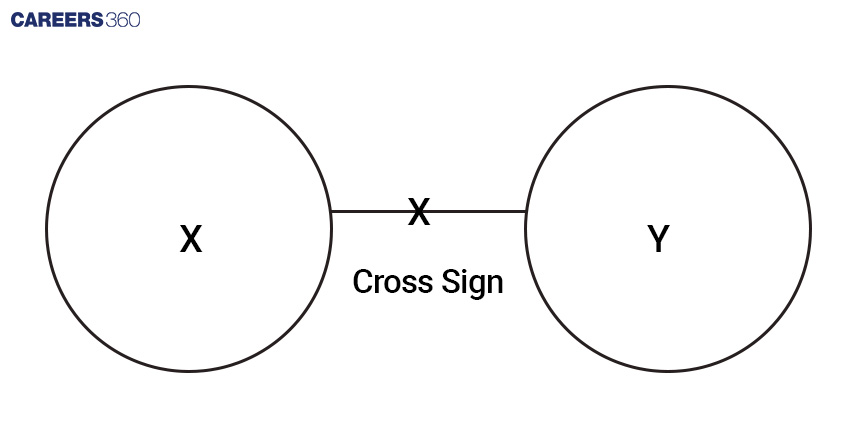
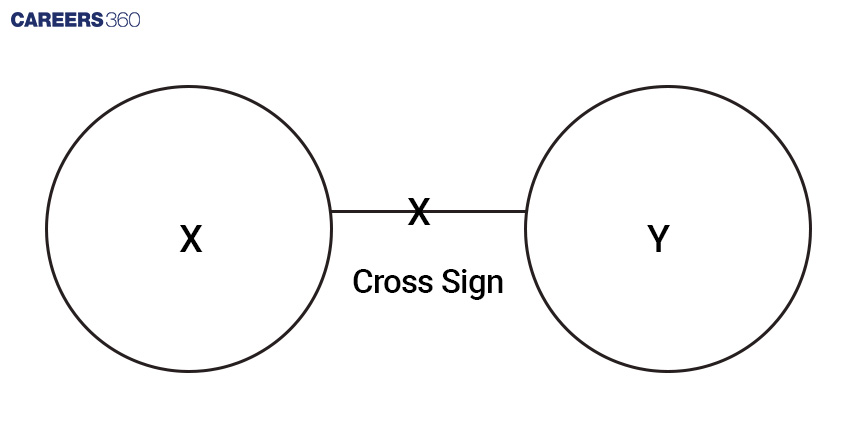
4) No X is Y
In syllogism, when you say “All,” it automatically brings in “Some” too, but if two groups have a direct negative bond (like “No A is B”), then you can’t get a positive outcome between them. Practice examples for each kind are listed down below.
Example: Directions: Read the given statements and conclusions carefully. You have to take the given statements to be true even if they seem to be at variance from commonly known facts. You have to decide which conclusion/s logically and definitely follow/s from the given statements.
Statements:
I. All Fingers are Hands.
II. Some Hands are Seconds.
III. All Seconds are Clocks.
Conclusions:
I. Some Clocks are Hands.
II. Some Fingers are Clocks.
1) Both conclusions (I) and (II) follow
2) Both conclusions (I) and (II) do not follow
3) Only conclusion (I) follows
4) Only conclusion (II) follows
Solution:
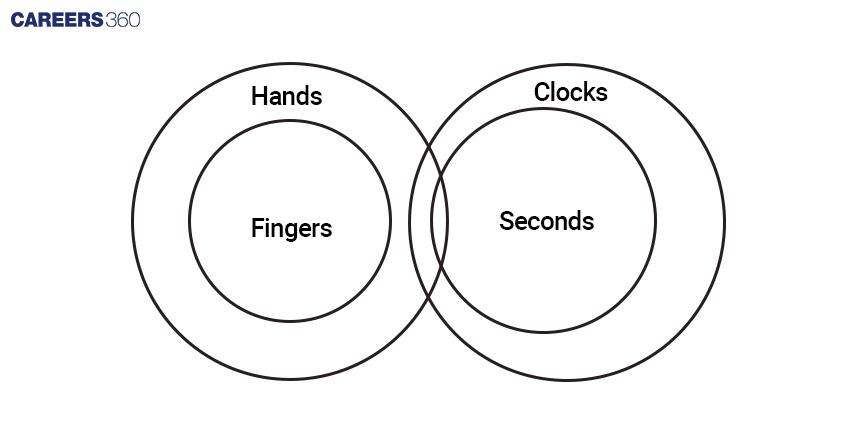
The possible Venn diagram according to the given statements is as follows –
Let's analyse the conclusions –
Conclusion (I): Some Clocks are Hands – From the Venn diagram, we can see that the two circles representing clocks and hands intersect and have a part of their area in common. So, this conclusion follows.
Conclusion (II): Some Fingers are Clocks – From the Venn diagram, we can see that there is no definite relation between fingers and clocks. So, this conclusion does not follow.
So, the only conclusion I follow. Hence, the third option is correct.
2. Either-or Case / Neither-Nor Case of Syllogism
This sort of thing leans on complementary conclusions. An either-or case comes up when two conclusions have the same subject and predicate, with one affirmative, the other negative, and in addition both taken on their own, don’t follow. In those situations, it is required that exactly one of the conclusions is true, not both, not neither.
Example: Directions: In the question two statements are given, followed by two conclusions, I and II. You have to consider the statements to be true even if they seem to be at variance from commonly known facts. You have to decide which of the given conclusions, if any, follows from the given statements.
Statements:
l. No mobile is an electronic item.
ll. All electronic items are costly.
Conclusions:
I. No costly is a mobile.
II. Some costly are mobile.
1) Only conclusion II follows
2) Both conclusions I and II follow
3) Either conclusion I or II follow
4) Only conclusion I follow
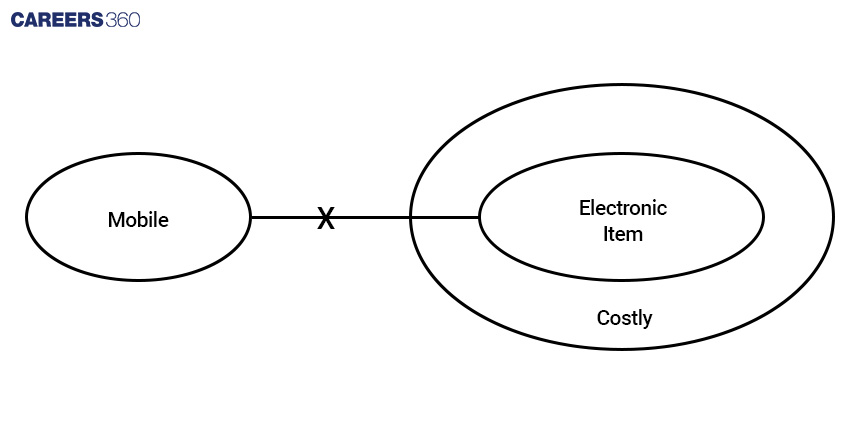
Solution: The possible Venn diagram according to the given statements is as follows –
Let's analyse the conclusions –
Conclusion (I): No costly is a mobile – According to the Venn diagram, there is no definite relation between costly and mobile. So, this conclusion does not follow.
Conclusion (II): Some costly are mobile – According to the Venn diagram, there is no definite relation between costly and mobile. So, this conclusion does not follow.
But, Some + No is a complimentary pair, it can be concluded that either conclusion I or conclusion II follows. Hence, the third option is correct.
Neither-Nor case of syllogism - When the conclusions can not be drawn from the given statements the result for 2 conclusions can be written as ‘neither nor’ in many cases of syllogism.
Example: Directions: Read the given statements and conclusions carefully. You have to take the given statements to be true even if they seem to be at variance from commonly known facts. You have to decide which conclusion/s logically follow/s from the given statements.
Statements:
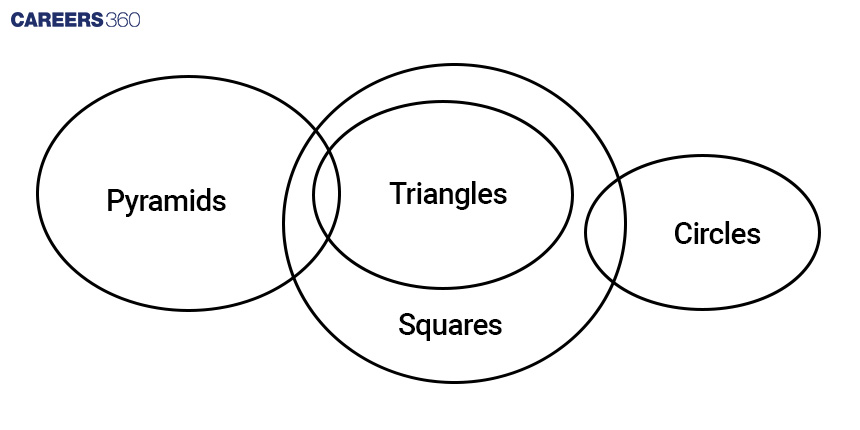
All triangles are squares.
Some squares are circles.
Some triangles are pyramids.
Conclusions:
(I) Some circles are pyramids.
(II) All pyramids are triangles.
1) Only conclusion (I) is true
2) Both conclusions (I) and (II) are true
3) Neither conclusion (I) nor (II) is true
4) Only conclusion (II) is true
Solution:
The possible Venn diagram, according to the given statements is as follows –
Let's analyse the conclusions –
Conclusion (I): Some circles are pyramids – From the diagram, it is evident that there is no direct relation between pyramids and circles. So, this conclusion does not follow.
Conclusion (II): All pyramids are triangles – From the diagram, it is evident that the circles representing pyramids and triangles overlap each other. So, it can be concluded that only some pyramids are triangles.
So, neither conclusion (I) nor (II) is true. Hence the third option is correct.
3. Only and Only a Few Cases of Syllogism (including possibility)
Possibility based syllogism is a advanced question type, commonly asked in Bank PO and CAT exams. Unlike regular syllogism, a conclusion is said to be correct if it can be possible in at least one valid Venn diagram, even when it is not surely true in every case.
Below are the diagrams that help you understand the definite and the possible diagrams:
1. All X are Y.
2. Some X are Y.
3. Some X are not Y.
4. No X is Y.
Example: Directions: Two Statements are given followed by two conclusions numbered I and II. Assuming the statements to be true, even if they seem to be at variance with commonly known facts, decide which of the conclusions logically follow(s) from the statements.
Statements:
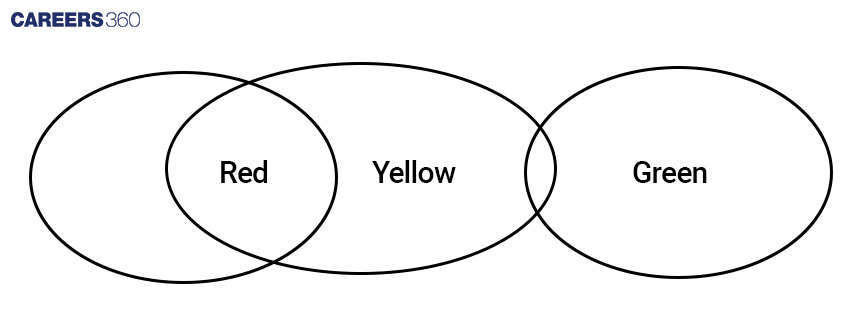
Most red are yellow.
Some yellow are green.
Conclusions:
I. Some green are yellow.
II. Some green is red.
1) Neither conclusion I nor II follows
2) Only conclusion II follows
3) Both conclusions I and II follow
4) Only conclusion I follows
Solution:
The possible Venn diagram according to the given statements is as follows –
Let's analyse the conclusions –
Conclusion (I): Some green are yellow – According to the Venn diagram, some parts of the circle of green intersect with the circle of yellow and have some common parts between them. Therefore, some green are yellow is true conclusion.
Conclusion (II): Some green is red – According to the Venn diagram, there is no direct relation between green and red. Therefore, some green are red is a false conclusion.
So, the only conclusion I follow. Hence, the fourth option is correct.
Example: Directions: Two Statements are given followed by two conclusions numbered I and II. Assuming the statements to be true, even if they seem to be at variance with commonly known facts, decide which of the conclusions logically follow(s) from the statements.
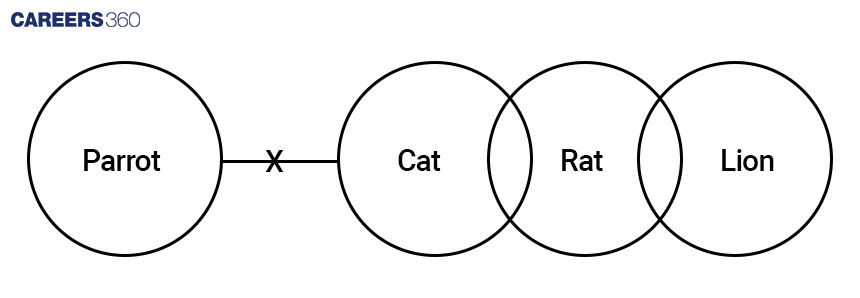
Statements: Some cats are rats. Some lions are rats. No parrot is cat. Conclusions: I) All lions being parrots is a possibility. II) Only a few rats are cats.
1) Only I follow
2) Only II follows
3) Both I and II follow
4) Neither I nor II follows
5) Either I or II follows
Solution:
The possible Venn diagram according to the given statements is as follows –
Let’s analyse the conclusions - Conclusion (I) All lions being parrots is a possibility - From the Venn diagram above, It is seen that there is no direct relation between lions and parrots is given. Therefore, all lions being parrots is a possibility. So, this conclusion follows. Conclusion (II) Only a few rats are cats - From the Venn diagram above, it is given that some cats are rats. But there is no restriction imposed on them. Therefore, we cannot say that only a few rats are cats. So, this conclusion doesn’t follow.
Hence, the first option is correct.
4. Coded Syllogism
Coded syllogism a higher level question style that is asked again and again in Bank PO mains exams, such as IBPS PO and SBI PO. In this stuff, the statements and the final outcomes are shown in coded form, so you have to decode them first before deciding which conclusions actually, logically follow.
Example: Directions: In the given question below, some symbols are used with the meaning. The information provided below is the coded statements followed by the three conclusions. You have to decode the provided information. Read all the conclusions and decide which conclusions logically follow from the given statements. A @ B means Only a few B are A A &B means All B are A A Misplaced &Misplaced & P; M & R Conclusions: I) All P is N is a possibility. II) No N is M. III) Some P is not M.
1. Only II and III follow
2. Only I and III follow
3. Only I follow
4. Only III follows
5. None follows
Solution: Given:
Symbols A to B
@
&
$
Meaning A to B
Only a Few
All
No
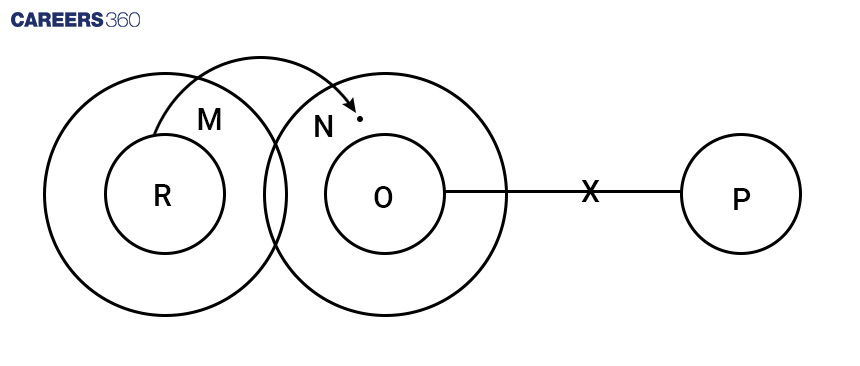
Statements: M @ N = Only a few N is M. N &O = All O is N. O $ P = No P is O. M &R = All R is M. Therefore, the possible Venn diagram for the given statement is:
Conclusions: I) All P is N is a possibility - There is no negative or direct relation given between P and N. Therefore, there is a possibility that all P is N. So, this conclusion follows. II) No N is M - As shown in the Venn diagram, It is definite that some M is N because the circles of M and N overlap. Therefore, it is a false conclusion. III) Some P is not M - There is a possibility that some or all P is M as there is no direct relation given between them. Therefore, it is a false conclusion. So, only the conclusion I follow. Hence, the third option is correct.
5. Sequential Syllogism
Sequential syllogism is a high level question type, most of the time you see it in exams like IBPS PO, SBI PO, and even UGC NET. Basically it gives you a chain of statements, and you need to figure out which option is correct where the third statement comes after ( or logically follows ) from the first two. You know, it’s not just random guessing, there’s an order, a hidden relation there.
Example: Directions: Arrange the statements in a logical sequence I) All animals have legs. II) Some animals are cats. III) All cats can walk. 1) I, II, III 2) II, III, I 3) III, II, I 4) II, I, III Solution: The correct logical sequence is: All animals have legs (I); Some animals are cats (II); All cats can walk. Hence, the first option is correct.
Statements of Syllogism
Statements are the given facts that establish logical relationships between different groups or categories in a syllogism question.
Type
Statement Format
Symbolic Form
Example
Universal Affirmative
All A are B
A → B
All dogs are animals.
Universal Negative
No A is B
A → ¬B
No fruits are meat.
Particular Affirmative
Some A are B
∃A ∧ B
Some students are athletes.
Particular Negative
Some A are not B
∃A ∧ ¬B
Some cars are not electric.
Complementary Affirmative
All A are not B (less common form)
A → ¬B
All toys are not dangerous. (rare)
Probable Affirmative
Most A are B (used in modern logic)
Most A → B
Most birds can fly.
Conditional Statement
If A, then B
A → B
If it rains, the ground gets wet.
How to Solve Syllogism Questions
Start by figuring out whether the statements are universal like All, No or particular such as Some, Some not .
Then make a simple Venn diagram, to show how the sets are related in between.
After that, check each conclusion using only what is given in the statements, not from your own idea.
Finally, decide if the conclusion is a must follow, or just a chance.
Important Points to Remember
For a definite conclusion you need a clear link, between the groups mentioned.
If the statement gives a direct negative relation, then any positive conclusion gets ruled out, because that won’t fit.
Also an either-or case is okay, only when neither one of the two complementary conclusions comes out on its own.
Verbal Reasoning Topics
Syllogism is a key verbal reasoning subject, that is commonly asked in SSC, Banking, RRB, Insurance, CAT, XAT, and also other competitive exams.
Solved Syllogism Reasoning Questions with answers for Practice
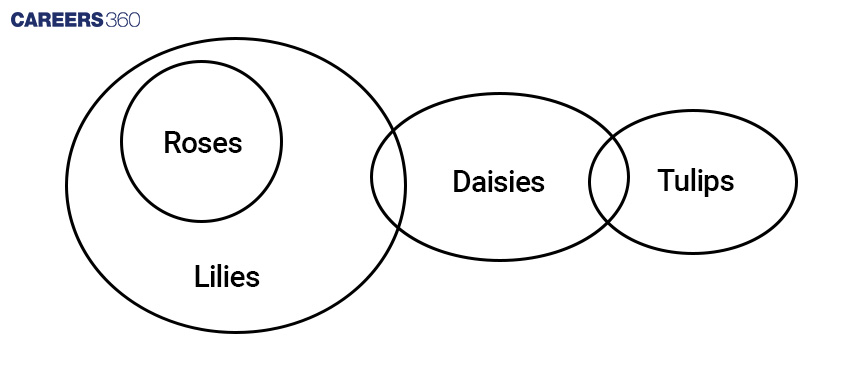
1. Directions: Read the given statements and conclusions carefully. Assuming that the information given in the statements is true, even if it appears to be at variance with commonly known facts, decide which of the given conclusions logically follow(s) from the statements.
Statements:
Some daisies are lilies.
All roses are lilies.
Some tulips are daisies.
Conclusions:
(I) Some lilies are tulips.
(II) Some roses are daisies.
1) Only conclusion (II) follows
2) Only conclusion (I) follows
3) Both conclusions (I) and (II) follow
4) Neither conclusion (I) nor (II) follows
Solution:
The possible Venn diagram according to the given statements is as follows –
Let's analyse the conclusions – Conclusion (I): Some lilies are tulips – From the Venn diagram, it is evident that there is no direct relation between lilies and tulips. So, this conclusion does not follow.
Conclusion (II): Some roses are daisies – From the Venn diagram, it is evident that there is no direct relation between roses and daisies. So, this conclusion does not follow.
So, neither conclusion I nor II follows. Hence the fourth option is correct.
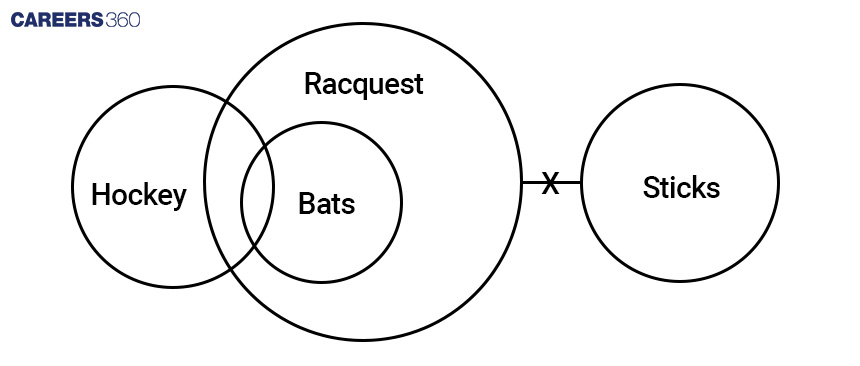
2. Directions: Read the given statements and conclusions carefully. Assuming that the information given in the statements is true, even if it appears to be at variance with commonly known facts, decide which of the given conclusions logically follow(s) from the statements.
Statements:
Some hockey are bats.
All bats are racquets.
No stick is a racquet.
Conclusions:
I. Some sticks are bats.
II. Some sticks are hockey is a possibility.
III. All hockey are racquets.
1) Only conclusion II follows
2) Both conclusions I and II follow
3) Both conclusions II and III follow
4) Only conclusion I follows
Solution:
The possible Venn diagram, according to the given statements is as follows –
Let's analyse the conclusions –
Conclusion (I): Some sticks are bats – From the Venn diagram, it is evident that there is a negative relation between sticks and bats. So, it can be concluded that no sticks are bats.
Conclusion (II): Some sticks are hockey is a possibility – It is a possibility that the circle representing hockey overlaps the circle representing sticks. So, this conclusion follows.
Conclusion (III): All hockey are racquets – From the Venn diagram, it is evident that only some part of the circle representing hockey is overlapped by the circle representing racquets. So, it can be concluded that only some hockey are racquets.
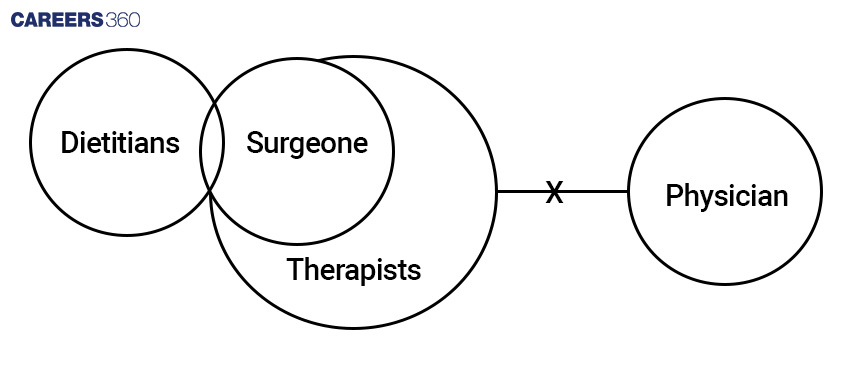
3. Directions: Read the given statements and conclusions carefully. You have to take the given statements to be true even if they seem to be at variance from commonly known facts. You have to decide which conclusion/s logically follow/s from the given statements.
Statements: Some dietitians are surgeons. All surgeons are therapists.
No therapist is a physician.
Conclusions: (I) Some therapists are dietitians.
(II) No dietitian is a physician.
1) Only conclusion I follows
2) Only conclusion II follows
3) Both conclusions I and II follow
4) Neither conclusion I nor II follows
Solution:
The possible Venn diagram, according to the given statements is as follows –
Let's analyse the conclusions –
Conclusion (I): Some therapists are dietitians – From the Venn diagram, it is evident that the two circles representing therapists and dietitians overlap and have a part of their area in common. So, this conclusion follows.
Conclusion (II): No dietitian is a physician – From the Venn diagram, it is evident that there is no direct relation between dietitians and physicians. Thus, no definite relation can be drawn. So, this conclusion does not follow.
From the above, the only conclusion I follow. Hence, the first option is correct.
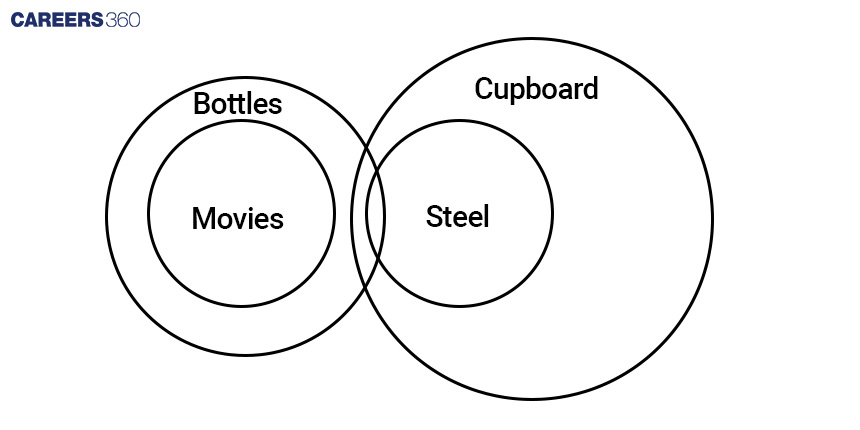
4. Directions: Read the given statements and conclusions carefully. You have to take the given statements to be true even if they seem to be at variance from commonly known facts. You have to decide which conclusions logically follow/s from the given statements.
Statements:
All movies are bottles.
Some bottles are steel.
All steel is cupboards.
Conclusions:
I. Some movies are bottles.
II. Some cupboards are steel.
1) Only conclusion (II) follows
2) Neither conclusion (I) nor (II) follows
3) Only conclusion (I) follows
4) Both conclusions (I) and (II) follow
Solution:
The possible Venn diagram according to the given statements is as follows –
Let's analyse the conclusions –
Conclusion I: Some movies are bottles – From the Venn diagram, it is evident that the circle representing movies lies inside the circle representing bottles. Since all movies are bottles, some movies will definitely be bottles. Therefore, this conclusion follows.
Conclusion II: Some cupboards are steel – From the Venn diagram, it is evident that some parts of the circle representing the cupboard lie inside the circle representing steel. So, it can be concluded that some cupboards are steel.
From the above, both conclusions I and II follow. Hence, the fourth option is correct.
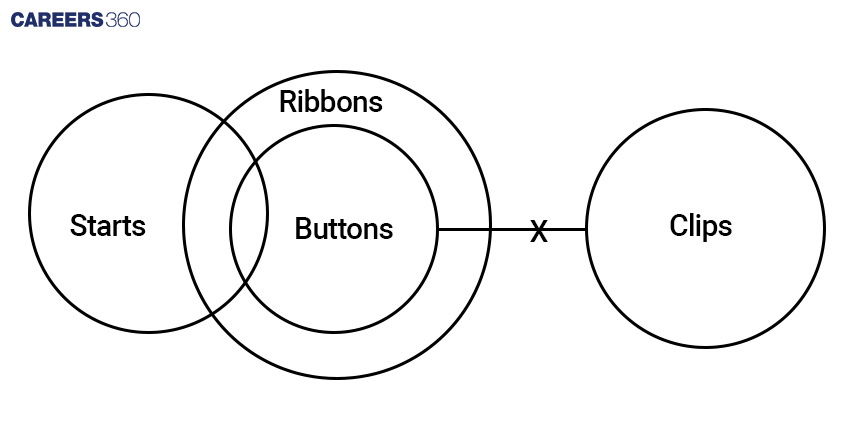
5. Directions: Read the given statements and conclusions carefully. Assuming that the information given in the statements is true, even if it appears to be at variance with commonly known facts, decide which of the given conclusions logically follow[s] from the statements.
Statements:
Some stars are buttons.
No buttons are clips.
All buttons are ribbons.
Conclusions:
I. Some stars are ribbons.
II. Some ribbons are buttons.
1) Both conclusions (I) and (II) follow
2) Only conclusion (I) follows
3) Neither conclusion (I) nor (II) follows
4) Only conclusion (II) follows
Solution:
The possible Venn diagram according to the given statements is as follows –
Let's analyse the conclusions –
Conclusion I: Some stars are ribbons – From the Venn diagram, it is evident that the two circles representing stars and ribbons overlap and have a part of their area in common. So, it can be concluded that some stars are ribbons.
Conclusion II: Some ribbons are buttons – From the Venn diagram, it is evident that some parts of the circle representing ribbons lie inside the circle representing buttons. So, it can be concluded that some ribbons are buttons.
So, both conclusions I and II follow. Hence, the first option is correct.
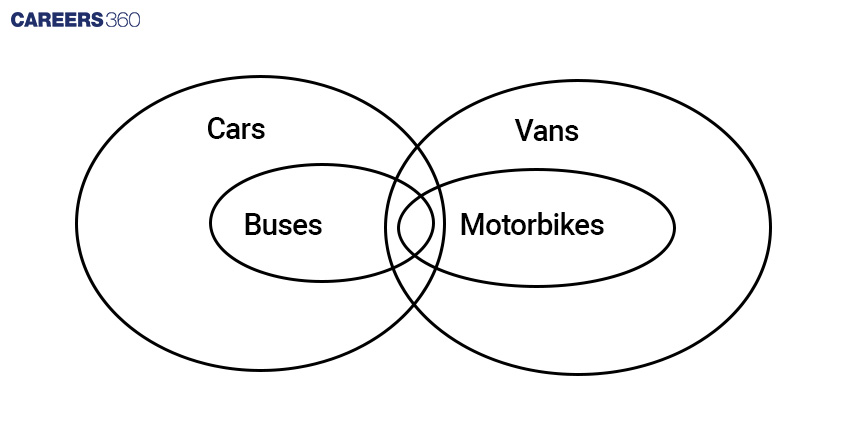
6. Directions: Read the given statements and conclusions carefully. Assuming that the information given in the statements is true, even if it appears to be at variance with commonly known facts, decide which of the given conclusions logically follow(s) from the statements.
Statements:
I. Some buses are motorbikes.
II. All motorbikes are vans.
III. All buses are cars.
Conclusions:
I. Some cars are vans.
II. Some vans are buses.
III. Some vans are motorbikes.
1) Only conclusion II follows
2) All conclusions I, II and III follow
3) Only conclusion I follows
4) Both conclusions I and II follow
Solution:
The possible Venn diagram, according to the given statements is as follows –
Let's analyse the conclusions –
Conclusion (I): Some cars are vans – From the Venn diagram, we can see that the two circles representing cars and vans intersect and have a common area between them. So, this conclusion follows.
Conclusion (II): Some vans are buses – From the Venn diagram, we can see that the two circles representing vans and buses intersect and have a common area between them. So, this conclusion follows.
Conclusion (III): Some vans are motorbikes – From the Venn diagram, we can see that the circle representing motorbikes is completely inside the circle representing vans. So, some vans are motorbikes is a true conclusion.
So, all conclusions I, II, and III follow. Hence, the second option is correct.
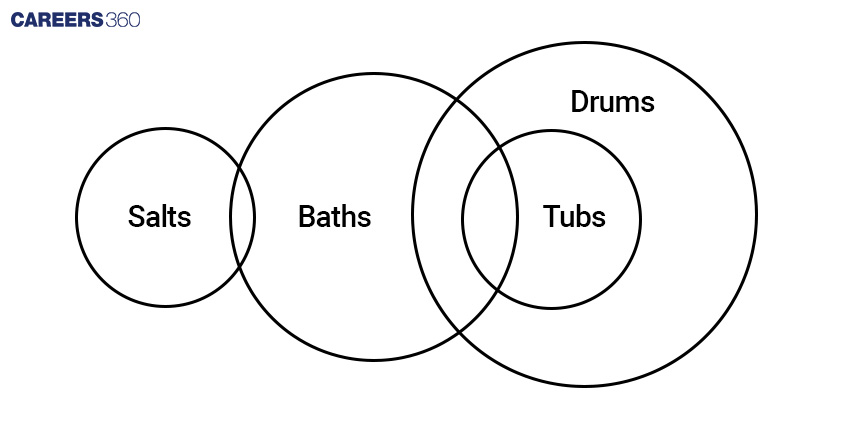
7. Directions: Read the given statements and conclusions carefully. You have to take the given statements to be true even if they seem to be at variance from commonly known facts. You have to decide which conclusion/s logically and definitely follow/s from the given statements.
Statements:
|. Some Salts are Baths.
||. All Tubs are Drums. |||. Some Baths are Tubs.
Conclusions:
I. Some Salts are Tubs.
||. Some Drums are Baths.
1) Both conclusions I and II follow
2) Both conclusions I and II do not follow
3) Only conclusion I follows
4) Only conclusion II follows
Solution:
The possible Venn diagram, according to the given statements is as follows –
Let's analyse the conclusions –
Conclusion I: Some Salts are Tubs – According to the Venn diagram, there is no direct relation between salt and tubs. Therefore, this conclusion is false.
Conclusion II: Some Drums are Baths – According to the Venn diagram, the circle of drums and baths intersect and have a common area between them. Therefore, this conclusion is true.
So, the only conclusion II follows. Hence, the fourth option is correct.
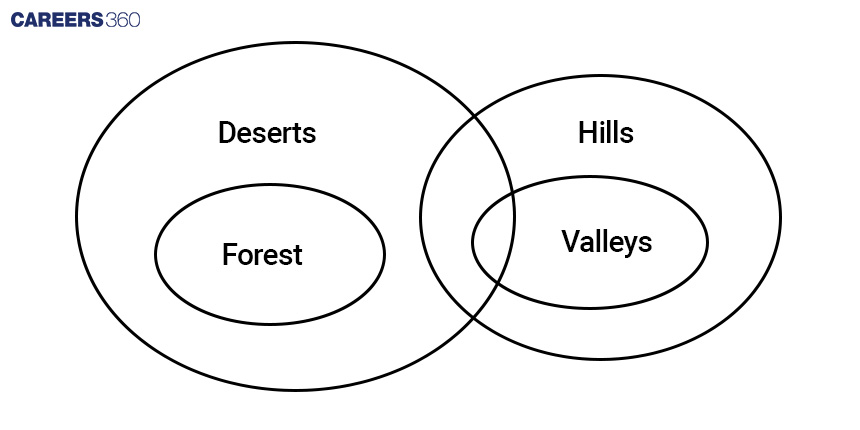
8. Directions: Read the given statements and conclusions carefully. You have to take the given statements to be true even if they seem to be at variance from commonly known facts. You have to decide which conclusion/s logically follow/s from the given statements.
Statements:
I. All forests are deserts.
II. Some deserts are valleys.
III. All valleys are hills.
Conclusions:
I. No hill is a forest.
II. Some deserts are hills.
1) Only conclusion II follows
2) Neither conclusion I nor II follows
3) Only conclusion I follows
4) Both conclusions I and II follow
Solution:
The possible Venn diagram, according to the given statements is as follows –
Let's analyse the conclusions –
Conclusion I: No Hill is a Forest – According to the Venn diagram, there is no direct relation between hills and forests, it is a possibility but is not definite. So this conclusion is false.
Conclusion II: Some Deserts are Hills – According to the Venn diagram, the circle of desert and hill intersect and have some common area between them. Therefore, some deserts are hills is a true conclusion.
So, the only conclusion II follows. Hence, the first option is correct.
9. Directions: In the following question, three statements are given followed by three conclusions I, II, and III. You have to consider the two statements to be true even if they seem to be at variance from commonly known facts. You have to decide which of the given conclusions, if any, follow from the given statements.
Statements:
All chickens are birds.
Some chickens are hens.
Female birds lay eggs.
Conclusions:
I. All birds lay eggs.
II. Some hens are birds.
III. Some chickens are not hens.
1) Conclusions II and III follow
2) All conclusions I, II, and III follow
3) Only conclusion I follows
4) Only conclusion II follows
Solution:
The possible Venn diagram according to the given statements is as follows –
Let's analyse the conclusions –
Conclusion I: All birds lay eggs – According to the given statements, it is clear that female birds lay eggs, but birds can be both male and female. So, it can be concluded that only some birds lay eggs not all. Therefore, this conclusion does not follow.
Conclusion II: Some hens are birds – From the Venn diagram, it is evident that the circles representing hens and birds overlap each other and have a part of their areas in common. So, from this, it can be concluded that some hens are birds. Thus, this conclusion follows.
Conclusion III: Some chickens are not hens – According to the given statements, it is clear that there is a possibility that some chickens may not be hens but it is not definite. So, this conclusion does not follow.
Therefore, only conclusion II follows. Hence, the fourth option is correct.
10. Directions: In the following question, two statements are given followed by two conclusions I and II. You have to consider the two statements to be true even if they seem to be at variance from commonly known facts. You have to decide which of the given conclusions, if any, follow from the given statements.
Statements:
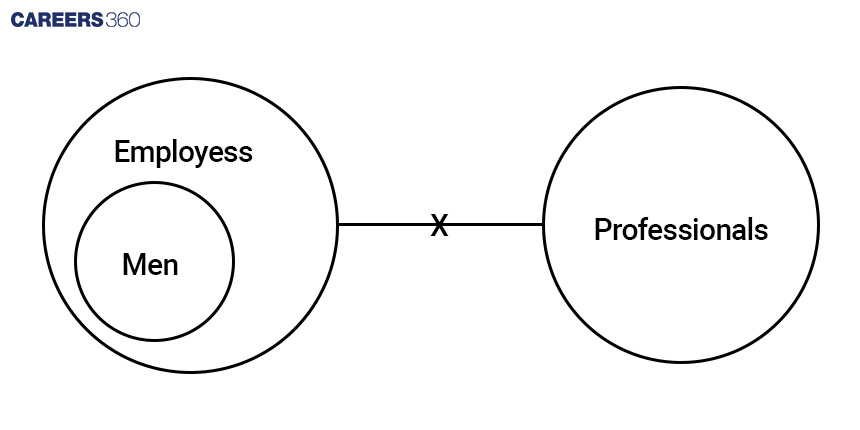
All men are employees.
No employees are professionals.
Conclusions:
I. No men are employees.
II. No men are professionals.
1) Only I follow
2) Only II follows
3) Neither I nor II follows
4) Both I and II follow
Solution:
The possible Venn diagram according to the given statements is as follows –
Let's analyse the conclusions –
Conclusion I: No men are employees – Based on the given statements, it is given that all men are employees. So, this conclusion does not follow.
Conclusion II: No men are professionals – Based on the given statements, it is given that all men are employees and no employees are professionals. From this, it can be inferred that no men are professionals. So, this conclusion follows.
Therefore, only conclusion II follows. Hence, the second option is correct.
11. Directions: In the following question, two statements are given followed by two conclusions I and II. You have to consider the two statements to be true even if they seem to be at variance from commonly known facts. You have to decide which of the given conclusions, if any, follow from the given statements.
Statements:
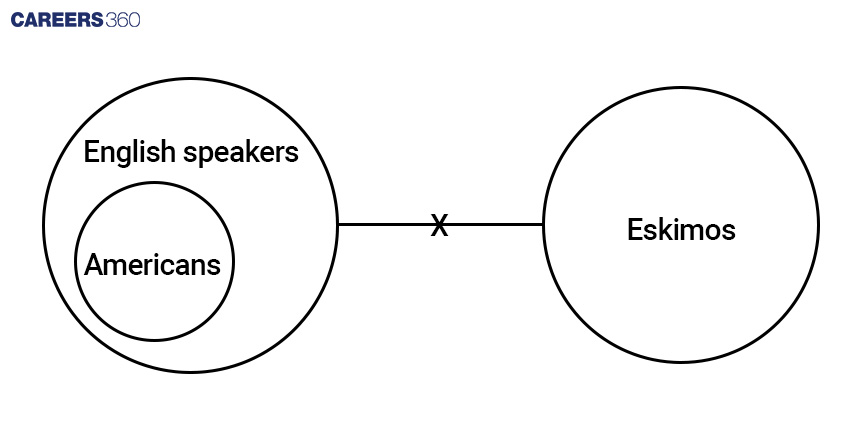
All Americans are English speakers.
No English speakers are Eskimos.
Conclusions:
I. No Eskimos are Americans.
II. No Eskimos are English speakers.
1) Only I follow
2) Neither I nor II follows
3) Only II follows
4) Both I and II follow
Solution:
The possible Venn diagram according to the given statements is as follows –
Let's analyse the conclusions – Conclusion I: No Eskimos are Americans – Based on the given statements, it is given that all Americans are English speakers and no English speakers are Eskimos. From this, it can be inferred that no Eskimos are Americans. So, this conclusion follows.
Conclusion II: No Eskimos are English speakers – Based on the given statements, it is given that no English speakers are Eskimos. So, this conclusion follows.
Therefore, both conclusions follow. Hence, the fourth option is correct.
12. Directions: In the following question, three statements are given followed by four conclusions, I, II, III, and IV. You have to consider the statements to be true even if they seem to be at variance from the commonly known facts. You have to decide which of the given conclusions, if any, follow from the given statements.
Statements:
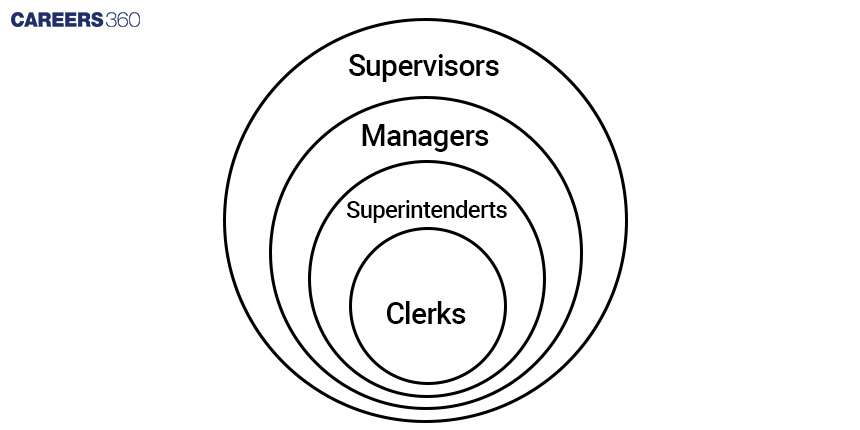
All clerks are superintendents.
All superintendents are managers.
All managers are supervisors.
Conclusions:
I. All supervisors are clerks.
II. Some clerks are supervisors.
III. Some managers are clerks.
IV. All superintendents are clerks.
1) Only conclusions I and II follow
2) Only conclusions II and III follow
3) Only conclusions III and IV follow
4) Only conclusions IV and I follow
Solution:
The possible Venn diagram according to the given statements is as follows –
Let's analyse the conclusions –
Conclusion I: All supervisors are clerks – From the Venn diagram, it is evident that some parts of the circle representing supervisors lie outside the circle representing clerks while some lie inside. So, from this, it can be concluded that some supervisors are clerks. Therefore, this conclusion does not follow.
Conclusion II: Some clerks are supervisors – From the Venn diagram, it is evident that the circle representing clerks completely lies inside the circle representing supervisors. So, from this, it can be concluded that all clerks are supervisors. Thus, if all clerks are supervisors, then some clerks will definitely be supervisors. So, this conclusion follows.
Conclusion III: Some managers are clerks – From the Venn diagram, it is evident that some parts of the circle representing managers lie outside the circle representing clerks while some lie inside. So, from this, it can be concluded that some managers are clerks. Therefore, this conclusion follows.
Conclusion IV: All superintendents are clerks – From the Venn diagram, it is evident that some parts of the circle representing superintendents lie outside the circle representing clerks while some lie inside. So, from this, it can be concluded that some superintendents are clerks. Therefore, this conclusion does not follow.
Therefore, only conclusions II and III follow. Hence, the second option is correct.
13. Directions: In the following question, two statements are given and four conclusions I, II, III, and IV. You have to consider the two statements true even if they seem at variance from commonly known facts. You have to decide which conclusions, if any, follow from the given statements.
Statements:
Anand is an artist.
Artists are beautiful.
Conclusions:
1. All beautiful people are artists.
2. Anand is beautiful.
3. Anand is not beautiful.
4. Beautiful people are not artists.
1) Only conclusion I follows
2) Only conclusion II follows
3) Only conclusion III follows
4) Only conclusion IV follows
Solution:
Based on the given statements, let's analyse the conclusions –
Conclusion I: All beautiful people are artists – Based on the given statements, it is clear that artists are beautiful. But it does not mean that all beautiful people are also artists. So, this conclusion does not follow.
Conclusion II: Anand is beautiful – Based on the given statements, artists are beautiful, and Anand is an artist, which implies that Anand is beautiful. So, this conclusion follows.
Conclusion III: Anand is not beautiful – Based on the given statements, artists are beautiful, and Anand is an artist, which implies that Anand is beautiful. So, this conclusion does not follow.
Conclusion IV: Beautiful people are not artists – Based on the given statements, it is clear that artists are beautiful. But it does not conclude that beautiful people are not artists. So, this conclusion does not follow.
Therefore, only conclusion II follows. Hence, the second option is correct.
14. Directions: In the following question, two statements are given followed by two conclusions I and II. You must consider the two statements true even if they seem at variance from commonly known facts. You have to decide which conclusions, if any, follow from the given statements.
Statements:
I. All English movies are violent.
II. Some people like watching English movies.
Conclusions:
I. All people watching English movies like violence.
II. All people who like violence watch English movies.
1) Only I follow
2) Only II follows
3) Neither I nor II follows
4) Both I and II follow
Solution:
According to the given statements –
Conclusion I: All people watching English movies like violence – According to the given statement, all English movies are violent. Therefore, we can conclude that all people watching English movies like violence. So, this conclusion follows.
Conclusion II: All people who like violence watch English movies – According to the given statement, all English movies are violent and some people like watching English movies. Therefore, we cannot conclude that all people who like violence watch English movies. So, this conclusion does not follow.
So, only I follow. Hence, the first option is correct.
15. Directions: In this question, three statements are given, followed by two conclusions numbered I and II. Assuming the statements to be true, even if they seem to be at variance with commonly known facts, decide which of the conclusions logically follows/follow from the statements.
Statements:
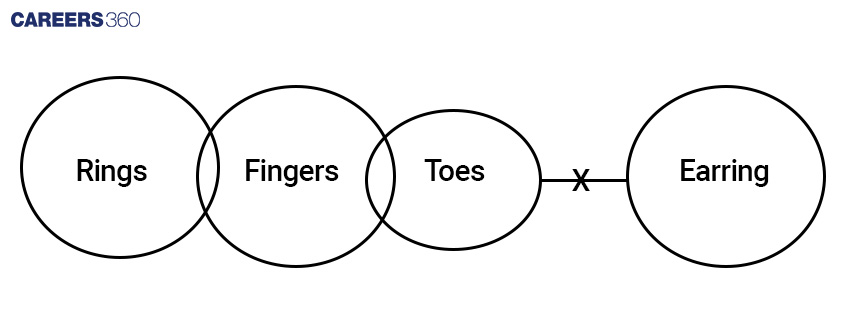
I. Some rings are fingers.
II. Some fingers are toes.
III. No toe is an earring.
Conclusions:
1. No earring is a ring.
II. Some toes are rings.
1) Neither conclusion I nor II follows
2) Only conclusion II follows
3) Only conclusion I follows
4) Both conclusions I and II follow
Solution:
According to the given statements, the following diagram can be drawn:
Conclusion I: No earring is a ring – From, the above diagram, it can be seen that there is no direct relation between earring and ring. Therefore, this conclusion is false.
Conclusion II: Some toes are rings – From, the above diagram, it can be seen that there is no direct relation between toes and rings. Therefore, this conclusion is false.
Therefore, neither Conclusion I nor Conclusion II follows according to the given statements. Hence, the first option is correct.
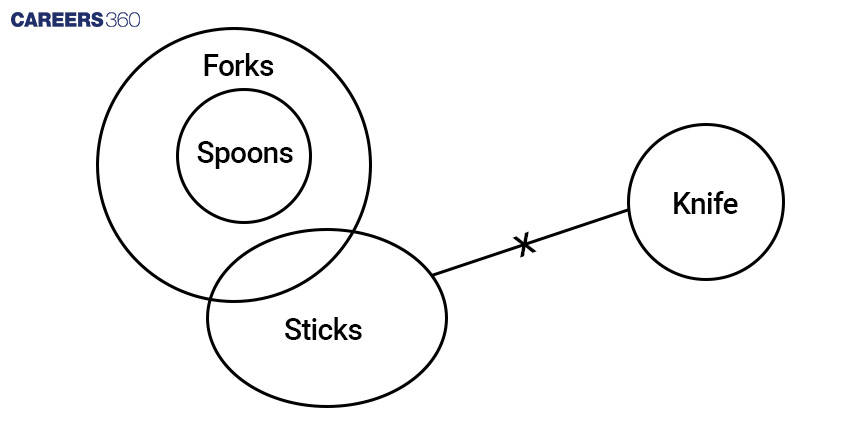
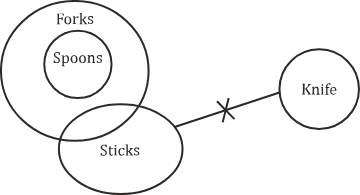
16. Directions: Read the given statements and conclusions carefully. You have to consider the given statements true even if they seem at variance from commonly known facts. You have to decide which conclusion/s logically follow/s from the given statements.
Statements:
(I) All spoons are forks.
(II) Some forks are sticks.
(III) No stick is a knife.
Conclusions:
(I) Some knives are forks.
(II) No stick is a spoon.
1) Only conclusion II follows
2) Both conclusions I and II follow
3) Only conclusion I follows
4) Neither conclusion I nor II follows
Solution:
The possible Venn diagram according to the statements is as follows –
Let's analyse the conclusions –
Conclusion (I): Some knives are forks – According to the Venn diagram, there is no definite relation between knives and forks. Therefore, this conclusion is false.
Conclusion (II): No stick is a spoon – According to the Venn diagram, there is no definite relation between a stick and a spoon. Therefore, this conclusion is false. So, neither conclusion I nor II follows. Hence, the fourth option is correct.
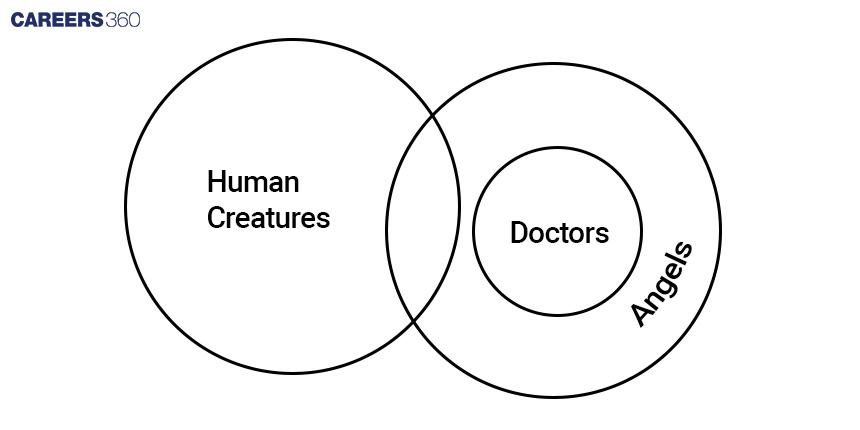
17. Directions: In the following question, two statements are given followed by two conclusions I and II. You must consider the two statements true even if they seem at variance from commonly known facts. You have to decide which conclusions, if any, follow from the given statements.
Statements:
I. Some human creatures are angels.
II. All doctors are angels.
Conclusions:
I. Some human creatures are doctors.
II. Some doctors are human creatures.
1) Only I follow
2) Only II follows
3) Either I or II follows
4) Neither I nor II follows
Solution:
According to the given statements, the following Venn diagram can be drawn –
Let's analyse the conclusions –
Conclusion I: Some human creatures are doctors – From the above diagram, there is no direct relation between human creatures and doctors. So, this conclusion does not follow.
Conclusion II: Some doctors are human creatures – From the above diagram, there is no direct relation between doctors and human creatures. So, this conclusion does not follow.
So, neither I nor II follows. Hence, the fourth option is correct.
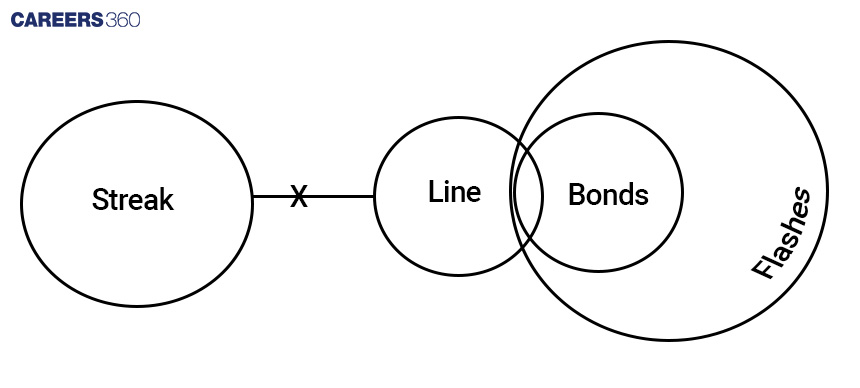
18. Directions: In this question, three statements are given, followed by two conclusions. Assuming the statements to be true, even if they seem to be at variance with commonly known facts, decide which of the conclusions logically follows/follow from the statements.
Statements:
I. No streak is a line.
II. Some lines are bonds.
III. All bonds are flashes.
Conclusions:
I. Some flashes are streaks.
II. No flash is a line.
1) Only conclusion I follows
2) Both conclusions I and II follow
3) Only conclusion II follows
4) Neither conclusion I nor II follows
Solution:
The possible Venn diagram according to the given statements is as follows –
Let's analyse the conclusions –
Conclusion I: Some flashes are streaks – From the above diagram, it can be seen that there is no direct relation between flashes and streaks. Therefore, this conclusion is false.
Conclusion II: No flash is a line – From the Venn diagram, it can be seen that the circle of flash and line intersect and have some common area between them and it implies that some flash are lines. Therefore, this conclusion is false.
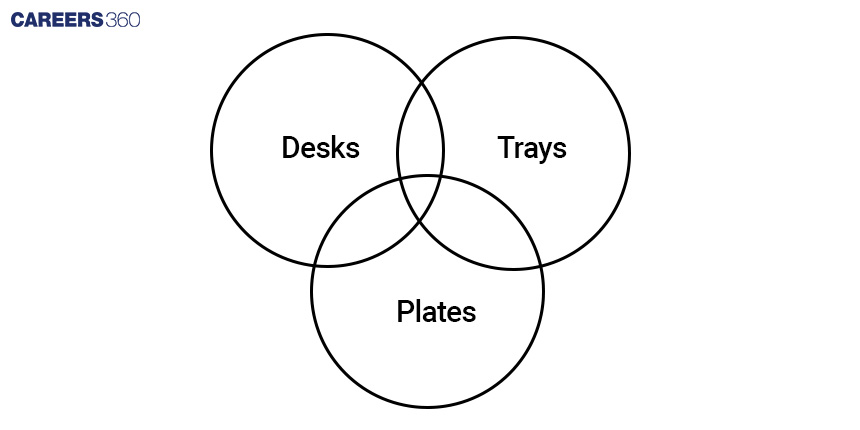
Therefore, neither conclusion I nor II follows. Hence, the fourth option is correct. 19. Directions: Three statements are given, followed by four conclusions numbered I, II, III, and IV. Assuming the statements to be true, even if they seem to be at variance with commonly known facts, decide which of the conclusions logically follow(s) from the statements.
Statements:
Some desks are trays.
Some trays are plates.
Some plates are desks.
Conclusions:
I. All desks are plates.
II. All plates are desks.
III. Some plates are trays.
IV. All trays are desks.
1) Only conclusion III follows
2) Only conclusion IV follows
3) Only conclusion II follows
4) Only conclusion I follows
Solution:
The possible Venn diagram according to the given statements is as follows –
Let's analyse the conclusions –
Conclusion I: All desks are plates – From the above diagram, it is clear that only some parts of the circle that are desks overlap with the circle that is plate. So, only some desks are plates. Therefore, this conclusion does not follow.
Conclusion II: All plates are desks – From the above diagram, it is clear that only some parts of the circle that are plates overlap with the circle that is desks. So, only some plates are desks. Therefore, this conclusion does not follow.
Conclusion III: Some plates are trays – From the above diagram, it is clear that only some parts of the circle that are plates overlap with the circle that is trays. So, only some plates are trays. Therefore, this conclusion follows.
Conclusion IV: All trays are desks – From the above diagram, it is clear that only some parts of the circle that are trays overlap with the circle that is desks. So, only some trays are desks. Therefore, this conclusion does not follow.
So, only conclusion III follows. Hence, the first option is correct.
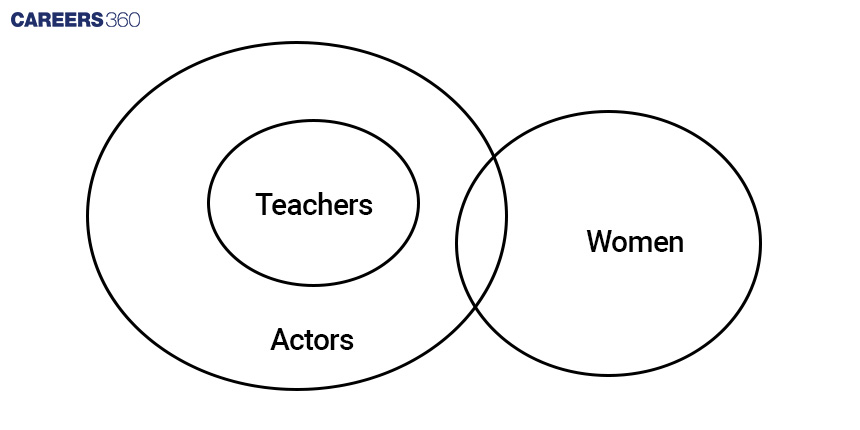
20. Directions: Some statements are given followed by four conclusions numbered I, II, III, and IV. You have to consider the statements to be true, even if they seem to be at variance from commonly known facts. You have to decide which of the given conclusions, if any, follows from the given statements.
Statements:
All the teachers are actors.
Some actors are women.
Conclusions:
I. All the teachers are women.
II. Some women are teachers.
III. Some women are actors.
IV. All the actors are teachers.
1) Only Conclusion I follows
2) Only Conclusions II and IV follow
3) Only Conclusion III follows
4) None of the Conclusions follows
Solution:
The possible Venn diagram according to the given statements –
Let's analyse the conclusions –
Conclusion I: All teachers are women – From the Venn diagram, it is evident that there is no direct relation between teachers and women. So, no definite relation can be drawn between them. Therefore, this conclusion does not follow.
Conclusion II: Some women are teachers – From the Venn diagram, it is evident that there is no direct relation between teachers and women. So, no definite relation can be drawn between them. Therefore, this conclusion does not follow.
Conclusion III: Some women are actors – From the given Venn diagram, it is evident that the circles representing women and actors overlap and have a part of their area in common. So, from this, it can be concluded that some women are actors. Therefore, this conclusion follows. Conclusion IV: All actors are teachers – From the Venn diagram, it is evident that some parts of the circle representing actors lie outside the circle representing teachers while some lie inside. So, from this, it can be concluded that some actors are teachers. Therefore, this conclusion does not follow.
Therefore, the only conclusion III is true. Hence, the third option is correct.
Syllogism Practice Questions PDF Download
The candidates should practice online syllogism reasoning mock tests, and also syllogism reasoning questions with answers PDF to ace the entire topic of syllogism. Click below to grab a PDF for your practice, and start working on it right away.
1) Directions: In the following question some statements are given, followed by some conclusions based on those statements. Taking the given statements to be true even if they seem to be at variance from commonly known facts. Read all the conclusions and then decide which of the given conclusions logically follows the given statements.
Statements:
I. All S is R.
II.No R is T.
Conclusions:
I. No T is R.
II. No S is T.
III. No R is S.
1) All conclusions follow
2) Both conclusions I and III follow
3) Both conclusions II and III follow
4) Both conclusions I and II follow
Hint: Think about the rule of syllogism that the relation of 'All' covers the relation of 'some' by default. If there is a direct negative relation between two elements then no positive relation can be drawn between them.
Solution
The possible Venn diagram, according to the given statements is as follows –
Let's analyse the conclusions –
Conclusion (I): No T is R – From the Venn diagram, it is evident that there is a negative relation between R and T. So, from this, it can be concluded that no R is T. Thus, this conclusion follows.
Conclusion (II): No S is T – From the Venn diagram, it is evident that all S is R and no R is T. So, from this, it can be concluded that no S is T. Thus, this conclusion follows.
Conclusion (III): No R is S – From the Venn diagram, it is evident that some parts of the circle representing R lie outside the circle representing S while some lie inside. So, from this, it can be concluded that some R is S. Thus, this conclusion does not follow.
So, both conclusions I and II follow. Hence, the fourth option is correct.
2) Directions: Read the given statements and conclusions carefully. Assuming that the information given in the statements is true, even if it appears to be at variance with commonly known facts, decide which of the given conclusions logically follow(s) from the statements.
Statements:
I. All Hulk are Thor.
II. All Thor are Flash.
Conclusions:
I. All Hulk are Flash.
II. No Thor is a Hulk.
1) Neither I nor II follows
2) Only I follow
3) Only II follows
4) Both I and II follow
Hint: Think about the rule of syllogism that the relation of 'All' covers the relation of 'some' by default. If there is a direct negative relation between two elements then no positive relation can be drawn between them.
Solution
The possible Venn diagram according to the given statements is as follows –
Let's analyse the conclusions –
Conclusion (I): All Hulk are Flash – From the Venn diagram, it is evident that the circle representing Hulk completely lies inside the circle representing Flash. So, from this, it can be concluded that all Hulk are flash. Thus, this conclusion follows.
Conclusion (II): No Thor is a Hulk – From the Venn diagram, it is evident that some parts of the circle representing Thor lie inside the circle representing Hulk while some lie outside. So, from this, it can be concluded that some thor are hulk. Thus, this conclusion does not follow.
So, the only conclusion I follow. Hence, the second option is correct.
Syllogism Questions for KMAT/ SUAT/ JIPMAT/ MAT
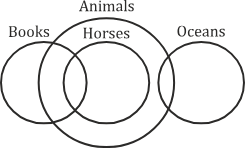
1) Directions: Read the given statements and conclusions carefully. You have to take the given statements to be true even if they seem to be at variance from commonly known facts. You have to decide which conclusion/s logically follow/s from the given statements.
Statements:
(I) Some books are horse.
(II) All horses are animals.
(III) Some animals are oceans.
Conclusions:
(I) Some horses are oceans.
(II) Some animals are books.
1) Both conclusions (I) and (II) are true
2) Only conclusion (I) is true
3) Only conclusion (II) is true
4) Neither conclusion (I) nor (II) is true
Hint: Think about the rule of syllogism that the relation of 'All' covers the relation of 'some' by default. If there is a direct negative relation between two elements then no positive relation can be drawn between them.
Solution
The possible Venn diagram as per the given statements is as follows –
Let's analyse the conclusions –
Conclusion (I): Some horses are oceans – From the Venn diagram, there is no definite relation between horses and oceans. So, this conclusion does not follow.
Conclusion (II): Some animals are books – From the Venn diagram, there is some region common to both animals and books. So, this conclusion follows.
Thus, the only conclusion (II) is true. Hence, the third option is correct.
2) Directions: Read the given statements and conclusions carefully. You have to consider the given statements true even if they seem at variance from commonly known facts. You have to decide which conclusion/s logically follow/s from the given statements.
Statements:
(I) All spoons are forks.
(II) Some forks are sticks.
(III) No stick is a knife.
Conclusions:
(I) Some knives are forks.
(II) No stick is a spoon.
1) Only conclusion II follows
2) Both conclusions I and II follow
3) Only conclusion I follows
4) Neither conclusion I nor II follows
Hint: Think about the rule of syllogism that the relation of 'All' covers the relation of 'some' by default and if there is a direct negative relation between two elements then no positive relation can be drawn between them.
Solution
The possible Venn diagram according to the statements is as follows –
Let's analyse the conclusions –
Conclusion (I): Some knives are forks – According to the Venn diagram, there is no definite relation between knives and forks. Therefore, this conclusion is false.
Conclusion (II): No stick is a spoon – According to the Venn diagram, there is no definite relation between a stick and a spoon. Therefore, this conclusion is false.
So, neither conclusion I nor II follows. Hence, the fourth option is correct.
Rules of Syllogism
All + All: A direct relationship can be formed.
All + Some: A definite conclusion may not always follow.
Some + Some: No definite conclusion can be drawn.
No + Some: A positive conclusion cannot be assumed.
Conversion Rules
All A are B → Some B are A
No A is B → No B is A
Some A are B → Some B are A
Some A are not B cannot be converted.
Complementary Pair Rule
When two opposing conclusions don’t work on their own, but they do fit together as complementary, then an either-or situation may kick in.
Venn Diagram Method
Draw a Venn diagram, sort of combine all the statements, and check each conclusion you end up with. Also, don’t assume anything outside what’s already given.
Shortcut Tips
Try the conversion rule and the complementary pair rule.
For possibility questions, treat the conclusion as valid if it can hold without contradiction.
First, wipe out the clearly wrong options.
Syllogism Questions for SSC/ RRB Exams
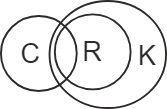
1) Directions: In the following question below are given some statements followed by some conclusions based on those statements. Taking the given statements to be true even if they seem to be at variance from commonly known facts. Read all the conclusions and then decide which of the given conclusions logically follows the given statements.
Statements:
I. Some R is C.
II. All R is K.
Conclusions:
I. All K is R.
II. All C is R.
III. All C is K.
1) Both conclusions II and III follow
2) Both conclusions I and III follow
3) Neither conclusion follows
4) All conclusions follow
Hint: Think about the rule of syllogism that the relation of 'All' covers the relation of 'some' by default. If there is a direct negative relation between two elements then no positive relation can be drawn between them.
Solution
The possible Venn diagram according to the given statements is as follows –
Let's analyse the conclusions –
Conclusion (I): All K is R – From the Venn diagram, it is evident that some parts of the circle representing K lie outside the circle representing R while some lie inside. So, from this, it can be concluded that some K is R. Thus, this conclusion does not follow.
Conclusion (II): All C is R – From the Venn diagram, it is evident that the two circles representing C and R overlap and have a part of their areas in common. So, from this, it can be concluded that some C is R. Thus, this conclusion does not follow.
Conclusion (III): All C is K – From the Venn diagram, it is evident that the two circles representing C and K overlap and have a part of their areas in common. So, from this, it can be concluded that some C is K. Thus, this conclusion does not follow.
So, none of the conclusions follows. Hence, the third option is correct.
2) Directions: In the question below two statements are given, followed by two conclusions, I and II. You have to consider the statements to be true even if they seem to be at variance from commonly known facts. You have to decide which of the given conclusions, if any, follows from the given statements.
Statements:
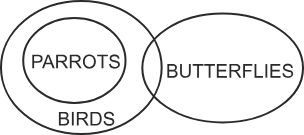
I. All parrots are birds.
II. Some birds are butterflies.
Conclusions:
I. All butterflies are parrots.
II. Some parrots are butterflies.
1) Both conclusions I and II follow
2) Only conclusion II follows
3) Neither conclusion I nor II follows
4) Only conclusion I follows
Hint: Think about the rule of syllogism that the relation of 'All' covers the relation of 'some' by default. If there is a direct negative relation between two elements then no positive relation can be drawn between them.
Solution
The possible Venn diagram, according to the given statements is as follows –
Let's analyse the conclusions –
Conclusion (I): All butterflies are parrots – It is a possibility that the circle representing butterflies is completely overlapped by the circle that represents parrots. But, this is not definite. So, this conclusion does not follow.
Conclusion (II): Some parrots are butterflies – It is a possibility that the two circles representing parrots and butterflies overlap and have a part of their area in common. But, this is not definite. So, this conclusion does not follow.
So, neither conclusion I nor II follows. Hence, the third option is correct.
Syllogism Reasoning Questions for the CAT/ SBI PO exam
1) Directions: Read the given statements and conclusions carefully. Assuming that the information given in the statements is true, even if it appears to be at variance with commonly known facts, decide which of the given conclusions logically follow(s) from the statements.
Statements:
I. No B is L.
II. No C is B.
Conclusions:
I. Some L are C.
II. Some B are C.
1) Both conclusions I and II follow
2) Only conclusion I follows
3) Neither conclusion I nor II follows
4) Only conclusion II follows
Hint: Think about the rule of syllogism that the relation of 'All' covers the relation of 'some' by default. If there is a direct negative relation between two elements then no positive relation can be drawn between them.
Solution
The possible Venn diagram according to the given statements is as follows –
Let's analyse the conclusions:
Conclusions (I): Some L are C - In the above diagram it is clearly shown that circles of L and C are independent. It doesn't define any relation between them. So, this conclusion doesn't follow.
Conclusion (II): Some B are C - In the above diagram it is clearly shown that a relation of no is given between B and C and if it is clear that no B are C or vice versa so some B are C is not true and this conclusion doesn't follow.
So, neither I nor conclusion II follows. Hence, the third option is correct.
2) Directions: Read the given statements and conclusions carefully. Assuming that the information given in the statements is true, even if it appears to be at variance with commonly known facts, decide which of the given conclusions logically follow(s) from the statements.
Statements:
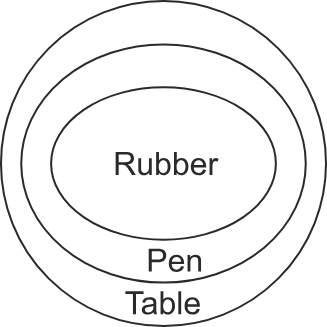
All pens are tables.
All rubbers are pens.
Conclusions:
I. All pens are rubbers.
II. All tables are pens.
III. No rubber is a table.
1) Both conclusions II and III follow
2) All conclusions follow
3) Only conclusion III follows
4) Neither conclusion follows
Hint: Think about the rule of syllogism that the relation of 'All' covers the relation of 'some' by default. If there is a direct negative relation between two elements then no positive relation can be drawn between them.
Solution
The possible Venn diagram according to the given statements is as follows –
Let's analyse the conclusions –
Conclusion (I): All pens are rubbers- As shown in the diagram, all rubbers are pens which means that some pens are rubber. So, this conclusion doesn't follow.
Conclusion (II): All tables are pens - As shown in the diagram, all pens are tables which means some tables are pens. So, this conclusion doesn't follow.
Conclusion (III): No rubber is a table - As shown in the diagram, all rubbers are tables as the circle of rubber is in the circle of the table. So, this conclusion doesn't follow.
So, neither of the conclusions follows. Hence, the fourth option is correct.
Syllogism Reasoning Questions for Bank exams/ Insurance exams
1) Directions: In the question two statements are given, followed by two conclusions, I and II. You have to consider the statements to be true even if they seem to be at variance from commonly known facts. You have to decide which of the given conclusions, if any, follows from the given statements.
Statements:
I. Each correct is wrong.
II. No wrong is right.
Conclusions:
I. No correct is right.
II. Some wrongs are correct.
1) Only conclusion II follows
2) Both conclusions I and II follow
3) Only conclusion I follows
4) Neither conclusion I nor II follows
Hint: Think about the rule of syllogism that the relation of 'All' covers the relation of 'some' by default. If there is a direct negative relation between two elements then no positive relation can be drawn between them.
Solution
The possible Venn diagram, according to the given statements is as follows –
Let's analyse the conclusions –
Conclusion (I): No correct is right – From the Venn diagram, it is evident that all correct is wrong and no wrong is right. So, from this, it can be concluded that no correct is right. Thus, this conclusion follows.
Conclusion (II): Some wrongs are correct – From the Venn diagram, it is evident that some parts of the circle representing wrong lie outside the circle representing correct while some lie inside. So, from this, it can be concluded that some wrongs are correct. Thus, this conclusion follows.
So, both conclusions I and II follow. Hence, the second option is correct.
2) Directions: In the following question below are given some statements followed by some conclusions based on those statements. Taking the given statements to be true even if they seem to be at variance from commonly known facts. Read all the conclusions and then decide which of the given conclusions logically follows the given statements.
Statements:
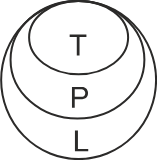
I. All T is P.
II. All P is L.
Conclusions:
I. All T is L.
II. All L is P.
III. Some P is T.
1) Both conclusions II and III follow
2) Both conclusions I and II follow
3) Both conclusions I and III follow
4) All conclusions follow
Hint: Think about the rule of syllogism that the relation of 'All' covers the relation of 'some' by default. If there is a direct negative relation between two elements then no positive relation can be drawn between them.
Solution
The possible Venn diagram according to the given statements is as follows –
Let's analyse the conclusions –
Conclusion (I): All T is L – From the Venn diagram, it is evident that the circle representing T completely lies inside the circle representing L. So, from this, it can be concluded that all T is L. Thus, this conclusion follows.
Conclusion (II): All L is P – From the Venn diagram, it is evident that some parts of the circle representing L lie outside the circle representing P while some lie inside. So, from this, it can be concluded that some L is P. Thus, this conclusion does not follow.
Conclusion (III): Some P is T – From the Venn diagram, it is evident that some parts of the circle representing P lie outside the circle representing T while some lie inside. So, from this, it can be concluded that some P is T. Thus, this conclusion follows.
So, both conclusions I and III follow. Hence, the third option is correct.
Logical Approach vs Venn Diagram Approach: Key Differences
Basis of Comparison
Logical Approach
Venn Diagram Approach
Method
Rule-based mental reasoning
Visual diagram representation
Speed
Faster for simple questions
Slightly time-consuming
Accuracy
Depends on logical clarity
Very high accuracy
Best For
Direct conclusions
Complex & possibility-based questions
Beginner-Friendly
Moderate
High
Exam Suitability
CAT, XAT
SNAP, SSC, Banking
Which Approach Should You Use?
For the small, quick questions, I use a logical approach, so I save time, and I dont overthink it. But if the relationships look a little murky, or if there are multiple claims, or some maybe type conclusion, then I switch to Venn diagrams. Once you get both methods down, you improve speed and also accuracy, overall.
Important Rules and Formulae for Syllogism (Quick Revision Table)
Here is a concise table covering the most important rules, logic patterns, and formulae used in syllogism reasoning questions:
Concept / Rule
Statement Form
Key Logic
Conclusion Type
Universal Affirmative
All A are B
A is completely inside B
Some B are A (conversion possible)
Universal Negative
No A is B
A and B do not overlap
No B is A (conversion possible)
Particular Affirmative
Some A are B
Partial overlap between A and B
Some B are A (conversion possible)
Particular Negative
Some A are not B
Some part of A lies outside B
No direct conversion possible
All + All Rule
All A are B, All B are C
Forms a direct chain
All A are C follows
All + Some Rule
All A are B, Some B are C
Partial link
No definite conclusion
Some + Some Rule
Some A are B, Some B are C
Weak relationship
No conclusion follows
No + Some Rule
No A is B, Some B are C
Negative + partial
Possible conclusions only
Conversion Rule
Swap subject and predicate
Works for All, No, Some
Helps simplify statements
Complementary Pair Rule
Some A are B / Some A are not B
One must be true
Either-or case
Possibility Rule
Can be / May be statements
Valid if no contradiction
Treated as possible
Either-Or Rule
Two opposite conclusions
Only one can be true
Choose either one
Venn Diagram Logic
Circles represent sets
Visual representation
Used for validation
Chain Rule
A → B → C
Direct logical connection
A → C conclusion
Negative Rule
No A is B
No overlap
Helps eliminate options
Key Takeaways
All statements are assumed true, even if unrealistic
Avoid assumptions beyond given data
Focus on definite vs possible conclusions
Use rules and patterns instead of guesswork
Best Books for Syllogism Reasoning Preparation
Here is a table of the most recommended books and resources to master syllogism reasoning questions for competitive exams:
Book Name
Author
Key Features
Best For
A Modern Approach to Verbal & Non-Verbal Reasoning
R.S. Aggarwal
Covers all reasoning topics including syllogism with basic to advanced questions and clear explanations
Beginners and SSC aspirants
Analytical Reasoning
M.K. Pandey
Strong concept-building with advanced level syllogism and logical reasoning problems
Banking and MBA exams
A New Approach to Verbal & Non-Verbal Reasoning
B.S. Sijwali
Includes shortcuts, tricks, and topic-wise practice for reasoning
Beginners to intermediate level
Analytical & Logical Reasoning for CAT & Other Exams
P. A. Anand
Covers syllogism along with various logical reasoning topics in a structured manner
MBA entrance exams
Shortcuts in Reasoning
Disha Experts
Focus on quick tricks, shortcut methods, and time-saving techniques
Speed improvement in exams
Objective Logical Reasoning
Vikas Experts
Wide range of practice questions with different difficulty levels
All competitive exams
100+ Questions for Competitive Exams (Syllogism Focus)
Puneet Kumar Sharma
High-frequency previous year questions for practice and revision
Practice and revision
Ultimate Reasoning 2.0
Radhey Sir
Contains 2500+ questions with shortcuts and exam-oriented practice
SSC and Banking exams
Non-Verbal Reasoning Topics
Non verbal reasoning tests your ability to crack problems by using figures, patterns, and diagrams. It is a key topic in SSC, Banking, RRB and other competitive exams, so doing regular practice is essential for boosting speed, accuracy, and even a bit of confidence.
Q: How many types of questions from syllogism are asked in the examinations?
A:
There are three types of questions from syllogism which are mostly asked in the examinations. The either-or and possibility-based questions are generally seen in the recent years of exams.
Q: What is the weightage of syllogism in exams?
A:
The weightage of syllogism in the banking exams differs according to the level of the exam but mostly 4-5 questions are seen in banking exams whereas in SSC, Railways, Insurance and Entrance exams 2-3 questions are asked.
Q: How to solve syllogism problems in reasoning?
A:
Read the statements carefully, identify the type of question, apply rules or use Venn diagrams, and then check whether the conclusions logically follow without making assumptions.
Q: What are the basic rules of syllogism?
A:
The basic rules include All + All, All + Some, Some + Some, and No + Some cases, along with concepts like conversion rules, complementary pair rule, and possibility logic.
Q: How to solve syllogism problems in reasoning using Venn diagram?
A:
To solve syllogism problems in reasoning using Venn diagram firstly, read the statements thoroughly. After that start drawing the Venn diagram. Make sure that you are following the sequence of the question while drawing. Analyse the conclusion from the Venn diagram and in the end mark the answers according to the Venn diagram.
Q: What is syllogism in reasoning?
A:
Syllogism is a logical reasoning topic where conclusions are drawn from given statements. It tests your ability to understand relationships between groups and determine whether a conclusion logically follows.
Q: What is another word for syllogism?
A:
There are various near-synonyms for "syllogism," including formal argument, deductive argument, and deductive reasoning. rational inference.