


Alphabet Test: Meaning, Reasoning Questions, Mock Test, Types
Have you ever arranged letters in alphabetical order or tried to find the position of a letter in the English alphabet? That’s exactly what alphabet test in reasoning is all about. In these questions, you work with letters - arranging them, finding positions, identifying patterns, or forming meaningful sequences. These alphabet test reasoning questions with answers are designed to check your understanding of letter positions, sequence patterns, and logical thinking. By practicing different alphabet test examples and mock test questions, you can improve your speed, accuracy, and ability to solve questions quickly in exams. In this article, we will cover the meaning of alphabet test in reasoning, different types of questions, detailed explanations with solved examples, important practice questions and mock tests, effective tricks to solve alphabet test questions quickly, and a list of frequently asked questions (FAQs) to help you prepare for exams like SSC, Banking, Railway, CUET, and other aptitude tests.
This Story also Contains
- What is Alphabet Test in Reasoning?
- Types of Alphabet Test Reasoning Questions Explained
- Important Points to Remember
- Important Formulae and Rules for Alphabet Test Reasoning
- Question Weightage of Alphabet Test Reasoning in Competitive Exams
- Verbal Reasoning Topics
- Alphabet Test Reasoning Questions and Answers of Word Arrangements as per the Dictionary Order
- Alphabet Test Reasoning Questions and Answers of Word Formation
- Alphabet Test Reasoning Questions and Answers of Meaningful/Logical Order
- Alphabet Test Reasoning Questions and Answers of Series-Based Alphabet Test
- Alphabet Test Reasoning Questions and Answers of Set-Based Alphabet Test
- Alphabet Test Practice Questions with Answers PDF Download
- Alphabet Test Questions for BITSAT/VITEEE/SRMJEE
- Best Books for Alphabet Test Reasoning Preparation
- Alphabet Test Questions for APICET/ TANCET/ KMAT/ JIPMAT
- Alphabet Test Questions for SSC MTS/ SSC CHSL/ SSC Stenographer/ RRB exams
- Alphabet Test Questions for Banking IBPS CWE Clerical/ IBPS RRB Assistant/ SBI Assistant/ RBI Assistant exams
- Step-by-Step Approach to Solve Alphabet Test Questions
- Non-Verbal Reasoning Topics
What is Alphabet Test in Reasoning?
Alphabet test is one of the most scoring topics in logical reasoning and verbal ability, where questions are based on the arrangement, position, and pattern of letters in the English alphabet. In these alphabet test reasoning questions with answers, you may be asked to find the position of a letter, arrange words in alphabetical order, identify patterns, or form meaningful sequences. These questions are widely asked in competitive exams to test your observation skills, speed, and understanding of letter sequences. With regular practice of alphabet test examples and mock questions, you can solve these problems quickly and accurately.
Alphabet Test Meaning in Logical Reasoning
In logical reasoning, the alphabet test refers to questions that involve analyzing letters based on their positions (A to Z), order, and relationships.
- Each letter has a fixed position, such as A = 1, B = 2, ..., Z = 26
- Questions may involve forward or backward counting in the alphabet
- Patterns like skipping letters, pairing, or reversing sequences are commonly used
- You may need to compare letters or words based on alphabetical order
Understanding the meaning of alphabet test in reasoning helps in solving a wide variety of questions efficiently.
Definition of Alphabet Test with Examples
Alphabet test can be defined as a type of reasoning question where letters of the English alphabet are used to form patterns, sequences, or arrangements, and the candidate must identify the correct answer based on logical rules.
For example:
If you are asked, “What is the position of the letter M in the English alphabet?”
You should know that M is the 13th letter.
Another example could involve arranging words like “Apple, Mango, Banana” in alphabetical order. The correct order would be Apple, Banana, Mango.
These types of alphabet test questions with answers help in building a strong foundation in reasoning.
Real-Life Examples of Alphabet Test
Alphabet test concepts are not limited to exams—they are used in everyday situations as well.
- Arranging names in alphabetical order in school or office records
- Searching contacts in a mobile phone or directory
- Organizing files or folders based on alphabetical sorting
- Finding words quickly in a dictionary
- Sorting items in lists, databases, or spreadsheets
These real-life examples show how alphabet test reasoning skills are useful in daily life. Understanding these concepts not only helps in exams like SSC, Banking, Railway, and CUET but also improves your overall logical thinking and organization skills.
Types of Alphabet Test Reasoning Questions Explained
Alphabet test is a versatile topic in logical reasoning, and questions can be asked in different formats based on letter positions, patterns, and arrangements. Understanding the different types of alphabet test reasoning questions helps you quickly identify the approach needed and solve them with better accuracy in exams.
Word Arrangement as per Dictionary (Alphabetical Order Questions)
These are one of the most common alphabet test questions, where you are asked to arrange words in dictionary order.
Compare words letter by letter from left to right
The word with the earlier letter in the alphabet comes first
If the first letters are the same, move to the next letter
These alphabetical order reasoning questions test your understanding of letter positions and are frequently asked in exams.
Word Formation Questions in Alphabet Test
In these questions, you are given a set of letters and asked to form meaningful words or count how many words can be formed.
Identify possible meaningful words from given letters
Sometimes, repeated letters or positions are important
Questions may ask for the number of words formed
These word formation reasoning questions help test vocabulary, observation, and logical arrangement skills.
Meaningful or Logical Order Arrangement
These questions involve arranging words or items in a meaningful or logical sequence.
Arrange items based on a logical flow (e.g., process, size, time)
Understand the relationship between different elements
Identify the correct sequence based on real-world logic
These logical order arrangement questions check your ability to think logically beyond just alphabet positions.
Series-Based Alphabet Test Questions
Series-based questions are very common in alphabet test reasoning.
Identify patterns like skipping letters, repeating sequences, or alternating series
Use letter positions (A=1 to Z=26) to decode patterns
Find the missing or next term in the series
These alphabet series questions with answers test your pattern recognition and analytical thinking.
Set-Based Alphabet Test Questions
In set-based questions, letters or words are grouped based on a specific rule.
Identify the pattern or logic behind grouping
Find the odd one out or complete the set
Understand similarities or differences between elements
These set-based alphabet reasoning questions require careful observation and logical comparison.
By understanding these types of alphabet test reasoning questions, you can easily recognize the question pattern and apply the correct method, which helps improve speed and accuracy in competitive exams.
Now let’s understand all of the types of analogy in detail:
1. Word Arrangements as per the Dictionary
Words arrangements as per the dictionary is a type of alphabet test where a set of words are given and an aspirant has to arrange all the words according to the English dictionary.
Approach - To find the answer compare each letter of the words and arrange them according to the English dictionary order.
Example
1. Cow
2. Crow
3. Cannon
4. Cat
a) 1, 2, 3, 4
b) 2, 1, 4, 3
c) 3, 4, 1, 2
d) 4, 3, 2, 1
Solution
Step 1: Compare the first letter of each word. Since all the words start with the same letter C, then move on to the next letter.
Step 2: The second letter of each word is a, o, r. Based on the alphabetical order of these letters, we can arrange them – Cat, Cannon, Cow, Crow.
Step 3: Compare the third letter of (Cat, Cannon). Cannon will come before Cat in the sequence as n comes before t in the alphabetical system.
So, the sequence is Cannon, Cat, Cow, Crow, or 3, 4, 1, 2. Hence, the third option is correct.
2. Word Formation
Word formation in reasoning is a type of alphabet test where a word is given and an aspirant has to find a new word that can be formed using the letters of the given word.
Approach - To find the answer compare the letters of the given word with the letters of the given words in the options.
Example
BIOCHEMICAL
a) CHEMIST
b) BIOLOGY
c) CHEMIO
d) CHECK
Solution:
Let’s check each option -
a) CHEMIST - Letters S and T are not present in the word BIOCHEMICAL.
b) BIOLOGY - Leter one O, G and Y are absent in the word BIOCHEMICAL.
c) CHEMIO - All the letters are present in BIOCHEMICAL.
d) CHECK - Letter K is not present in CHECK.
Hence, The third option is correct.
3. Meaningful/Logical Order Arrangement
Meaningful/logical order arrangement is a type of alphabet test where a set of words are given and an aspirant has to arrange all the words in a natural order that will generate step by step for solving a problem, process or activity.
Approach - To find the answer observe the given words and arrange them in descending/ ascending order, or in an order that will be the required steps for completing the task.
The arrangement can be based on the sequence of occurrence of events, the sequence of objects in a class or group, the sequence in ascending or descending order etc.
Example
1) School 2) Graduation 3) Higher Secondary 4) Post Graduation
a) 1, 2, 3, 4
b) 1, 3, 2, 4
c) 4, 3, 1, 2
d) 4, 3, 2, 1
Solution
The stages of education are as follows -
First, we have to be admitted to a school, the after completion of higher secondary education we get admission to a college for completion of graduation. After completion of graduation, a candidate can complete a postgraduate.
Therefore, the correct order is 1, 3, 2, 4. Hence, the second option is correct.
4. Series Based
Series-based alphabet test is a type of alphabet test where a series of letters, numbers or symbols are given and an aspirant has to determine the answer according to the question asked. Based on the elements series can be divided into the following categories -
a) Letters Based Series
b) Mixed Series
Now let’s understand all of the types of series in detail -
a) Letters Based Series
In this type of series, a series of capital or small letters are given and an aspirant has to determine an answer according to the question asked based on this series.
The question asked is based on preceding letters, succeeding letters, pairs of letters that follow a particular pattern etc.
Approach - To find the answer, an aspirant should know the concept of left, right preceding, succeeding etc.
Example
How many letters are there between the seventh letter from the left and the fifth letter from the right?
A Q W E R T S D C F S R F H J K L B N M X Z U
a) 2
b) 12
c) 11
d) 13
Solution:
Seventh from the left is - S
Fifth from the right is - N
Number of letters between S and N = 11 letters
Hence, the third option is correct.
b) Mixed Series
In this type of series, a series of numbers, letters or symbols are given and an aspirant has to answer the question based on this series.
Approach - To find the answer, an aspirant should know the concept of left, right preceding, succeeding etc.
Example
How many such consonants are there in the given series, each of which is immediately preceded by a vowel and succeeded by a symbol?
A H # U K O & M L $ % X I A V E @ ? E D + F M
a) 1
b) 2
c) 3
d) 4
Solution:
The consonants that are immediately preceded by a vowel and succeeded by a symbol is as follows:
A H # U K O & M L $ % X I A V E @ ? E D + F M
Therefore, there are 2 pairs. Hence, the second option is correct.
5. Set-Based
Set-based alphabet test is a type of alphabet test where a set of alphabets is given and an aspirant has to answer the question based on these sets. Therefore, there are two types of set-based alphabet test -
Example
MON TEN HPA DVB
If the position of the first and third letters are interchanged in each set, then how many words start with the vowel?
a) 2
b) 3
c) 4
d) 1
Solution
After interchanging the positions according to the question, we get -
NOM NET APH BVD
Therefore, 1 word is the correct answer. Hence, the fourth option is correct.
Important Points to Remember
The candidates must remember the points below while solving the alphabet test questions.
1) A is preceded by B, which means it is written as B A.
2) A is followed by B which means it is written as A B.
3) A precedes B which means it is written as A B.
4) A follows B which means it is written as B A.
5) The candidates must learn the vowels which are A, E, I, O, and U and the consonants which are B, C, D, F, G, H, J, K, L, M, N, P, Q, R, S, T, V, W, X, Y, Z.
6) A number which has two factors. The first factor is the number itself and the other factor is 1 those numbers are known as prime numbers. Examples of Prime Numbers are 2, 3, 5, 7, 11, 13, 17, 19, 23, etc.
7) Any number divisible by 2, is known as Even Number. Examples of Even Numbers are 0, 2, 4, 6, 8, 10, 12, 14,16, 18, 20, 22, etc.
8) Any number not divisible by 2, is known as Odd Numbers. Examples of Odd Numbers are 1,3, 5, 7, 9, 11, 13, 15, 17, 19, 21, etc.
Important Formulae and Rules for Alphabet Test Reasoning
This section covers the key formulas and rules used in alphabet test questions, helping you solve problems faster by understanding letter positions, patterns, and relationships.
| Concept | Formula / Rule | Explanation |
|---|---|---|
| Alphabet Position | $A=1, B=2, \ldots, Z=26$ | Each letter has a fixed numerical position in the English alphabet |
| Reverse Position | $\text{Opposite Position} = 27 - \text{Letter Position}$ | Used to find reverse letters (e.g., A ↔ Z, B ↔ Y) |
| Letter Difference | $\text{Difference} =\text{Pos}_1 - \text{Pos}_2$ | Difference in the letter positions |
| Middle Letter | $\text{Middle} = \frac{\text{Pos}_1 + \text{Pos}_2}{2}$ | Finds middle letter between two given letters |
| Alphabet Series Pattern | $\text{Next Term} = \text{Previous} \pm n$ | Used in letter series based on skipping pattern |
| Word Value | $\text{Value} = \sum \text{Position of each letter}$ | Calculates total value of a word |
| Reverse Alphabet Mapping | $A \leftrightarrow Z,; B \leftrightarrow Y,; C \leftrightarrow X$ | Used in coding-decoding and pattern questions |
These formulas are essential for solving alphabet test reasoning questions quickly and accurately in competitive exams.
Question Weightage of Alphabet Test Reasoning in Competitive Exams
The number of questions based on the alphabet test varies from exam to exam -
1) Alphabet test-based questions asked in SSC exams i.e. SSC MTS, SSC CGL, SSC CHSL, SSC CPO, Steno - 1 to 3 questions.
2) Alphabet test-based questions asked in the RRB exam i.e. RRB Group D, NTPC, JE, ALP etc - 1 to 2 questions.
3) Alphabet test-based questions asked in Banking exams - 3 to 6 questions. Sometimes questions based on analogy can be seen in CSAT and IB exams as well.
Verbal Reasoning Topics
Verbal reasoning evaluates a candidate’s ability to understand, interpret, and logically process information presented in words or numbers. It is a key part of competitive exam reasoning sections, testing analytical and problem-solving skills. Below are the important verbal reasoning topics you should focus on for effective preparation. The verbal reasoning topics are given below.
Alphabet Test Reasoning Questions and Answers of Word Arrangements as per the Dictionary Order
1. Directions: Select the option that represents the correct order of the given words as they would appear in an English dictionary.
1. Laudanum
2. Lattice
3. Laudation
4. Latterly
5. Laudable
1) 2, 4, 5, 3, 1
2) 2, 4, 1, 5, 3
3) 4, 2, 3, 1, 5
4) 4, 2, 5, 1, 3
Solution
Given:
1. Laudanum 2. Lattice 3. Laudation 4. Latterly 5. Laudable
The first two letters are common in all the words, so we will start from the third letter of the given words.
Step 1: We can see that the third letters are u and t, and as t comes before u in the dictionary (Lattice, Latterly) will come before options (Laudanum, Laudation, Laudable).
Step 2: On comparing Lattice and Latterly, we can see Latt is common, and after that i and e are there, as e comes before i, so Latterly will come before Lattice.
Step 3: In Laudanum, Laudation, and Laudable, the first 5 letters are common, and after that n, t, and b are there, and in the dictionary b comes before n, and after that t comes.
Therefore, Laudable will be in third place, Laudanum in fourth place, and Laudation in fifth place.
So the sequence will be Latterly, Lattice, Laudable, Laudanum, Laudation, or 4, 2, 5, 1, 3. Hence, the fourth option is correct.
2. Directions: Select the option that represents the correct order of the given words as they would appear in an English dictionary.
1. Fustian
2. Funerary
3. Fusion
4. Funicular
5. Fuscous
6. Fundament
7. Fuselage
1. 6, 2, 5, 7, 3, 4, 1
2) 6, 2, 5, 7, 4, 1, 3
3) 6, 2, 4, 5, 7, 3, 1
4) 6, 2, 5, 4, 7, 3, 1
Solution
Given:
1. Fustian 2. Funerary 3. Fusion 4. Funicular 5. Fuscous 6. Fundament 7. Fuselage
Step 1: We have Fu common in all the given words, so we will start from the third letter. The third letter is n and s in the given words. Since n comes before s, the sequence will be – Funerary, Funicular, Fundament, Fustian, Fusion, Fuscous, Fuselage.
Step 2: On comparing the fourth letter of (Funerary, Funicular, Fundament) the sequence will be – Fundament, Funerary, Funicular
Step 3: Now on comparing the fourth letter of (Fustian, Fusion, Fuscous, Fuselage) the sequence will be – Fuscous, Fuselage, Fusion, Fustian
So, the order will be Fundament, Funerary, Funicular, Fuscous, Fuselage, Fusion, Fustian, or 6, 2, 4, 5, 7, 3, 1. Hence, the third option is correct.
3. Directions: Arrange the given words in the sequence in which they occur in the dictionary.
1. Migrate
2. Migrant
3. Might
4. Migrator
5. Mig
1) 3, 5, 1, 4, 2
2) 5, 3, 2, 1, 4
3) 3, 1, 4, 5, 2
4) 5, 3, 1, 2, 4
Solution
Given:
1. Migrate 2. Migrant 3. Might 4. Migrator 5. Mig
As we can see, Mig the first three letters are the same in all the words, so we will start observing from the fourth letter of each word.
Step 1: In Mig, we don't have any fourth letter so it will come in first place.
Step 2: Compare the fourth letter of (Migrate, Migrant, Might, Migrator). Might will come before Migrate, Migrant, Migrator in the sequence as h comes before r in the alphabetical system.
Step 3: Compare the sixth letter of (Migrate, Migrant, Migrator). Migrant will come before Migrate and Migrator in the sequence as n comes before t in the alphabetical order.
Step 4: Compare the seventh letter of (Migrate, Migrator). Migrate will come before Migrator in the sequence as e comes before o in alphabetical order.
So, the sequence will be Mig, Might, Migrant, Migrate, Migrator, or 5, 3, 2, 1, 4. Hence, the second option is correct.
4. Directions: After arranging the given words according to dictionary order, which word will come in the fourth position?
1. Reposed
2. Reporter
3. Represent
4. Repository
5. Repress
1) Repress
2) Repository
3) Reposed
4) Represent
Solution -
Given:
1. Reposed 2. Reporter 3. Represent 4. Repository 5. Repress
Step 1: Compare the first letter of all the words. Since all the words start with the same letter R, move on to the next letter.
Step 2: The second, and third letters of all the words are the same, i.e., e, and p. So, move on to the next letter.
Step 3: Compare the fourth letter of Reposed, Reporter, Represent, Repository, Repress. (Reposed, Reporter, Repository) will come before (Represent, Repress) as o comes before r according to the alphabetical system.
Step 4: Compare the fifth letter of (Reposed, Reporter, Repository). Reporter will come before Reposed and Repository as r comes before s according to the alphabetical system.
Step 5: Compare the sixth letter of (Reposed, Repository). Reposed will come before Repository as e comes before i according to the alphabetical system.
Step 6: The fifth, and sixth letters of (Represent, Repress) are the same, i.e., e, and s. So, move on to the next letter.
Step 7: Compare the seventh letter of (Represent, Repress). Represent will come before Repress as e comes before s according to the alphabetical system.
Therefore, the sequence is Reporter, Reposed, Repository, Represent, Repress.
So, the word Represent appears in the fourth position when the given words are arranged in the dictionary order. Hence, the fourth option is correct.
5. Directions: After arranging the given words according to dictionary order, which word will come in the third position?
1. Special
2. Speck
3. Species
4. Speckle
5. Spectacle
1) Special
2) Speckle
3) Speck
4) Species
Solution
Given:
1. Special 2. Speck 3. Species 4. Speckle 5. Spectacle
Step I: The first four letters are the same, S, P, E, and C.
Step II: The fifth letters are i, k, i, k, and t. Based on the alphabetical order, the words can be arranged as – (Special, Species), (Speck, Speckle), Spectacle.
Step III: Compare the sixth letters of (Special, Species). Special will come before Species in the sequence as a comes before e in the alphabetical system. Speck (5-letter word) will come before Speckle(7-letter word).
The sequence is Special, Species, Speck, Speckle, Spectacle. Thus, the third word is Speck. Hence, the third option is correct.
Alphabet Test Reasoning Questions and Answers of Word Formation
1. Directions: From the given alternatives, select the word that can be formed using the letters of the given word.
COMMUNICATION
1) AMMUNITION
2) MONITOR
3) COUNTRY
4) UNIFICATION
Solution
Given:
COMMUNICATION
Let's compare all the option words with the word COMMUNICATION –
First option: AMMUNITION; All the letters of AMMUNITION are present in the word COMMUNICATION.
Second option: MONITOR; R is not present in the word COMMUNICATION. Therefore, all the letters of MONITOR are not present in the word COMMUNICATION.
Third option: COUNTRY; R and Y are not present in the word COMMUNICATION. Therefore, all the letters of the word COUNTRY are not present in the word COMMUNICATION.
Fourth option: UNIFICATION; In the word UNIFICATION, three I's are present but in the word COMMUNICATION, only two I's are present. Also, F is not present in the word COMMUNICATION. Therefore, all the letters of the word UNIFICATION are not present in the word COMMUNICATION.
So, AMMUNITION is the only word that can be formed with the help of the letters of the word COMMUNICATION. Hence, the first option is correct.
2. Directions: In the following question a word is followed by four other words, one of which cannot be formed by using the letters of the given word. Find this word.
ORGANISATION
1) STRONG
2) ORANGE
3) NOTION
4) GROAN
Solution
Given:
ORGANISATION
Let's compare all the option words with the word ORGANISATION –
First option: STRONG; All the letters of STRONG are present in the word ORGANISATION.
Second option: ORANGE; E is not present in the word ORGANISATION. Therefore, this word cannot be formed from the given question word.
Third option: NOTION; All the letters of NOTION are present in the word ORGANISATION
Fourth option: GROAN; All the letters of GROAN are present in the word ORGANISATION.
So, ORANGE cannot be formed with the help of the letters of the word ORGANISATION. Hence, the second option is correct.
3. Directions: In the following question a word is followed by four other words, one of which cannot be formed by using the letters of the given word. Find this word.
CATERING
1) ARGENTIC
2) CREATING
3) RETIRING
4) REACTING
Solution
Given:
CATERING
Let's compare all the option words with the word CATERING –
First option: ARGENTIC; All the letters of ARGENTIC are present in the word CATERING.
Second option: CREATING; All the letters of CREATING are present in the word CATERING.
Third option: RETIRING; Two I's are not present in the word CATERING. Therefore, this word cannot be formed from the given question word.
Fourth option: REACTING; All the letters of REACTING are present in the word CATERING.
So, RETIRING cannot be formed with the help of the letters of the word CATERING. Hence, the third option is correct.
4. Directions: In the following question a word is followed by four other words, one of which cannot be formed by using the letters of the given word. Find the word.
STCTRUIONMISCON
1) STRICT
2) CONSTRUCTION
3) STATION
4) MOTION
Solution
Given:
STCTRUIONMISCON
Let's compare all the option words with the word STCTRUIONMISCON –
First option: STRICT; All the letters of STRICT are present in the word STCTRUIONMISCON.
Second option: CONSTRUCTION; All the letters of CONSTRUCTION are present in the word STCTRUIONMISCON.
Third option: STATION; A is not present in the word STCTRUIONMISCON. Thus, it is the odd one.
Fourth option: MOTION; All the letters of MOTION are present in the word STCTRUIONMISCON.
So, STATION cannot be formed with the help of the letters of the word STCTRUIONMISCON. Hence, the third option is correct.
5. Directions: In the following question a word is followed by four other words, one of which cannot be formed by using the letters of the given word. Find the word.
REPUBLICAN
1) CLIP
2) PURE
3) ANKLE
4) BANE
Solution
Given:
REPUBLICAN
Let's compare all the option words with the word REPUBLICAN –
First option: CLIP; All the letters of CLIP are present in the word REPUBLICAN.
Second option: PURE; All the letters of PURE are present in the word REPUBLICAN.
Third option: ANKLE; K is not present in the word REPUBLICAN. Thus, it is the odd one.
Fourth option: BANE; All the letters of BANE are present in the word REPUBLICAN.
So, ANKLE cannot be formed with the help of the letters of the word REPUBLICAN. Hence, the third option is correct.
Alphabet Test Reasoning Questions and Answers of Meaningful/Logical Order
1. Directions: Which one of the given responses would be a meaningful order of the following words?
a. House
b. Street
c. Room
d. Town
e. District
1) c, b, a, d, e
2) c, a, d, b, e
3) c, a, b, d, e
4) c, a, b, e, d
Solution
Given:
a. House b. Street c. Room d. Town e. District
When it comes to geographical locations, there is a clear hierarchy in place. At the bottom of this hierarchy lies the room, which is essentially a part of a larger structure - the house. A house may consist of one or more rooms, and multiple houses make up a street. A street, in turn, is a part of a larger town, which is made up of several streets. Finally, at the top of this hierarchy is the district, which falls under the town and is a larger administrative division.
So, the sequence is Room, House, Street, Town, District or c, a, b, d, e. Hence, the third option is correct.
2. Directions: Which one of the given responses would be a meaningful order of the following words?
a. Lungs
b. Nostrils
c. Windpipe
d. Blood
1) a, b, c, d
2) b, c, a, d
3) a, c, d, b
4) d, c, b, a
Solution
Given:
a. Lungs b. Nostrils c. Windpipe d. Blood
When we inhale, the air containing oxygen enters our body through the nostrils. It then passes through the windpipe, also known as the trachea, which branches into two smaller tubes called bronchi. These tubes lead to the lungs, where the oxygen is diffused into the tiny air sacs called alveoli. From there, oxygen dissolves into the blood vessels surrounding the alveoli and is transported throughout the body to fuel our cells and organs.
So, the correct order is Nostrils, Windpipe, Lungs, Blood or b, c, a, d. Hence, the second option is correct.
3. Directions: Which one of the given responses would be a meaningful order of the following words?
a. Open Text Book
b. Attend Assembly
c. Catch Bus
d. Wear Uniform
e. Get into Classroom
1) d, b, c, e, a
2) d, c, e, a, b
3) d, c, b, e, a
4) d, c, a, e, b
Solution
Given:
a. Open Text Book b. Attend Assembly c. Catch Bus d. Wear Uniform e. Get into Classroom
To ensure a smooth start to the school day, it is important to follow the correct order of attendance. First and foremost, students must don their uniforms, ensuring they are neatly dressed and ready for the day ahead. Next, it's time to catch the bus, which will transport them safely to school. Upon arrival, students are expected to attend the morning assembly, where they will receive important announcements and engage in communal activities. After the assembly, students make their way to their respective classrooms, where they will spend the majority of their day. Once there, they will open their textbooks and begin their studies, preparing for the academic challenges.
So, the sequence is Wear Uniform, Catch Bus, Attend Assembly, Get into Classroom, Open Text Book or d, c, b, e, a. Hence, the third option is correct.
4. Directions: Which one of the given responses would be a meaningful order of the following words?
a. Book
b. Words
c. Letters
d. Sentences
e. Chapters
f. Pages
1) c, b, f, e, d, a
2) c, b, e, d, f, a
3) c, b, d, e, f, a
4) c, b, d, f, e, a
Solution
Given:
a. Book b. Words c. Letters d. Sentences e. Chapters f. Pages
Books are fascinating objects that consist of various elements that work together to convey a message or tell a story. The most basic building blocks of a book are letters, which are combined to form words. Words, in turn, are strung together to make sentences, which are then written on a page. As more pages are added, they are grouped into chapters, and these chapters collectively make up a book. Ultimately, a book is a carefully crafted piece of literature that can educate, inspire, entertain, or enlighten readers.
So, the sequence is Letters, Words, Sentences, Pages, Chapters, Book or c, b, d, f, e, a. Hence, the fourth option is correct.
5. Directions: Which one of the given responses would be a meaningful order of the following words?
a. Grandfather
b. Great grandfather
c. Grandson
d. Son
e. Father
1) c, d, e, a, b
2) d, a, c, e, b
3) a, b, c, d, e
4) b, c, a, e, d
Solution
Given:
a. Grandfather
b. Great grandfather
c. Grandson
d. Son
e. Father
The family tree hierarchy can be determined based on the generation of each family member. As per the hierarchy, the youngest family member is the Grandson. The son of the family is older than the grandson and comes next in the hierarchy. The immediate elder family member after the son is the Father. Further up the hierarchy is the Grandfather, followed by the Great grandfather who is the eldest family member.
So, the sequence is Grandson, Son, Father, Grandfather, Great grandfather or c, d, e, a, b. Hence, the first option is correct.
Alphabet Test Reasoning Questions and Answers of Series-Based Alphabet Test
1. Directions: Which of the following elements is 4th to the right of the one which is 7th from the right end of the given arrangement?
B N M K L Z G J A S D F G H W E R T Y U
1) W
2) T
3) J
4) S
Solution
7th from the right end of the series is: H
4th to the right of H is: T
Hence, the third option is correct.
2. Directions: How many letters are there which are preceded by a symbol and followed by a number within the group in the given arrangement?
A B @ C 7 N E X R % 5 $ G 6 K M & 4 S # P U 5 Y
1) 2
2) 3
3) 1
4) 4
Solution
Letters that are preceded by a symbol and followed by a number in the series are as follows -
A B @ C 7 N E X R % 5 $ G 6 K M & 4 S # P U 5 Y
Therefore, there are 2 pairs in the series. Hence, the first option is correct.
3. Directions: How many such numbers are there each of which is either immediately followed by a symbol or immediately preceded by a letter, but not both?
Z 1 3 + T # & I J N % 8 $ J R 1 L M * @ X R 6 4 # D F +
1) 2
2) 1
3) 4
4) 5
Solution
Numbers which is either immediately followed by a symbol or immediately preceded by a letter, but not both are as follows -
Z 1 3 + T # & I J N % 8 $ J R 1 L M * @ X R 6 4 # D F +
Therefore, there are 5 pairs. Hence, the fourth option is correct.
Alphabet Test Reasoning Questions and Answers of Set-Based Alphabet Test
1. Directions: If the position of the first and last alphabets of each word are interchanged within the word, which word comes last?
WAR DEW RAW CAP
1) WAR
2) RAW
3) CAP
4) DEW
Solution
After interchanging the position of the first and last alphabet within the word, we have -
RAW WED WAR PAC
According to the dictionary, WED comes last.
Hence, the fourth option is correct.
2. Directions: If the position of the first and third letters interchanged within the word, then how many meaningful words can be formed?
TEA LAP RED EAT
1) 2
2) 1
3) 3
4) 0
Solution
After interchanging the position of the first and last alphabet within the word, we have -
AET PAL DER TAE
No meaningful word can be found. Hence, the fourth option is correct.
3. Directions: If the position of all the letters is reversed within the word, then which of the following words comes at the second position according to the English dictionary?
CAT PRT PAT STA
1) CAT
2) PRT
3) PAT
4) SAT
Solution
After reversing the position of all the letters, we get -
TAC TRP TAP ATS
After arranging their words according to the English dictionary, we get -
ATS TAC TAP TRP
Therefore, TAC will come in the second position and the original word is PRT. Hence, the second option is correct.
Alphabet Test Practice Questions with Answers PDF Download
To improve your performance in alphabet test reasoning questions, regular and focused practice is essential. Solving a variety of alphabet test practice questions with answers helps you understand patterns, improve speed, and build strong conceptual clarity. You can practice through alphabet test reasoning PDFs and MCQs, which cover important question types like letter series, word arrangement, and coding patterns.
Download Now: Alphabet Test Questions with Solutions PDF
Alphabet Test Questions for BITSAT/VITEEE/SRMJEE
1. Directions: The position of how many letters will remain unchanged if each letter in the word HEARDVG is arranged in alphabetical order.
1) Three
2) One
3) Two
4) None
Hint: Arrange the letters in alphabetical order and then check the position of the letters in the new letter cluster thus formed.
Solution
When the letters of HEARDVG are arranged in alphabetical order, the letter cluster formed is ADEGHRV.
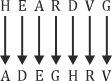
So, no letter has the same position as before. Hence, the fourth option is correct.
2) Directions: Each of the letters in the word WORKING is arranged in alphabetical order. How many letters are there in the English alphabetical series between the letter which is third from the left and the one which is fourth from the right in the new letter cluster thus formed?
1) One
2) Six
3) Two
4) Four
Hint: Arrange the letters in alphabetical order and determine the third letter from the left and the one that is the fourth letter from the right in the newly formed letter cluster.
Solution
Arrange the letters of WORKING in alphabetical order –
W O R K I N G→G I K N O R W
Now, according to the new letter cluster formed, the third letter from the left is K and the fourth letter from the right is N.
Letters between K and N, according to the alphabetical order→L, M
So, 2 letters are there between K and N. Hence, the third option is correct.
Best Books for Alphabet Test Reasoning Preparation
These books are widely recommended for logical reasoning preparation and help build strong fundamentals along with practice for topics like alphabet test.
| Book Name | Author | Key Features | Best For |
|---|---|---|---|
| A Modern Approach to Verbal & Non-Verbal Reasoning | R.S. Aggarwal | Covers alphabet test, series, coding, and arrangement with clear concepts and practice | Beginners to advanced learners |
| A New Approach to Reasoning (Verbal & Non-Verbal) | Arihant Experts | Exam-oriented questions with shortcut techniques and updated patterns | SSC, Banking, CUET |
| Analytical Reasoning | M.K. Pandey | Strong focus on logical thinking and pattern-based questions | CAT, XAT, advanced level |
| Logical Reasoning and Data Interpretation for CAT | Nishit K. Sinha | Concept-based learning with mixed practice sets including alphabet series | CAT and MBA exams |
| Shortcuts in Reasoning | Disha Experts | Quick tricks and techniques for solving alphabet test questions faster | SSC, Banking, Railway exams |
Alphabet Test Questions for APICET/ TANCET/ KMAT/ JIPMAT
1. Directions: From the given alternatives, select the word which can be formed using the letters of the given word.
IMMEASURABLE
1) BAILABLE
2) BLUE
3) MEAT
4) BIBLE
Hint: Compare all the letters in the option words with the question word.
Solution
Let's compare the given options –
First option: BAILABLE; Two B's are not present in the word IMMEASURABLE. Therefore, all the letters of BAILABLE are not present in the word IMMEASURABLE.
Second option: BLUE; All the letters of BLUE are present in the word IMMEASURABLE.
Third option: MEAT; T is not present in the word IMMEASURABLE. Therefore, all the letters of MEAT are not present in the word IMMEASURABLE.
Fourth option: BIBLE; Two B's are not present in the word IMMEASURABLE. Therefore, all the letters of the BIBLE are not present in the word IMMEASURABLE.
So, from the above, only BLUE can be formed using the letters of the word IMMEASURABLE. Hence, the second option is correct.
2. Directions: If it is possible to form a word with the first, fourth, seventh, and eleventh letters in the word SUPERFLUOUS, write the first letter of that word.
1) L
2) O
3) E
4) S
Hint: Think of a word that means a smaller amount.
Solution
The first, fourth, seventh, and eleventh letters are S, E, L, and S.
From these letters, we can make a word LESS.
LESS means a smaller amount or a reduced quantity of something.
So, the first letter is L. Hence, the first option is correct.
Alphabet Test Questions for SSC MTS/ SSC CHSL/ SSC Stenographer/ RRB exams
1) Directions: Select the correct option that indicates the arrangement of the given words in the order in which they appear in an English dictionary.
1. Advantage
2. Advice
3. Advise
4. Admirable
5. Adorable
1) 4, 5, 3, 2, 1
2) 4, 5, 1, 2, 3
3) 4, 5, 1, 3, 2
4) 4, 2, 3, 5, 1
Solution
Arrange the words in alphabetical order.
Step 1: Compare the first letter of each word. Since all the words start with the same letter A, then move on to the next letter.
Step 2: The second letter of each word is the same, i.e., d, move on to the next letter.
Step 3: The third letter of each word is v, v, v, m and o. Based on the alphabetical order of these letters, we can arrange them – Admirable, Adorable, Advantage, Advice, Advise
Step 4: Compare the fourth letter of (Advantage, Advice, Advise). Advantage will come before Advice and Advise in the sequence as a comes before i in the alphabetical system.
Step 5: Compare the fifth letter of (Advice, Advise). Advice will come before Advise in the sequence as c comes before s in the alphabetical system.
So, the sequence is Admirable, Adorable, Advantage, Advice, Advise, or 4, 5, 1, 2, 3. Hence, the second option is correct.
2) Directions: Each of the letters in the word JOURNAL are arranged in alphabetical order. How many letters are there in the English alphabetical series between the letter which is fourth from the left and the one which is second from the right in the new letter cluster thus formed?
1) Six
2) Three
3) Five
4) Four
Solution
Arrange the given word in alphabetical order and then find the number of letters between them according to the instructions.
When the letters of JOURNAL are arranged in alphabetical order, the letter cluster formed is AJLNORU.
The letter which is fourth from the left is N. (AJLNORU)
The letter which is second from the right is R. (AJLNORU)
Letters between N and R→O, P, Q
So, there are 3 letters between the letter, which is fourth from the left and the one which is second from the right. Hence, the second option is correct.
Alphabet Test Questions for Banking IBPS CWE Clerical/ IBPS RRB Assistant/ SBI Assistant/ RBI Assistant exams
1. Directions: Each of the letters in the word KINGDOM is arranged in alphabetical order. How many letters are there in the English alphabetical series between the letter which is fourth from the left and the one which is second from the right in the new letter cluster thus formed?
1) Three
2) One
3) Two
4) None
Hint: Arrange the letters of the given word according to the alphabetical order and find the letters between the letter which is fourth from the left and the one which is second from the right.
Solution
On arranging the letters of the word KINGDOM in alphabetical order the letter cluster formed is→DGIKMNO
Now, the letter which is fourth from the left is K (DGIKMNO)
And the letter which is second from the right is N (DGIKMNO)
Letters in between K and N in alphabetical series are L and M.
So, only two letters are there between the letters K and M. Hence, the third option is correct.
2. Directions: The position of how many letters will remain unchanged if each of the letters in the word GASOLINE is arranged in alphabetical order.
1) Two
2) Three
3) Four
4) One
Hint: Arrange the letters of the given word in alphabetical order and then compare their position with the original word.
Solution
The letter cluster after arranging the letters in alphabetical order will be –
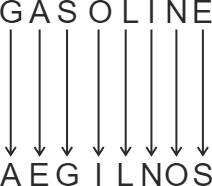
The letter that remained in the same position is L.
So, only L remain unchanged. Hence, the fourth option is correct.
Step-by-Step Approach to Solve Alphabet Test Questions
A structured method is essential to solve Alphabet Test questions efficiently in competitive exams. Following a clear approach ensures accuracy while saving valuable time during the test. Below are the key steps you can follow for effective preparation.
Identifying Letter Positions Quickly
Familiarise yourself with the numerical positions of all 26 letters in the English alphabet (A = 1, B = 2, ..., Z = 26).
Practice mental mapping so you can recall positions instantly without counting each time.
For SSC reasoning alphabet test questions, direct position recall saves valuable seconds in the exam.
Learn the reverse positions as well (Z = 1, Y = 2, ..., A = 26) for abcd reasoning variations.
Use SSC CGL alphabet reasoning questions and mock tests to strengthen memory-based recognition.
Make use of quick reference charts during practice until positions are memorised.
Applying Forward and Backward Alphabet Sequences
Understand how to move letters forward (+) or backward (–) in the sequence as per the question requirement.
In forward shifting, move ahead in the alphabet (e.g., C + 3 = F), and in backward shifting, move back (e.g., F – 2 = D).
Pay attention to wrap-around changes, after Z, continue from A; before A, continue from Z.
Many English alphabet test problems in SSC CGL and RRB NTPC involve combined forward and backward shifts.
For coded sequences, apply shifts step-by-step to avoid errors.
Regular practice of the SSC reasoning alphabet test questions will make forward and backward operations almost automatic during exams.
Non-Verbal Reasoning Topics
Non-verbal reasoning focuses on problem-solving through visual patterns, shapes, and figures rather than words or numbers. It helps in assessing a candidate’s observation skills and logical thinking without language barriers. Below are the important non-verbal reasoning topics you should be familiar with for competitive exams.
About the Faculty
Tanu Gupta, with over a decade of experience as a reasoning faculty, specializes in preparing students for various entrance examinations and career development. Her extensive work with multiple educational platforms and institutions has honed her expertise in logical and analytical thinking. Her dedication to innovative teaching methods ensures these articles provide practical insights and expert guidance.
Frequently Asked Questions (FAQs)
The alphabet test is asked in many Government exams like SSC, Railway, Insurance, Defence, Banking, CUET, IPMAT and other competitive exams.
Alphabet test is a type of logical reasoning where questions are based on letter positions, sequences, arrangements, and patterns in the English alphabet.
You can solve them quickly by remembering letter positions, using shortcut tricks, and identifying patterns like skipping or reversing letters.
Important tricks include using number mapping, reverse alphabet logic, and breaking down patterns step by step.
Alphabet test-based questions are asked in SSC exams and weightage is 1 to 3 questions.
In the railways exam, 1 to 2 questions and in banking exams, 3 to 6 questions.
Alphabet testing is defined as the arrangement of letters/ words according to the given instructions and set rules.
Alphabet test in IQ is to check the ability of a candidate to see and the rules that are implemented on words, letters and sentences.
To learn the alphabet test firstly you should learn the positional values of the alphabet from both the ends and than work on the rearrangements of the alphabets. This will help you to learn the alphabet test easily.
The positional values of the alphabet remains same in reasoning also. You should write the alphabet from the left end in the similar way you are writing since your childhood.