KCC Institute of Legal and Higher Education, Greater Noida
Law Admissions 2026 Open | Avail Merit-Based Scholarships


Think of a dice or a Rubik’s cube - each face, edge, and corner holds important information that can be used to solve logical problems. Cube-based questions in reasoning are built around this idea, where you analyze how a cube looks after cuts, folds, or color changes. These questions test your spatial visualization skills and understanding of three-dimensional structures. Cube reasoning is commonly asked in competitive exams like SSC, banking, and defence exams. In this article, you will learn the basic definition of a cube in mathematics, important concepts related to cube-based reasoning questions, and examples to help you solve them with clarity and confidence.
This Story also Contains
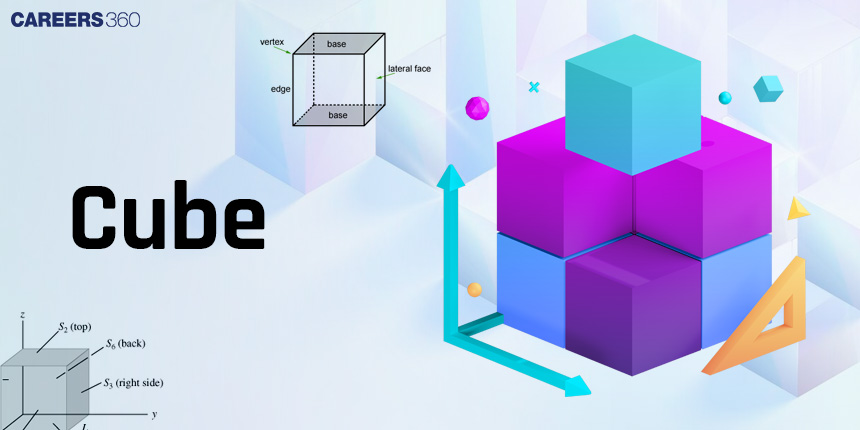
A cube is a 3D figure with three sides, length, breadth and height, where all the sides are equal. A cube has 6 faces, 8 vertices, and 12 edges. The faces of the cube are square-shaped, and each face meets at a right angle. Each of the faces meets the other four faces, and one face is opposite. Each of the vertices meets three faces and three edges. The edges and faces opposite to each other are parallel.
A cube is a three-dimensional geometric shape that plays an important role in both mathematics and reasoning-based problems. It is commonly used in aptitude and logical reasoning questions where candidates are required to visualize cuts, colors, or positions on different faces. Cube-based questions test spatial understanding, visualization skills, and logical thinking, making them a frequent topic in competitive exams.
Law Admissions 2026 Open | Avail Merit-Based Scholarships
BBA/MBA/PGDM Early Bird Applications Deadline 06th Nov'26. Apply now using coupon code CAREER250 and get ₹250 off the application fee
A cube is a solid figure in which all sides are equal and all angles are right angles.
Understanding this definition is essential for solving cube-based problems in exams.
A cube has several unique properties that make it easy to analyze in reasoning questions.
These properties help in solving cube-related reasoning questions accurately.
To understand cube problems, it is important to know its structural elements.
Knowing these basics is crucial for solving cube cutting and painted cube questions.
Cube concepts are widely used in reasoning and aptitude sections of competitive exams.
Because of their practical and visual nature, cube questions are an important part of reasoning preparation for exams like SSC, banking, MBA, and defence tests.
Cube reasoning requires a clear understanding of structure and spatial relationships. These concepts help in solving cube-based questions in aptitude and logical reasoning.
There are several types of questions that have been seen from the topic cube -
Cutting of a cube and counting of smaller cubes
Counting of coloured cubes
Let’s discuss these types and cube reasoning tricks in detail with the help of examples -
In these types of problems, a bigger cube is divided into smaller cubes by making the required number of cuts on different faces. Each smaller cube is of equal length.
To understand the concept, let’s assume that the bigger cube of length ‘L1’ is cut from different faces to form smaller cubes of length ‘L2’.
If we divide the length of a bigger cube by the length of the smaller cubes, we will get the number of parts (of each face) in which the cube is divided, and that is denoted by ‘n’.
∴ n = L1/L2
So, the total number of cuts to be made = 3 × (n - 1)
The total number of smaller cubes formed due to the division of a cube = (n)3
Example: Suppose a cube of length 27 cm is cut into smaller cubes of length 3 cm. How many cuts will be made and how many smaller cubes will be formed?
Answer: n = L1/L2 = 27/3 = 9
∴ Total number of cuts = 3 × (n - 1) = 3 × (9 - 1) = 3 × 8 = 24
∴ Total number of smaller cubes = (n)3 = (9)3 = 729
In these types of problems, the given cube will be painted on all its surfaces with any colour. So, here, we have to find the number of coloured cubes based on the number of painted surfaces of smaller cubes. When we cut a painted cube to form smaller cubes, we will get different types of painted cubes based on the number of painted surfaces. We have two categories of coloured cubes:
Here, all the surfaces of the cube are painted with only one colour. When the cube is cut into smaller cubes, we will get different types of cubes based on the number of painted surfaces. They are as follows:
Corner cube (3-Faces coloured) - When the painted cube is cut to form smaller cubes, the maximum number of the painted surfaces of smaller cubes can be 3. These types of cubes are formed at the corner of the bigger cube, that’s why, these cubes are also known as corner cubes. Thus, all the corner cubes are painted on 3 surfaces. As we know, there are a total of 8 corners.
So, the number of smaller cubes of which 3 surfaces are painted = 8
Middle cubes (2-Faces coloured) - When the painted cube is cut, the formed smaller cubes are also painted. These types of cubes are formed at the middle of the edges of the cube, that’s why, these cubes are also known as middle cubes.
The number of smaller cubes of which 2 surfaces are painted = 12 × (n - 2)
Central cubes (1-Face coloured) - When the painted cube is cut, the formed smaller cubes are also painted. These types of cubes are formed at the centre of the faces of the cube, that’s why, these cubes are also known as central cubes.
The number of smaller cubes of which 1 surface is painted = 6 × (n - 2)2
Inner Central cubes (0-Faces coloured) - When the painted cube is cut, the formed smaller cubes are also painted. These types of cubes are formed inside the centre of the cube, that’s why, these cubes are also known as inner central cubes.
The number of smaller cubes of which 0 surface is painted = (n - 2)3
Example: A bigger cube with all surfaces painted yellow is cut into 27 smaller cubes of equal size. How many smaller cubes are there which have 3 surfaces painted, 2 surfaces painted, 1 surface painted, and no surface painted?
Answer: Total smaller cubes = 27
⇒ (n)3 = 27 ⇒ n = 3
Total number of cubes with 3 surfaces painted = 8
Total number of cubes with 2 surfaces painted = 12 × (n - 2) = 12 × (3 - 2) = 12 × 1 = 12
Total number of cubes with 1 surface painted = 6 × (n - 2)2 = 6 × (3 - 2)2 = 6 × 1 = 6
Total number of cubes with 0 surfaces painted = (n - 2)3 = (3 - 2)3 = 1
Here, all the surfaces of the cube are painted with different colours. When the cube is cut into smaller cubes, we will get different types of cubes based on the number of painted surfaces. They are as follows:
Corner Cube (3-Faces coloured) - When the painted cube is cut to form smaller cubes, the maximum number of the painted surfaces of smaller cubes can be 3. These types of cubes are formed at the corner of the bigger cube, that’s why, these cubes are also known as corner cubes. Thus, all the corner cubes are painted on 3 surfaces. As we know, there are a total of 8 corners.
So, the number of smaller cubes of which 3 surfaces are painted = 8
But here, if we talk about the painted surfaces with a particular colour, then we can simply refer to the picture of the cube to identify the painted surface of the cube with a specific colour.
Middle Cubes (2-Faces coloured) - When the painted cube is cut, the formed smaller cubes are also painted. These types of cubes are formed at the middle of the edges of the cube, that’s why, these cubes are also known as middle cubes.
The number of smaller cubes of which 2 surfaces are painted = 12 × (n - 2)
But here, if we talk about the painted surfaces with a particular colour, then we can simply refer to the picture of the dice. 2-faces coloured cubes depend on the edges of the cube. Multiply (n - 2) by the number of required edges to identify the painted surfaces of the cube with a specific colour.
Central Cubes (1-Face coloured) - When the painted cube is cut, the formed smaller cubes are also painted. These types of cubes are formed at the centre of the faces of the cube, that’s why, these cubes are also known as central cubes.
The number of smaller cubes of which 1 surface is painted = 6 × (n - 2)2
But here, if we talk about the painted surfaces with a particular colour, then we can simply refer to the picture of the dice. 1-face coloured cubes depend on the faces of the cube. Multiply (n - 2)2 by the number of required faces to identify the painted surfaces of the cube with a specific colour.
Inner Central Cubes (0-Faces coloured) - When the painted cube is cut, the formed smaller cubes are also painted. These types of cubes are formed inside the centre of the cube, that’s why, these cubes are also known as inner central cubes.
The number of smaller cubes of which 0 surface is painted = (n - 2)3
Example: Two adjacent surfaces of a cube are painted red, two other adjacent faces are blue, and two remaining adjacent faces are painted green. Now it is cut into 125 smaller cubes, then how many smaller cubes have 2 surfaces painted with red and green colour, and 1 surface painted with blue colour?
Answer: Total smaller cubes = 125
⇒ (n)3 = 125 ⇒ n = 5
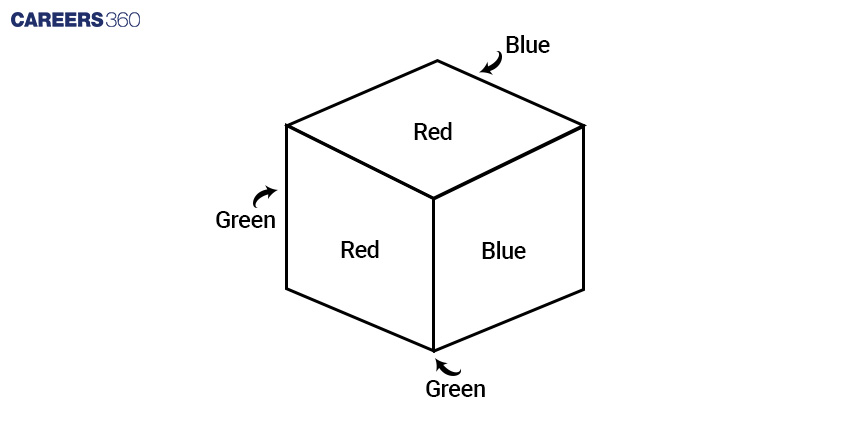
Total number of cubes with 2 surfaces painted (Red + Green), Here, if we check the figure, the edges that have red and green faces at their sides, there are only 3 such edges.
Thus, the total number of required cubes = 3 × (n - 2) = 3 × (5 - 2) = 3 × 3 = 9
Total number of cubes with 1 surface painted (Blue), here, if we check the figure, 2 faces that are painted blue.
Thus, the total number of required faces = 2 × (n - 2)2 = 2 × (5 - 2)2 = 2 × 9 = 18
This section covers the key formulas and standard concepts used in cube-based reasoning questions, helping you quickly calculate values related to cuts, painted faces, and smaller cubes for faster problem-solving.
This section includes figure-based and visual reasoning topics that focus on patterns, shapes, and logical analysis without the use of words.
The number of questions based on the cube varies from exam to exam -
1) Questions asked in SSC exams i.e. SSC MTS, SSC CGL, SSC CHSL, SSC CPO, Steno - 2 to 3 questions.
2) Questions asked in the RRB exam i.e. Group D, NTPC, JE, ALP etc - 2 to 3 questions.
3) Questions asked in Banking exams, Bank PO, Bank Clerk - 1 to 2 questions.
4) The candidates must practice cube reasoning questions pdf or questions on cube reasoning, to ace the topic of cube reasoning.
Note: Practice cube reasoning questions with answers of each type given below.
Q1. Directions: A bigger cube of length 64 cm is cut into smaller cubes of length 8 cm. What is the total number of cubes made?
A) 27
B) 125
C) 512 (Correct)
D) 64
Solution:
Length of bigger cube = 64 cm, Length of each smaller cube = 8 cm
Thus, n = 64/8 = 8
So, the total number of cubes made = (n)3 = (8)3 = 512
Hence, the third option is correct.
Q2. Directions: A bigger cube is cut into 125 smaller cubes. How many cuts are required to form these smaller cubes?
A) 20
B) 5
C) 10
D) 12 (Correct)
Solution:
The total number of cubes made = 125
⇒ (n)3 = 125 ⇒ n = 5
Total number of cuts = 3 × (n - 1) = 3 × (5 - 1) = 3 × 4 = 12
Hence, the fourth option is correct.
Q3. Directions: A bigger cube of length 48 cm is cut into smaller cubes of length 8 cm. What is the total number of cubes made?
A) 64
B) 216 (Correct)
C) 125
D) 40
Solution:
Length of bigger cube = 48 cm, Length of each smaller cube = 8 cm
Thus, n = 48/8 = 6
So, the total number of cubes made = (n)3 = (6)3 = 216
Hence, the second option is correct.
Q4. Directions: If a number of smaller cubes are taken out from a bigger cube, each side is ¼ the size of the original cube’s side. What is the total number of smaller cubes made?
A) 60
B) 64 (Correct)
C) 25
D) 20
Solution:
Let the length of the bigger cube = x cm and the length of each smaller cube = x/4 cm
Thus, n = x/(x/4) = 4
So, the total number of cubes made = (n)3 = (4)3 = 64
Hence, the second option is correct.
Q5. Directions: If a number of smaller cubes are taken out from a bigger cube, each side is 1/7 the size of the original cube’s side. What is the total number of smaller cubes made?
A) 343 (Correct)
B) 64
C) 125
D) 150
Solution:
Let the length of the bigger cube = x cm, and the length of each smaller cube = x/7 cm
Thus, n = x/(x/7) = 7
So, the total number of cubes made = (n)3 = (7)3 = 343
Hence, the first option is correct.
Q1. A 12 cm coloured cube is cut into 2 cm smaller cubes. How many cubes have 2 surfaces painted and 1 surface painted?
A) 48, 96 (Correct)
B) 48, 90
C) 56, 96
D) 36, 94
Answer:
Length of original cube = 12 cm, Length of smaller cubes = 2 cm
So, n = 12/2 = 6
Total number of cubes with 2 surfaces painted = 12 × (n - 2) = 12 × (6 - 2) = 12 × 4 = 48
Total number of cubes with 1 surface painted = 6 × (n - 2)2 = 6 × (6 - 2)2 = 6 × 16 = 96
Hence, the first option is correct.
Q2. A 25 cm coloured cube is cut into 5 cm smaller cubes. How many cubes have 3 surfaces painted, 2 surfaces painted and 1 surface painted?
A) 8, 24, 54
B) 8, 36, 45
C) 8, 36, 54 (Correct)
D) 8, 48, 36
Answer:
Length of original cube = 25 cm, Length of smaller cubes = 5 cm
So, n = 25/5 = 5
Total number of cubes with 3 surfaces painted = 8
Total number of cubes with 2 surfaces painted = 12 × (n - 2) = 12 × (5 - 2) = 12 × 3 = 36
Total number of cubes with 1 surface painted = 6 × (n - 2)2 = 6 × (5 - 2)2 = 6 × 9 = 54
Hence, the third option is correct.
Q3. A bigger cube with all surfaces painted yellow is cut into 27 smaller cubes of equal size. How many cubes are there which have only one surface painted?
A) 1
B) 6 (Correct)
C) 8
D) 10
Solution:
Total number of smaller cubes = 27
⇒ Total number of smaller cubes = (n)3 ⇒ (n)3 = 27 ⇒ n = 3
Total number of cubes with 1 surface painted = 6 × (n - 2)2 = 6 × (3 - 2)2 = 6 × 1 = 6
Hence, the second option is correct.
Q4. A cube of white material is painted black on all its surfaces. If it is cut into 216 smaller cubes of the same size, then how many cubes will have 2 surfaces painted black?
A) 96
B) 56
C) 64
D) 48 (Correct)
Solution:
Total number of smaller cubes = 216
⇒ Total number of smaller cubes = (n)3 ⇒ (n)3 = 216 ⇒ n = 6
Total number of cubes with 2 surface painted = 12 × (n - 2) = 12 × (6 - 2) = 12 × 4 = 48
Hence, the fourth option is correct.
Q5. A coloured cube is cut into 343 smaller cubes of the same size, then how many cubes will have at least 2 surfaces painted?
A) 48
B) 68 (Correct)
C) 8
D) 40
Solution:
Total number of smaller cubes = 343
⇒ Total number of smaller cubes = (n)3 ⇒ (n)3 = 343 ⇒ n = 7
Total number of cubes with at least 2 surfaces painted = Cubes with 2 surfaces painted + Cubes with 3 surfaces painted = (12 × (n - 2)) + 8 = (12 × (7 - 2)) + 8 = (12 × 5) + 8 = 60 + 8 = 68
Hence, the second option is correct.
Q6. A coloured cube is cut into 125 smaller cubes of the same size, then how many cubes will have at most 2 surfaces painted?
A) 117 (Correct)
B) 124
C) 96
D) 105
Solution:
Total number of smaller cubes = 125
⇒ Total number of smaller cubes = (n)3 ⇒ (n)3 = 125 ⇒ n = 5
Total number of cubes with at most 2 surfaces painted = Cubes with 2 surfaces painted + Cubes with 1 surfaces painted + Cubes with no surface painted = (12 × (n - 2)) + (6 × (n - 2)2) + ((n - 2)3) = (12 × (5 - 2)) + (6 × (5 - 2)2) + ((5 - 2)3) = (12 × 3) + (6 × 9) + (27) = 117
Hence, the first option is correct.
Q7. There is a bigger cube of 12 cm. 2 adjacent surfaces of it are painted red, 2 other adjacent surfaces are painted yellow, 1 surface is painted blue, and 1 surface is painted green. Now it is cut into smaller cubes of 2 cm, then how many smaller cubes are there which have only 2 surfaces painted with red and blue colour?
A) 48
B) 8 (Correct)
C) 24
D) 32
Solution:
Length of bigger cube = 12 cm, Length of smaller cube = 2 cm
So, n = 12/2 = 6
Now, we have to consider the smaller cubes whose one surface is painted red and the other is painted blue, as shown in the diagram below:
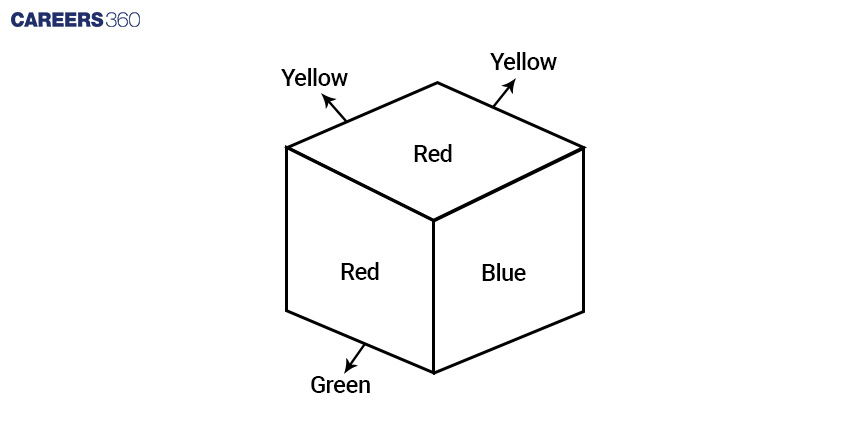
So, according to the above diagram, there are only 2 such edges where these required cubes are formed.
The number of smaller cubes which have only 2 surfaces painted with red and blue colour = 2 × (n - 2)
= 2 × (6 - 2) = 2 × 4 = 8
Hence, the second option is correct.
Q8. A bigger coloured cube is cut into 125 smaller cubes of 8 cm3, then what is the length of the bigger cube?
A) 40 cm
B) 20 cm
C) 5 cm
D) 10 cm (Correct)
Solution:
Total number of smaller cubes = 125
The total number of smaller cubes = (n)3 ⇒ (n)3 = 125 ⇒ n = 5
The volume of each smaller cube = 8 cm3
So, the length of the smaller cube = 2 cm
Let the length of the bigger cube be L cm.
So, n = L/2 ⇒ 5 = L/2 ⇒ L = 10 cm
Hence, the fourth option is correct.
Q9. Two adjacent surfaces of a bigger cube are painted red, 1 surface is painted blue and the remaining 3 surfaces are painted yellow. Now, it is cut into 216 smaller cubes. How many smaller cubes have only 1 surface painted with a yellow colour?
A) 48 (Correct)
B) 32
C) 16
D) 12
Solution:
Total number of smaller cubes = 216
The total number of smaller cubes = (n)3 ⇒ (n)3 = 216 ⇒ n = 6
Here, we have to determine the number of smaller cubes that have 1 surface painted with yellow colour.
Yellow painted surfaces are 3,
The number of cubes that have only 1 surface painted with yellow colour = 3 × (n - 2)2 = 3 × (6 - 2)2 = 3 × 16 = 48
Hence, the first option is correct.
Q10. Four surfaces of a bigger cube are painted red, and the remaining 2 surfaces are painted yellow. Now, it is cut into 64 smaller cubes. How many smaller cubes have only 1 surface painted with a red colour?
A) 8
B) 32
C) 16 (Correct)
D) 12
Solution:
Total number of smaller cubes = 64
The total number of smaller cubes = (n)3 ⇒ (n)3 = 64 ⇒ n = 4
Here, we have to determine the number of smaller cubes that have 1 surface painted with red colour.
Red painted surfaces are 4,
The number of cubes that have only 1 surface painted with red colour = 4 × (n - 2)2 = 4 × (4 - 2)2 = 4 × 4 = 16
Hence, the third option is correct.
A structured method helps in solving cube reasoning questions accurately.
Shortcut techniques help in saving time in exams.
This section lists the most recommended books to help you build strong concepts and practice cube reasoning questions effectively for competitive exams.
| Book Name | Author | Key Features | Best For |
|---|---|---|---|
| A Modern Approach to Verbal & Non-Verbal Reasoning | R.S. Aggarwal | Covers cube, dice, and spatial reasoning with diagrams and practice | Beginners and SSC aspirants |
| Analytical Reasoning | M.K. Pandey | Includes puzzle-based and visualization questions | Banking and MBA exams |
| A New Approach to Reasoning Verbal & Non-Verbal | B.S. Sijwali | Provides shortcut techniques and concept clarity | Beginners to intermediate level |
| Logical Reasoning | Arun Sharma | Advanced level reasoning and visualization questions | MBA entrance exams |
| Magical Book on Puzzles | K. Kundan | Helps improve spatial reasoning and speed | Practice and speed improvement |
| SSC Reasoning Chapterwise Solved Papers | Kiran Publications | Previous year cube questions with solutions | SSC exam preparation |
This section provides key formulas and concepts related to cube problems, helping you quickly revise and solve questions with accuracy.
| Concept / Formula | Expression | Use Case |
|---|---|---|
| Total smaller cubes | $n^3$ | When cube is divided into n parts |
| Corner cubes | $8$ | Always fixed |
| Edge cubes | $12(n - 2)$ | Cubes on edges |
| Face center cubes | $6(n - 2)^2$ | Cubes on faces |
| Inner cubes | $(n - 2)^3$ | Completely inside cubes |
| Cubes with 3 faces painted | $8$ | Corner cubes |
| Cubes with 2 faces painted | $12(n - 2)$ | Edge cubes |
| Cubes with 1 face painted | $6(n - 2)^2$ | Face center cubes |
| Cubes with no paint | $(n - 2)^3$ | Inner cubes |
This section covers important topics based on words, letters, and language patterns that are essential for reasoning sections in exams. For verbal reasoning, read the topics below:
Frequently Asked Questions (FAQs)
The questions related to the cube are asked in various competitive exams such as SSC, Bank PO, Bank Clerk, Railway, Defence, UPSC, State PCS, etc.
In the SSC exams around 2-3 questions have been asked every year whereas in other exams like Railways, CUET or Defence mostly 1-2 questions have been asked.
Key formulas include total cubes = $n^3$, edge cubes = $12(n-2)$, and inner cubes = $(n-2)^3$.
Most cube questions can be solved within 1–2 minutes with proper practice.
The questions asked from the topic cube are based on the cutting of the cube, counting of smaller cubes when the cube is being cut into smaller pieces, and counting of coloured cubes.
There are several types of questions that have been seen from the topic cube like Cutting of a cube and counting of smaller cubes or Counting of coloured cubes. To solve these types of questions follow the below points.
1) Cutting of a cube or counting of smaller cubes: In these types of problems, a bigger cube is divided into smaller cubes by making the required number of cuts on different faces. Each smaller cube is of equal length. To understand the concept, let’s assume that the bigger cube of length ‘L1’ is cut from different faces to form smaller cubes of length ‘L2’. If we divide the length of a bigger cube by the length of the smaller cubes, we will get the number of parts (of each face) in which the cube is divided, and that is denoted by ‘n’. n = L1/L2
So, the total number of cuts to be made = 3 × (n - 1)
The total number of smaller cubes formed due to the division of a cube = (n)3
2) Counting of coloured cubes: In these types of problems, the given cube will be painted on all its surfaces with any colour. So, here, we have to find the number of coloured cubes based on the number of painted surfaces of smaller cubes. When we cut a painted cube to form smaller cubes, we will get different types of painted cubes based on the number of painted surfaces.
For a detailed explanation, you must read the article above.
The reasoning formula for a cube: A cube of side nnn painted on all sides which is uniformly cut into smaller cubes of dimension 111,
1) Number of cubes with 0 side painted= (n-2) 3.
2) Number of cubes with 1 sides painted =6(n - 2) 2.
3) Number of cubes with 2 sides painted= 12(n-2)
To solve a 3 dice problem follow the below steps:
1) The formula which is used to solve is of probability which is equal to (Favorable outcomes/Total number of outcomes.)
2) Now when three dice are thrown then the total number of outcomes = 63 = 216.
3) Now the total number of outcomes = 216. The probability of not getting 3 on a single die = 5/6.
4) Therefore the required probability is 91/216.

Law Admissions 2026 Open | Avail Merit-Based Scholarships
BBA/MBA/PGDM Early Bird Applications Deadline 06th Nov'26. Apply now using coupon code CAREER250 and get ₹250 off the application fee
Ranked #36 amongst institutions in Management by NIRF | 100% Placement
Globally Recognized by AACSB (US) & AMBA (UK) | 18 LPA Avg. CTC for PGPM 2026
NEET PG All India & State College Predictor with Admission Process Guide
Top B-School: Ranked #9 in NIRF Management Rankings 2025.