


Binary Logic: Meaning, Reasoning Questions with Answers, Examples
Have you ever tried solving a puzzle where you had to work with only two possibilities - like true or false, yes or no, or 0 and 1? That’s exactly what binary logic in reasoning is all about. In these questions, you are given conditions based on two possible states, and your task is to analyze the statements logically to arrive at the correct conclusion. These binary logic reasoning questions with answers test your ability to think systematically, follow conditions carefully, and eliminate contradictions. By practicing different binary logic examples and solutions, you can improve your logical thinking, accuracy, and speed in solving such questions in exams. In this article, we will cover the meaning of binary logic in reasoning, detailed explanations with solved questions, important practice questions with answers, effective tricks and techniques to solve binary logic questions quickly, and a list of frequently asked questions (FAQs) to help you prepare for competitive exams like CAT, XAT, CUET, SSC, Banking, and other aptitude tests.
This Story also Contains
- What is Binary Logic in Reasoning?
- Key Concepts of Binary Logic in Reasoning
- Types of Persons in Binary Logic Reasoning Questions Explained
- Binary Logic and Boolean Algebra
- Types Binary Logic Reasoning Questions
- Truth-Tellers and Liars Problems
- Logical Reasoning Topics
- Binary Logic Reasoning CAT Questions for Practice
- Best Approach to Solve Binary Logic Reasoning Questions Quickly and Accurately
- Binary Logic Reasoning Questions for UPESMET/ JIPMAT
- Binary Logic Reasoning Questions for CAT/ XAT/ MAT
- Best Books for Binary Logic Reasoning Preparation
- Non Verbal Reasoning Topics
What is Binary Logic in Reasoning?
Binary logic is an important concept in logical reasoning and analytical thinking, where problems are based on only two possible outcomes—such as true or false, yes or no, or 0 and 1. In binary logic reasoning questions, candidates are given statements, conditions, or puzzles, and they must analyze them logically to determine the correct conclusion. These types of questions are widely asked in competitive exams to test clarity of thought, decision-making skills, and the ability to handle condition-based reasoning accurately. Practicing binary logic questions with answers helps improve both speed and accuracy in solving such problems.
Binary Logic Meaning in Logical Reasoning
In logical reasoning, binary logic refers to a system where every statement has only two possible states. There is no middle ground—each statement must be either completely true or completely false.
These binary logic reasoning questions typically involve:
- Identifying whether a statement is true or false
- Analyzing conditions based on yes/no responses
- Eliminating contradictions to arrive at the correct answer
- Evaluating multiple statements to determine consistency
Understanding the meaning of binary logic in reasoning is essential for solving puzzles and condition-based questions efficiently.
Definition of Binary Logic with Examples
Binary logic can be defined as a reasoning system in which conclusions are drawn based on two possible outcomes, and logical consistency is maintained throughout the problem.
For example:
If a statement says, “Either A is telling the truth or B is lying,” you must evaluate both possibilities and eliminate contradictions to find the correct answer. This is a typical binary logic reasoning example, where only two outcomes are possible.
Such binary logic questions with solutions require careful analysis of conditions, statements, and their relationships to arrive at a valid conclusion.
Real-Life Examples of Binary Logic
The concept of binary logic is not limited to exams—it is widely used in everyday life and decision-making situations.
- Deciding whether a statement is true or false while reading news or information
- Answering yes/no questions in surveys or interviews
- Making simple decisions like accept/reject or approve/deny
- Understanding how computers and digital systems operate using binary (0 and 1)
- Playing logic-based games that involve either/or conditions
These real-life applications show how binary logic reasoning skills are useful beyond exams and help in making clear and logical decisions.
Key Concepts of Binary Logic in Reasoning
To solve binary logic reasoning questions effectively, it is important to understand the core concepts that form the foundation of this topic. These concepts help in analyzing statements, identifying patterns, and avoiding logical errors.
True and False Conditions in Binary Logic
The most fundamental concept in binary logic reasoning is the idea of true and false conditions.
- Every statement is either completely true or completely false
- There is no partial truth or ambiguity in binary logic
- Identifying the truth value of statements helps in solving the problem step by step
- Contradictions indicate that a particular assumption is incorrect
Understanding true and false conditions in binary logic questions is essential for accurate problem-solving.
Yes/No and Either/Or Based Logic
Many binary logic reasoning questions are based on yes/no or either/or conditions.
- Yes/No logic requires determining whether a statement is correct or incorrect
- Either/Or logic involves choosing between two mutually exclusive options
- Only one condition can be true at a time in such scenarios
- Careful analysis is required to avoid confusion between options
These either/or and yes/no reasoning questions are commonly asked in competitive exams.
Understanding Binary Constraints and Conditions
Binary logic problems often include multiple constraints that must be satisfied simultaneously.
- Conditions must be followed strictly without assumptions
- All statements should be logically consistent with each other
- Violating any condition leads to an incorrect answer
- Step-by-step evaluation helps in handling complex constraints
Mastering binary logic constraints and conditions allows candidates to solve even the most challenging binary logic reasoning questions with answers confidently and efficiently.
Types of Persons in Binary Logic Reasoning Questions Explained
In binary logic reasoning questions, understanding the different types of persons is essential to solve problems accurately. These questions are often based on how individuals make statements—whether they always tell the truth, always lie, or switch between both. By identifying the type of person involved, candidates can easily decode the logic and arrive at the correct answer. Mastering these concepts is crucial for solving binary logic reasoning questions with answers in competitive exams.
True Teller in Binary Logic Reasoning
A true teller is a person who always speaks the truth in every situation.
- Every statement made by a true teller is always correct
- Their answers can be directly trusted without any modification
- They help in validating the correctness of other statements in the question
In binary logic questions, identifying a true teller early can simplify the entire problem, as their statements provide a reliable base for analysis.
Liar in Binary Logic Reasoning
A liar is a person who always gives false statements.
- Every statement made by a liar is always incorrect
- Their answers must be logically reversed to find the truth
- They often create confusion in binary logic reasoning problems
Recognizing a liar is important because it allows you to apply the opposite logic and eliminate incorrect possibilities quickly.
Alternator in Binary Logic Reasoning
An alternator is a person who switches between truth and lies.
- They do not consistently tell the truth or lie
- Their statements may alternate between true and false
- They require careful analysis of each statement individually
In binary logic reasoning questions, alternators are usually the most challenging to deal with, as you need to track the pattern of their statements before drawing conclusions.
Binary Logic and Boolean Algebra
As we know binary logic works on the values of true or false whereas boolean algebra is the type of algebra that works on the values 0 or 1. Here, 1 denotes True and 0 denotes false values. Three important types of operations are performed on boolean algebra called conjunction (∧), disjunction (∨) and negation (¬). Conjunction means AND, Disjunction means OR and Negation denotes NOT.
Boolean Algebra Operations
1. Conjunction or AND operation
2. Disjunction or OR operation
3. Negation or Not operation
P | Q | P ∧ Q | P ∨ Q |
True | True | True | True |
True | False | False | True |
False | True | False | True |
False | False | False | False |
A | ¬A |
True | False |
False | True |
Types Binary Logic Reasoning Questions
There are two types of questions asked in the exam on this topic.
Note: Binary logic examples are given with each question type.
Question Type 1
In this type of question, three persons stated six statements each person stated two statements where one statement is true and one false.
Example
Sam, Ram and Max participated in a game and one of them won the game. They belong to three different communities - A, B and C. A community always speak the truth, B community always lies and C community tells the truth and lies alternatively. (Each of Sam, Ram and Max belongs to one community.) After the game, they gave these statements.
Sam:
I would have won the game if Max had not obstructed me at the last moment.
Max always speaks the truth.
Ram:
Sam won the race.
Max does not belong to the B community.
Max:
I hadn’t obstructed Sam at the last moment.
Ram won the game.
Max belongs to which community?
1. A
2. B
3. C
4. Either 2 or 3
Solution:
Assume Ramis is a truth-teller (So, he belongs to A community). Then Sam is the winner and Max belongs to the C community (Alternator) which implies Sam is a liar (B).
If we check the truthfulness of Sam, we get that both his statements are wrong and Max's one statement is wrong. So, Max belongs to C and Sam won the game.
Question Type 2
In this type of question, if two types of persons are there where one person always speaks the truth and the other always tells a lie.
Example
Three persons P, Q and R gave these statements:
P said, either the Red Party or BlueParty won the elections.
Q said the Red Party won.
R said neither the Red Party nor the Blue Party won the elections.
Of these persons, only one person is wrong.
Who won the elections?
1. Red Party
2. Blue Party
3. Data Inadequate
4. None of these
Solution
As only one person is wrong, Therefore, two persons are right. Assume that the Red Party won the election. So, the statements of P and Q are true as they satisfy our condition that 2 of them are truth-tellers. Therefore, the Red Party wins the election.
If you assume that the Blue Party won the election, statements of Q and R become false that is violating the given condition.
Truth-Tellers and Liars Problems
Truth-tellers and liars problems is a logical puzzle and it is also called the Knights and Knaves problem. In this type of question or puzzle, a sequence of statements is given in which some are true and some are false. Based on these statements an aspirant has to determine the true statements.
Example
Chris and Bob are in the garden.
Bob says: "If 48 is odd, then I am a truth-teller."
Chris says: "Bob is a liar."
Determine whether each person is a truth-teller or a liar.
Solution
As we know 48 is not an odd number, the "if" part of Bob's statement is false. Hence, Bob's statement is true. Therefore, Bob must be a truth-teller.
Now, Chris says "Bob is a liar", and that is false since I just showed that Bob is a truth-teller. Therefore, Chris is a liar.
Hence, Phoebe is a truth-teller and Calvin is a liar.
Logical Reasoning Topics
Binary logic is asked in CAT and CLAT exams and the weightage is 3 to 5 questions. As it is one of the important chapters you should practice various binary logic reasoning pdf. We have provided below reasoning topics so that you can prepare better:
Binary Logic Reasoning CAT Questions for Practice
1. Directions: In an institute, there are three top rankers in a batch, Karthik, Waheeda, and Ritesh, not necessarily in the same order, who made the following statements about their ranks.
Karthik: (A) I am not the top ranker.
(B) Waheeda is not the second ranker.
(C) Ritesh is the third ranker.
Waheeda: (A) Karthik’s first statement is false.
(B) I am the third ranker.
(C) I made two false statements.
Ritesh: (A) Karthik is the first ranker.
(B) Waheeda is not the second ranker.
(C) I am the second ranker.
It is known that each of Karthik and Ritesh made only one false statement. Waheeda made only one true statement.
Question: Who is the first ranker?
1) Karthik
2) Waheeda
3) Ritesh
4) Cannot be determined
Solution
It is given that Waheeda made only one true statement. It implies that she made two false statements.
⇒ Waheeda’s third statement is true and the other two are false.
⇒ Karthik’s first statement is true. (From Waheeda’s first statement) i.e. Karthik is not the top ranker.
⇒ Ritesh’s first statement is false and the other two are true.
⇒ Ritesh is the second ranker and Waheeda is not the second ranker. As Karthik is not the first ranker, Waheeda is the first ranker and Karthik is the third ranker.
⇒ Karthik’s second statement is true and the third one is false.
Therefore, the arrangement is as follows:
Waheeda > Ritesh > Karthik
So, Waheeda is the first ranker. Hence, the second option is correct.
2. Directions: In an institute, there are three top rankers in a batch, Karthik, Waheeda, and Ritesh, not necessarily in the same order, who made the following statements about their ranks.
Karthik: (A) I am not the top ranker.
(B) Waheeda is not the second ranker.
(C) Ritesh is the third ranker.
Waheeda: (A) Karthik’s first statement is false.
(B) I am the third ranker.
(C) I made two false statements.
Ritesh: (A) Karthik is the first ranker.
(B) Waheeda is not the second ranker.
(C) I am the second ranker.
It is known that each of Karthik and Ritesh made only one false statement. Waheeda made only one true statement.
Question: Which of the following represents the correct order of truth and false statements made by Karthik?
1) True, False, True
2) True, True, False
3) False, True, True
4) Cannot be determined
Solution
It is given that Waheeda made only one true statement. It implies that She made two false statements.
⇒ Waheeda’s third statement is true and the other two are false.
⇒ Karthik’s first statement is true. (From Waheeda’s first statement) i.e. Karthik is not the top ranker.
⇒ Ritesh’s first statement is false and the other two are true.
⇒ Ritesh is the second ranker and Waheeda is not the second ranker. As Karthik is not the first ranker, Waheeda is the first ranker and Karthik is the third ranker.
⇒ Karthik’s second statement is true and the third one is false.
Therefore, the correct order of truth and false statements made by Karthik are true, true false. Hence, the second option is correct.
3. Directions: In an institute, there are three top rankers in a batch, Karthik, Waheeda, and Ritesh, not necessarily in the same order, who made the following statements about their ranks.
Karthik: (A) I am not the top ranker.
(B) Waheeda is not the second ranker.
(C) Ritesh is the third ranker.
Waheeda: (A) Karthik’s first statement is false.
(B) I am the third ranker.
(C) I made two false statements.
Ritesh: (A) Karthik is the first ranker.
(B) Waheeda is not the second ranker.
(C) I am the second ranker.
It is known that each of Karthik and Ritesh made only one false statement. Waheeda made only one true statement.
Question: Who is the third ranker?
1) Karthik
2) Waheeda
3) Ritesh
4) Cannot be determined
Solution
It is given that Waheeda made only one true statement. It implies that She made two false statements.
⇒ Waheeda’s third statement is true and the other two are false.
⇒ Karthik’s first statement is true. (From Waheeda’s first statement) i.e. Karthik is not the top ranker.
⇒ Ritesh’s first statement is false and the other two are true.
⇒ Ritesh is the second ranker and Waheeda is not the second ranker. As Karthik is not the first ranker, Waheeda is the first ranker and Karthik is the third ranker.
⇒ Karthik’s second statement is true and the third one is false.
Therefore, the arrangement is as follows:
Waheeda > Ritesh > Karthik
Therefore, Karthik is the third ranker. Hence, the first option is correct.
4. Directions: In an institute, there are three top rankers in a batch, Karthik, Waheeda, and Ritesh, not necessarily in the same order, who made the following statements about their ranks.
Karthik: (A) I am not the top ranker.
(B) Waheeda is not the second ranker.
(C) Ritesh is the third ranker.
Waheeda: (A) Karthik’s first statement is false.
(B) I am the third ranker.
(C) I made two false statements.
Ritesh: (A) Karthik is the first ranker.
(B) Waheeda is not the second ranker.
(C) I am the second ranker.
It is known that each of Karthik and Ritesh made only one false statement. Waheeda made only one true statement.
Question: If Waheeda’s statements are not considered, which of the following represents the correct order of truth and false statements made by Ritesh so that the rank of all three will not alter?
1) True, False, True
2) True, True, False
3) False, True, True
4) Cannot be determined
Solution
It is given that Waheeda made only one true statement. It implies that She made two false statements.
⇒ Waheeda’s third statement is true and the other two are false.
⇒ Karthik’s first statement is true. (From Waheeda’s first statement) i.e. Karthik is not the top ranker.
⇒ Ritesh’s first statement is false and the other two are true.
⇒ Ritesh is the second ranker and Waheeda is not the second ranker. As Karthik is not the first ranker, Waheeda is the first ranker and Karthik is the third ranker.
⇒ Karthik’s second statement is true and the third one is false.
Therefore, the arrangement is as follows:
Waheeda > Ritesh > Karthik
If Waheeda’s statements are not considered, then the correct order of truth and false statements made by Ritesh are False, true, and true. Hence, the third option is correct.
5. Directions: In an institute, there are three top rankers in a batch, Karthik, Waheeda, and Ritesh, not necessarily in the same order, who made the following statements about their ranks.
Karthik: (A) I am not the top ranker.
(B) Waheeda is not the second ranker.
(C) Ritesh is the third ranker.
Waheeda: (A) Karthik’s first statement is false.
(B) I am the third ranker.
(C) I made two false statements.
Ritesh: (A) Karthik is the first ranker.
(B) Waheeda is not the second ranker.
(C) I am the second ranker.
It is known that each of Karthik and Ritesh made only one false statement. Waheeda made only one true statement.
Question: Which statement of Karthik and Ritesh is True?
1) 1
2) 2
3) 3
4) None
Solution
It is given that Waheeda made only one true statement. It implies that she made two false statements.
⇒ Waheeda’s third statement is true and the other two are false.
⇒ Karthik’s first statement is true. (From Waheeda’s first statement) i.e. Karthik is not the top ranker.
⇒ Ritesh’s first statement is false and the other two are true.
⇒ Ritesh is the second ranker and Waheeda is not the second ranker. As Karthik is not the first ranker, Waheeda is the first ranker and Karthik is the third ranker.
⇒ Karthik’s second statement is true and the third one is false.
Therefore, statement 2 is true of Karthik and Ritesh. Hence, the second option is correct.
6. Directions: The police rounded up Aman, Ram and Paran yesterday because one of them was suspected of robbing the local bank. The 3 suspects gave the following statements after intensive questioning:
Aman: I’m innocent.
Ram: I’m innocent.
Paran: Ram is the guilty one.
Question: Who robbed the bank among the three persons, if only one of the statements will be true?
1. Ram
2. Aman
3. Param
4. None of these
Solution
Suppose Ram is the robber therefore, Aman is correct. But the statement given by Ram is wrong and Param is also correct as he is pointing towards Ram as the robber. So, 2 statements are correct which is the violation of the given condition.
Now let us assume that Aman is the robber. Then we can see that except for Ram’s statement, the remaining two statements become false. So Aman is the robber.
7. Directions: While Balbir had his back turned, a dog ran into his butcher shop, snatched a piece of meat off the counter and ran out. Balbir was mad when he realised what had
happened. He asked three other shopkeepers, who had seen the dog, to describe it. The shopkeepers didn't want to help Balbir. So each of them made a statement which contained one truth and one lie.
A. Shopkeeper Number 1 said: "The dog had black hair and a long tail."
B. Shopkeeper Number 2 said: "The dog has a short tail and wore a collar."
C. Shopkeeper Number 3 said: "The dog had white hair and no collar."
Based on the above statements, which of the following could be a correct description?
(a) The dog had white hair, a short tail and no collar.
(b) The dog had white hair, a long tail and a collar.
(c) The dog had black hair, a long tail and a collar.
(d) The dog had black hair, a long tail and no collar.
Solution
According to the statement of shopkeeper 1, The dog had black hair and a long tail.
Therefore option (3) and (4) are incorrect.
According to the statement of Shopkeeper 3, The dog had white hair and no collar.
Therefore, option (1) is incorrect.
Hence, the second option is correct.
8. Direction: In each of the following sentences, the main statement is followed by four sentences each. Select a pair of sentences that relate logically to the given statement.
Either Sam is ill, or he is drunk.
A. Sam is ill.
B. Sam is not ill.
C. Sam is drunk.
D. Sam is not drunk.
(a) AB
(b) DA
(c) AC
(d) CD
Solution
According to the statements, Either Sam is ill, or he is drunk so, only Sam is not drunk, so he must be ill are true.
Hence, the second option is correct.
Best Approach to Solve Binary Logic Reasoning Questions Quickly and Accurately
Solving binary logic reasoning questions requires a clear understanding of conditions, careful analysis of statements, and a structured approach to avoid confusion. Since these questions are based on only two possible outcomes—true/false or yes/no—your goal is to identify logical consistency and eliminate contradictions. By applying the right binary logic tricks and strategies, you can solve even complex questions with confidence in competitive exams.
Step-by-Step Approach to Solve Binary Logic Questions
- Carefully read all the given statements and conditions without rushing
- Identify the type of problem (truth-teller/liar, yes/no, or either/or logic)
- Break down each statement into simple, understandable parts
- Assume one possibility (true or false) and check its validity
- Follow the conditions step by step and observe the outcomes
- If a contradiction occurs, reject that assumption and try the alternative
- Continue the process until a consistent solution is found
This step-by-step binary logic solving method helps in avoiding guesswork and ensures logical accuracy.
Case-Based Analysis Technique in Binary Logic
One of the most effective methods in binary logic reasoning questions is case-based analysis.
- Start by assuming one condition (e.g., a person is telling the truth)
- Analyze all related statements based on that assumption
- Check whether the statements remain consistent
- If inconsistency arises, switch to the opposite case
This case-based approach in binary logic is especially useful for solving puzzles involving multiple conditions.
Identifying True and False Statements Effectively
- Determine which statements can be directly verified
- Look for statements that depend on each other
- Use known truths to evaluate other statements
- Avoid making assumptions beyond the given information
Understanding true/false conditions in binary logic reasoning is key to solving questions accurately.
Elimination Technique for Binary Logic Questions
- Eliminate options that clearly violate given conditions
- Remove answers that create contradictions
- Narrow down choices step by step
- Re-evaluate remaining options carefully before finalizing
Using the elimination method in binary logic reasoning saves time and increases accuracy, especially in tricky questions.
Handling Either/Or and Yes/No Logic Questions
- Remember that only one option can be correct in either/or conditions
- Analyze both possibilities separately before concluding
- Ensure that the final answer satisfies all given conditions
- Avoid confusion by clearly separating each case
This technique is crucial for solving yes/no and either/or binary logic questions commonly asked in exams.
Common Mistakes to Avoid in Binary Logic Reasoning
- Ignoring given conditions or misinterpreting statements
- Making assumptions not supported by the question
- Not checking both possible cases (true and false)
- Rushing to conclusions without verifying consistency
Avoiding these mistakes will improve performance in binary logic reasoning questions with answers.
Key Tips to Improve Binary Logic Reasoning Skills
- Practice a variety of binary logic questions and puzzles regularly
- Focus on building logical thinking and analytical skills
- Work on solving questions within a time limit
- Review mistakes to understand logical gaps
- Stay calm and methodical while solving complex problems
By following this complete approach to binary logic reasoning, candidates can improve accuracy, enhance problem-solving skills, and perform better in competitive exams like CAT, XAT, CUET, SSC, and banking exams.
Binary Logic Reasoning Questions for UPESMET/ JIPMAT
Directions: Q (1-4) Students in a college are discussing two proposals -
A: a proposal by the authorities to introduce a dress code on campus, and
B: a proposal by the students to allow multinational food franchises to set up outlets on college campus.
A student does not necessarily support either of the two proposals.
In an upcoming election for student union president, there are two candidates in the fray:
Sunita and Ragini. Every student prefers one of the two candidates.
A survey was conducted among the students by picking a sample of 500 students. The following information was noted from this survey.
1. 250 students supported proposal A and 250 students supported proposal B.
2. Among the 200 students who preferred Sunita as student union president, 80% supported proposal A.
3. Among those who preferred Ragini, 30% supported proposal A.
4. 20% of those who supported proposal B preferred Sunita.
5. 40% of those who did not support proposal B preferred Ragini.
6. Every student who preferred Sunita and supported proposal B also supported proposal A.
7. Among those who preferred Ragini, 20% did not support any of the proposals.
Q -1) How many of the students surveyed supported proposal B, did not support proposal A and preferred Ragini as student union president?
1) 150
2) 210
3) 200
4) 40
Solution
We can represent the preferences of students who like Sunita and Ragini as disjoint sets in a Venn diagram:
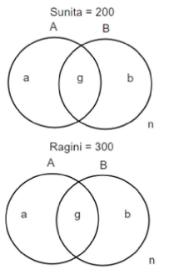
Given: There are a total of 500 students in the survey.
From statement (2),
the number of students who prefer Sunita (S) is 200. Hence, the number of students who prefer Ragini (R) is 500 - 200 = 300.
From statement (1),
A (Sunita) + A (Ragini) = 250 and B (Sunita) + B (Ragini) = 250.
From statement (2),
the number of students who prefer Sunita and support Proposal A (A(S)) is 80% of 200, which is 160.
=> A (Sunita) = 160.
=> A (Ragini) = 90.
From statement (4),
20% of the total 250 students who support Proposal B prefer Sunita
=> B (Sunita) = 20 % of 250 = 50.
=> B (Ragini) = 200.
From statement (6),
=> g (Sunita) = 50 and hence, b (Sunita) = 0 and a (Sunita) = 110.
=> n (Sunita) = 40.
From statement (7),
=> n (Ragini) = 60
Now, it is given that 250 students support the proposal B
=> Hence the other 250 students do not support proposal B.
From statement (5),
(a + n) of Ragini
= 40 % of 250
= 100.
Hence, a (Ragini) = 40.
Based on the above findings, the below Venn Diagram can be prepared:
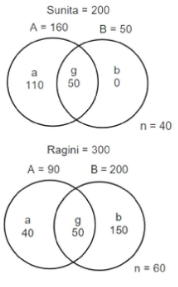
From the diagram, we can understand that option A is correct.
The students who supported proposal B but not A are b (Sunita) and b (Ragini).
Among them, those supported Ragini are b (Ragini) = 150.
Hence, the first option is correct.
Q-2) What percentage of the students surveyed who supported both proposals A and B preferred Sunita as student union president?
1) 40
2) 25
3) 20
4) 50
Solution
We can represent the preferences of students who like Sunita and Ragini as disjoint sets in a Venn diagram:
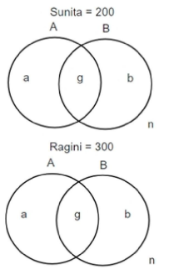
Given: There are a total of 500 students in the survey.
From statement (2),
the number of students who prefer Sunita (S) is 200. Hence, the number of students who prefer Ragini (R) is 500 - 200 = 300.
From statement (1),
A (Sunita) + A (Ragini) = 250 and B (Sunita) + B (Ragini) = 250.
From statement (2),
the number of students who prefer Sunita and support Proposal A (A(S)) is 80% of 200, which is 160.
=> A (Sunita) = 160.
=> A (Ragini) = 90.
From statement (4),
20% of the total 250 students who support Proposal B prefer Sunita
=> B (Sunita) = 20 % of 250 = 50.
=> B (Ragini) = 200.
From statement (6),
=> g (Sunita) = 50 and hence, b (Sunita) = 0 and a (Sunita) = 110.
=> n (Sunita) = 40.
From statement (7),
=> n (Ragini) = 60
Now, it is given that 250 students support the proposal B
=> Hence the other 250 students do not support proposal B.
From statement (5),
(a + n) of Ragini
= 40 % of 250
= 100.
Hence, a (Ragini) = 40.
Based on the above findings, the below Venn Diagram can be prepared:
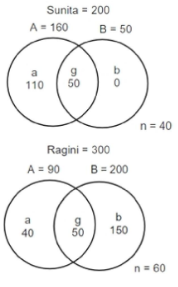
According to the Venn diagram,
the students surveyed who supported both proposals A and B preferred Sunita as the student union president
= 50/ (50 +50)%
= 50%
Hence, the fourth option is correct.
Q-3) What percentage of the students surveyed who did not support proposal A preferred Ragini as student union president?
1) 84
2) 83
3) 82
4) 85
Solution
We can represent the preferences of students who like Sunita and Ragini as disjoint sets in a Venn diagram:
Given: There are a total of 500 students in the survey.
From statement (2),
the number of students who prefer Sunita (S) is 200. Hence, the number of students who prefer Ragini (R) is 500 - 200 = 300.
From statement (1),
A (Sunita) + A (Ragini) = 250 and B (Sunita) + B (Ragini) = 250.
From statement (2),
the number of students who prefer Sunita and support Proposal A (A(S)) is 80% of 200, which is 160.
=> A (Sunita) = 160.
=> A (Ragini) = 90.
From statement (4),
20% of the total 250 students who support Proposal B prefer Sunita
=> B (Sunita) = 20 % of 250 = 50.
=> B (Ragini) = 200.
From statement (6),
=> g (Sunita) = 50 and hence, b (Sunita) = 0 and a (Sunita) = 110.
=> n (Sunita) = 40.
From statement (7),
=> n (Ragini) = 60
Now, it is given that 250 students support the proposal B
=> Hence the other 250 students do not support proposal B.
From statement (5),
(a + n) of Ragini
= 40 % of 250
= 100.
Hence, a (Ragini) = 40.
Based on the above findings, the below Venn Diagram can be prepared:
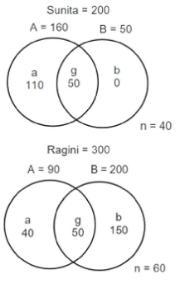
According to the Venn diagram,
The % of the students surveyed who did not support proposal A preferred Ragini as student union president
= 210/250
= 84%
Hence, the first option is correct.
Q-4) Among the students surveyed who supported proposal A, what percentage preferred Sunita for student union president?
1) 64
2) 63
3) 62
4) 61
Solution
We can represent the preferences of students who like Sunita and Ragini as disjoint sets in a Venn diagram:
Given: There are a total of 500 students in the survey.
From statement (2),
the number of students who prefer Sunita (S) is 200. Hence, the number of students who prefer Ragini (R) is 500 - 200 = 300.
From statement (1),
A (Sunita) + A (Ragini) = 250 and B (Sunita) + B (Ragini) = 250.
From statement (2),
the number of students who prefer Sunita and support Proposal A (A(S)) is 80% of 200, which is 160.
=> A (Sunita) = 160.
=> A (Ragini) = 90.
From statement (4),
20% of the total 250 students who support Proposal B prefer Sunita
=> B (Sunita) = 20 % of 250 = 50.
=> B (Ragini) = 200.
From statement (6),
=> g (Sunita) = 50 and hence, b (Sunita) = 0 and a (Sunita) = 110.
=> n (Sunita) = 40.
From statement (7),
=> n (Ragini) = 60
Now, it is given that 250 students support the proposal B
=> Hence the other 250 students do not support proposal B.
From statement (5),
(a + n) of Ragini
= 40 % of 250
= 100.
Hence, a (Ragini) = 40.
Based on the above findings, the below Venn Diagram can be prepared:
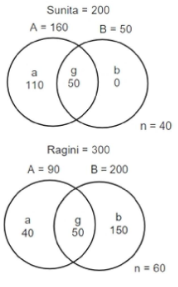
According to the Venn diagram,
Among the students who supported proposal A, the number of students who preferred Sunita
= 160
Therefore the % of these students is:
= 160 / (160 + 90)
= 160 / 250
= 64%
Hence, the first option is correct.
Binary Logic Reasoning Questions for CAT/ XAT/ MAT
Q-1) Directions: In an institute, there are three top rankers in a batch, Karthik, Waheeda, and Ritesh, not necessarily in the same order, who made the following statements about their ranks.
Karthik: (A) I am not the top ranker.
(B) Waheeda is not the second ranker.
(C) Ritesh is the third ranker.
Waheeda: (A) Karthik’s first statement is false.
(B) I am the third ranker.
(C) I made two false statements.
Ritesh: (A) Karthik is the first ranker.
(B) Waheeda is not the second ranker.
(C) I am the second ranker.
It is known that each of Karthik and Ritesh made only one false statement. Waheeda made only one true statement.
Q -1): Which statement of Karthik and Ritesh is True?
1) 1
2) 2
3) 3
4) None
Solution
It is given that Waheeda made only one true statement. It implies that she made two false statements.
⇒ Waheeda’s third statement is true and the other two are false.
⇒ Karthik’s first statement is true. (From Waheeda’s first statement) i.e. Karthik is not the top ranker.
⇒ Ritesh’s first statement is false and the other two are true.
⇒ Ritesh is the second ranker and Waheeda is not the second ranker. As Karthik is not the first ranker, Waheeda is the first ranker and Karthik is the third ranker.
⇒ Karthik’s second statement is true and the third one is false.
Therefore, statement 2 is true of Karthik and Ritesh. Hence, the second option is correct.
Q-2) Directions: In an institute, there are three top rankers in a batch, Karthik, Waheeda, and Ritesh, not necessarily in the same order, who made the following statements about their ranks.
Karthik: (A) I am not the top ranker.
(B) Waheeda is not the second ranker.
(C) Ritesh is the third ranker.
Waheeda: (A) Karthik’s first statement is false.
(B) I am the third ranker.
(C) I made two false statements.
Ritesh: (A) Karthik is the first ranker.
(B) Waheeda is not the second ranker.
(C) I am the second ranker.
It is known that each of Karthik and Ritesh made only one false statement. Waheeda made only one true statement.
Q-2) If Waheeda’s statements are not considered, which of the following represents the correct order of truth and false statements made by Ritesh so that the rank of all three will not alter?
1) True, False, True
2) True, True, False
3) False, True, True
4) Cannot be determined
Solution
It is given that Waheeda made only one true statement. It implies that She made two false statements.
⇒ Waheeda’s third statement is true and the other two are false.
⇒ Karthik’s first statement is true. (From Waheeda’s first statement) i.e. Karthik is not the top ranker.
⇒ Ritesh’s first statement is false and the other two are true.
⇒ Ritesh is the second ranker and Waheeda is not the second ranker. As Karthik is not the first ranker, Waheeda is the first ranker and Karthik is the third ranker.
⇒ Karthik’s second statement is true and the third one is false.
Therefore, the arrangement is as follows:
Waheeda > Ritesh > Karthik
If Waheeda’s statements are not considered, then the correct order of truth and false statements made by Ritesh are False, true, and true. Hence, the third option is correct.
Q-3) Directions: In an institute, there are three top rankers in a batch, Karthik, Waheeda, and Ritesh, not necessarily in the same order, who made the following statements about their ranks.
Karthik: (A) I am not the top ranker.
(B) Waheeda is not the second ranker.
(C) Ritesh is the third ranker.
Waheeda: (A) Karthik’s first statement is false.
(B) I am the third ranker.
(C) I made two false statements.
Ritesh: (A) Karthik is the first ranker.
(B) Waheeda is not the second ranker.
(C) I am the second ranker.
It is known that each of Karthik and Ritesh made only one false statement. Waheeda made only one true statement.
Q-3) Who is the third ranker?
1) Karthik
2) Waheeda
3) Ritesh
4) Cannot be determined
Solution
It is given that Waheeda made only one true statement. It implies that She made two false statements.
⇒ Waheeda’s third statement is true and the other two are false.
⇒ Karthik’s first statement is true. (From Waheeda’s first statement) i.e. Karthik is not the top ranker.
⇒ Ritesh’s first statement is false and the other two are true.
⇒ Ritesh is the second ranker and Waheeda is not the second ranker. As Karthik is not the first ranker, Waheeda is the first ranker and Karthik is the third ranker.
⇒ Karthik’s second statement is true and the third one is false.
Therefore, the arrangement is as follows:
Waheeda > Ritesh > Karthik
Therefore, Karthik is the third ranker. Hence, the first option is correct.
Best Books for Binary Logic Reasoning Preparation
Choosing the right study material is essential to master binary logic reasoning questions, especially those involving true/false conditions, assumptions, and logical constraints. Here is a well-structured table of the best books for binary logic and logical reasoning preparation:
| Book Name | Author | Key Features | Best For |
|---|---|---|---|
| Analytical Reasoning | M.K. Pandey | Strong focus on logical concepts, case-based reasoning, excellent for binary logic and puzzles | CAT, XAT, and advanced level exams |
| A Modern Approach to Verbal & Non-Verbal Reasoning | R.S. Aggarwal | Covers basic to moderate level reasoning, includes binary logic-type questions | Beginners and general competitive exams |
| Logical Reasoning and Data Interpretation for CAT | Nishit K. Sinha | Concept-driven approach, includes puzzles and condition-based reasoning | CAT and MBA entrance exams |
| How to Prepare for Logical Reasoning for CAT | Arun Sharma | Structured learning, topic-wise practice, high-level questions | CAT, XAT, and advanced learners |
| Logical and Analytical Reasoning | A.K. Gupta | Wide coverage of reasoning topics with practice sets | Beginners and intermediate learners |
| Puzzle and Reasoning Book | K.K. Verma | Focus on puzzle-based and condition-based reasoning including binary logic | SSC, Banking, and Railway exams |
These books are highly recommended for strengthening your preparation in binary logic reasoning, improving analytical thinking, and solving condition-based questions efficiently in competitive exams.
Non Verbal Reasoning Topics
This section walks you through the most important non-verbal reasoning concepts that boost pattern recognition and visual analysis skills. Think of it as a quick help to train your eyes to spot logic without relying on words.
About the Faculty
Tanu Gupta, with over a decade of experience as a reasoning faculty, specializes in preparing students for various entrance examinations and career development. Her extensive work with multiple educational platforms and institutions has honed her expertise in logical and analytical thinking. Her dedication to innovative teaching methods ensures these articles provide practical insights and expert guidance.
Frequently Asked Questions (FAQs)
Two types of questions are asked in exams. In type 1 each person stated 2 statements and in type 2 each person told true or false statements.
You can solve them by analyzing each statement carefully, identifying true/false conditions, and eliminating contradictions step by step.
The level of the binary logic questions has been seen as moderate to difficult in the examinations.
Binary logic questions are commonly asked in exams like CAT, XAT, CUET, SSC, banking exams, and other aptitude tests.
The best strategy is to consider all possible cases, eliminate contradictions, and use logical deduction to arrive at the correct answer.
Basically, binary logic method is the basics of the electronic system such as computers. It works on 0's and 1's. It includes mathematical operations such as addition, subtraction, multiplication and division of 0's and 1's. It also involves logic gate functions such as AND, OR and NOT.
