Think about being asked to follow a person’s movement—like walking 10 meters north, then turning right and moving 5 meters, and afterward turning left again. It sounds basic, but getting the final direction, or the shortest distance back to the starting point, needs careful mental work. Distance and direction problems actually test how well you can keep track of steps, notice which direction is where, and then calculate the final position, or the minimum distance. This is a familiar scoring part in SSC, Banking, Railways, CAT, XAT, and various other competitive exams too.
This Story also Contains
What is Distance and Direction Reasoning?
Types of Distance and Direction Reasoning Questions
Tips for tackling distance nd direction problems
Useful Books for Distance and Direction Reasoning
Verbal Reasoning Topics
Solved Examples of Distance and Directions
Direction Sense Questions PDF Download
Distance and Directions Questions for SRMJEE/ VITEEE
Distance and Directions Questions for TANCET/ JIPMAT
Distance and Directions Questions for CUET/ Bank Pre/ Insurance Pre exams
Distance and Directions Questions for SSC/ RRB exams
Step-by-Step Approach
Formula & Trick
Pythagoras Theorem for direction and distance
Non-Verbal Reasoning Topics
Distance and Direction: Definition, Reasoning Questions, Examples
What is Distance and Direction Reasoning?
Distance and direction reasoning is when you look at a set of movements, those turns, and the way someone is facing, so you can figure out where they end up, and which direction they are pointing at the end. Sometimes it feels a bit like following a path in your head, but with angles.
Basic directions are usually the starting point.
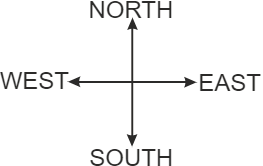
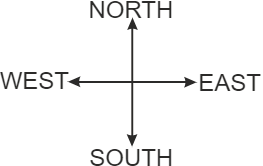
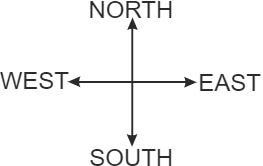
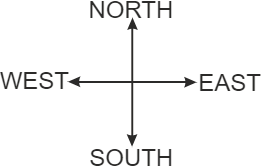
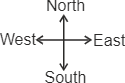
Primary ones are North, South, East, and West.
Then you also have the inter-cardinal directions, like North-East, North-West, South-East, and South-West.
Now for the turns, you typically see:
Left turn means 90° to the left.
Right turn means 90° to the right.
U-turn is a 180° reversal, the opposite direction, you can think of it as turning your back on where you were going.
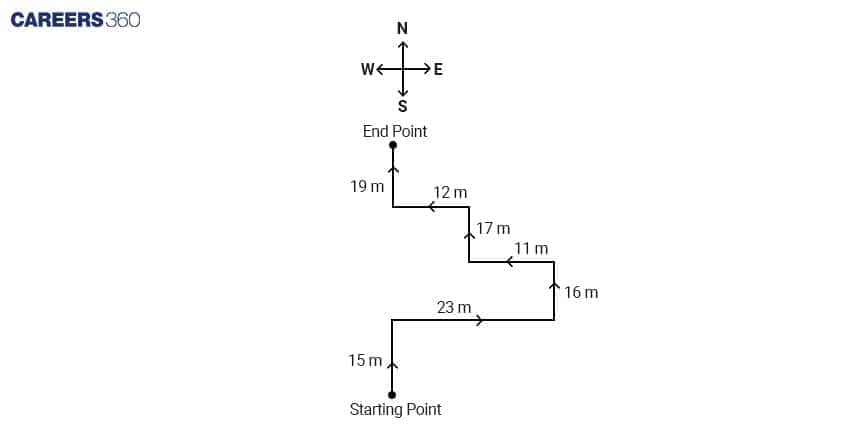
Example: Directions: Ratan walks 15 m towards the north and then turns right and walks 23 m. Then, he turns left and walks 16 m. After that, he turns left and walks 11 m. Then, he turns right and walks 17 m. Then, he turns left and walks 12 m. He finally turns right and walks 19 m. In which direction and how far is he now with reference to the starting point?
1) South, 51 m
2) North, 52 m
3) North, 48 m
4) North, 67 m
Solution: Firstly, we will draw the diagram as per the given instructions –
From the above diagram, it is clear that Ratan is in the North direction from his starting point.
Ratan's distance between the starting point and the endpoint = 15 + 16 + 17 + 19 = 67 m
Thus, Ratan is towards the North direction and 67 m away from the starting point. Hence, the fourth option is correct.
Types of Distance and Direction Reasoning Questions
Passage Based
Angle Based
Shadow Based
Let’s understand each type in detail -
1) Passage-Based Distance and Direction Reasoning Questions
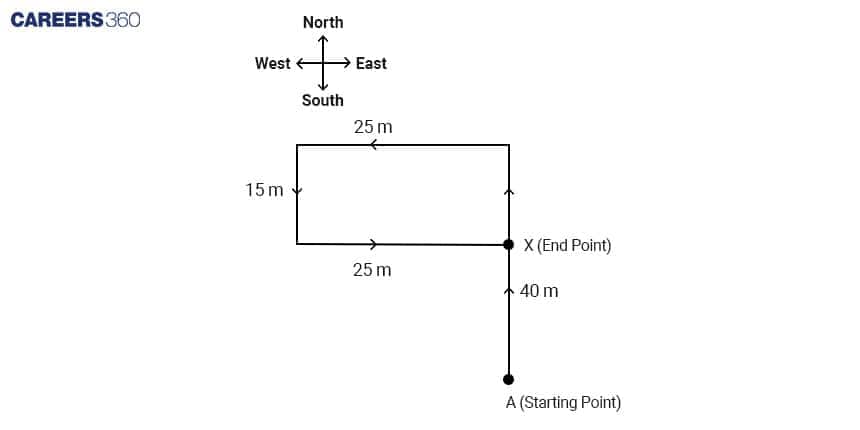
Example: Directions: Kartik walks 40 m straight from his home towards the North. Then, he turns left and walks 25 m. He turns left again and walks 15 m. Finally, he turns left and walks 25 m to reach Point X. What is the shortest distance between his home and Point X?
1) 22 m
2) 25 m
3) 15 m
4) 55 m
Solution:
Firstly, we will draw the diagram as per the given instructions –
Point A is the starting point and X is the endpoint, so the distance between them is XA.
XA = 40 – 15 = 25
So, the shortest distance between Kartik's home and point X is 25 m. Hence, the second option is correct.
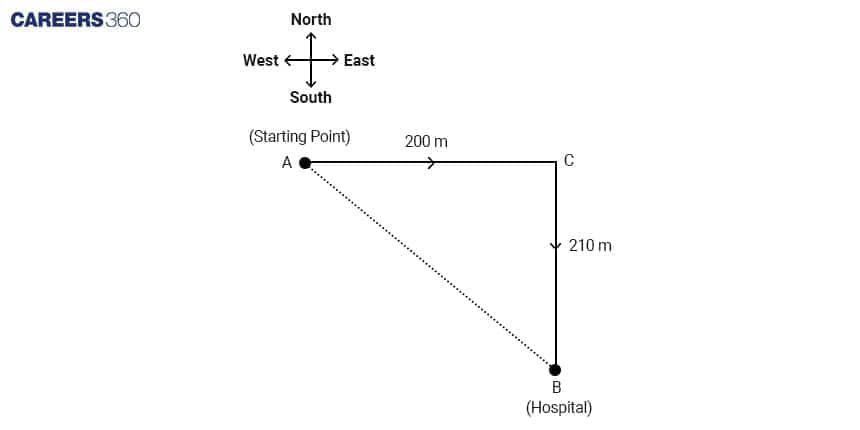
Example: Directions: Bismita walks 200 m towards the East and then turns right and walks 210 m to reach a hospital. What is the shortest distance between the starting point and the hospital?
1) 310 m
2) 290 m
3) 220 m
4) 260 m
Solution:
Firstly, we will draw the diagram as per the given instructions –
Here, A is the starting point and B is the endpoint.
For the shortest distance (AB) between the starting point and the endpoint,
So, the shortest distance between Bismita's starting point and the hospital is 290 m. Hence, the second option is correct.
2) Angle-Based Distance and Direction Reasoning Questions
In this question, the information is usually given in the angle way, like one has turned 90͒ / 45͒, and so on. Let’s, uh, understand it with an example-
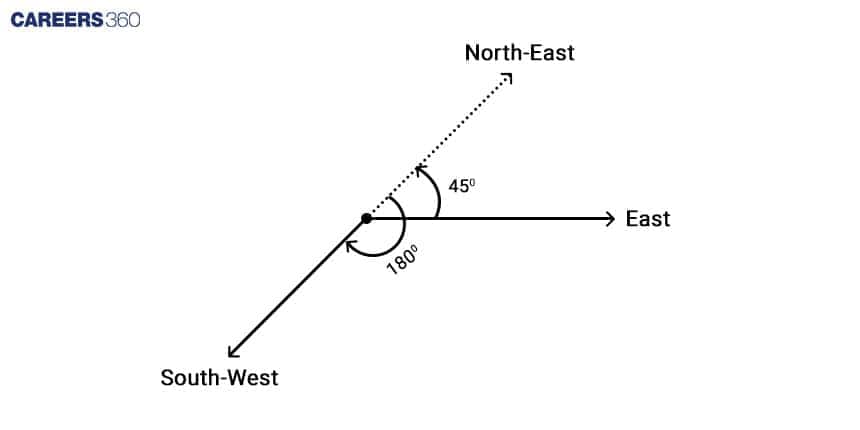
Example: Directions: A girl is standing facing towards the east. She turns 45 degrees in the anticlockwise direction and then turns 180 degrees in the clockwise direction. Which direction is she facing now?
1) West 2) South 3) North 4) South-West
Solution:
As per the given information, the direction the girl will look is as follows –
Therefore, the girl is facing towards the southwest direction. Hence, the fourth option is correct.
3) Shadow-Based Distance and Direction Reasoning Questions
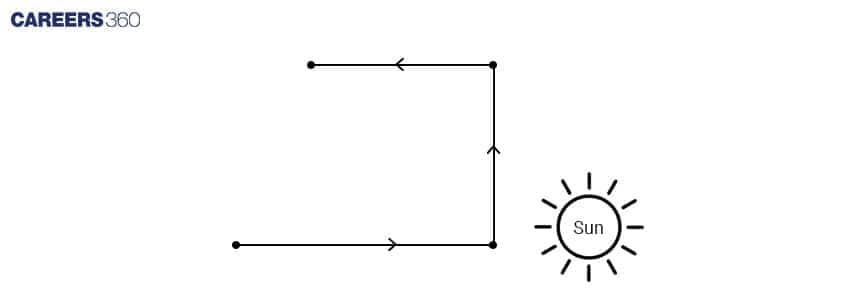
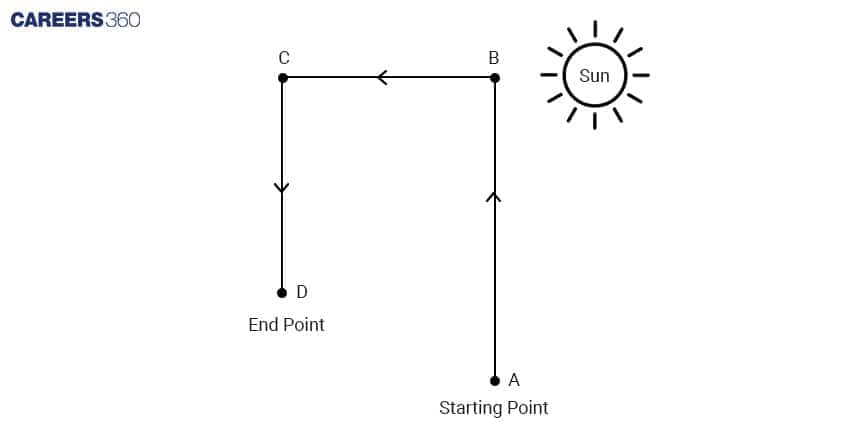
In shadow based direction questions, you have to remember that a shadow always lands on the opposite side of the Sun, like its sort of directly away from where the light is coming from. So, in the morning the shadow points to the west, then in the evening it shifts toward the east, and around noon 12 PM, it can be very small or even absent.
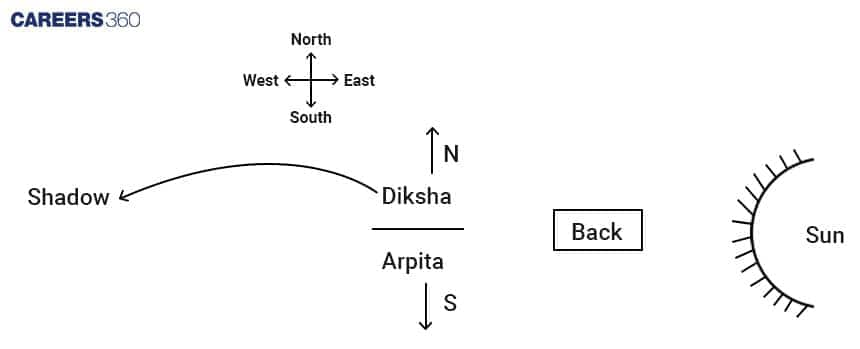
Example: Directions: At the time of sunrise, Diksha and Arpita are sitting in a park with their backs facing each other. If the shadow of Diksha falls to the right of Arpita, then in which direction is Arpita facing?
1) North
2) East
3) West
4) South
Solution:
Given: At the time of sunrise, Diksha and Arpita are sitting in a park with their backs facing each other.
At the time of Sunrise, the Sun is in the east direction, and the shadow will be in the west direction. So, it is given that the shadow is on the right side of Arpita. Therefore, Arpita will face towards the South direction.
Hence, the fourth option is correct.
Tips for tackling distance nd direction problems
First, get comfy with directions, like the four main ones N S E W and also the “half” directions NE, NW, SE, SW. Try to see them in your head, not just recite them. Also, turns matter: a right turn is clockwise, while a left turn goes anticlockwise.
When numbers show up, don’t ignore the Pythagorean theorem, it can find the shortest distance between where you begin and where you end, especially when a diagonal path is involved. It’s the quick route in disguise, or at least that’s how it feels.
One more habit to remember, the NESW order: start at North then go to East, next South then West, moving clockwise, unless the question says “wait, no” or something changes it.
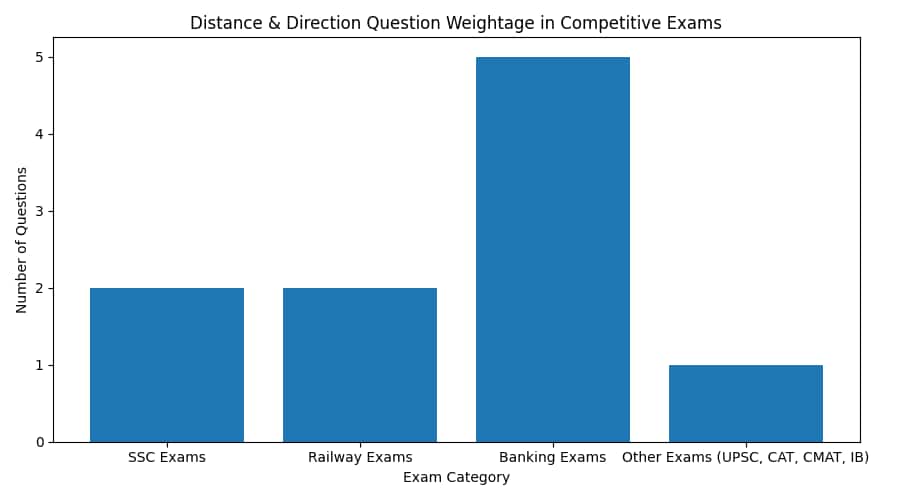
Question Weightage of Distance and Direction Reasoning Questions in Competitive Exams
The number of Direction and Distance questions varies from exam to exam:
This section gives out a few of the most solid books for learning distance and direction reasoning, with the whole idea, you know, of covering the fundamentals, some solved specimens, and then practice questions too for competitive exams.
Book Title
Author
How It Helps in Distance and Direction Reasoning
A Modern Approach to Verbal & Non-Verbal Reasoning
R.S. Aggarwal
Covers fundamental concepts and includes practice questions for distance and direction reasoning problems.
Analytical Reasoning
M.K. Pandey
Helps develop logical thinking and direction sense skills with structured reasoning exercises.
A New Approach to Reasoning (Verbal, Non-Verbal & Analytical)
B.S. Sijwali & Indu Sijwali
Provides detailed explanations and examples for direction sense and movement-based reasoning questions.
How to Prepare for Logical Reasoning for CAT
Arun Sharma
Offers advanced strategies and practice sets useful for complex distance and direction questions.
Logical Reasoning and Data Interpretation for CAT
Nishit K. Sinha
Includes structured practice and concepts to improve analytical reasoning and direction sense problem-solving ability.
Verbal Reasoning Topics
Explore the key verbal reasoning topics that are commonly asked in CAT, SSC, RRB, IBPS, Banking, and other competitive exams, so you can build up strong reasoning skills. This can help with your overall preparation too, because the questions tend to lean on similar things again and again.
According to the different types, the practice questions for direction and distance are as follows -
1. Passage-based distance and direction questions
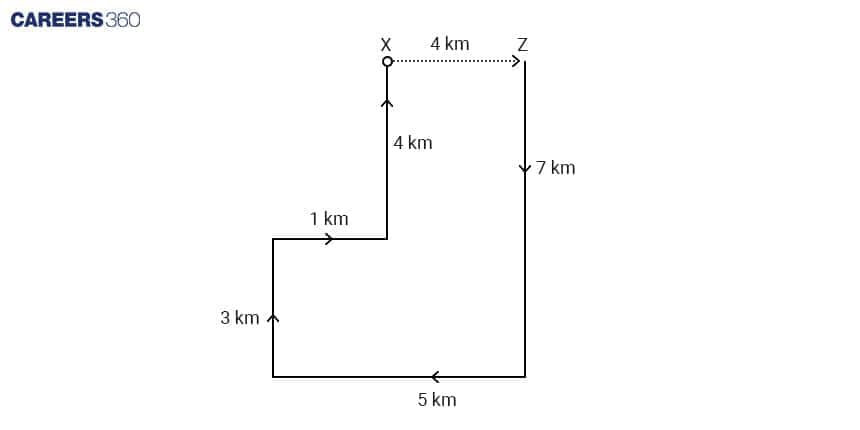
1. Directions: A person starts from point Z and moves 7 km towards the South. He turns right and moves 5 km, turns right and moves 3 km, then turns right and moves 1 km. He takes a left turn and moves 4 km to reach point X. How much and in which direction does he need to move now to reach point Z?
1) 4 km South
2) 4 km East
3) 4 km West
4) 6 km East
Solution:
Firstly, we will draw the diagram as per the given instructions –
Now, we have to find the direction and distance to reach the point Z.
From the above diagram, the Z point is in the east direction and at a distance of (5 – 1) = 4km from point X. Hence, the second option is correct.
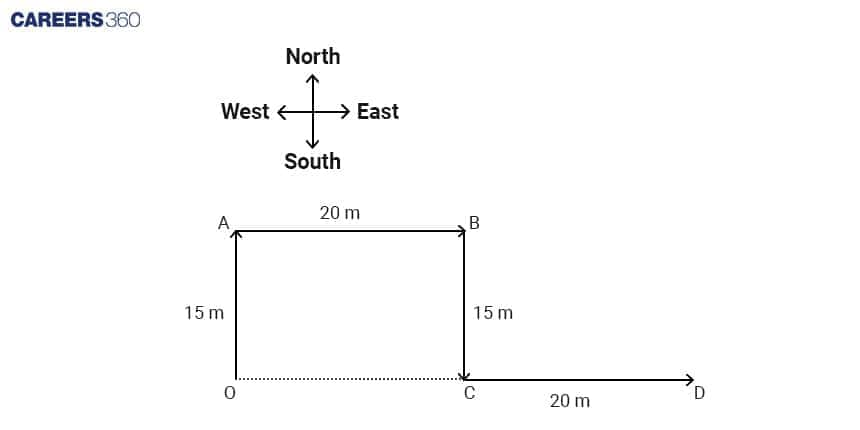
2. Directions: A boy walks 15 m north, turns right, and walks 20 m. Again, he turns right and walks 15 m. Finally, he turns to his left and moves 20 m. What is the distance now from his original position?
1) 40 m 2) 46 m 3) 50 m 4) 45 m
Solution:
According to the instructions given, the diagram is as follows –
Here, O is the starting point and D is the finishing point, and OD is the total distance from the starting point.
OA = 15m; AB = 20m; BC = 15m; CD = 20m
And, OD = 20 + 20 = 40m
So, the distance now from his original position is 40m. Hence, the first option is correct.
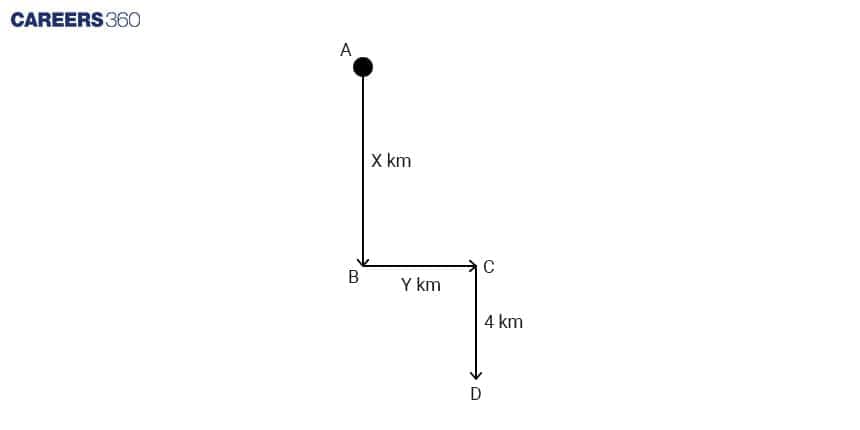
3. Directions: Manoj starts from point A and drives X km towards the south and then turns left and drives Y km. He then takes a right turn and drives for 4 km to reach point D. If Manoj drove a total of 17 km between Points A and D, and both X and Y are perfect squares where X > Y, then what is the value of X?
1) 4 km
2) 11 km
3) 5 km
4) 9 km
Solution:
According to the instructions given, the diagram is as follows –
Now, we have to find the values of X and Y.
Here, A is the starting point and D is the finishing point.
AB = X km; BC = Y km; CD = 4 km
And, the total distance between Points A and D is 17 km.
⇒ AD = AB + BC + CD
⇒ 17 = X + Y + 4
⇒ 17 – 4 = X + Y
⇒ 13 = X + Y
It is given that both X and Y are perfect squares where X > Y, so X = 9 km and Y = 4 km.
So, the value of X is 9 km. Hence, the fourth option is correct.
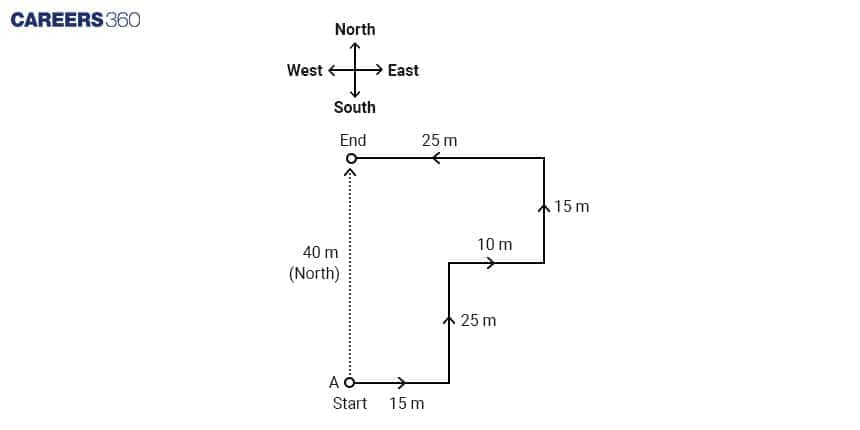
4. Directions: Starting from point A, an animal walked 15 m towards the East. It took a left turn and walked 25 m. Then, it took a right turn and walked 10 m. Again it took a left turn and walked 15 m. Finally, it took a left turn and walked 25 m. How far and in which direction is the animal now from the starting point A?
1) 25 m, East
2) 40 m, South
3) 40 m, North
4) 25 m, West
Solution:
Firstly, we will draw the diagram as per the given instructions –
From the above diagram, the endpoint is in the north direction from the starting point and at a distance of 40 m. Hence, the fourth option is correct.
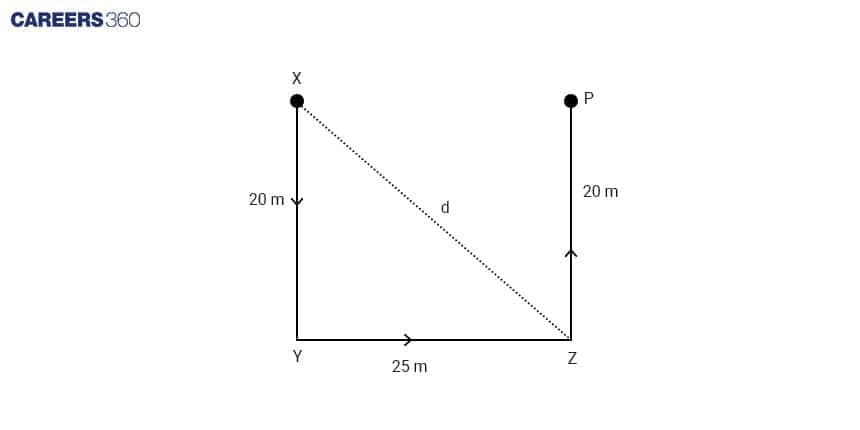
5. Directions: Starting from point X, a person walked 20 m towards the South to reach point Y. From there, he took a left turn and walked 25 m to reach point Z. He then took a left turn and walked for another 20 m to reach point P. What is the approximate shortest distance between the points X and Z and in which direction is the person's final position with respect to point X?
1) 50 m, South East
2) 36 m, South East
3) 32 m, East
4) 46 m, North West
Solution:
Firstly, we will draw the diagram as per the given instructions –
Now, we have to find the approximate shortest distance between points X and Z and in which direction is the person's final position with respect to point X.
Here, X is the starting point, Z is the endpoint, and the shortest distance between points X and Z = d
Using Pythagoras' theorem, we have
⇒ $(d)^2 = (20)^2 + (25)^2$
⇒ $(d)^2 = 400 + 625$
⇒ $(d)2 = 1025$
⇒ $d = 32.01 ~ 32$
From the above diagram, the endpoint (P) is in the east direction from the starting point (X), and the shortest distance between points X and Z is 32m. Hence, the fourth option is correct.
2. Angle-based distance and direction questions
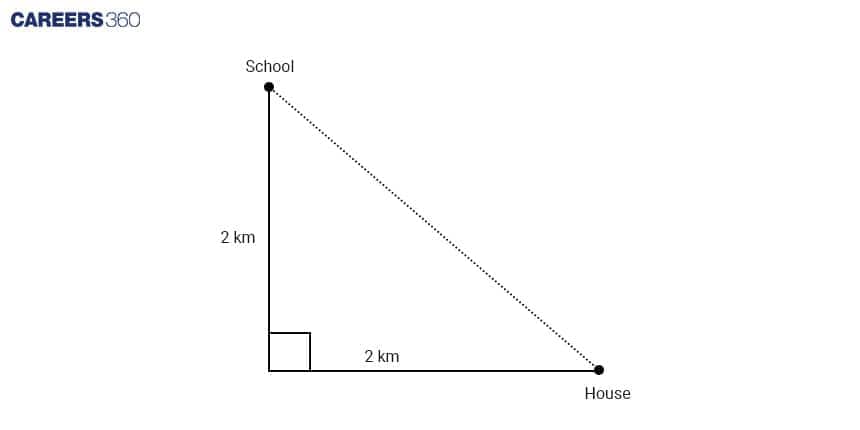
1. Directions: Joseph starts for his school from his house. He first goes 2 km towards the west and then turns 90° clockwise and goes further 2 km to reach his school. In which direction is his house from his school?
1) Southeast
2) South
3) Northwest
4) North
Solution:
Firstly, we will draw the diagram as per the given instructions –
Now, we have to find the direction of the school with respect to the house.
Therefore, the house is in the southeast direction with respect to the school. Hence, the first option is correct.
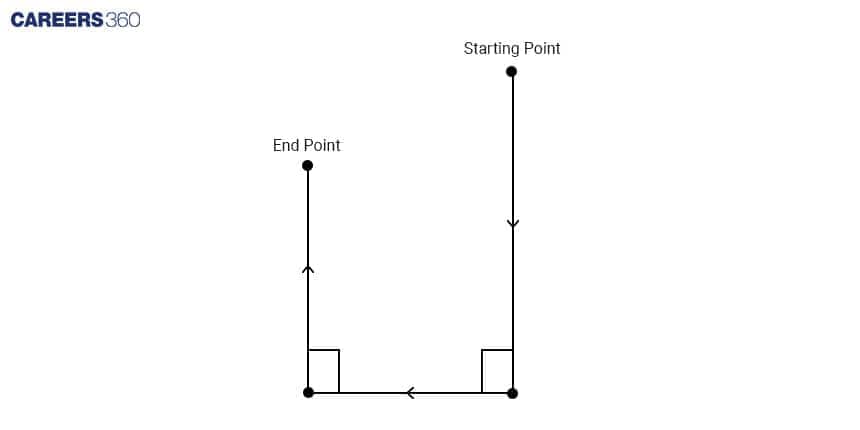
2. Directions: P started walking from north to south. She turned right at a right angle and then again right at a right angle. In which direction was she ultimately walking?
1) North
2) East
3) South
4) West
Solution:
Firstly, we will draw the direction and distance diagram according to the instructions –
Now, we have to find the direction in which P is moving.
So, P was facing in the north direction. Hence, the first option is correct.
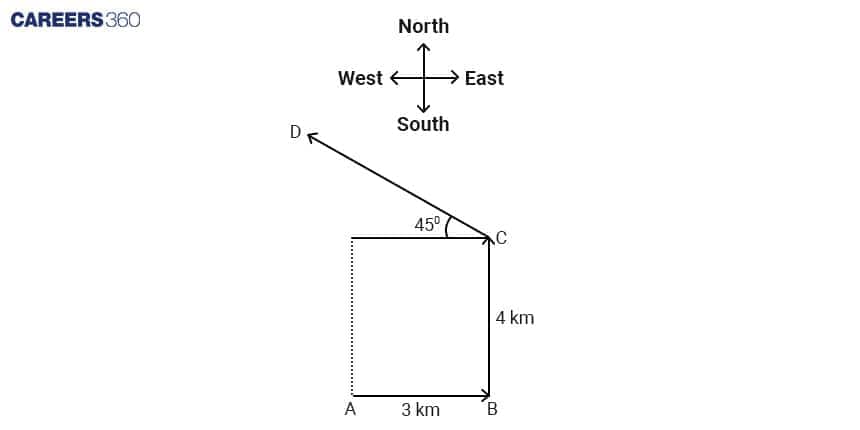
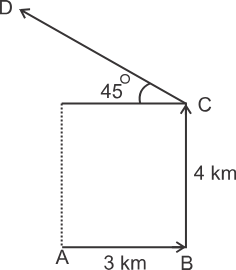
3. Directions: Starting from a point, a person travels 3 km towards the east and turns left and travels 4 km. Then again he turns to the left by 45° and moves straight. Which direction is he facing now?
1) North-East
2) North-West
3)South-East
4)South-West
Solution:
Firstly, we will draw the diagram as per the given instructions –
Here, A is the starting point and D is the endpoint.
So, the person is facing in the northwest direction. Hence, the second option is correct.
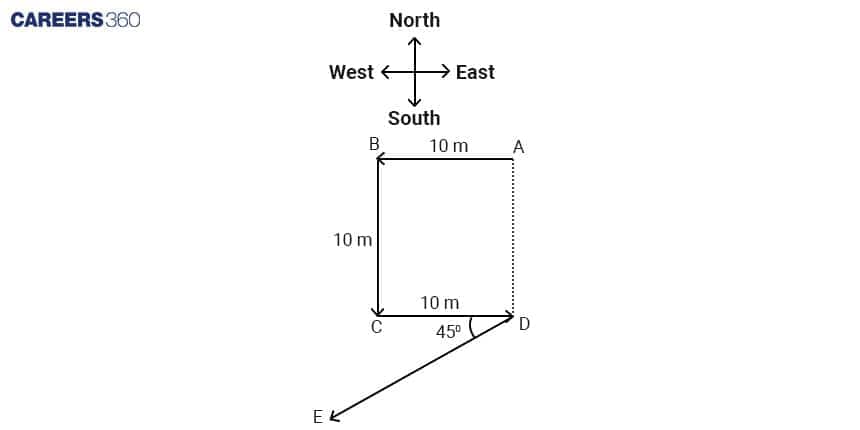
4. Directions: Vijay walks 10 metres westward, then turns left and walks 10 metres. He then again turns left and walks 10 metres. He takes a 45° turn rightwards and walks straight. In which direction is he walking now?
1) South
2) West
3) South-East
4) South-West
Solution:
Firstly, we will draw the diagram as per the given instructions –
Here, A is the starting point and E is the endpoint.
So, Vijay is walking in the southwest direction. Hence, the fourth option is correct.
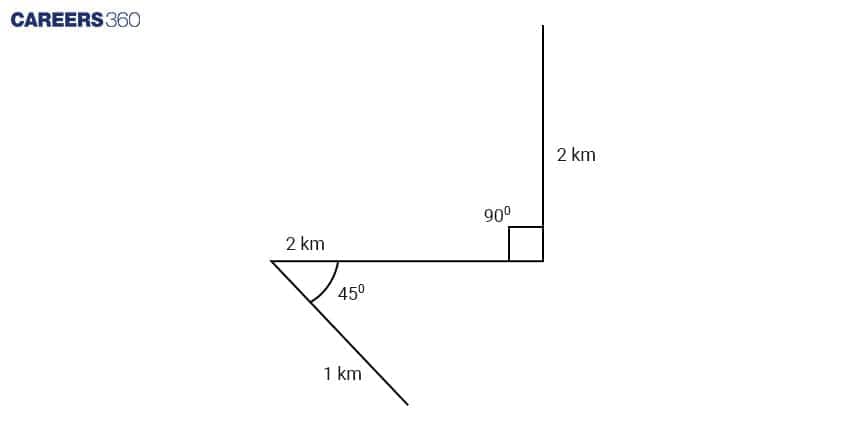
5. Directions: Karan, facing south, moved straight 2 km and from there turned to his right 90° and travelled 2 km. Then he took a 45° turn to his left and travelled 1 km. Where would he be now concerning the starting point?
1) South Region
2) South-East Region
3) North-West Region
4) South-West Region
Solution:
Firstly, we will draw the diagram as per the given instructions –
Now we have to find the direction of Karan concerning the starting point.
So, Karan is in the South-West region concerning the starting point. Hence, the fourth option is correct.
3. Shadow-Based Distance and Direction Questions
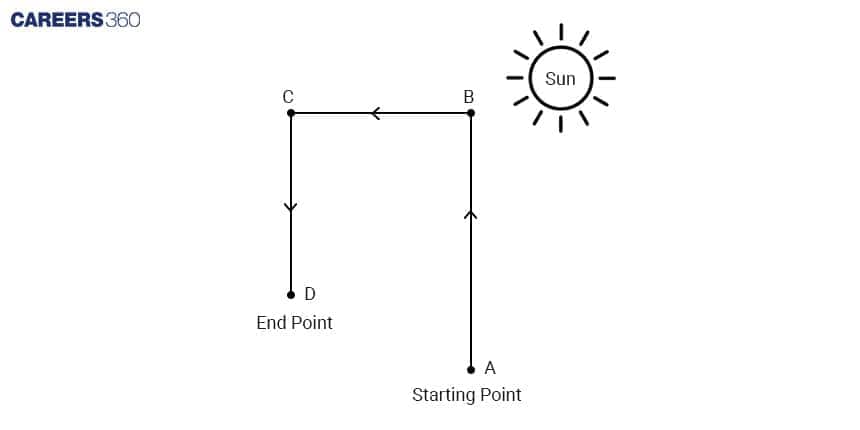
1. Directions: John, in the morning, started walking towards the north and then turned towards the opposite side of the sun. He then turns left again and stops. Which direction is he facing now?
1) North
2) West
3) South
4) East
Solution:
Firstly, we will draw the diagram as per the given instructions –
After walking towards the north direction, John turns toward the left direction (As the sun rises in the east direction and the opposite side of the east is west direction.)
So, John is facing towards the south direction. Hence, the third option is correct.
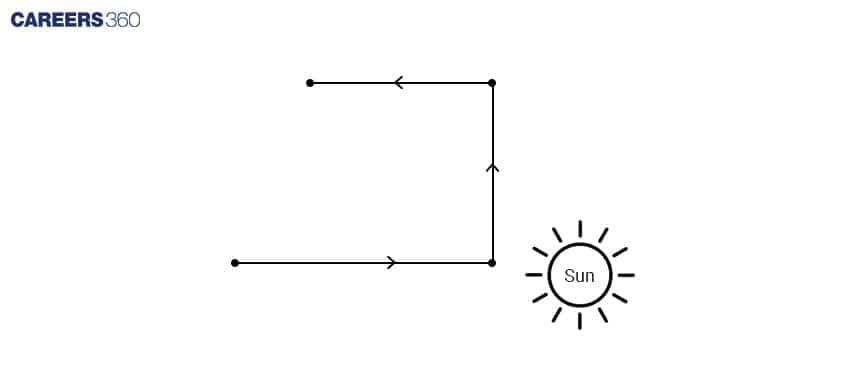
2. Directions: One morning, Raju walked towards the sun. After some time, he turned left and again to his left. Which direction is he facing?
1) North
2) South
3) East
4) West
Solution:
Given: One morning, Raju walked towards the sun, i.e., he walked towards the east direction. (Because in the morning, the Sun is in the east direction.)
Firstly, we will draw the diagram as per the given instructions –
Now, we have to find which direction Raju is facing.
So, Raju is facing towards the west direction. Hence, the fourth option is correct.
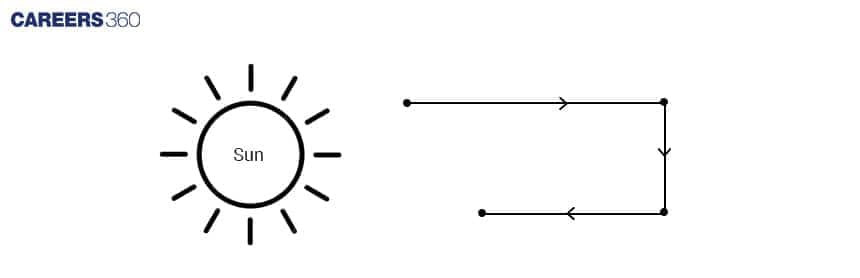
3. Directions: Shama, during the time of sunset, started walking towards the opposite side of the sun and then she turned right and right again. What direction is she facing?
1) South
2) West
3) East
4) North
Solution:
Firstly, we will draw the direction and distance diagram according to the instructions given in the question
Shama started walking towards the opposite direction of the sun during sunset, i.e., she was walking in the East direction (because during sunset, the sun is in the west direction).
So, Shama is facing the west direction. Hence, the second option is correct.
4. Directions: One morning, Raju walked towards the sun. After some time, he turned left and again to his left. Which direction is he facing?
1) North
2) South
3) East
4) West
Solution:
Given: One morning, Raju walked towards the sun, i.e., he walked towards the east direction. (Because in the morning, the Sun is in the east direction.)
Firstly, we will draw the diagram as per the given instructions –
Now, we have to find which direction Raju is facing.
So, Raju is facing towards the west direction. Hence, the fourth option is correct.
5. Directions: John, in the morning, started walking towards the north and then turned towards the opposite side of the sun. He then turns left again and stops. Which direction is he facing now?
1) North
2) West
3) South
4) East
Solution:
Firstly, we will draw the diagram as per the given instructions –
After walking towards the north direction, John turns toward the left direction (As the sun rises in the east direction and the opposite side of the east is the West direction.)
So, John is facing towards the south direction. Hence, the third option is correct.
Direction Sense Questions PDF Download
For more practice, you should try the online distance and direction mock test, and download the distance and direction reasoning questions PDF e-book below.
Distance and Directions Questions for SRMJEE/ VITEEE
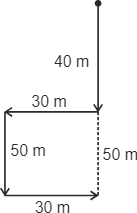
Q-1) Directions: Kritika walks 40 m towards the south. Then, turning to her right, she rides 30 m. Then, turning to her left, she rides 50 m. Again, she turns to her left and rides 30 m. How far (in m) is she from her initial position?
1) 65 m
2) 70 m
3) 80 m
4) 90 m
Solution:
Firstly, we will draw the diagram as per the given instructions –
Now, we have to find the distance between the starting and end points –
Therefore, the distance between Kritika's final point and starting point = 40 + 50 = 90 m. Hence, the fourth option is correct.
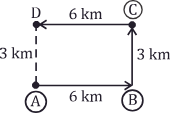
Q-2) Directions: Kishore starts from a point and walks 6 km towards the east, and turning to his left, he moves 3 km. After this, he again turns to his left and moves 6 km. Now, how far is he from his starting point?
1) 3 km
2) 2 km
3) 4 km
4) 5 km
Solution:
Firstly, we will draw the diagram as per the given instructions –
Now, we have to find the distance between the starting and endpoints.
In the figure, A is the starting point and D is the finishing point. So, AD is the distance from the starting point.
Here, AB = CD = 6 km
And, AD = BC = 3 km
So, the distance from the starting point is 3 km. Hence, the first option is correct.
Distance and Directions Questions for TANCET/ JIPMAT
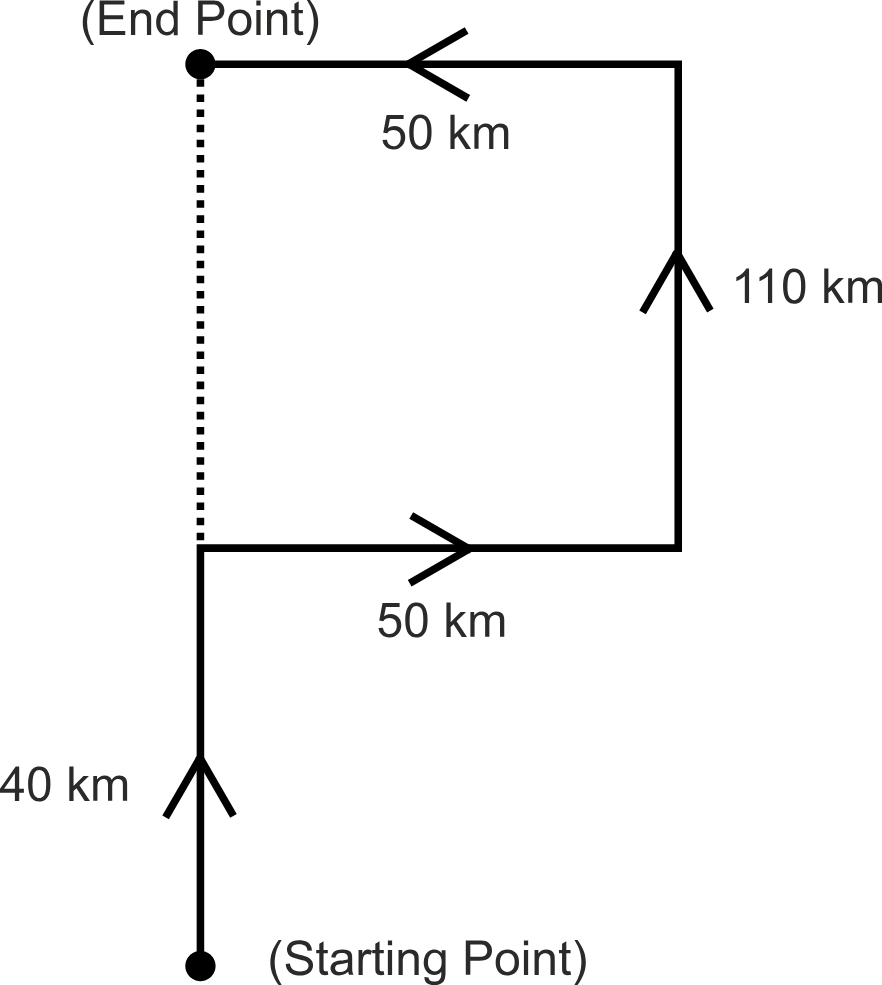
Q-1) Directions: A migrating bird flies 40 km north, then turns east and flies 50 km, then turns north and flies 110 km, and then turns to its left and flies 50 km. Where is it now with reference to its starting position?
1) 150 km south
2) 150 km north
3) 70 km north
4) 70 km south
Solution:
As per the given information, the movement of the bird will look as follows –
The distance between the migrating bird's starting point and end point = 40 + 110 = 150 km
The distance between the migrating bird's starting and end points is 150 km, and the migrating bird is in the north direction with respect to its starting position. Hence, the second option is correct.
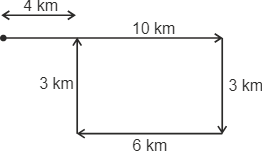
Q-2) Directions: A paperboy cycles 10 km east, then turns south and cycles 3 km, then turns west and cycles 6 km, then turns to his right and cycles 3 km. Where is he now with reference to his starting position?
1) 4 km west
2) 14 km east
3) 4 km east
4) 14 km west
Solution:
Firstly, we will draw the diagram as per the given instructions –
Now, we have to find the distance and the final position with respect to the starting position –
The distance between starting position and end point = 10 – 6 = 4 km
Therefore, the paperboy is in the East direction with respect to his starting position and the distance between his starting point and final point is 4 km. Hence, the third option is correct.
Distance and Directions Questions for CUET/ Bank Pre/ Insurance Pre exams
Q-1) Directions: A man starts from a point, walks 5 km towards the east, turns right and walks 3 km, turns right again and walks. What is the direction he is facing? 1) North
2) South
3) West
4) South-West
Solution:
Firstly, we will draw the diagram as per the given instructions –
Here, A is the starting point and D is the endpoint.
So, the man is facing in west direction. Hence, the third option is correct.
Q-2)Directions: If the South-East is changed to North and North-East to West and so on, then what will come in place of South?
1) South-West
2) North-East
3) South-East
4) North-West
Solution:
From the given information, South-East means North, and North-East means West.
We can see that, to determine the directions need to move 3rd steps in a clockwise direction.
So, South means northeast direction. Hence, the second option is correct.
Distance and Directions Questions for SSC/ RRB exams
Q-1) Directions: Starting from a point, a person travels 3 km towards the east and turns left and travels 4 km. Then again he turns to the left by 45° and moves straight. Which direction is he facing now?
1) North-East
2) North-West
3) South-East
4) South-West
Solution:
Firstly, we will draw the diagram as per the given instructions –
Here, A is the starting point and D is the endpoint.
So, the person is facing in the northwest direction. Hence, the second option is correct.
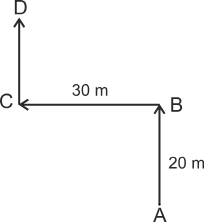
Q-2) Directions: Rajneesh started walking towards the north. He took a left turn after walking 20 metres. He again took a right turn after walking 30 metres. Which direction is he facing now?
1) North
2) East
3) West
4) South
Solution:
Firstly, we will draw the diagram as per the given instructions –
Here, A is the starting point and D is the endpoint.
So, Rajneesh is facing in the north direction. Hence, the first option is correct.
Step-by-Step Approach
First thing, figure out which way you begin, like north south east west, or whatever direction the question gives. Then track each movement as it happens, step by step, don’t just jump to the end. You write it down as you go, or at least keep a mental note of the changing sides. After that, draw a quick, simple diagram, just a line with turns, so the path doesn’t feel so abstract . Use arrows for the motion, and mark the corners, even if it looks a bit messy.
Then decide the final direction by looking at where you end up after all the turns. If the question asks for the shortest distance, you calculate that too, usually by breaking the route into a right angle shape.
Formula & Trick
Use the Pythagorean theorem to get the shortest distance when the movement forms something like a right-angled triangle .
But in many reasoning problems, speed and time aren’t given. So you switch strategies, and you count movements in steps, units, or blocks to get the total distance. For shortest path questions where the turns are right angles :
When you’re solving direction and distance questions with answers, you can save time with these little tricks:
Situation
Tip
Formula/Approach
Movement in the same straight line
Add distances
$D = D_1 + D_2$
Movement in opposite directions
Subtract distances
$D = D_1-D_2$
Movement at right angles
Apply Pythagoras
$D = \sqrt{D_x^2 + D_y^2}$
Movement forming a rectangle
Use diagonal as shortest path
$D = \sqrt{\text{Length}^2 + \text{Width}^2}$
Tip: Always draw a little diagram when you’re solving. It helps you see the turn(s) and avoid errors in direction reasoning, like what goes where.
Pythagoras Theorem for direction and distance
In logical reasoning, direction and distance questions the Pythagoras theorem is your best friend, for shortest path calculations, especially when your movements form a right angled triangle, or something that becomes one after you reshape the scenario.
This method is useful when the questions get complex, like direction and distance reasoning ones, and the answers matter,where you want something fast, accurate, but not that long-winded step by step thing adding distances, again and again.
Non-Verbal Reasoning Topics
Non verbal reasoning is your ability to tackle problems using figures, patterns, and diagrams, so you’re not depending on plain text. If you want to boost your speed and correctness for competitive exams, just focus on the topics below, and keep moving.
Q: What is the weightage of the direction and distance topic?
A:
Direction and distance questions asked in SSC exams i.e. SSC MTS, SSC CGL, SSC CHSL, SSC CPO, Steno - 1 to 2 questions.In the Defence and Railways exams i.e. Group D, NTPC, JE, ALP etc - 1 to 2 questions. In Banking exams - 1 to 5 questions. Sometimes questions based on analogy can be seen in UPSC and IB exams.
Q: What are distance and direction reasoning questions?
A:
Distance and direction reasoning questions test your ability to track movement, understand directions, and determine final position or distance. These are common in the logical reasoning section of competitive exams.
Q: What are the types of direction and distance in reasoning?
A:
There are some types of direction and distance such as turn and rotation-based, distance and displacement-based, shadow-based, coded, puzzle and angle-based.
Q: What is the level of questions asked from the distance and direction topic?
A:
The level of the questions of the direction and distance has been seen as easy to moderate in the examinations.
Q: How to find distance and direction?
A:
To find distance and direction questions first of all you should be aware of the directions as north, south, east and west. You should solve the distance and direction question by the diagram and after that using the distance and direction formula such as the pythagorean theorem or by simply finding the shortest or longest distance between the given points.
Q: How do you solve direction sense questions quickly?
A:
To solve direction sense questions quickly, carefully follow each movement, note all left/right turns, and use a simple diagram to track direction changes. This helps avoid confusion and improves accuracy.
Q: What are the basic directions used in reasoning?
A:
The basic directions in direction sense reasoning are North, South, East, and West, along with sub-directions like North-East, North-West, South-East, and South-West.