Imagine you are given a sequence like 3, 6, 12, 24, ? and asked to find the missing number. At first, it may seem tricky, but once you identify the pattern, the answer becomes obvious. This type of problem is known as a number series reasoning question, where numbers follow a specific logical pattern. Number series questions are commonly asked in the logical reasoning sections of competitive exams such as banking exams, SSC, railways, and various aptitude tests. These questions evaluate a candidate’s ability to identify patterns, apply logical thinking, and solve problems quickly. By learning the right number series tricks, methods, and practice techniques, candidates can solve these questions faster and improve their accuracy. In this article, we will explore important number series tricks, solved number series reasoning questions, common patterns, and useful examples to help you master number series problems for competitive exams.reasoni
This Story also Contains
What is Number Series Reasoning?
Types of Number Series in Reasoning
How to Solve Number Series Questions Quickly in Reasoning
Smart Tricks to Solve Number Series Reasoning Questions
Solve Number Series Questions in Seconds | Logical Reasoning Short Tricks
Solved Number Series Questions of Each Type
Question-wise Weightage of Number Series in Competitive Exams
Common Mistakes in Number Series Reasoning Questions
Number Series Reasoning Questions for Practice
Wrong Number Series Reasoning Questions for Practice
Verbal Reasoning Topics
Number Series Questions for Bank Exams
Number Series Questions for Competitive Exams and Entrance Exams
Number Series Questions for VITEEE Exam
Useful Books for Number Series and Logical Reasoning
Non-Verbal Reasoning Topics
Number Series
What is Number Series Reasoning?
Number series reasoning involves arranging numbers in a specific sequence based on a hidden pattern. In missing number series, candidates must identify the missing term, while in wrong number series, they need to spot the incorrect term. Solving these requires recognizing arithmetic, geometric, or other logical progressions. Since each question can follow a unique rule, strong observation and reasoning skills are essential. For better practice, number series reasoning is classified into different types commonly asked in competitive exams.
Types of Number Series in Reasoning
There are many types of number series which are discussed below:
Increasing/ Addition number series: In this type of number series, numbers based on a specific pattern are added to get the next number. The added numbers can be consecutive even numbers, odd numbers, squares, cubes or multiples of any number, depending on the series.
Decreasing/ Subtraction number series: In this type of number series, numbers based on a specific pattern are subtracted to get the next number. The subtracted numbers can be consecutive even numbers, odd numbers, squares, cubes or multiples of any number depending on the series.
Multiplication number series: In this type of number series, numbers based on a specific pattern are multiplied to get the next number. The multiplied numbers can be consecutive natural numbers, even numbers, odd numbers or multiples of a particular number depending on the series.
Division Number Series: In this type of number series, numbers based on a specific pattern are divided to get the next number. The number divided by the numbers in the series can be consecutive natural numbers, even numbers, odd numbers or a particular number depending on the series.
Square Number Series: In this type of number series, perfect squares are given and candidates need to find the missing square. The squares of the numbers which are given can be squares of consecutive numbers, even numbers, odd numbers etc.
Cube Number Series: In this type of number series, perfect cubes are given and candidates need to find the missing square. The cubes of the numbers which are given can be squares of consecutive numbers, even numbers, odd numbers etc.
Ascending/ Descending Number Series: In this type of number series, candidates are required to rearrange the numbers to find out the required number.
Mixed Number Series: In this type of number series, multiple mathematical operators such as addition, subtraction, multiplication and division are implemented to get the next number in the series.
Alternating Number Series: In this type of number series, several number patterns are used alternatively to form a series.
Wrong Number Series: In this type of number series, only one number doesn’t follow the same pattern as followed by the other numbers.
Fibonacci Number Series: In this type of number series, the next number is obtained by adding the two preceding or previous numbers.
How to Solve Number Series Questions Quickly in Reasoning
Number series reasoning questions are a common and scoring topic in the logical reasoning section of competitive exams such as SSC, banking exams, railways, and management entrance tests. These questions test your ability to identify patterns in numbers and determine the missing term in the sequence. By following a systematic approach and applying the right number series tricks, candidates can solve these questions quickly and accurately.
Step-by-Step Method to Solve Number Series Questions
Read the number series carefully The first step is to observe the given number sequence reasoning question properly. Sometimes the pattern becomes obvious just by carefully examining the numbers in the series.
Identify the pattern in the number series Check whether the series is increasing, decreasing, or alternating. After identifying the pattern, determine the mathematical operation used in the sequence.
Apply the correct mathematical operation Once the pattern is identified, apply the appropriate operation to find the missing number.
Increasing series → Usually involves addition or multiplication
Decreasing series → Often involves subtraction or division
Alternating series → Split the sequence into two separate series patterns
Smart Tricks to Solve Number Series Reasoning Questions
Using the right number series tricks and reasoning strategies can significantly improve speed and accuracy in competitive exams.
Identify the Pattern Between Consecutive Numbers
Check the difference between consecutive numbers to identify addition or subtraction patterns.
Sometimes the pattern may involve two alternating operations or a combination of multiple rules.
Some series may also consist of two interlinked number sequences.
Check Multiplication or Division Patterns
If the difference pattern is not visible, try dividing or multiplying consecutive numbers.
A constant ratio between numbers usually indicates a geometric number series pattern.
Remember Important Squares and Cubes
Many number series reasoning questions are based on perfect squares or perfect cubes.
It is helpful to remember:
Squares of numbers from 1 to 30
Cubes of numbers from 1 to 25
These patterns frequently appear in competitive exam number series questions.
Break Complex Series into Factors
If the pattern is not obvious, try expressing numbers as multiples or factors of smaller numbers.
This technique often helps identify hidden patterns in complex number series reasoning problems.
Solve Number Series Questions in Seconds | Logical Reasoning Short Tricks
Solving number series reasoning questions quickly is an essential skill for candidates preparing for competitive exams such as SSC, banking, railways, and entrance tests. These questions require identifying the pattern between numbers and determining the missing or next number in the sequence. By learning a few logical reasoning short tricks for number series, candidates can solve these problems in seconds and improve their speed and accuracy in the reasoning section.
Identify the Pattern in the Number Series
The first step in solving number series questions in logical reasoning is to carefully observe the pattern between consecutive numbers.
Check whether the numbers follow an increasing or decreasing sequence.
Look for patterns involving addition, subtraction, multiplication, or division.
Sometimes the series may follow alternating operations or two interlinked patterns.
Recognizing the pattern quickly helps solve number series reasoning questions faster.
Check the Difference Between Consecutive Numbers
Many number series reasoning problems are based on the difference between numbers.
Find the difference between each pair of consecutive numbers.
If the difference increases or decreases regularly, the series may follow an arithmetic pattern.
Some series use alternating differences, which means two different patterns appear in the sequence.
Look for Square, Cube, or Prime Number Patterns
In many number series questions for competitive exams, the pattern is based on special number sequences.
Perfect squares such as 1, 4, 9, 16, 25 often appear in number series.
Perfect cubes such as 1, 8, 27, 64 may also be used in patterns.
Some questions involve prime numbers or Fibonacci-type sequences.
Recognizing these patterns can help solve number series reasoning questions in seconds.
Split the Series into Two Parts
Some advanced number series reasoning questions contain two separate patterns.
Divide the series into odd and even positions.
Identify the pattern in each part separately.
This trick is especially useful in alternating number series questions.
Practice Common Number Series Patterns
Regular practice helps candidates become familiar with frequently asked number series patterns.
Practice questions involving arithmetic progression and geometric progression.
Learn common patterns used in SSC, banking, and aptitude exams.
The more patterns you practice, the easier it becomes to solve number series questions quickly during exams.
Solved Number Series Questions of Each Type
1)Increasing/ Addition Number Series Example: Find the next number in the series: 2, 4, 8, 14, 22, ?
1) 28
2) 30
3) 32
4) 36
Solution:
The series follows the pattern of adding consecutive even numbers:
So, the next number in the series is 32. Hence, the third option is correct.
2)Decreasing/ Subtraction number series Example: Which of the following numbers will replace the question mark (?) in the given series? 730, 692, 654, ?, 578
1) 612
2) 626
3) 616
4) 622
Solution
Let's check the difference between each number of the given series –
Like, 730 – 692 = 38
And, 692 – 654 = 38
Thus, the common difference between the two numbers is 38.
Similarly, 654 – 38 = 616
616 – 38 = 578
Thus, the missing number is 616. Hence, the third option is correct.
3)Multiplication number series Example: Select the number from among the given options that can replace the question mark (?) in the following series.
242, 288, ?, 392, 450
1) 338
2) 375
3) 316
4) 324
Solution
Multiply the square of the consecutive natural numbers (starting from 11) by 2 to get the terms given in the series.
(11 × 11) × 2 = 121 × 2 = 242
(12 × 12) × 2 = 144 × 2 = 288
(13 × 13) × 2 = 169 × 2 = 338
(14 × 14) × 2 = 196 × 2 = 392
(15 × 15) × 2 = 225 × 2 = 450
So, 338 is the missing term in the series. Hence, the first option is correct.
4) Division Number Series Example: Find the next number in the series: 1000, 200, 40, ?
1) 2
2) 10
3) 8
4) 20
Solution:
The series follows the pattern of dividing by 5
1000 ÷ 5 = 200; 200 ÷ 5 = 40; 40 ÷ 5 = 8
So, the next number will be 8. Hence, the third option is correct.
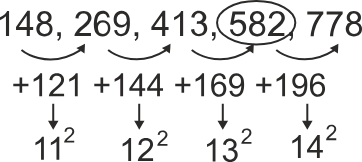
5) Square Number Series Example: Which number will replace the question mark (?) to complete the given series?
148, 269, 413, ?, 778
1) 548
2) 512
3) 582
4) 614
Solution
Add the square of consecutive natural numbers starting from 11, to get the required missing term –
So, 582 is the required missing term in the series. Hence, the third option is correct.
6) Cube Number Series Example: In the following question, select the missing number from the given series. 729, 512, 343, 216, ?
1) 36
2) 64
3) 25
4) 125
Solution
Find the cube roots of the given numbers to obtain the missing number of the series.
The numbers given in the series are the cubes of the natural numbers in descending order. 729 ⇒ ∛729 = 9 512 ⇒ ∛512 = 8 343 ⇒ ∛343 = 7 216 ⇒ ∛216 = 6 So, the next term of the series is 5³ = 125 Hence, the fourth option is correct.
7) Ascending/ Descending Number Series Example: Which of the following numbers will replace the question mark (?) in the given series? 89, 170, 219, 244, 253, ?
1) 254
2) 257
3) 255
4) 256
Solution
Add the square of consecutive odd numbers in descending order starting from 9, to get the required missing number – 89 + 92 = 89 + 81 = 170; 170 + 72 = 170 + 49 = 219; 219 + 52 = 219 + 25 = 244; 244 + 32 = 244 + 9 = 253; 253 + 12 = 253 + 1 = 254
So, the missing number is 254. Hence, the first option is correct.
8) Mixed Number Series Example: In the following question, select the missing number from the given series. 36, 18, 54, 27, 81, ?, 121.5
1) 40.5
2) 41.5
3) 40
4) 38
Solution Divide and multiply the numbers by 2 and 3 alternatively.
So, the missing number in the series is 13. Hence, the second option is correct.
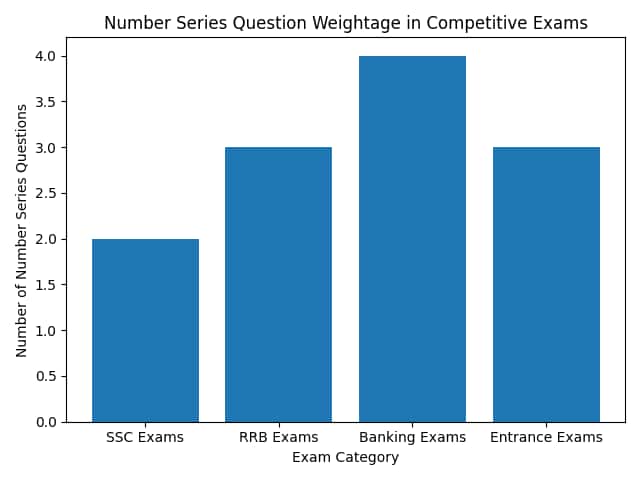
Question-wise Weightage of Number Series in Competitive Exams
Below is the graph-based distribution of questions among different competitive exams:
Common Mistakes in Number Series Reasoning Questions
Even well-prepared candidates make mistakes in number series reasoning questions because of small errors or lack of attention. Avoiding these mistakes can improve your performance in competitive exams.
Rushing Without Identifying the Pattern
Many candidates rush while solving number series questions for competitive exams and miss the actual pattern.
Taking a few seconds to analyze the sequence can prevent wrong answers and negative marking.
Confusing Similar Number Patterns
Some sequences look similar but follow different logic.
For example, students may confuse prime number series, Fibonacci sequences, or alternating number patterns.
Ignoring Basic Arithmetic Patterns
A large number of number series questions in reasoning exams are based on simple operations like addition, subtraction, multiplication, or division.
Ignoring these basic patterns and jumping to complex tricks can waste time.
Lack of Practice with Advanced Number Series
Many aspirants practice only basic questions and ignore advanced number series reasoning problems.
Exams like SSC CGL, IBPS PO, CAT, and CUET often include complex patterns that require consistent practice.
Number Series Reasoning Questions for Practice
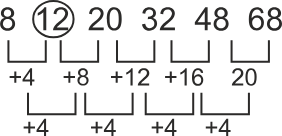
1) Directions: Which of the following numbers will replace the question mark (?) in the given series?
8, ?, 20, 32, 48, 68
1) 14
2) 10
3) 12
4) 16
Hint: Add consecutive multiples of 4 to the numbers of the given series.
Solution
The pattern is as follows –
So, 12 is the missing number of the series. Hence, the third option is correct.
2) Directions: Which of the following numbers will replace the question mark (?) in the given series?
109, 113, 122, 147, ?
1) 196
2) 148
3) 154
4) 166
Hint: Check the difference between the numbers of the given series.
Solution
Add the square of consecutive prime numbers in each number, to get the required number –
$109 + (2)^2 = 109 + 4 = 113$
$113 + (3)^2 = 113 + 9 = 122$
$122 + (5)^2 = 122 + 25 = 147$
$147 + (7)^2 = 147 + 49 = 196$
So, 196 is the missing number in the series. Hence, the first option is correct.
3) Directions: Which number will replace the question mark (?) in the following series?
57, 50, 55, 52, ?
1) 50
2) 53
3) 51
4) 55
Hint: Check the difference between the number of the given series.
Solution
Subtract and add the consecutive odd numbers alternatively (starting from 7) in decreasing order from each term to get the required missing number –
So, 552 is the missing number of the series. Hence, the second option is correct.
8) Directions: Which of the following numbers will replace the question mark (?) in the given series?
144, 127, 110, ?, 76, 59
1) 95
2) 93
3) 89
4) 97
Hint: Subtract 17 from the previous number to get the next number of the series.
Solution
The pattern is as follows: 144 – 17 = 127, 127 – 17 = 110, 110 – 17 = 93, 93 – 17 = 76, 76 – 17 = 59
So, 93 is the missing number of the series. Hence, the second option is correct.
9) Directions: Study the given pattern carefully and select the number that can replace the question mark (?) in it.
First row – 4, 6, 13
Second row – 9, 8, 21
Third row – 5, 6, ?
(NOTE: Operations should be performed on the whole numbers, without breaking down the numbers into their constituent digits. Eg. 13 – operations on 13 such as adding /subtracting /multiplying etc. to 13 can be performed. Breaking down 13 into 1 and 3 and then performing mathematical operations on 1 and 3 is not allowed.)
1) 14
2) 13
3) 12
4) 16
Hint: Add the first and second numbers, divide the second number by 2, and then add both the resultants, to get the third number.
Solution The pattern is as follows:
In the first row: 4, 6, 13→(4 + 6) + (6 ÷ 2) = 10 + 3 = 13
In the second row: 9, 8, 21→(9 + 8) + (8 ÷ 2) = 17 + 4 = 21
Similarly, follow the same pattern in the third row: 5, 6, ?→(5 + 6) + (6 ÷ 2) = 11 + 3 = 14
So, the missing number is 14. Hence, the first option is correct.
10) Directions: Which of the following numbers will replace the question mark (?) in the given series?
64, 67, 76,103, ?
1) 145
2) 194
3) 184
4) 154
Hint: Check the difference between the number of the given series.
Solution
Add the power of 3 to the previous term to obtain the next term.
$64 + (3)^1 = 64 + 3 = 67$,
$67 + (3)^2 = 67 + 9 = 76$,
$76 + (3)^3 = 76 + 27 = 103$,
$103 + (3)^4 = 103 + 81 = 184$
So, 184 is the missing number. Hence, the third option is correct.
Wrong Number Series Reasoning Questions for Practice
1) Directions: Identify the number that does NOT belong to the following series.
1.5, 2, 3, 6, 18, 108, 1964
1) 108
2) 6
3) 18
4) 1964
Hint: For the given series, multiply the consecutive terms of the series to get the next term in the series.
So, from the given series, 1964 is incorrect. Hence, the fourth option is correct.
2) Directions: Identify the number that does not belong to the following series.
414, 430, 462, 526, 664, 910
1) 462
2) 526
3) 910
4) 664
Hint: Every number is double the previous number on checking the number difference in the series.
Solution
414 + 16 = 430; 430 + 32 = 462; 432 + 64 = 526; 526 + 128 = 654(but the given number is 664); 654 + 256 = 910
From the given series, we see that 664 is incorrect. Hence, the fourth option is correct.
3) Directions: In the given series one number is incorrect. Identify the INCORRECT number from among the options given.
3, 5, 7, 6, 10, 14, 12, 24, 28, 24, 40, 56
1) 10
2) 24
3) 12
4) 28
Hint: Think about splitting the series into three parts and then doubling the preceding numbers to obtain the next number.
Solution
Split the series into three parts.
(I) 3, 6, 12, 24
(II) 5, 10, 24, 40
(III) 7, 14, 28, 56
In all the series above the following number is double of the preceding number.
⇒ 3 + 3 = 6; 6 + 6 = 12; 12 + 12 = 24
⇒ 5 + 5 = 10; 10 + 10 = 20; 20 + 20 = 40
⇒ 7 + 7 = 14; 14 + 14 = 28; 28 + 28 = 56
In series (II) it is written 24 instead of 20.
So, 24 in the second series is the wrong number. Hence, the second option is correct.
4) Directions: In the following number series, two numbers have been put within brackets. Select the most appropriate option for these numbers in relation to their inclusion in the series.
21, 24, 19, (29), 17, 28, (15), 30
1) The first bracketed number (from the left) is correct and the second bracketed number (from the left) is incorrect.
2) Both the bracketed numbers are correct.
3) The first bracketed number (from the left) is incorrect and the second bracketed number (from the left) is correct.
4) Both the bracketed numbers are incorrect.
Hint: Determine the difference in alternative terms.
Solution The pattern is as follows –
Therefore, the first bracketed number (from the left) is incorrect it should be 26 instead of 29 and the second bracketed number (from the left) is correct. Hence, the third option is correct.
5) Directions: Identify the number that does NOT belong to the following series.
30, 15, 15, 22.5, 46, 112.5
1) 46
2) 112.5
3) 22.5
4) 30
Hint: Multiply the numbers by consecutive numbers starting from 0.5
Solution
30 × 0.5 = 15
15 × 1 = 15
15 × 1.5 = 22.5
22.5 × 2 = 45
45 × 2.5 = 112.5
So, the wrong number in the series is 46. Hence, the first option is correct.
Verbal Reasoning Topics
Verbal reasoning is an important part of competitive exams as it tests your ability to understand, analyze, and draw logical conclusions from given information. Below are the key verbal reasoning topics that are frequently asked in exams.
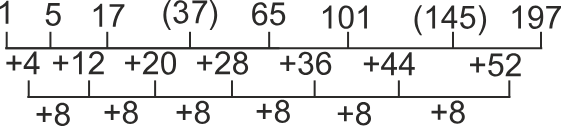
1) Directions: In the following number series, two numbers have been put within brackets. Select the most appropriate option for these numbers about their inclusion in the series.
1, 5, 17, (39), 65, 101, (145), 197
1) Both the bracketed numbers are correct
2) Both the bracketed numbers are incorrect
3) The first bracketed number from the left is correct and the second bracketed number from the left is incorrect
4) The first bracketed number from the left is incorrect and the second bracketed number from the left is correct
Hint: Determine the difference between two consecutive numbers to determine the correct number.
Solution
In the series given above the logic is defined by the figure given below:
The number in the first bracket is replaced by 37 according to the given logic above.
So, the first bracket from the left is incorrect and the second bracket is correct. Hence, the fourth option is correct.
2) Directions: Select the number from among the given options that can replace the question mark (?) in the following series.
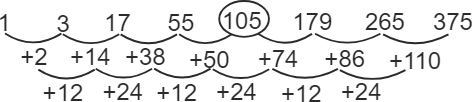
1, 3, 17, 55, ?, 179, 265, 375
1) 169
2) 157
3) 91
4) 105
Hint: Determine the difference between two consecutive numbers to obtain the required missing number.
Solution
The pattern is as follows –
So, the required missing number in the series is 105. Hence, the fourth option is correct.
Number Series Questions for Competitive Exams and Entrance Exams
1) Directions: Select the number from among the given options that can replace the question mark (?) in the following series.
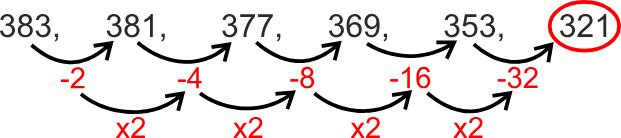
383, 381, 377, 369, 353, (?)
1) 325
2) 323
3) 322
4) 321
Hint: Determine the missing term by using difference and multiplication.
Solution Follow the pattern to find the missing term –
So, 321 is the missing term in the series. Hence, the fourth option is correct.
2) Directions: Which number will replace the question mark (?) to complete the given series?
55, 42, 31, 22, 15, 10,?
1) 7
2) 5
3) 3
4) 6
Hint: Check the difference between the numbers given in the series, to get the missing number.
Solution
Subtract the consecutive odd numbers in decreasing order (starting from 13), to get the missing number in the series.
So, 7 is the missing term in the series. Hence, the first option is correct.
Number Series Questions for VITEEE Exam
1) Directions: Which number will replace the question mark (?) to complete the given series?
15, 16, 20, 29, 45, (?)
1) 70
2) 65
3) 75
4) 60
Hint: Determine the missing term by adding the squares of the consecutive natural numbers in the previous term.
Solution
Add the squares of the consecutive natural numbers in the previous term to get the next term.
So, 116 is the missing number of the series. Hence, the first option is correct.
5) Directions: Which of the following numbers will replace the question mark (?) in the given series?
286, 192, 263, 176, 240, 160, 217, 144, ?
1) 186
2) 194
3) 165
4) 190
Hint: Determine the difference between two alternate numbers to obtain the required missing number.
Solution
Subtract 23 from numbers in odd positions and 16 from even position numbers –
So, 194 is the missing term in the series. Hence, the second option is correct.
Useful Books for Number Series and Logical Reasoning
This section lists some of the best books to learn number series and logical reasoning concepts for competitive exam preparation. These books provide clear explanations, solved examples, and practice questions that help improve pattern recognition and problem-solving skills in number series reasoning.
Book Title
Author
How It Helps in Number Series & Reasoning
A Modern Approach to Verbal & Non-Verbal Reasoning
R.S. Aggarwal
Explains fundamental reasoning concepts and includes many practice sets for number series reasoning questions and pattern identification.
Analytical Reasoning
M.K. Pandey
Helps develop analytical thinking and provides exercises useful for solving number series and logical reasoning problems.
A New Approach to Reasoning Verbal & Non-Verbal
B.S. Sijwali & Indu Sijwali
Covers various reasoning topics with practice questions that strengthen number pattern recognition and series-based reasoning.
How to Prepare for Logical Reasoning for CAT
Arun Sharma
Provides advanced strategies and solved examples helpful for complex number series questions in competitive exams.
Logical Reasoning and Data Interpretation for CAT
Nishit K. Sinha
Includes practice sets and conceptual explanations to improve analytical reasoning and number series problem-solving skills.
Non-Verbal Reasoning Topics
Non-verbal reasoning focuses on problem-solving using figures, patterns, and visual logic instead of words. It is a crucial part of many competitive exams to test analytical and visual reasoning skills. Below are the important non-verbal reasoning topics that you need to practice.
About the Faculty Tanu Gupta, with over a decade of experience as a reasoning faculty, specializes in preparing students for various entrance examinations and career development. Her extensive work with multiple educational platforms and institutions has honed her expertise in logical and analytical thinking. Her dedication to innovative teaching methods ensures these articles provide practical insights and expert guidance.
Frequently Asked Questions (FAQs)
Q: What is a number series in logical reasoning?
A:
A number series is a sequence of numbers that follows a specific pattern or rule. In number series reasoning questions, candidates must identify the pattern and find the missing or next number in the sequence.
Q: How do you solve number series questions quickly?
A:
To solve number series questions quickly, identify the pattern between consecutive numbers. Check for operations such as addition, subtraction, multiplication, division, squares, cubes, or alternating patterns.
Q: What will be the next number in the following series? 623, 626, 635, 662, 743, ?.
A:
Add the power of 3 to the previous term to obtain the next term.
Q: What will be the next number in the following series? 2, 4, 12, 48, ?.
A:
In the above-given series, multiply the numbers by consecutive natural numbers. 2 × 2 = 4; 4 × 3 = 12; 12 × 4 = 48; 48 × 5 = 240
So, 240 is the missing number of the given series.
Q: Which exams include number series reasoning questions?
A:
Number series reasoning questions are commonly asked in SSC exams, banking exams, railway exams, and entrance tests such as CUET, CAT, and other aptitude exams.