


Blood Relation: Definition, Practice Questions, Examples, Types
Imagine someone says, “A is the father of B, and B is the sister of C,” then maybe they ask how is A connected to C? This question is trying to untie a tiny family knot, not fully straight, you know. That's why blood relation reasoning questions are so popular - they check if you can actually read the relationship chain, the generations involved, and how each person links to the next. Blood relation is a major part of logical reasoning, and it shows up again and again in competitive exams such as SSC, banking exams, MBA entry tests, and defence exams too. In this article, you’ll understand what blood relation means, the various types of question patterns, step by step solving ways, and some practice questions with examples so you can pick the topic up quickly, without much stress.
This Story also Contains
- What is Blood Relation in Reasoning?
- Importance of Understanding Family Relationships in Blood Relations
- Types of Blood Relation: Practice Questions
- Verbal Reasoning Topics
- Step-by-step approach to solve blood relation reasoning questions
- Blood Relations Practice Questions PDF Download
- Questionwise Weightage of Blood Relations in Competitive Exams
- Best Books for Blood Relation Reasoning Preparation
- Practice Questions Based on Passage/Relation Based Blood Relation
- Practice Questions Based on Coded Blood Relation
- Practice Questions Based on Picture/Person Pointing Based Blood Relation
- Blood Relation Questions for CAT/ XAT/ MAT/ KMAT/ IPMAT/ UPESMET/ JIPMAT
- Blood Relation Questions for APICET/ TANCET/ CUET/ CLAT
- Shortcut Tricks to Solve Blood Relation Questions Quickly
- Blood Relation Questions for SSC/ RRB Exams
- Blood Relation Questions for Banking/ Insurance Exams
- Blood Relation Tricks and Shortcuts for Competitive Exams
- Common Mistakes to Avoid in Blood Relation Reasoning
- Important Rules and Concepts for Blood Relation Reasoning (Quick Revision Table)
- Non-Verbal Reasoning Topics
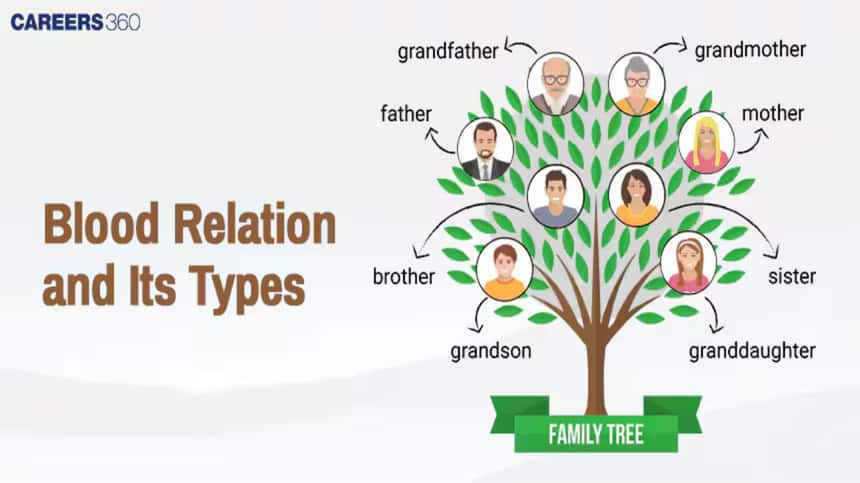
What is Blood Relation in Reasoning?
Blood relation in reasoning is the questions where someone gives you info about family members, like how they are connected, and then you have to figure out the right link between two persons. it’s like working through a family web, but you can’t see it directly. you interpret what you’re told and then connect the dots.
These questions lean on family tree logic, and also on generation levels, so the age-gap or rank in the family matters. You might get hints involving terms like father, sister, uncle, or grandfather and you must treat them carefully. Sometimes the relationship is direct, sometimes it’s indirect, and sometimes they even use coded style clues, where you have to decode the meaning, not just read the words.
Importance of Understanding Family Relationships in Blood Relations
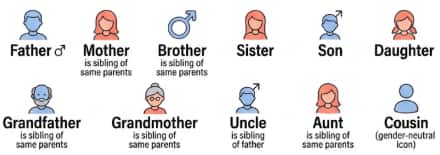
In today’s modern society, almost all families are nuclear, and we rarely see a joint family. In this modern era, students have difficulty understanding the relationships between the other family members. So, the following are some basic terms used in the blood relation-based questions which an aspirant must know before commencing the blood relation questions.
| Relation Type | Definition / Examples |
|---|---|
| Paternal Relations | Relations from the father’s side (Paternal Grandfather, Paternal Grandmother, Paternal Uncle, Paternal Aunt) |
| Maternal Relations | Relations from the mother’s side (Maternal Grandfather, Maternal Grandmother, Maternal Uncle, Maternal Aunt) |
| Great Grandparents | Grandfather’s Father / Mother → Great Grandfather / Great Grandmother |
| Grandparents | Parent’s Father / Mother → Grandfather / Grandmother |
| Parents | Father / Mother |
| Children | Son / Daughter |
| Spouse | Husband / Wife |
| Siblings | Brother / Sister (same parents) |
| Cousins | Children of Uncle and Aunt |
| Aunt | Mother’s sister, Father’s sister, Mother’s brother’s wife, Father’s brother’s wife |
| Uncle | Father’s sister’s husband, Mother’s sister’s husband, Mother’s brother, Father’s brother |
| Niece | Daughter of one’s sister or brother |
| Nephew | Son of one’s sister or brother |
| Father-in-law | Spouse’s father |
| Mother-in-law | Spouse’s mother |
| Brother-in-law | Sister’s husband, Spouse’s brother |
| Sister-in-law | Brother’s wife, Spouse’s sister |
| Grandchildren | Son or Daughter of one’s children → Grandson / Granddaughter |
(Note: In the questions, the circle represents females, the Quadrilateral represents males, the Double arrow represents the relation of spouse and the Single arrow represents the family relation between the interconnected persons.)
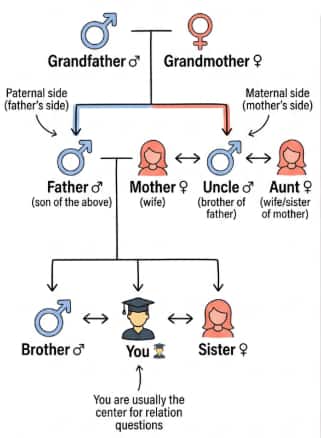
How to Draw a Family Tree Diagram for Blood Relation Reasoning Questions
Standard Symbols Used
- Square (□): Male
- Circle (○): Female
- Double horizontal line (=): Husband and wife
- Single line (│/─): Parent-child or sibling relationship
Arrange Members by Generation
- Top: Grandparents
- Middle: Parents and their siblings
- Bottom: Children and younger members
Steps to Draw the Diagram
- Read the question carefully and identify all relationships.
- Start with a known person and add other members one by one.
- Use standard symbols to show gender and relationships.
- Place members in the correct generation
.png)
Example Insight for Better Understanding
Suppose a question states that A is the father of B and B is the sister of C. You can place A at the top, and B and C below as children. From this, it becomes clear that A is also the father of C.
Types of Blood Relation: Practice Questions
Blood Relation require logical thinking and a clear understanding of family hierarchies. Below are the key types and questions for quick reference.
1) Passage/Relation Based Blood Relation
In such types of questions, a passage of information is given as a question related to various persons. You have to analyse the information and draw a family tree to determine the relation between the persons asked in the question.
Example 1:
Directions: Preeti is the only sister of Virat. Manoj is the son of Dileep, who is the husband of Maaya. Virat is the son of Devansh. Devansh is Manoj's father-in-law. How is Maaya related to Preeti?
1) Mother-in-law
2) Daughter-in-law
3) Sister-in-law
4) Mother
Solution:
Draw the family tree as per the given instructions.
Following the instructions of the question, the family tree will be –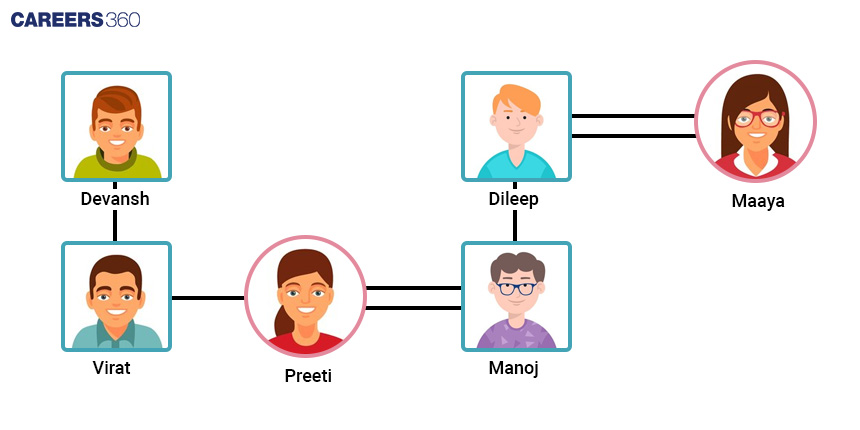
Here, the quadrilateral represents the male and the circular figure represents the female in the figure. So, Maaya is the mother-in-law of Preeti. Hence, the first option is correct.
Example 2:
K is the daughter of S. S is married to G. A is the only grandson of M. G is the son of M. A has one daughter H who is the only granddaughter of S. How is K related to A?
1) Sister
2) Mother's mother
3) Daughter
4) Mother's sister
Solution:
Draw the family tree as per the instructions given to determine the relation.
Following the instructions of the question, the family tree will be –
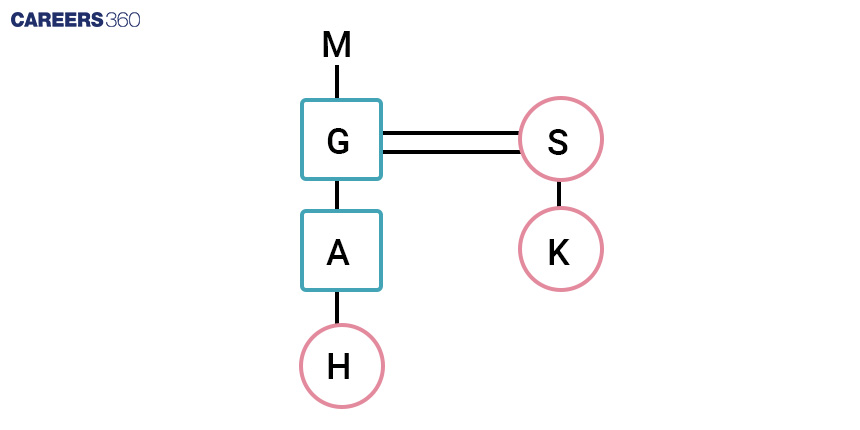
Here, the quadrilateral represents the male, and the circular figure represents the female in the figure.
So, K is the sister of A. Hence, the first option is correct.
2) Coded Blood Relations
In such questions, relations between the members are given as a code. A code can be any character such as a letter, number or symbol. Generally, it is analysed that codes given are in the form of symbols such as @, #, $,%, * etc.
Example:
Directions:
A + B means A is the brother of B;
A – B means A is the mother of B;
A × B means A is the husband of B;
A ÷ B means A is the sister of B;
A @ B means A is the son of B.
If U + V ÷ W – X × Y, which of the following statements is correct?
1) U is Y's husband's mother's brother
2) W, X and Y are sisters
3) V is the father of X's mother
4) Y is the wife of W
Solution:
First, decode the symbols using the given information, and then draw the family tree per the instructions.
As per the given information, the family tree will be as follows –
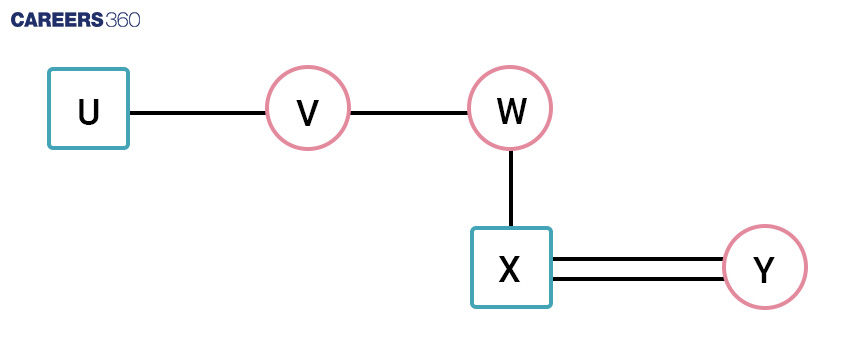
Here, the quadrilateral represents the male and the circular figure represents the female in the figure.
So, only the statement in the first option is correct. Hence, the first option is correct.
3) Pointing Based Blood Relation:
In such questions, one person indicates the other person in a picture or directly towards someone. The person in the pointed picture and the person who indicates are directly and indirectly connected with the chain of relations.
Example:
Directions: Pointing towards a girl Amit says, she is his only daughter's father's paternal grandfather's granddaughter. Amit's father has no siblings. How is the girl related to Amit?
1) Granddaughter
2) Sister
3) Paternal grandmother
4) Mother
Solution:
Draw the family tree as per the instructions given to determine the relation.
According to the given information, the family tree will be –
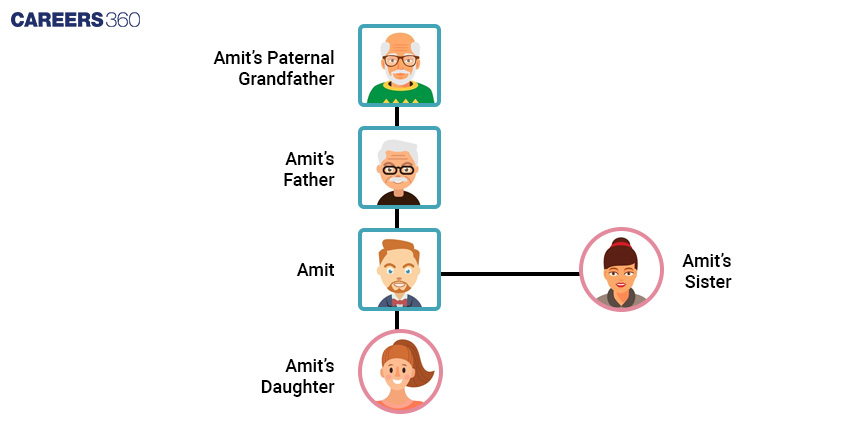
Here, the quadrilateral represents the male, and the circular figure represents the female in the figure.
So, from the family tree, that girl is Amit's sister. Hence, the second option is correct.
Verbal Reasoning Topics
The candidates who are preparing for the upcoming entrance and Government exams can also refer to the links given below and master the reasoning ability section:
Step-by-step approach to solve blood relation reasoning questions
To solve blood relation reasoning questions quickly, and accurately in competitive exams it helps to use a clear plan that feels a bit structured but not overly rigid.
First, create a simple family tree diagram
The most helpful way to crack blood relation problems is to draw a family tree.
It lets you picture the relationships more clearly
Helps with understanding the generations, and the hierarchy
Cuts down confusion when the questions get messy
Start by putting one known person in the diagram, and then expand it slowly, step by step.
Change each relationship into easy personal terms
A useful idea is to connect the given sentence to yourself.
Like, “Hemant’s mother” can be treated as “my mother”
That way the confusing links become simpler to read
It also reduces the load of long and indirect statements
This trick is effective for those tricky blood relation questions
Do not guess gender if the question doesn’t say it
One frequent error in these kinds of questions is assuming gender just because of names.
Always depend only on what is written in the question
Words like child, or sibling do not automatically tell gender
So don’t make assumptions unless it is clearly mentioned
This keeps your answers more accurate.
Build the family tree gradually
Instead of placing everything at once, add it little by little.
Add just one relation at a time
Review what you wrote before moving ahead
Keep the structure arranged by generations
Blood Relations Practice Questions PDF Download
The candidates must practice blood relation reasoning questions with answers PDF and a blood relation reasoning practice set available online to ace the topic of blood relation.
Download Now: Blood Relation Questions with Solutions PDF
Questionwise Weightage of Blood Relations in Competitive Exams
The number of questions based on blood relations varies from exam to exam -
1) Blood Relations questions asked in SSC exams, i.e. SSC MTS, SSC CGL, SSC CHSL, SSC CPO, Steno - 2 to 3 questions.
2) Blood Relations questions asked in the Railways exam, i.e. Group D, NTPC, JE, ALP, etc. and banking exams - 2 to 3 questions.
3) Blood Relations questions asked in CUET, VITEE, NMAT and other college entrance exams - 1 to 2 questions. Sometimes, questions based on blood relation can be seen in CSAT and IB exams as well.
4) But sometimes it comes in the form of comprehension consisting of 4-5 questions in every competitive exam.
Note: The candidates must practice the blood relation reasoning questions with the answers given below for each type.
Best Books for Blood Relation Reasoning Preparation
Here is a clean and exam-focused table of the most recommended books to master blood relation reasoning questions for competitive exams:
| Book Name | Author | Key Features | Best For |
|---|---|---|---|
| A Modern Approach to Verbal & Non-Verbal Reasoning | R.S. Aggarwal | Covers blood relation with clear concepts, examples, and practice questions | Beginners and SSC aspirants |
| Analytical Reasoning | M.K. Pandey | Strong focus on logical puzzles and concept-building including blood relations | Banking and MBA exams |
| A New Approach to Reasoning Verbal & Non-Verbal | B.S. Sijwali | Includes shortcut tricks, solved examples, and topic-wise practice | Beginners to intermediate level |
| Shortcuts in Reasoning for Competitive Exams | Disha Experts | Focus on quick solving techniques and time-saving methods | Speed improvement |
| How to Crack Test of Reasoning | Arihant Experts | Comprehensive reasoning coverage with detailed explanations | All competitive exams |
| SSC Reasoning Chapterwise Solved Papers | Kiran Publications | Previous year blood relation questions with step-by-step solutions | SSC exam preparation |
| Logical Reasoning | Arun Sharma | Covers reasoning topics with advanced level practice sets | MBA entrance exams |
Practice Questions Based on Passage/Relation Based Blood Relation
1. Directions: Bharti is the sister of Chavi. Avni is the mother of Bharti. Chavi is the wife of Dhruv. Dhruv is the father of Esha. Who is the maternal grandmother of Esha?
1) Dhruv
2) Avni
3) Chavi
4) Bharti
Solution:
As per the given information, the family tree will be as follows –
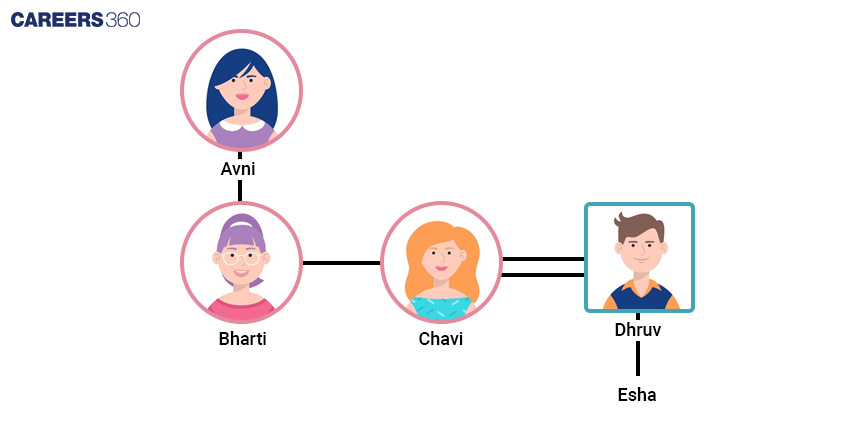
Here, the quadrilateral represents the male, and the circular figure represents the female in the figure.
So, from the above family tree, Avni is the maternal grandmother of Esha. Hence, the second option is correct.
2. Directions: Bhanu is the sister of Chirag. Aryan is the father of Bhanu. Chirag is the brother of Dewan. Dewan is the husband of Esha. How is Esha related to Aryan?
Daughter
Sister
Niece
Daughter-in-law
Solution:
As per the given information, the family tree will be as follows –
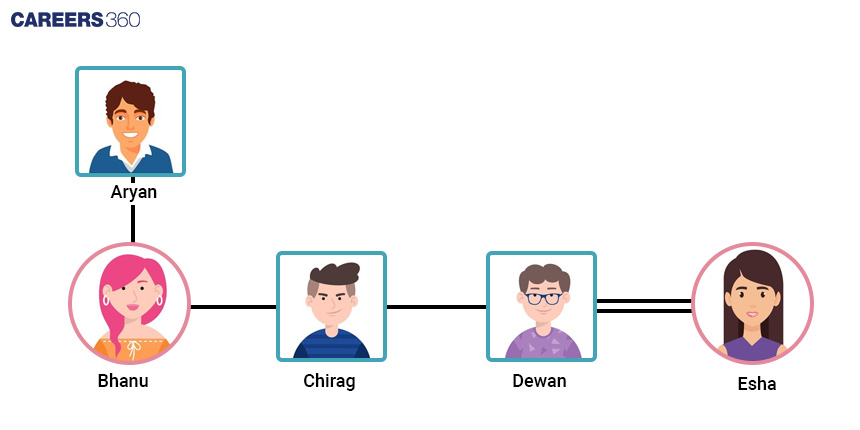
Here, the quadrilateral represents the male, and the circular figure represents the female in the figure.
So, from the above family tree, Esha is the daughter-in-law of Aryan. Hence, the fourth option is correct.
3. Directions: John is the father of Mary and Joseph is the son of Myra. Ishu is the brother of John. Joseph is the only brother of Mary. How is Myra related to Ishu?
1) Sister
2) Cousin
3) Wife
4) Sister–in–law
Solution:
Draw the family tree as per the instructions given to determine the relation.
As per the given information, the family tree will be as follows –
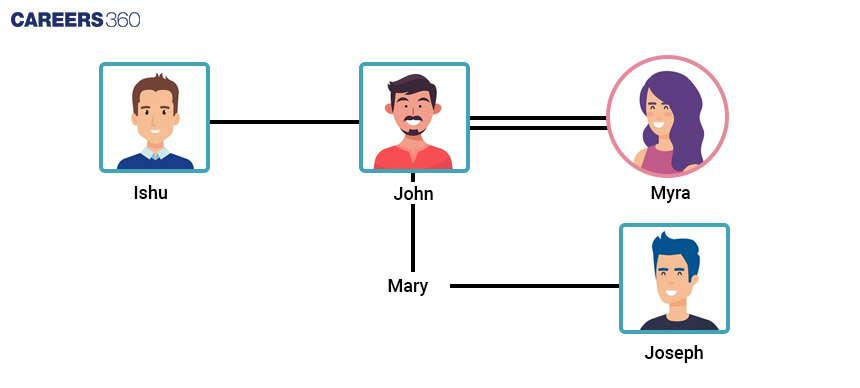
Here, the quadrilateral represents the male and the circular figure represents the female in the figure.
So, from the above family tree, Myra is the sister–in–law of Ishu. Hence, the fourth option is correct.
4. Directions: A and B are a married couple. X and Y are brothers. X is the brother of A. How is Y related to B?
1) Brother-in-law
2) Brother
3) Son-in-law
4) Cousin
Solution:
As per the given information, the family tree will be as follows –
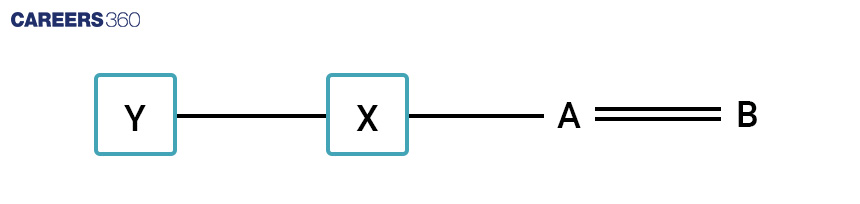
Here, the quadrilateral represents the male, and the circular figure represents the female in the figure.
So, from the above family tree, Y is the brother-in-law of B. Hence, the first option is correct.
5. Directions: F is the brother of A. C is the daughter of A. K is the sister of F. G is the brother of C. Who is the uncle of G?
1) A
2) C
3) K
4) F
Solution:
As per the given information, the family tree will be as follows –
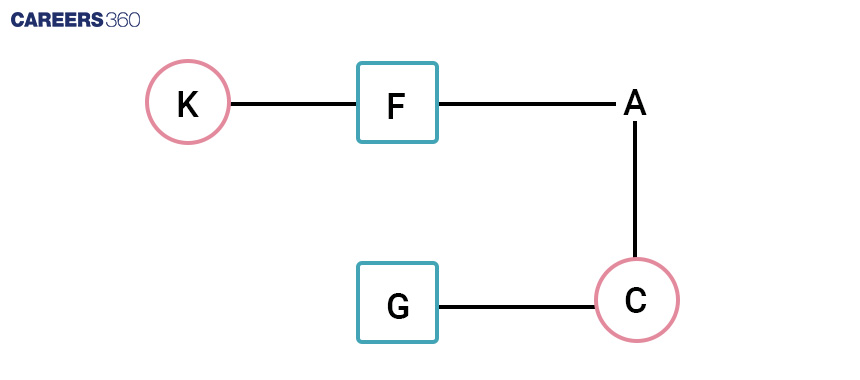
Here, the quadrilateral represents the male, and the circular figure represents the female in the figure.
So, from the above family tree, F is the uncle of G. Hence, the fourth option is correct.
Practice Questions Based on Coded Blood Relation
1. Directions: If, B % D means B is the brother of D,
B & D means B is the mother of D,
B × D means B is the husband of D,
B # D means B is the sister of D,
B $ D means B is the son of D,
B @ D means B is the father of D.
So how is A related to E in the given expression?
A % D $ F # B % E × S
1) Husband
2) Nephew
3) Uncle
4) Brother
Solution:
As per the given information, the family tree will be as follows –
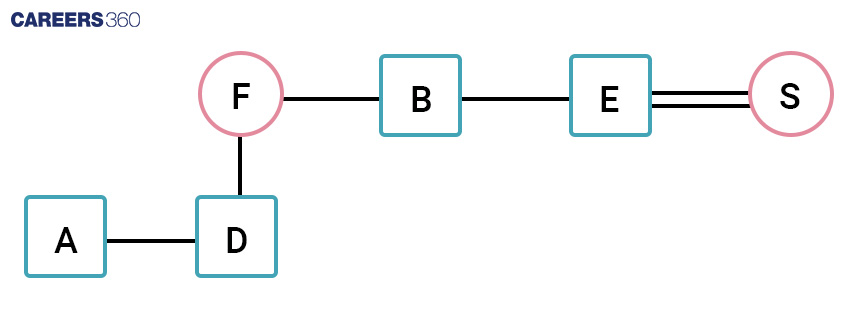
Here, the quadrilateral represents the male, and the circular figure represents the female in the figure.
So, A is the nephew of E. Hence, the second option is correct.
2. Directions: P @ Q means P is the wife of Q.
P # Q means P is the brother of Q.
P % Q means P is the father of Q.
P – Q means P is the daughter of Q.
If Z – B % D % G, then how is Z related to G?
1) Z is the mother of G
2) Z is the sister of G
3) Z is the father's sister of G
4) Z is the daughter of G
Solution:
As per the given information, the family tree will be as follows –
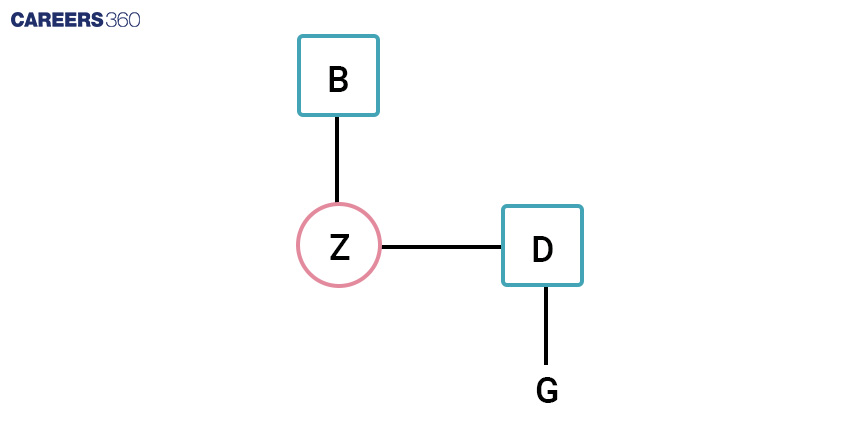
Here, the quadrilateral represents the male, and the circular figure represents the female in the figure.
So, Z is the father's sister of G. Hence, the third option is correct.
3. Directions: A + B means A is the brother of B;
A – B means A is the mother of B;
A × B means A is the husband of B;
A ÷ B means A is the sister of B.
If C ÷ B – E + A × F – D, then which of the following statements is NOT correct?
1) D is the daughter of B
2) C is the sister of the mother of A
3) F is the wife of the son of B
4) B is the mother of A
Solution:
As per the given information, the family tree will be as follows –
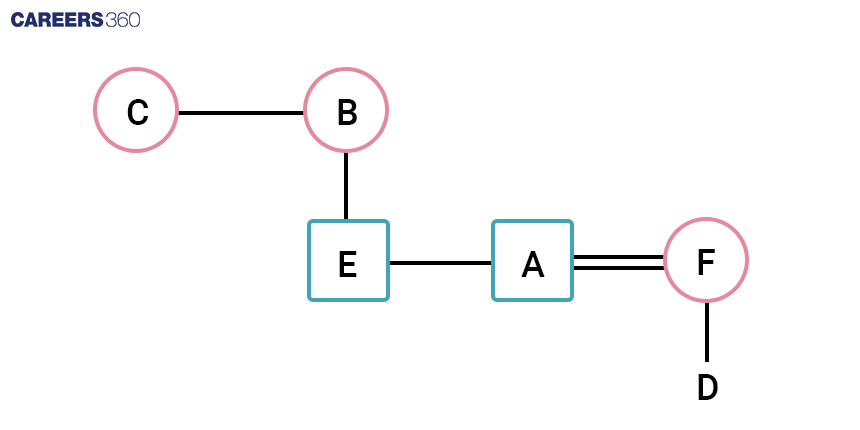
Here, the quadrilateral represents the male, and the circular figure represents the female in the figure.
Let's check the options –
First option: D is the daughter of B – From the above family tree, it's clear that D is either the daughter or son of A and F. Therefore, this option is incorrect.
Second option: C is the sister of the mother of A – From the above family tree, it's clear that B is the mother of E and, E is the brother of A. So, B is the mother of A and E both. So, C is the sister of B, the mother of A. Therefore, this option is correct.
Third option: F is the wife of the son of B – From the above family tree, it's clear that A is the son of B, and F is the wife of A. So, F is the wife of the son of B. Therefore, this option is correct.
Fourth option: B is the mother of A – From the above family tree, it's clear that B is the mother of E and, E is the brother of A. So, B is the mother of A and E both. Therefore, this option is correct.
So, only the first option does not fulfil the relation as per the family tree. Hence, the first option is correct.
4. Directions: A + B means A is the sister of B;
A – B means A is the brother of B;
A × B means A is the father of B;
A ÷ B means A is the wife of B.
If A + B – C ÷ D × E – F, then which of the following statements is NOT correct?
1) C is the mother of F
2) E is the brother of B
3) A is the sister of the wife of D
4) A is the sister of C
Solution:
According to the given information, the family tree will be as follows –
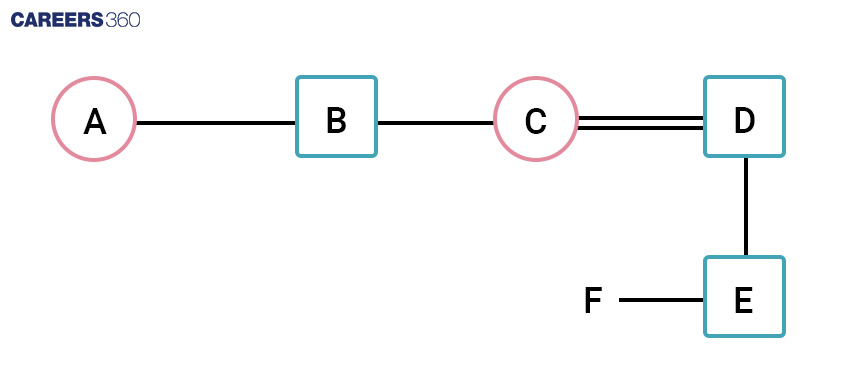
Here, the quadrilateral represents the male, and the circular figure represents the female in the figure.
Let's check the options –
First option: C is the mother of F – From the above family tree, it's clear that E is the brother of F, and E is the Son of C. So, C is the mother of F as well. Therefore, this option is correct.
Second option: E is the brother of B – From the above family tree, it's clear that E is the brother of F, and B is the uncle of E. Therefore, this option is incorrect.
Third option: A is the sister of the wife of D – From the above family tree, it's clear that A is the sister of C, and C is D's wife. So, A is the sister of the wife of D. Therefore, this option is correct.
Fourth option: A is the sister of C – From the above family tree, it's clear that A is the sister of B and C. Therefore, this option is correct.
So, only the second option does not depict the correct relation, as per the family tree. Hence, the second option is correct.
5. Directions: A + B means A is the father of B;
A – B means A is the son of B;
A × B means A is the sister of B;
A ÷ B means A is the wife of B.
If H + I – J × K × L – M ÷ N, then which of the following statements is not correct?
1) H is the husband of the sister of K
2) J is the wife of the son of M
3) H is the husband of the sister of L
4) H is the husband of the daughter of M
Solution:
As per the given information, the family tree will be as follows –
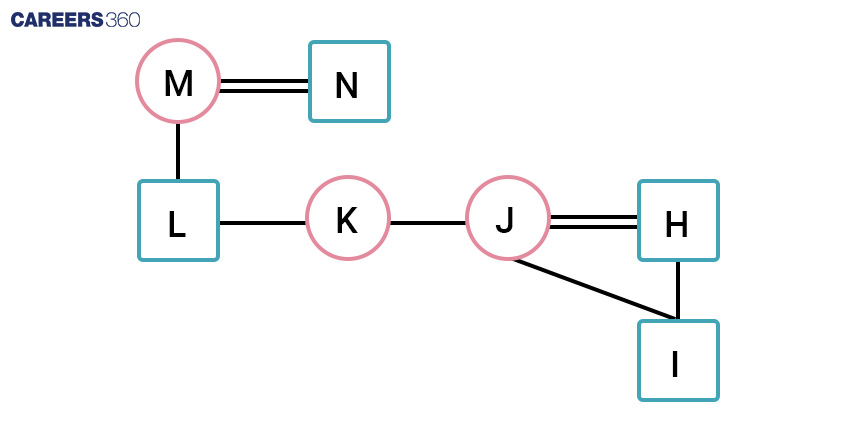
Here, the quadrilateral represents the male, and the circular figure represents the female in the figure.
Let's check the options –
First option: H is the husband of the sister of K – From the above family tree, it's clear that J is the sister of K, and H is J's husband. So, H is the husband of the sister of K. Therefore, this option is correct.
Second option: J is the wife of the son of M – From the above family tree, it's clear that J is the daughter of M and H is the son-in-law of M. Therefore, this option is incorrect.
Third option: H is the husband of the sister of L – From the above family tree, it's clear that J is the sister of L, and H is J's husband. So, H is the husband of the sister of L. Therefore, this option is correct.
Fourth option: H is the husband of the daughter of M – From the above family tree, it's clear that J is the daughter of M, and H is J's husband. So, H is the husband of the daughter of M. Therefore, this option is correct.
So, only the second option does not depict the correct relation, as per the family tree. Hence, the second option is correct.
Practice Questions Based on Picture/Person Pointing Based Blood Relation
1. Directions: Pointing to a lady in a photograph, Meera said, "Her father's only son's wife is my mother-in-law". How is Meera's husband related to that lady in the photo?
1) Nephew
2) Uncle
3) Son
4) Father
Solution:
As per the given information, the family tree will be as follows –
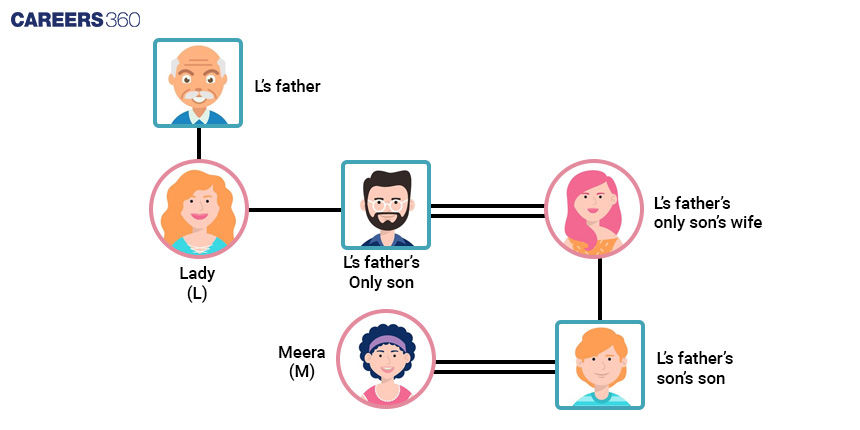
Here, the quadrilateral represents the male, and the circular figure represents the female in the figure.
According to the above family tree, Meera's husband is the nephew of that lady. Hence, the first option is correct.
2. Directions: Mohan said, "This girl is the wife of the grandson of my mother". How is Mohan related to that girl?
1) Grandfather
2) Husband
3) Father
4) Father-in-law
Solution:
As per the given information, the family tree will be as follows –
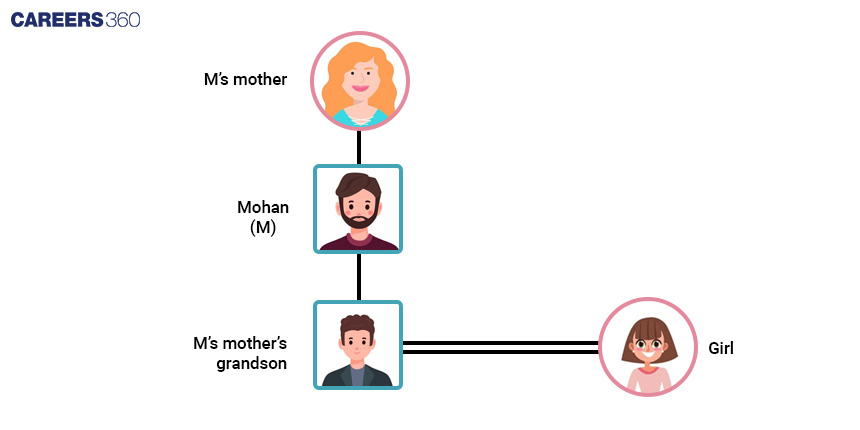
Here, the quadrilateral represents the male, and the circular figure represents the female in the figure.
According to the above family tree, Mohan is the father-in-law of the girl. Hence, the fourth option is correct.
3. Directions: Introducing a man, a woman said, "He is the son of my mother's brother's father's son". Then how is the woman related to the man?
1) Nephew
2) Brother
3) Son
4) Cousin
Solution:
As per the given information, the family tree will be as follows –
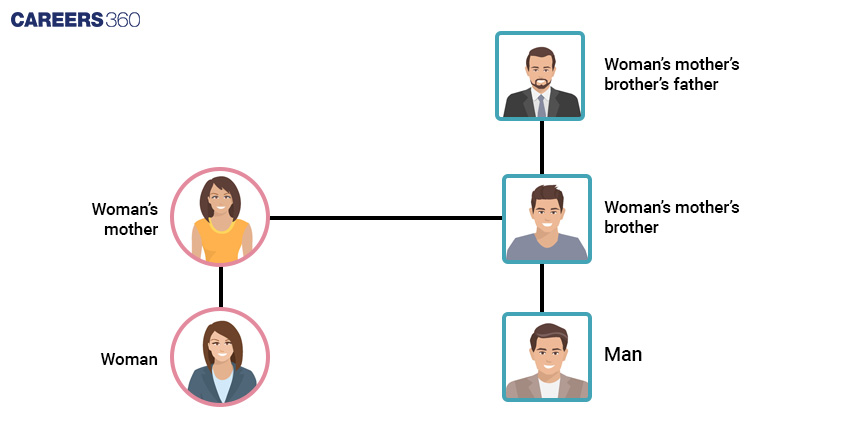
Here, the quadrilateral represents the male, and the circular figure represents the female in the figure.
According to the above family tree, the woman is the cousin of the man. Hence, the fourth option is correct.
4. Directions: Pointing to a boy, Mrs. Anita said, "He is the only son of my paternal grandmother's only daughter's husband". How is the boy related to Mrs. Anita?
1) Nephew
2) Uncle
3) Sister
4) Cousin
Solution:
As per the given information, the family tree will be as follows –
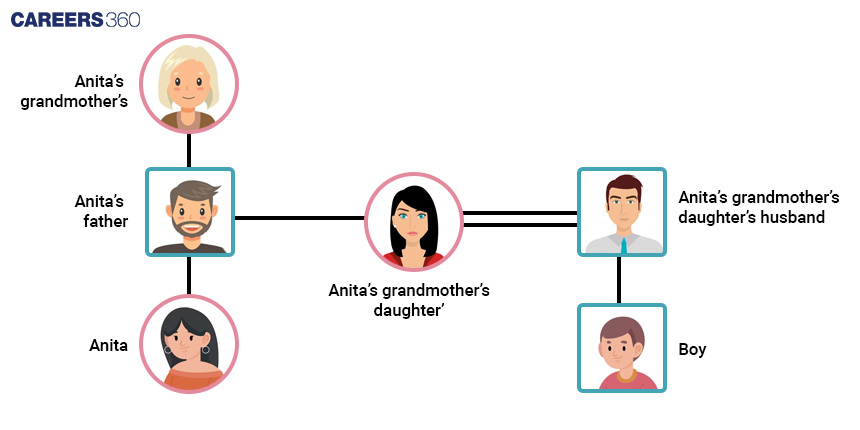
Here, the quadrilateral represents the male, and the circular figure represents the female in the figure.
According to the above family tree, the boy is the cousin of Mrs. Anita. Hence, the fourth option is correct.
5. Directions: Pointing to a man in a photograph, a woman said, "He is the only son of my mother's father." How is the woman related to the man in the photograph?
1) Niece
2) Sister
3) Daughter
4) Granddaughter
Solution:
As per the given information, the family tree will be as follows –
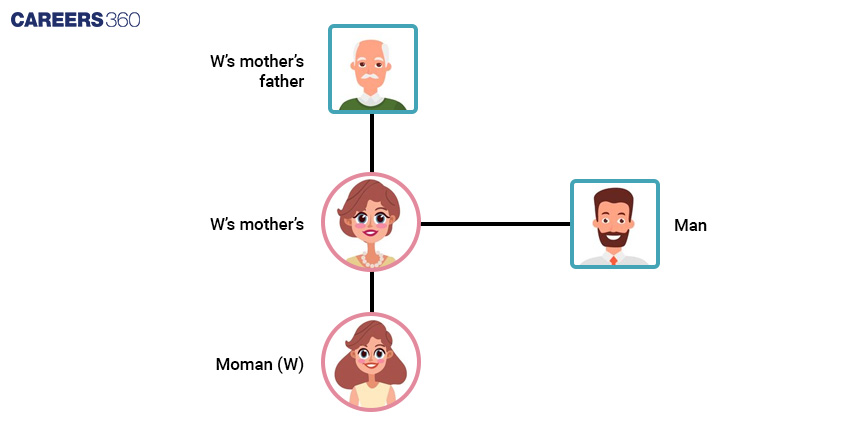
Here, the quadrilateral represents the male, and the circular figure represents the female in the figure.
According to the above family tree, the woman is the niece of the man. Hence, the first option is correct.
Blood Relation Questions for CAT/ XAT/ MAT/ KMAT/ IPMAT/ UPESMET/ JIPMAT
1. Directions: If A + B means A is the brother of B; A % B means A is the father of B and A x B means A is the sister of B. Which of the following means M is the uncle of P?
1) M % N x P
2) N x P % M
3) M + S % R % P
4) M + K % T x P
Solution:
Let us break down each option and draw the respective family diagram
A) M % N x P
M is the N
N is the sister of P
B) N x P % M
N is the sister of P
P is the father of M
C) M is the brother of S
S is the father of R
R is the father of P
D) M is the brother of K
K is the father of T
T is the sister of P
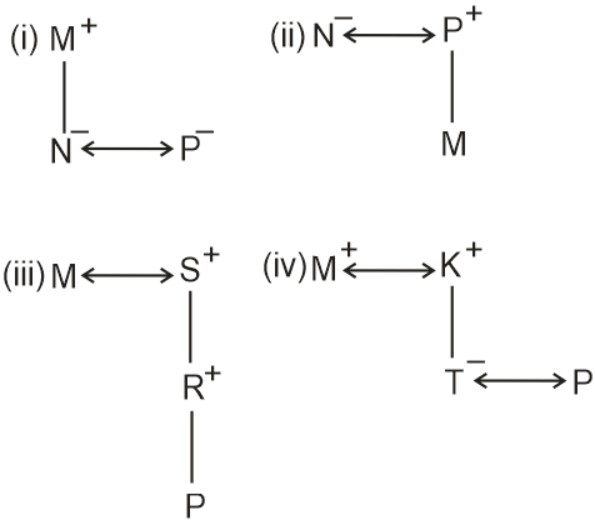
It can be concluded from the above that only in Option (D) the required condition M is the uncle of P is met. Hence Option (D) is the right answer
2. Directions: The woman added, pointing at the man, "His mother is the only daughter of my mother". How is the woman related to the man?
1) Sister
2) Mother
3) Aunt
4) Grandmother
Solution:
The statement, "the only daughter of my mother" indicates the lady herself, and the man is the son of that only daughter. Thus, that man is the son of the woman.
Hence, the second option is correct.
Blood Relation Questions for APICET/ TANCET/ CUET/ CLAT
1. Directions: Maya said, "My mother is the sister of Ranjeet's brother". What is Ranjeet's brother's relationship with her (Maya)?
1) Cousin
2) Maternal uncle
3) Uncle
4) Brother-in-law
Solution:
As per the instructions, the family tree will be –
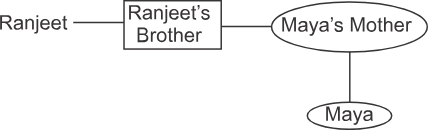
Here, the quadrilateral represents the male and the circular figure represents the female in the above figure.
So, from the above, Ranjeet's brother is the maternal uncle of Maya. Hence, the second option is correct.
2. Directions: Pointing to a picture of a boy, Shreya said, "He is the only son of the man who is the father of my father's only son's son". How is the boy related to Shreya?
Father
Nephew
Son-in-law
Brother
Solution:
As per the given information, the family tree will be as follows –
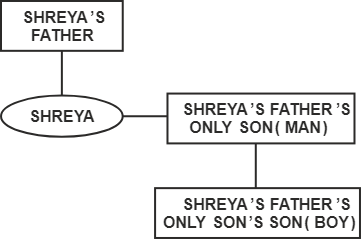
Here, the quadrilateral represents the male, and the circular figure represents the female in the figure.
So, from the above family tree, the boy is the nephew of Shreya. Hence, the second option is correct.
Shortcut Tricks to Solve Blood Relation Questions Quickly
- Use a family tree diagram, draw a simple chart and put the relatives by generations. Then use short labels so the relationships look clearer, not too wordy.
- Try to break long statements into smaller pieces, don’t rush. Work on one relationship at a time and solve it, then move on.
- Spot gender clues carefully: look for words like father, mother, brother, and sister. Don’t assume gender unless it is explicitly stated, otherwise you can misread what’s going on.
- Apply elimination first, remove the wrong options to narrow down the most logical answer, and save time.
Blood Relation Questions for SSC/ RRB Exams
1. Directions: Pointing towards a man, Parkhi said, "He is the brother of my son's mother". How that man is related to Parkhi's husband?
Nephew
Uncle
Son
Brother-in-law
Solution:
As per the given information, the family tree will be as follows –

Here, the quadrilateral represents the male, and the circular figure represents the female in the figure.
So, the man is the brother-in-law of Parkhi's husband. Hence, the fourth option is correct.
Blood Relation Questions for Banking/ Insurance Exams
1. Directions: T + U means T is the mother of U;
T – U means T is the husband of U;
T ÷ U means T is the son of U;
T × U means T is the sister of U.
If M ÷ N + O – P, how is N related to P?
Daughter
Mother-in-law
Father-in-law
Sister
Solution:
Given:
T + U ⇒ T is the mother of U
T – U ⇒ T is the husband of U
T ÷ U ⇒ T is the son of U
T × U ⇒ T is the sister of U
As per the given information, the family tree will be as follows –
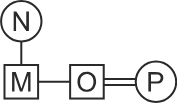
Here, the quadrilateral represents the male, and the circular figure represents the female in the figure.
So, N is the mother-in-law of P. Hence, the second option is correct.
2. Directions: A is B's brother, C is A's mother, D is C's father, and B is D's granddaughter. How is B related to F who is A's son?
1) Aunt
2) Cousin
3) Niece
4) Daughter
Solution:
As per the given information the family tree will be as follows –
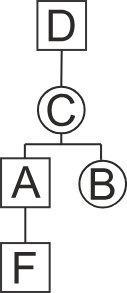
Here, the quadrilateral represents the male and the circular figure represents the female in the figure.
So, from the above family tree, B is the Aunt of F. Hence the first option is correct.
Blood Relation Tricks and Shortcuts for Competitive Exams
The table below summarizes smart approaches, common patterns, and time-saving techniques for different types of blood relation problems.
| Blood Relation Type | Common Clue Words | Quick Trick to Solve |
|---|---|---|
| Parent–Child | Father, Mother, Son, Daughter | Move one level up for parents and one level down for children |
| Siblings | Brother, Sister | Check same parents, same generation |
| Grandparents | Grandfather, Grandmother | Move two levels up from the person |
| Grandchildren | Grandson, Granddaughter | Move two levels down |
| Uncle / Aunt | Brother/Sister of parent | First go to parent, then move to their sibling |
| Nephew / Niece | Son/Daughter of sibling | First go to sibling, then to their child |
| Cousins | Children of uncle/aunt | Same generation, different parents |
| Maternal Relations | Mother’s side | Always trace from mother, not father |
| Paternal Relations | Father’s side | Always trace from father, not mother |
| Mixed Statements | He/she, indirect links | Draw a family tree immediately to avoid confusion |
| Direction-based Questions | Left/right facing | Fix reference direction first, then solve relations |
| Generation-based Questions | Oldest/youngest | Mark generation levels before identifying relation |
Common Mistakes to Avoid in Blood Relation Reasoning
Skipping the chart and trying to solve entirely in your head, which increases errors.
Misinterpreting gender due to ignoring pronouns in the question.
Overcomplicating by drawing unnecessary extra connections.
Forgetting that some relationships are relative to a point of view: the answer changes if the reference person changes.
Rushing without double-checking, especially in exam blood relation reasoning practice sets, where small errors cost marks.
Important Rules and Concepts for Blood Relation Reasoning (Quick Revision Table)
Here is a quick-reference table to help you solve blood relation reasoning questions easily and accurately:
| Concept / Rule | Key Logic | Shortcut / Trick | Example Insight |
|---|---|---|---|
| Generation Levels | Family is divided into levels | Top = elders, middle = parents, bottom = children | Grandfather → Father → Son |
| Gender Identification | Male or female matters | Use clues like son, daughter, brother, sister | “Daughter” = female |
| Direct Relation | Simple relationships | Identify immediate connection | A is father of B |
| Indirect Relation | Multi-step relationships | Break into smaller parts | A → B → C |
| Coded Relations | Symbols represent relations | Decode symbols first | A + B = A is father of B |
| Pointing Method | Real-life scenario | Replace with “my” to simplify | “My mother’s brother” |
| Family Tree Method | Visual representation | Draw diagram step by step | Helps avoid confusion |
| Paternal Side | Father’s family | Father’s brother = uncle | Easy identification |
| Maternal Side | Mother’s family | Mother’s sister = aunt | Track separately |
| Sibling Relation | Same parents | Brother/sister relation | B and C are siblings |
| Marriage Relation | Husband-wife link | Use double connection in diagram | A is husband of B |
| Elimination Technique | Remove wrong options | Use logic to narrow answers | MCQ solving |
| Direction of Relation | Upward or downward | Parent vs child difference | Father vs son |
Non-Verbal Reasoning Topics
Non-Verbal Reasoning Topics are commonly asked in competitive exams to assess speed, accuracy, and visual reasoning ability. Below are the key non-verbal reasoning topics you should practice for accuracy and speed.
Frequently Asked Questions (FAQs)
Blood relations are asked in almost all competitive exams like SSC, Railway, Teaching, Insurance, Defence, Banking, CUET, IPMAT and other competitive exams.
Blood relation reasoning is a type of logical reasoning where you identify relationships between family members based on given statements and determine how two people are related.
Start by reading the question carefully, identify key relationships, draw a simple family tree diagram, and then connect each relation step by step to reach the final answer.
The main types include direct relation questions, coded blood relation questions, and pointing-based questions.
Blood relation questions are asked in SSC exams and weightage is 1 to 3 questions.
In the railways exam, 1 to 2 questions and in banking exams, 3 to 6 questions and in entrance exams it depends on the level and type of the exam. But 2 to 3 questions are expected in every exam.
The trick to solve the blood relation questions is that you have to draw the family tree to determine the relation between the members.
Follow the steps below to solve blood relation in reasoning:
1) In the beginning, you should draw a family tree to solve each type of question as it is the easiest way to solve the blood relations. Draw a family tree according to the generations as discussed above.
2) Try to solve the question by applying the information on yourself. Example: Hemant’s Mother = My mother.
3) Do not assume the gender by name if gender is mentioned then only you consider the gender. For example, My son’s child in this child can be anything either son or daughter.
4) Draw a family tree stepwise to solve the question quickly and accurately.
