


Series: Verbal Reasoning Practice Questions and Answers
Spotting the pattern is the key to solving series questions. Whether it is letters, numbers, or even words, you have to identify the underlying logic, to get the next term or the missing one. Series is a high scoring verbal reasoning topic, that keeps getting asked in SSC, Banking, CAT, XAT, and so on other competitive exams.
This Story also Contains
- What is Series in Verbal Reasoning ?
- Types of Series Reasoning
- How to solve series questions
- Tips for series questions
- Verbal Reasoning Topics
- Questionwise Weightage of Series Reasoning Questions in Competitive Exams
- Practice Questions For Repeating Pairs In Letter Series
- Practice Questions For Find The Next Term In The Letter Series
- Practice Questions For Missing Numbers In The Series
- Practice Questions For Wrong Numbers In The Series
- Practice Questions for the Mixed Series
- Series Questions for CAT/ MAT/ APICET/ TANCET/ KMAT/ JIPMAT
- Series Questions for APICET/ CUET
- Series Questions for SSC/ RRB exams
- Series Questions for Banking IBPS CWE Clerical/ IBPS RRB Clerical/ SBI Assistant/ Insurance Assistant exams
- Best Books for Series Reasoning Preparation
- Important Rules and Patterns for Series Reasoning
- Non Verbal Reasoning Topics

What is Series in Verbal Reasoning ?
Series reasoning means you figure out the pattern in a sequence of letters, numbers, or words, so you can decide what comes next or what’s absent.
Types of Series Reasoning
1) Letter-Based Series
2) Number-Based Series
3) Mixed Series
1. Letter-Based Series
In letter series questions, you need to detect the alphabet rule and then guess the missing, or the next term. Usually common types include repeating pair patterns and then next-term series as well.
1. Repeating Pair Series
Example:
In the following question, a number of letters are given. There are blanks which can be filled with the help of the letters of the options below. Pick the correct option and complete the series:
_ aa _ ba _ bb _ ab _ aab
1) aaabb
2) babab
3) bbaab
4) bbbaa
Solution: To solve this question, first we need to divide the series into parts and then we need to fill in the blanks of each part with the letters given in the option one by one. Through this, we will be able to identify the pattern being followed in the given series easily.
The sequence given is _ aa _ ba _ bb _ ab _ aab.
First, divide the series:- _ aa _ / ba _ b / b _ ab / _ aab
Now, fill in the blanks with the given options one by one.
So, only third option makes a sequence as baab / baab / baab / baab.
2. Find the next term in the letter series
Letter series questions tend to ask you to figure out the pattern using the alphabet positions. Usual pattern ideas are like alphabetical order, or the reverse order, fixed gaps in between, or a repeating letter group that just keeps coming back. Sometimes it’s a climb upward, or a steady drop down, and other times you see addition or subtraction based on the letter positions. Tip: ,learn the alphabet positions (A = 1 to Z = 26) and keep practicing different kinds of patterns, so your speed gets better.
2. Number Based Series
In number series questions you look for a logical rule, often involving operations such as addition, subtraction, multiplication, division, squares, cubes, or even prime numbers.
There are two kinds you will see the most, like this:
Missing Number: you need to work out the missing term by figuring the pattern first.
Wrong Number: you identify the number that does not belong in the sequence.
a) Missing Number In The Series
A series that has a number or two missing inside of it. The aspirants are expected to spot a certain pattern thats pushing the series ahead and after they do that, then they have to figure out what those missing number(s) are, exactly, based on that pattern.
Example:
Which number will replace the question mark (?) in the following series?
58, 59, 51, 78, 14,?
a) 97 b) 139 c) 83 d) 163
Solution:
The pattern is as follows –
58 + (1)³ = 58 + 1 = 59
59 – (2)³ = 59 – 8 = 51
51 + (3)³ = 51 + 27 = 78
78 – (4)³ = 78 – 64 = 14
14 + (5)³ = 14 + 125 = 139
So, 139 is the missing number of the series. Hence, the second option is correct.
b) Wrong Number In Series
In this type of series, a number is incorrect. We need to find out the number by determining the pattern being followed in the series.
Example:
4, 10, 16, 21, 28, 34
a) 10 b) 21 c) 28 d) 34
Solution:
Here, the difference between the numbers of the series is 6. But the difference between 16 and 21 is 5. So, the wrong number is 21. Instead of 21, it should be 22. Hence, the second option is correct.
3. Mixed Series
This type of series consists of questions based on alphabet, numeric or both.
Example:
AK12, GV29, LF18, PO?
a) 32 b) 31 c) 38 d) 34
Answer:
The sum of the numeric position of the letters according to the English alphabet equals the number of the series. Place value of P = 16 and O = 15. So, the missing number = 16 + 15 = 31. Hence, the second option is correct.
How to solve series questions
- First, take a good look at the sequence carefully . Don’t just skim it, try to notice small changes.
- Then, try to identify the pattern, it can be alphabetical, numerical, or something more logical.
- After that, use the pattern to figure out the missing term, or just the next one.
- Finally make sure your answer ,matches what the sequence is doing, not something close, but actually fits.
Tips for series questions
- Start by learning alphabet positions (A = 1 to Z = 26) and the opposite letters too.
- Revise the usual number ideas like squares, cubes, and prime numbers, those come up a lot.
- Watch for operations such as addition, subtraction, multiplication, and division.
- And last thing, practice regularly . The more you do it, the faster you get at spotting the pattern in the first place.
Verbal Reasoning Topics
If you want to improve faster, explore the verbal reasoning topics below. They’re meant to strengthen your overall reasoning skills for competitive exams.
Questionwise Weightage of Series Reasoning Questions in Competitive Exams
The number of questions based on series varies from exam to exam -
1) Series questions asked in SSC exams i.e. SSC MTS, SSC CGL, SSC CHSL, SSC CPO, Steno - 2 to 4 questions.
2) Series questions asked in Banking exams i.e., IBPS PO, IBPS Clerk, RRB PO, RRB Clerk - 5 to 6 questions.
3) Series questions asked in the RRB exam i.e. Group D, NTPC, JE, ALP etc - 2 to 3 questions.
Practice Questions For Repeating Pairs In Letter Series
1. Directions: Select the option that represents the letters that when sequentially placed from left to right in the blanks below will complete the letter series.
YO_LECT_OPL_C_YOP_ _CTYOPLE_T
PEYTELC
PYETLEC (correct)
PYECTLE
PEYTLCE
Solution-
Given:
YO_LECT_OPL_C_YOP__CTYOPLE_T
To fill the series we have to divide the series – YO_LECT / _OPL_C_ / YOP__CT / YOPLE_T
Let's check each option –
First option: PEYTELC; YOPLECT / EOPLYCT/ YOPELCT / YOPLECT (No repetitive pattern is followed)
Second option: PYETLEC; YOPLECT / YOPLECT / YOPLECT / YOPLECT (YOPLECT is repeated)
Third option: PYECTLE; YOPLECTYOPLECCYOPTLCTYOPLEET (No repetitive pattern is followed)
Fourth option: PEYTLCE; YOPLECTEOPLYCTYOPLCCTYOPLEET (No repetitive pattern is followed)
So, only the second option follows a pattern. Hence, the second option is correct.
2. Directions: Select the option that represents the letters that when placed from left to right in the following blanks will complete the letter series.
ASDF_A_ _FG_UD_GA_ _FG
GTDAFVD (correct)
FTEAFWD
FTDAFVD
GTEAGXE
Solution-
Given:
ASDF_A_ _FG_UD_GA_ _FG
To fill the series we have to divide the series – ASDF_ / A_ _FG / _UD_G / A_ _FG
Let's check each option –
First option: GTDAFVD; ASDFG / ATDFG / AUDFG / AVDFG (In each part, the second letter is increased by 1 place, and the rest of the letters are the same)
Second option: FTEAFWD; ASDFF / ATEFG / AUDFG / AWDFG (No repetitive pattern is followed)
Third option: FTDAFVD; ASDFF / ATDFG / AUDFG / AVDFG (No repetitive pattern is followed)
Fourth option: GTEAGXE; ASDFG / ATEFG / AUDGG / AXEFG (No repetitive pattern is followed)
So, only the first option follows a pattern. Hence, the first option is correct.
3. Directions: Select the option that represents the letters that when sequentially placed from left to right in the blanks below will complete the letter series.
T_OJEW_TRO_EWF_ROJ_WFTR_JE_F
RFJTEOW (correct)
RJFOTWE
RJFTWOE
RFJOTEW
Solution-
Given:
T_OJEW_TRO_EWF_ROJ_WFTR_JE_F
To fill the series we have to divide the series – T_OJEW_ / TRO_EWF / _ROJ_WF / TR_JE_F
Let's check each option –
First option: RFJTEOW; TROJEWF / TROJEWF / TROJEWF / TROJEWF (TROJEWF is repeated)
Second option: RJFOTWE; TROJEWJ / TROFEWF / OROJTWF / TRWJEEF (No repetitive pattern is followed)
Third option: RJFTWOE; TROJEWJ / TROFEWF / TROJWWF / TROJEEF (No repetitive pattern is followed)
Fourth option: RFJOTEW; TROJEWF / TROJEWF / OROJTWF / TREJEWF (No repetitive pattern is followed)
So, only the first option follows a pattern. Hence, the first option is correct.
4. Directions: Select the option that represents the letters that, when placed from left to right in the blanks below, will complete the letter series.
_RQ_PR_S_ _QSPRQ_
PQRSPR
PSQPRS (correct)
PSRQPS
PRQSPS
Solution-
Given:
_RQ_PR_S_ _QSPRQ_
Check the order of the letters in the given series.
To fill the series we have to divide the series – _RQ_ / PR_S / _ _QS / PRQ_
Let's check the options –
First option: PQRSPR; PRQQ/ PRRS / SPQS / PRQR (No repeated pattern has been found.)
Second option: PSQPRS; PRQS / PRQS / PRQS / PRQS (PRQS is the repeated letter cluster.)
Third option: PSRQPS; PRQS / PRRS / QPQS / PRQS (No repeated pattern has been found.)
Fourth option: PRQSPS; PRQR / PRQS / SPQS / PRQS (No repeated pattern has been found.)
So, PRQS is the repeated letter cluster in the second option. Hence, the second option is correct.
5. Directions: In the following question, which set of letters, when sequentially placed in the gaps in the given letter series, will complete it?
c_e_cd_f_d_f
dfcec
dfece (correct)
cfede
cdfed
Solution-
Given:
c_e_cd_f_d_f
Divide the series into letter clusters – c_ e_ / cd _f /_d _f
Let's check each option –
First option: dfcec; cdef / cdcf / edcf (No repeated pattern found.)
Second option: dfece; cdef / cdef / cdef (cdef is repeated in the series.)
Third option: cfede; ccef / cdef / ddef (No repeated pattern found.)
Fourth option: cdfed; cced / cdff / eddf (No repeated pattern found.)
So, the series becomes→cdefcdefcdef. Hence, the second option is correct.
Practice Questions For Find The Next Term In The Letter Series
1. Directions: Select the letter cluster from among the given options that can replace the question mark (?) in the following series.
PQJ, LMF, HIB, DEX, ?
ZAV
ZBT
ZAT (correct)
ZAU
Solution-
Given:
PQJ, LMF, HIB, DEX, ?
Subtract 4 from each letter of the given term, to get the required missing term.
PQJ→P – 4 = L; Q – 4 = M; J – 4 = J→LMF
LMF→L – 4 = H; M – 4 = I; F – 4 = B→HIB
HIB→H – 4 = D; I – 4 = E; B – 4 = X→DEX
DEX→D – 4 = Z; E – 4 = A; X – 4 = T→ZAT
Therefore, the required missing term in the series is ZAT. Hence, the third option is correct.
2. Directions: Which of the following letter clusters will replace the question mark (?) in the given series?
ZBQ, BFL, ?, FNB, HRW, JVR
DKG
DJF
DJG (correct)
DKF
Solution-
Given:
ZBQ, BFL, ?, FNB, HRW, JVR
Add 2 and 4 to the place values of the first and second letters and subtract 5 from the place value of the third letter of the given clusters to get the letters of the next term.
ZBQ→Z + 2 = B; B + 4 = F; Q – 5 = L→BFL
BFL→B + 2 = D; F + 4 = J; L – 5 = G→DJG
DJG→D + 2 = F; J + 4 = N; G – 5 = B→FNB
FNB→F + 2 = H; N + 4 = R; B – 5 = W→HRW
HRW→H + 2 = J; R + 4 = V; W – 5 = R→JVR
So, DJG is the required letter cluster of the series. Hence, the third option is correct.
3. Directions: Which of the following terms will replace the question mark (?) in the given series?
XGR, TKN, POJ, LSF, ?, DAX
HVB
HWB (correct)
GWB
HWA
Solution-
Given:
XGR, TKN, POJ, LSF, ?, DAX
Subtract and add 4 alternatively to the place values of the letters in the clusters.
XGR→X – 4 = T; G + 4 = K; R – 4 = N→TKN
TKN→T – 4 = P; K + 4 = O; N – 4 = J→POJ
POJ→P – 4 = L; O + 4 = S; J – 4 = F→LSF
LSF→L – 4 = H; S + 4 = W; F – 4 = B→HWB
HWB→H – 4 = D; W + 4 = A; B – 4 = X→DAX
So, HWB is the required missing term of the series. Hence, the second option is correct.
4. Directions: Which letter cluster will replace the question mark (?) to complete the given series?
BZVR, DXWQ, ?, HTYO, JRZN
FXPV
FXPN
FVXP (correct)
FVPX
Solution-
Given:
BZVR, DXWQ, ?, HTYO, JRZN
Add 2, and 1 to the first and the third letters respectively, and subtract 2 and 1 from the second and the fourth letters of the previous term to get the next term in the series.
BZVR→B + 2 = D; Z – 2 = X; V + 1 = W; R – 1 = Q→DXWQ
DXWQ→D + 2 = F; X – 2 = V; W + 1 = X; Q – 1 = P→FVXP
FVXP→F + 2 = H; V – 2 = T; X + 1 = Y; P – 1 = O→HTYO
HTYO→H + 2 = J; T – 2 = R; Y + 1 = Z; O – 1 = N→JRZN
So, FVXP is the missing term of the series. Hence, the third option is correct.
5. Directions: Which of the following letter clusters will replace the question mark (?) in the given series to make it logically complete?
ADZ, GJF, MPL, SVR, ?
XYB
YBX (correct)
XBY
YXB
Solution-
Given:
ADZ, GJF, MPL, SVR, ?
Add 6 to each letter cluster to get the next term in the given series –
ADZ→A + 6 = G, D + 6 = J, Z + 6 = F→GJF
GJF→G + 6 = M, J + 6 = P, F + 6 = L→MPL
MPL→M + 6 = S, P + 6 = V, L + 6 = R→SVR
SVR→S + 6 = Y, V + 6 = B, R + 6 = X→YBX
So, YBX is the missing term. Hence, the second option is correct.
Practice Questions For Missing Numbers In The Series
1. Directions: Which of the following numbers will replace the question mark (?) in the given series?
1, 4, 27, 16, 125, ?
216
36 (correct)
343
49
Solution-
Given:
1, 4, 27, 16, 125, ?
In the above-given series –
(1)³ = 1; (2)² = 4; (3)³ = 27; (4)² = 16; (5)³ = 125
According to the above pattern, the next number will be – (6)² = 36
So, 36 is the missing term. Hence, the second option is correct.
2. Directions: Which of the following numbers will replace the question mark (?) in the given series?
18, 20, 22, 27, 32, 39, ?
47
42
46 (correct)
45
Solution-
Given:
18, 20, 22, 27, 32, 39,?
Add 2, 5, and 7 to the numbers in the series to get the next term respectively.
18 + 2 = 20; 20 + 2 = 22; 22 + 5 = 27; 27 + 5 = 32; 32 + 7 = 39; 39 + 7 = 46
So, 46 is the missing number of the series. Hence, the third option is correct.
3. Directions: Select the number from among the given options that can replace the question mark (?) in the following series.
31, 37, 46, 60, 81, ?
117
106
122
111 (correct)
Solution-
Given:
31, 37, 46, 60, 81, ?
The difference of the numbers being added to the terms of the series is an odd number.
The pattern is as follows –
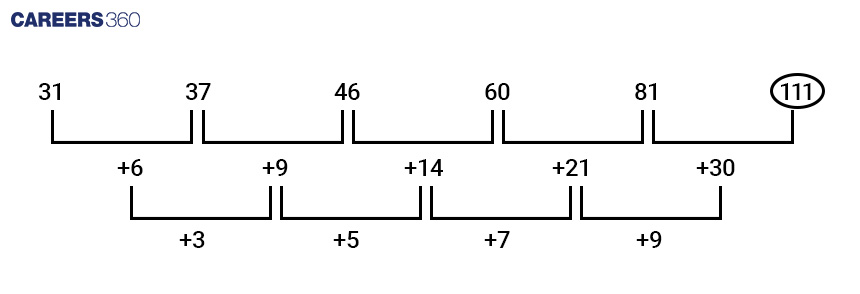
So, 111 is the missing number of the given series. Hence, the fourth option is correct.
4. Directions: Which of the following numbers will replace the question mark (?) in the given series?
27, 38, ?, 68, 87, 110
47
50
51 (correct)
53
Solution-
Given:
27, 38, ?, 68, 87, 110
Add consecutive prime numbers (starting from 11) to each number in the given series to get the next number of the series.
27 + 11 = 38; 38 + 13 = 51; 51 + 17 = 68; 68 + 19 = 87; 87 + 23 = 110
So, 51 is the missing number. Hence, the third option is correct.
5. Directions: Which of the following numbers will replace the question mark (?) in the given series?
3, 8, 15, 26, 39, ?
61
49
52
56 (correct)
Solution-
Given:
3, 8, 15, 26, 39, ?
Add consecutive prime numbers (starting from 5) to each number in the given series to get the next number of the series.
3 + 5 = 8; 8 + 7 = 15; 15 + 11 = 26; 26 + 13 = 39; 39 + 17 = 56
So, 56 is the missing term. Hence, the fourth option is correct.
Practice Questions For Wrong Numbers In The Series
1. Directions: Identify the number that does NOT belong to the following series.
104, 108, 54, 58, 29, 31
58
29
54
31 (correct)
Solution-
Given:
104, 108, 54, 58, 29, 31
Add 4 and divide the number by 2 alternatively in each number, to determine the wrong number in the series –
104 + 4 = 108; 108 ÷ 2 = 54; 54 + 4 = 58; 58 ÷ 2 = 29; 29 + 4 = 33 ≠ 31
So, 31 does not belong to the series. Hence, the fourth option is correct.
2. Directions: Select the number from among the given options that can replace the question mark (?) in the following series.
1, 3, 17, 55, ?, 179, 265, 375
169
157
91
105 (correct)
Solution-
Given:
1, 3, 17, 55, ?, 179, 265, 375
The pattern is as follows –
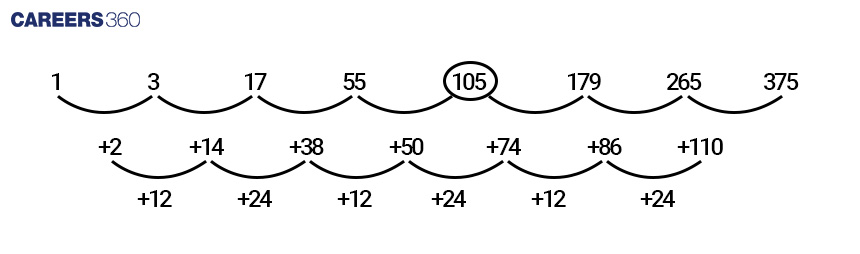
So, the required missing number in the series is 105. Hence, the fourth option is correct.
3. Directions: Identify the number that does NOT belong to the following series.
30, 15, 15, 22.5, 46, 112.5
46 (correct)
112.5
22.5
30
Solution-
Given:
30, 15, 15, 22.5, 46, 112.5
Multiply the numbers by 0.5; 1; 1.5; 2; and 2.5 to obtain the next number.
30 × 0.5 = 15
15 × 1 = 15
15 × 1.5 = 22.5
22.5 × 2 = 45
45 × 2.5 = 112.5
So, the wrong number in the series is 46. Hence, the first option is correct.
4. Directions: Identify the number that does not belong to the following series.
414, 430, 462, 526, 664, 910
462
526
910
664 (correct)
Solution-
Given:
414, 430, 462, 526, 664, 910
414 + 16 = 430; 430 + 32 = 462; 432 + 64 = 526; 526 + 128 = 654(but the given number is 664); 654 + 256 = 910
From the given series, we see that 664 is incorrect. Hence, the fourth option is correct.
5. Directions: Identify the number that does NOT belong to the following series.
1.5, 2, 3, 6, 18, 108, 1964
108
6
18
1964 (correct)
Solution-
Given:
1.5, 2, 3, 6, 18, 108, 1964
Multiply consecutive terms of the series to get the next term –
1.5 × 2 = 3; 2 × 3 = 6; 3 × 6 = 18; 6 × 18 = 108; 18 × 108 = 1944
But the number given in the series is 1964.
So, from the given series, 1964 is incorrect. Hence, the fourth option is correct.
Practice Questions for the Mixed Series
1. Directions: The following series has one term missing. Select the correct alternative from the options below to complete the series.
A7F, E15J, I23N, ?
R13M
M31R (correct)
R23M
R37S
Solution-
Given:
A7F, E15J, I23N, ?
Add 4 to each letter and 8 to each number of the previous term to obtain the next term in the series.
A7F→A + 4 = E; 7 + 8 = 15; F + 4 = J→E15J
E15J→E + 4 = I; 15 + 8 = 23; J + 4 = N→I23N
I23N→I + 4 = M; 23 + 8 = 31; N + 4 = R→M31R
M31R is the missing term of the series. Hence, the second option is correct.
2. Directions: A series is given with one term missing. Choose the correct alternative from the given ones that will complete the series.
?, Planning, Strategy, Marketing, Finance
Realization
Success
Failure
Idea (correct)
Solution-
Given:
?, Planning, Strategy, Marketing, Finance
To start a business, we need to come up with an idea, plan accordingly, strategize to implement the idea, identify target markets, and consider the finances required throughout the entire process.
So, the order of steps of the startup business project is as follows –
Idea < Planning < Strategy < Marketing < Finance
So, the idea is the missing term of the given series. Hence, the fourth option is correct.
3. Directions: A series is given with one term missing. Choose the correct alternative from the given ones that will complete the series.
Jaipur, Rajasthan, India, ?
Europe
Antarctica
Asia (correct)
Australia
Solution -
Given:
Jaipur, Rajasthan, India, ?
To complete the series, we need to provide a larger geographical region that encompasses India.
Asia has a larger geographical region that encompasses India.
So, the order of the series is –
Jaipur < Rajasthan < India < Asia
So, Asia is the missing term of the given series. Hence, the third option is correct.
4. Directions: In the following question, a series is given with one or more term(s) missing. Choose the correct alternative from the given options.
az225, cx423, ev621, _?, _?
jq1116, kp1215
go1314, mn126
gt819, ir1017 (correct)
gu720, gt819
Solution-
Given:
az225, cx423, ev621, _?, _ ?
az225→a + 2 = c; a and z are opposite pairs; 225 + 198 = 423
cx423→c + 2 = e; c and x are opposite pairs; 423 + 198 = 621
ev621→e + 2 = g; e and v are opposite pairs; 621 + 198 = 819
gt819→g + 2 = i; g and t are opposite pairs; 819 + 198 = 1017
So, gt819 and ir1017 are the missing terms of the series. Hence, the third option is correct.
5. Directions: In the following question, a series is given with one (or more) number(s)/alphabet missing. Choose the correct alternative from the given options.
J2Z, K4X, L7V, M11T, ?
O17R
N17S
R16N
N16R (correct)
Solution-
Given:
J2Z, K4X, L7V, M11T, ?
Add 1 to the place value of the first letter and add consecutive natural numbers starting from 2 to the number of the previous term respectively, and subtract 2 from the third letter to obtain the next term in the series –
J2Z→J + 1 = K; 2 + 2 = 4; Z – 2 = X→K4X
K4X→K + 1 = L; 4 + 3 = 7; X – 2 = V→L7V
L7V→L + 1 = M; 7 + 4 = 11; V – 2 = T→M11T
M11T→M + 1 = N; 11 + 5 = 16; T – 2 = R→N16R
So, N16R is the missing term of the series. Hence, the fourth option is correct.
Series Questions for CAT/ MAT/ APICET/ TANCET/ KMAT/ JIPMAT
1) Directions: A series is given with one term missing. Select the correct alternative from the given ones that will complete the series.
ABC, WHP, SNC, OTP, ?
1) KQR
2) KAC
3) KZC
4) KYB
Hint: Subtract 4 from the place value of the first letter and, add 6 and 13 to the place value of the second and third letters of the previous term, to obtain the next term in the series.
Solution:
ABC→A – 4 = W; B + 6 = H; C + 13 = P→WHP
WHP→W – 4 = S; H + 6 = N; P + 13 = C→SNC
SNC→S – 4 = O; N + 6 = T; C + 13 = P→OTP
OTP→O – 4 = K; T + 6 = Z; P + 13 = C→KZC
So, KZC is the missing term in the series. Hence, the third option is correct.
2) Directions: Which one set of letters when sequentially placed in the gaps in the given letter series shall complete it?
no_m _l _o _m _ln_r _al
1) naromra
2) ranraom
3) noamrna
4) manrmao
Hint: Divide the series into parts and fill in the blanks with the options one by one to identify the pattern of the given series.
Solution:
To fill the series, we have to divide the series – no_m _l / _o _m _l / n_r _al
Let's check the options –
First option: naromra; nonmal / roomml / nrraal (No repeated pattern found.)
Second option: ranraom; normal / normal / normal (normal is repeated in the series.)
Third option: noamrna; nonmol / aommrl / nnraal (No repeated pattern found.)
Fourth option: manrmao; nommal / normml / naroal (No repeated pattern found.)
So, the series becomes→normalnormalnormal. Hence, the second option is correct.
3) Directions: Which of the following numbers will replace the question mark (?) in the given series?
730, 692, 654, ?, 578
1) 612
2) 626
3) 616
4) 622
Hint: Find the difference between the numbers to obtain the missing number of the series.
Solution:
Let's check the difference between each number of the given series –
Like, 730 – 692 = 38
And, 692 – 654 = 38
Thus, the common difference between the two numbers is 38.
Similarly, 654 – 38 = 616
616 – 38 = 578
Thus, the missing number is 616.
Hence, the third option is correct.
Series Questions for APICET/ CUET
1) Directions: A series is given with one term missing. Select the correct alternative from the given ones that will complete the series.
RTM, VZX, ZFI, DLT, ?
1) HRE
2) RST
3) TMO
4) HRS
Hint: Add 4, 6, and 11 to the place value of the first, second, and third letters of the previous term to get the next term.
Solution:
RTM→R + 4 = V; T + 6 = Z; M + 11 = X
VZX→V + 4 = Z; Z + 6 = F; X + 11 = I
ZFI→Z + 4 = D; F + 6 = L; I + 11 = T
DLT→D + 4 = H; L + 6 = R; T + 11 = E
So, HRE is the missing term of the given series. Hence, the first option is correct.
2) Directions: Which of the following numbers will replace the question mark (?) in the given series?
29, 33, ?, 113, 369
1) 55
2) 51
3) 54
4) 49
Hint: Add 4, 16, 64, and 256 to the numbers of the given series.
Solution:
The pattern is as follows –
29 + (2)2 = 29 + 4 = 33
33 + (2 × 2)2 = 33 + (4)2 = 33 + 16 = 49
49 + (2 × 4)2 = 49 + (8)2 = 49 + 64 = 113
113 + (2 × 8)2 = 113 + (16)2 = 113 + 256 = 369
So, 49 is the missing number. Hence, the fourth option is correct.
3) Directions: Which letter cluster will replace the question mark (?) to complete the given series?
NAME, NEME, ?, NOME, NUME
1) NMME
2) NKME
3) NIME
4) NJME
Hint: N, M, and E are constant in each term and each second letter of the given terms is a vowel.
Solution:
NAME, NEME, ?, NOME, NUME
N, M, and E are constant in each term and each second letter of the given terms is a vowel (a, e, i, o, u). Put these vowels in second place to obtain the next term in the series.
NAME→A is a vowel and next is E.
NEME→E is a vowel and next is I.
NIME→I is a vowel and next is O.
NOME→O is a vowel and next is U.
So, NIME is the missing term in the series. Hence, the third option is correct.
Series Questions for SSC/ RRB exams
1) Directions: Select the combination of letters that when sequentially placed in the blanks of the given series will make the series logically complete.
F_HIEH_JDIF_ _JEL
1) ELFX
2) GGKC
3) KGGG
4) FGEL
Hint: Substitute each option to find out the repeating pattern.
Solution:
To fill the series we have to divide the series – F_HI / EH_J / DIF_ / _JEL
Let's check each option –
First option: ELFX; FEHI / EHLJ / DIFF / XJEL (No repeated pattern has been found)
Second option: GGKC; FGHI / EHGJ / DIFK / CJEL (The first letter decreased by 1, the second letter increased by 1, the third letter decreased by 1 and the fourth letter increased by 1 in the given series)
Third option: KGGG; FKHI / EHGJ / DIFG / GJEL (No repeated pattern has been found)
Fourth option: FGEL; FFHI / EHGJ / DIFE / LJEL (No repeated pattern has been found)
So, the series becomes→FGHIEHGJDIFKCJEL. Hence, the second option is correct.
3) Directions: Which of the following letter clusters will replace the question mark (?) in the given series to make it logically complete?
CMW, MWG, WGQ, GQA, ?
1) AKQ
2) KAQ
3) QAK
4) QBL
Hint: Add 10 to the place value of each letter of the previous term to obtain the next term in the series.
Solution:
Here, add 10 to the place value of each letter of the previous term to obtain the next term in the series –
CMW→C + 10 = M; M + 10 = W; W + 10 = G
MWG→M + 10 = W; W + 10 = G; G + 10 = Q
WGQ→W + 10 = G; G + 10 = Q; Q + 10 = A
GQA→G + 10 = Q; Q + 10 = A; A + 10 = K
So, QAK is the missing term in the series. Hence, the third option is correct.
3) Directions: What should come in place of the question mark (?) in the given series?
84, 89, 98, 111, 128, ?
1) 139
2) 132
3) 149
4) 143
Hint: Determine the difference between two consecutive terms to get the required missing term.
Solution:
The difference between given numbers in the series is increasing by 4.
84 + 5 = 89; 89 + 9 = 98; 98 + 13 = 111; 111 + 17 = 128; 128 + 21 = 149
So, 149 is the missing term in the series. Hence, the third option is correct.
Series Questions for Banking IBPS CWE Clerical/ IBPS RRB Clerical/ SBI Assistant/ Insurance Assistant exams
1) Directions: What should come in place of the question mark (?) in the given series?
42, 30, ?, 12, 6, 2
1) 24
2) 20
3) 18
4) 22
Hint: Subtract even numbers in decreasing order starting from 12 from the previous number to get the next number of the series.
Solution:
In the above-given series, subtract even numbers in decreasing order starting from 12 from the previous number to get the next number.
42 – 12 = 30; 30 – 10 = 20; 20 – 8 = 12; 12 – 6 = 6; 6 – 4 = 2
So, the missing number is 20. Hence, the second option is correct.
2) Directions: Select the term from the given options that can replace the question mark (?) in the given series to make it logically complete.
BP 74, ?, FT 64, HV 59, JX 54
1) CS 70
2) DR 69
3) ET 68
4) ES 70
Hint: Add 2 to the place value of the letters and subtract 5 from the number to get the next term of the series.
Solution:
Add 2 to both the letters and subtract 5 from the number to get the next term of the series –
BP 74→B + 2 = D; P + 2 = R; 74 – 5 = 69→DR 69
DR 69→D + 2 = F; R + 2 = T; 69 – 5 = 64→FT 64
FT 64→F + 2 = H; T + 2 = V; 64 – 5 = 59→HV 59
HV 59→H + 2 = J; V + 2 = X; 59 – 5 = 54→JX 54
So, the missing term is DR 69. Hence, the second option is correct.
3) Directions: What should come in place of the question mark (?) in the given series?
48, 100, ?, 1232, 6170
1) 306
2) 280
3) 304
4) 214
Hint: Multiply the numbers with consecutive natural numbers from 2 onwards and add consecutive even numbers from 4 onwards to find the next term.
Solution:
In the given series, multiply the numbers with consecutive natural numbers from 2 onwards and add consecutive even numbers from 4 onwards to find the next term.
(48 × 2) + 4 = 96 + 4 = 100;
(100 × 3) + 6 = 300 + 6 = 306;
(306 × 4) + 8 = 1224 + 8 = 1232;
(1232 × 5) + 10 = 6160 + 10 = 6170
So, the missing number is 306. Hence, the first option is correct.
Best Books for Series Reasoning Preparation
This part points to the most recommended books, so you can build solid concepts and also practice series reasoning questions pretty well for competitive exams.
| Book Name | Author | Key Features | Best For |
|---|---|---|---|
| A Modern Approach to Verbal & Non-Verbal Reasoning | R.S. Aggarwal | Covers series, analogy, classification with detailed explanations and practice sets | Beginners and SSC aspirants |
| Analytical Reasoning | M.K. Pandey | Strong concept-building with advanced reasoning questions | Banking and MBA exams |
| A New Approach to Reasoning Verbal & Non-Verbal | B.S. Sijwali | Includes shortcut tricks and topic-wise practice | Beginners to intermediate level |
| Logical Reasoning | Arun Sharma | Concept-based learning with high-level questions | MBA entrance exams |
| Logical and Analytical Reasoning | A.K. Gupta | Wide coverage of reasoning topics with practice questions | All competitive exams |
| SSC Reasoning Chapterwise Solved Papers | Kiran Publications | Previous year series questions with detailed solutions | SSC exam preparation |
Important Rules and Patterns for Series Reasoning
This section covers the important rules and typical patterns that show up in series type questions, so you can spot the sequences fast and solve with good accuracy .
| Concept / Rule | Key Logic | Shortcut / Trick | Example Insight |
|---|---|---|---|
| Number Series | Mathematical pattern | Check +, −, ×, ÷ | 2, 4, 6, 8 |
| Alphabet Series | Position-based logic | Use A=1 to Z=26 | A, C, E |
| Difference Pattern | Gap between terms | Identify constant difference | +2, +3 |
| Ratio Pattern | Multiplication/division | Check ratio between terms | ×2, ÷3 |
| Alternating Pattern | Two patterns combined | Separate odd-even terms | Mixed logic |
| Square/Cube Pattern | Power-based sequence | Check squares or cubes | 1, 4, 9 |
| Reverse Pattern | Backward sequence | Check reverse order | Z, X, V |
| Mixed Pattern | Combination of rules | Solve step-by-step | Complex series |
| Elimination Technique | Remove wrong options | Focus on correct pattern | Faster solving |
Non Verbal Reasoning Topics
Explore the non verbal reasoning topics below, to reinforce your visual intuition and pattern recognition skills for competitive exams. This helps a lot with those timed questions, where the answer is hidden in what you can see rather than what you can say.
Frequently Asked Questions (FAQs)
They mostly rely on logical patterns, though some number series use basic mathematical operations.
Pattern recognition is the key concept, especially identifying consistent changes between terms.
There is no shortcut to solving questions based on series. The best way to improve is to practice solving questions of the series within a time limit. With enough practice, your brain will become quicker at recognising the logic behind questions of the series.
Series in reasoning is defined as any process which is running on a particular sequence. So, you have to find out these particular sequences in the given series in a question to get the answers.
There are three types of series in reasoning which are as follows:
Letter-based Series
Number-based Series
Mixed Series
To solve reasoning questions in reasoning you have to determine the pattern being followed among the numbers, letters, words or symbols. You have to identify the common difference between the letters or numbers, or whether the given series of numbers are square, cubes or prime numbers.