KCC Institute of Legal and Higher Education, Greater Noida
Law Admissions 2026 Open | Avail Merit-Based Scholarships


Have you ever wondered how mathematicians quickly determine whether a system of equations has a unique solution or not? The answer often lies in determinants, an important concept that works hand in hand with matrices in Class 12 Mathematics. In Class 12, a determinant is defined as a special numerical value associated with a square matrix, used to analyse the properties of the matrix and solve systems of linear equations. Determinants help in finding the inverse of a matrix and in checking whether equations have a unique solution, infinitely many solutions, or no solution at all.
This Story also Contains
Determinants also have real-life applications. They are used in engineering and physics to solve network problems, in computer graphics for transformations like rotation and scaling, and in economics to analyse linear models. In this article, you will learn about determinants, including their definitions, formulas, properties, and methods to evaluate determinants of different orders. With solved examples and practice problems, this guide will help you build strong conceptual clarity and prepare confidently for Class 12 board exams and competitive examinations.
Determinants in Mathematics are used to study square matrices and solve systems of linear equations efficiently. They play an important role in higher mathematics and have practical applications in science, engineering, and economics.
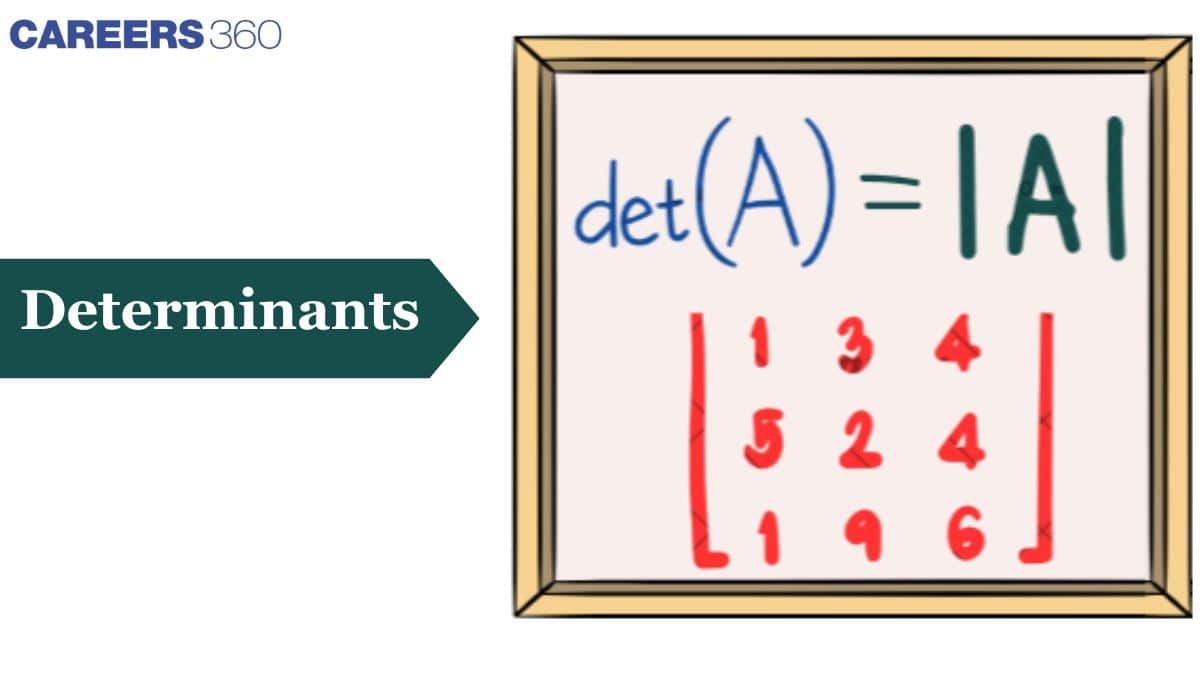
The determinant of a matrix A is a number that is calculated from the matrix. For a determinant to exist, the matrix $A$ must be a square matrix. A matrix is only a representation, while the determinant is the value of the matrix. The determinant of a matrix is denoted by $\operatorname{det} \mathrm{A}$ or $|\mathrm{A}|$.
Law Admissions 2026 Open | Avail Merit-Based Scholarships
BBA/MBA/PGDM Early Bird Applications Deadline 06th Nov'26. Apply now using coupon code CAREER250 and get ₹250 off the application fee
To every square matrix $A=\left[a_{i j}\right]$ of order $n$, we can associate a number called the determinant of the matrix $A$.
If $A=\left[\begin{array}{cccc}a_{11} & a_{12} & \cdots & a_{1 n} \\ a_{21} & a_{22} & \cdots & a_{2 n} \\ \vdots & \vdots & \ddots & \vdots \\ a_{n 1} & a_{n 2} & \cdots & a_{n n}\end{array}\right]$,
then determinant of $A$ is written as
$|A|=\left|\begin{array}{cccc}a_{11} & a_{12} & \cdots & a_{1 n} \\ a_{21} & a_{22} & \cdots & a_{2 n} \\ \vdots & \vdots & \ddots & \vdots \\ a_{n 1} & a_{n 2} & \cdots & a_{n n}\end{array}\right|$.
Let $A=\left[a_{i j}\right]_{3 \times 3}$ be a given square matrix of order $3$ . The minor of an arbitrary element $a_{i j}$ is the determinant obtained by deleting the $i^{\text {th }}$ row and $j^{\text {th }}$ column in which the element $a_{i j}$ stands. The minor of $a_{i j}$ is usually denoted by $M_{i j}$.
The cofactor is a signed minor. The cofactor of $a_{i j}$ is usually denoted by $A_{i j}$ and is defined as $A_{i j}=(-1)^{i+j} M_{i j}$.
For instance, consider the $3 \times 3$ matrix defined by $A=\left[\begin{array}{lll}a_{11} & a_{12} & a_{13} \\ a_{21} & a_{22} & a_{23} \\ a_{31} & a_{32} & a_{33}\end{array}\right]$
Then the minors and cofactors of the elements $a_{11}, a_{12}, a_{13}$ are given as follows :
(i) Minor of $a_{11}$ is $\mathrm{M}_{11} \quad=\left|\begin{array}{ll}a_{22} & a_{23} \\ a_{32} & a_{33}\end{array}\right|=a_{22} a_{33}-a_{32} a_{23}$
Cofactor of $a_{11}$ is $A_{11}=(-1)^{1+1} M_{11}=\left|\begin{array}{ll}a_{22} & a_{23} \\ a_{32} & a_{33}\end{array}\right|=a_{22} a_{33}-a_{32} a_{23}$
(ii) Minor of $a_{12}$ is $M_{12} \quad=\left|\begin{array}{ll}a_{21} & a_{23} \\ a_{31} & a_{33}\end{array}\right|=a_{21} a_{33}-a_{31} a_{23}$
Cofactor $a_{12}$ is $A_{12} \quad=(-1)^{1+2}\left|\begin{array}{ll}a_{21} & a_{23} \\ a_{31} & a_{33}\end{array}\right|=-\left(a_{21} a_{33}-a_{31} a_{23}\right)$
(iii) Minor of $a_{13}$ is $M_{13} \quad=\left|\begin{array}{ll}a_{21} & a_{22} \\ a_{31} & a_{32}\end{array}\right|=a_{21} a_{32}-a_{31} a_{22}$
Cofactor of $a_{13}$ is $A_{13}=(-1)^{1+3} M_{13}=\left|\begin{array}{ll}a_{21} & a_{22} \\ a_{31} & a_{32}\end{array}\right|=a_{21} a_{32}-a_{31} a_{22}$.
The determinant formula for $2 \times 2$ matrices
$
\mathrm{A}=\left[\begin{array}{ll}
a_1 & a_2 \\
b_1 & b_2
\end{array}\right]
$
then $\operatorname{det} \mathrm{A}$ is :
$
|\mathrm{A}|=\left|\begin{array}{ll}
a_1 & a_2 \\
b_1 & b_2
\end{array}\right|=\mathrm{a}_1 \mathrm{b}_2-\mathrm{a}_2 \mathrm{b}_1
$
For a $3 \times 3$ matrix determinant can be calculated in the following way :
$
\text { let } \mathrm{A}=\left[\begin{array}{lll}
a_1 & a_2 & a_3 \\
b_1 & b_2 & b_3 \\
c_1 & c_2 & c_3
\end{array}\right]
$
then we find $\operatorname{det} \mathrm{A}$ in following way
$
|A|=a_1\left(b_2 c_3-b_3 c_2\right)-a_2\left(b_1 c_3-c_1 b_3\right)+a_3\left(b_1 c_2-b_2 c_1\right)
$
This same process we follow to evaluate the determinant of the matrix of any order. Notice that we start the first term with the +ve sign, then the 2nd with the -ve sign and the 3rd again +ve sign; this sign sequence is followed for any order of the matrix.
To calculate the determinant of a matrix, first ensure it is square (same number of rows and columns). For a 2 × 2 matrix, multiply the diagonal elements and subtract the product of the off-diagonal elements. Let us understand in detail:
Let $A=\left[\begin{array}{ll}a_{11} & a_{12} \\ a_{21} & a_{22}\end{array}\right]$ be a matrix of order 2. Then the determinant of $A$ is defined as
$
|A|=\left|\begin{array}{ll}
a_{11} & a_{12} \\
a_{21} & a_{22}
\end{array}\right|=a_{11} \quad a_{22}-a_{21} a_{12}
$
Example: Let $|A|=$ $\left|\begin{array}{cc}2 & 4 \\ -1 & 2\end{array}\right|=(2 \times 2)-(-1 \times 4)=4+4=8$.
The determinant of the matrix $
\mathrm{A}=\left[\begin{array}{lll}
a_1 & a_2 & a_3 \\
b_1 & b_2 & b_3 \\
c_1 & c_2 & c_3
\end{array}\right]
$ is given by
$\qquad|\mathrm{A}|=\left|\begin{array}{lll}a_1 & b_1 & c_1 \\ a_2 & b_2 & c_2 \\ a_3 & b_3 & c_3\end{array}\right|=a_1\left|\begin{array}{ll}b_2 & c_2 \\ b_3 & c_3\end{array}\right|-b_1\left|\begin{array}{ll}a_2 & c_2 \\ a_3 & c_3\end{array}\right|+c_1\left|\begin{array}{ll}a_2 & b_2 \\ a_3 & b_3\end{array}\right|$
Example: $|A|= \left|\begin{array}{ccc}0 & \sin \alpha & -\cos \alpha \\ -\sin \alpha & 0 & \sin \beta \\ \cos \alpha & -\sin \beta & 0\end{array}\right|$
$\begin{aligned} & =0\left|\begin{array}{cc}0 & \sin \beta \\ -\sin \beta & 0\end{array}\right|-\sin \alpha\left|\begin{array}{cc}-\sin \alpha & \sin \beta \\ \cos \alpha & 0\end{array}\right|-\cos \alpha\left|\begin{array}{cc}-\sin \alpha & 0 \\ \cos \alpha & -\sin \beta\end{array}\right| \\ & =0-\sin \alpha(0-\sin \beta \cos \alpha)-\cos \alpha(\sin \alpha \sin \beta-0) \\ & =\sin \alpha \sin \beta \cos \alpha-\cos \alpha \sin \alpha \sin \beta=0\end{aligned}$
Evaluation of determinants of matrices of order $3$ by the Sarrus rule,
Let $A=\left[a_{i j}\right]_{3 \times 3}=\left[\begin{array}{lll}a_{11} & a_{12} & a_{13} \\ a_{21} & a_{22} & a_{23} \\ a_{31} & a_{32} & a_{33}\end{array}\right]$
Write the entries of Matrix $A$ as follows :

Then $|A|$ is computed as follows :
$
|A|=\left[a_{11} a_{22} a_{33}+a_{12} a_{23} a_{31}+a_{13} a_{21} a_{32}\right]-\left[a_{33} a_{21} a_{12}+a_{32} a_{23} a_{11}+a_{31} a_{22} a_{13}\right]
$
Notice that we start the first term with the +ve sign, then the 2nd with the -ve sign and the 3rd again +ve sign; this sign sequence is followed for any order of matrix.
Example: $A=\left[\begin{array}{ccc}3 & 4 & 1 \\ 0 & -1 & 2 \\ 5 & -2 & 6\end{array}\right]$

$|A| =[3(-1)(6)+4(2)(5)+1(0)(-2)]-[5(-1)(1)+(-2)(2) 3+6(0)(4)] $
$ =[-18+40+0]-[-5-12+0]$
$=22+17=39$
There are two types of multiplication of determinants:
1) Multiplication of a determinant by a scalar quantity
2) Multiplication of a determinant by another determinant
If $A$ is a square matrix and $k$ is a scalar quantity then, $|\mathrm{kA}|=\mathrm{k}^{\mathrm{n}}|\mathrm{A}|$, where $n$ is the order of $A$
Determinant multiplication is a binary operation that produces a determinant from two determinants. For determinant multiplication, the order of both determinants should be the same.
Multiplication of two determinants can be done by 4 methods, namely,
Let the two determinants of second order be
$\Delta_1=\left|\begin{array}{ll}a_1 & b_1 \\ a_2 & b_2\end{array}\right| \quad$ and $\quad \Delta_2=\left|\begin{array}{ll}\alpha_1 & \beta_1 \\ \alpha_2 & \beta_2\end{array}\right|$
We can multiply these by row-by-row or column-by-column or row-by-column or column-by-row
Row-by-row multiplication of these two determinants is given by
$\Delta_1 \times \Delta_2=\left|\begin{array}{ll}\left(a_1 \alpha_1+b_1 \alpha_2\right) & \left(a_1 \beta_1+b_1 \beta_2\right) \\ \left(a_2 \alpha_1+b_2 \alpha_2\right) & \left(a_2 \beta_1+b_2 \beta_2\right)\end{array}\right|$
Row-by-column multiplication of these two determinants is given by
$\Delta_1 \times \Delta_2=\left|\begin{array}{ll}\left(a_1 \alpha_1+b_1 \beta_1\right) & \left(a_1 \alpha_2+b_1 \beta_2\right) \\ \left(a_2 \alpha_1+b_2 \beta_1\right) & \left(a_2 \alpha_2+b_2 \beta_2\right)\end{array}\right|$
Column-by-row multiplication of these two determinants is given by
$\Delta_1 \times \Delta_2=\left|\begin{array}{ll}\left(a_1 \alpha_1+a_2 \alpha_2\right) & \left(b_1 \beta_1+b_2 \beta_2\right) \\ \left(a_1 \alpha_1+a_2 \alpha_2\right) & \left(b_1 \beta_1+b_2 \beta_2\right)\end{array}\right|$
Column-by-column multiplication of these two determinants is given by
$\Delta_1 \times \Delta_2=\left|\begin{array}{ll}\left(a_1 \alpha_1+a_2 \alpha_2\right) & \left(b_1 \beta_1+b_2 \beta_2\right) \\ \left(a_1 \alpha_1+a_2 \alpha_2\right) & \left(b_1 \beta_1+b_2 \beta_2\right)\end{array}\right|$
Let two determinants of third order be
$\begin{equation}
\begin{aligned}
&\Delta_1=\left|\begin{array}{lll}
a_1 & b_1 & c_1 \\
a_2 & b_2 & c_2 \\
a_3 & b_3 & c_3
\end{array}\right| \text { and } \Delta_2=\left|\begin{array}{ccc}
\alpha_1 & \beta_1 & \gamma_1 \\
\alpha_2 & \beta_2 & \gamma_2 \\
\alpha_3 & \beta_3 & \gamma_3
\end{array}\right|
\end{aligned}
\end{equation}$
We can multiply these row-by-row or column-by-column or row-by-column or column-by-row
Row-by-row multiplication of these two determinants is given by
$\begin{equation}
\begin{aligned}
&\Delta_1 \times \Delta_2=\left|\begin{array}{lll}
a_1 \alpha_1+b_1 \beta_1+c_1 \gamma_1 & a_1 \alpha_2+b_1 \beta_2+c_1 \gamma_2 & a_1 \alpha_3+b_1 \beta_3+c_1 \gamma_3 \\
a_2 \alpha_1+b_2 \beta_1+c_2 \gamma_1 & a_2 \alpha_2+b_2 \beta_2+c_2 \gamma_2 & a_2 \alpha_3+b_2 \beta_3+c_2 \gamma_3 \\
a_3 \alpha_1+b_3 \beta_1+c_3 \gamma_1 & a_3 \alpha_2+b_3 \beta_2+c_3 \gamma_2 & a_3 \alpha_3+b_3 \beta_3+c_3 \gamma_3
\end{array}\right|
\end{aligned}
\end{equation}$
Row-by-column multiplication of these two determinants is given by
$\Delta_1 \times \Delta_2=\left|\begin{array}{lll}a_1 \alpha_1+b_1 \alpha_2+c_1 \alpha_3 & a_1 \beta_1+b_1 \beta_2+c_1 \beta_3 & a_1 \gamma_1+b_1 \gamma_2+c_1 \gamma_3 \\ a_2 \alpha_1+b_2 \alpha_2+c_2 \alpha_3 & a_2 \beta_1+b_2 \beta_2+c_2 \beta_3 & a_2 \gamma_1+b_2 \gamma_2+c_2 \gamma_3 \\ a_3 \alpha_1+b_3 \alpha_2+c_3 \alpha_3 & a_3 \beta_1+b_3 \beta_2+c_3 \beta_3 & a_3 \gamma_1+b_3 \gamma_2+c_3 \gamma_3\end{array}\right|$
Column-by-row multiplication of these two determinants is given by
$\Delta_1 \times \Delta_2=\left|\begin{array}{lll}a_1 \cdot \alpha_1+a_2 \cdot \beta_1+a_3 \cdot \gamma_1 & b_1 \cdot \alpha_1+b_2 \cdot \beta_1+b_3 \cdot \gamma_1 & c_1 \cdot \alpha_1+c_2 \cdot \beta_1+c_3 \cdot \gamma_1 \\ a_1 \cdot \alpha_2+a_2 \cdot \beta_2+a_3 \cdot \gamma_2 & b_1 \cdot \alpha_2+b_2 \cdot \beta_2+b_3 \cdot \gamma_2 & c_1 \cdot \alpha_2+c_2 \cdot \beta_2+c_3 \cdot \gamma_2 \\ a_1 \cdot \alpha_3+a_2 \cdot \beta_3+a_3 \cdot \gamma_3 & b_1 \cdot \alpha_3+b_2 \cdot \beta_3+b_3 \cdot \gamma_3 & c_1 \cdot \alpha_3+c_2 \cdot \beta_3+c_3 \cdot \gamma_3\end{array}\right|$
Column-by-column multiplication of these two determinants is given by
$\Delta_1 \times \Delta_2=\left|\begin{array}{lll}a_1 \alpha_1+a_2 \alpha_2+a_3 \alpha_3 & b_1 \beta_1+b_2 \beta_2+b_3 \beta_3 & c_1 \gamma_1+c_2 \gamma_2+c_3 \gamma_3 \\ a_1 \alpha_1+a_2 \alpha_2+a_3 \alpha_3 & b_1 \beta_1+b_2 \beta_2+b_3 \beta_3 & c_1 \gamma_1+c_2 \gamma_2+c_3 \gamma_3 \\ a_1 \alpha_1+a_2 \alpha_2+a_3 \alpha_3 & b_1 \beta_1+b_2 \beta_2+b_3 \beta_3 & c_1 \gamma_1+c_2 \gamma_2+c_3 \gamma_3\end{array}\right|$
The properties of determinants are given below:
If $A$ and $B$ are square matrices of the same order:
| Formula Name | Formula / Expression | Description |
|---|---|---|
| Determinant of 2 × 2 matrix | $\det \begin{bmatrix} a & b \\ c & d \end{bmatrix} = ad - bc$ | Calculates the determinant for a 2 × 2 matrix. |
| Determinant of 3 × 3 matrix | $\det A = a_{11}(a_{22}a_{33} - a_{23}a_{32}) - a_{12}(a_{21}a_{33} - a_{23}a_{31}) + a_{13}(a_{21}a_{32} - a_{22}a_{31})$ | Formula for calculating the determinant of 3 × 3 matrix. |
| Minor of an element $a_{ij}$ | $M_{ij}$ is determinant after deleting row $i$ and column $j$ from matrix | Used in cofactor expansion. |
| Cofactor of element $a_{ij}$ | $C_{ij} = (-1)^{i+j} M_{ij}$ | Sign adjusted minor for determinant expansion. |
| Expansion of determinant | $\det A = \sum_{j=1}^n a_{ij} C_{ij}$ (expansion along $i^{th}$ row) | Calculate the determinant by cofactor expansion along a row or column. |
| Properties of determinants | $\det A = \det A^T$, $\det (kA) = k^n \det A$, $\det (AB) = \det A \cdot \det B$ | Key properties useful in simplification. |
| Cramer's Rule (2 variables) | $x = \frac{D_x}{D}, \quad y = \frac{D_y}{D}$ | Solve linear equations using determinants. |
| Determinant of the inverse matrix | $\det (A^{-1}) = \frac{1}{\det A}$ | Determinant of inverse matrix formula. |
| Zero determinant condition | If two rows (or columns) of a matrix are identical, then $\det A = 0$ | Important property for the determinant value. |
Question 1:
Let $A=\left[\begin{array}{ccc}2 & 2+p & 2+p+q \\ 4 & 6+2 p & 8+3 p+2 q \\ 6 & 12+3 p & 20+6 p+3 q\end{array}\right]$.
If $\operatorname{det}(\operatorname{adj}(\operatorname{adj}(3 \mathrm{~A})))=2^{\mathrm{m}} \cdot 3^{\mathrm{n}}, \mathrm{m}, \mathrm{n} \in \mathrm{N}$, then $\mathrm{m}+\mathrm{n}$ is equal to
Solution:
$\begin{aligned} & |\operatorname{adj}(\operatorname{adj} 3 \mathrm{~A})|=|\operatorname{adj} 3 \mathrm{~A}|^2 \\ & =|3 \mathrm{~A}|^4=\left(3^3|\mathrm{~A}|\right) 4 \\ & =3^{12}|\mathrm{~A}|^4 \\ & \begin{aligned}|\mathrm{A}|=\left|\begin{array}{ccc}2 & 2+\mathrm{p} & 2+\mathrm{p}+\mathrm{q} \\ 4 & 6+2 \mathrm{p} & 8+3 \mathrm{p}+2 \mathrm{q} \\ 6 & 12+3 \mathrm{p} & 20+6 \mathrm{p}+3 \mathrm{q}\end{array}\right|=8 \\ \begin{aligned} \mathrm{C}_2=|\operatorname{adj}(\operatorname{adj} 3 \mathrm{~A})| & =3^{12}(8)^4 \\ & =2^{12} 3^{12} \\ & =\mathrm{m}+\mathrm{n}=24\end{aligned}\end{aligned}\end{aligned}$
Hence, the answer is 24.
Question 2:
Let $A=\left[\mathrm{a}_{\mathrm{ij}}\right]=\left[\begin{array}{cc}\log _5 128 & \log _4 5 \\ \log _5 8 & \log _4 25\end{array}\right]$. If $\mathrm{A}_{\mathrm{ij}}$ is the cofactor of $\mathrm{a}_{\mathrm{ij}}, \mathrm{C}_{\mathrm{ij}}=\sum_{\mathrm{k}=1}^2 \mathrm{a}_{\mathrm{ik}} \mathrm{A}_{\mathrm{jk}}, 1 \leq \mathrm{i}$, $\mathrm{j} \leq 2$, and $\mathrm{C}=\left[\mathrm{C}_{\mathrm{ij}}\right]$, then $8|\mathrm{C}|$ is equal to:
Solution:
We are given the matrix:
$
A = \begin{bmatrix}
\log_5 128 & \log_4 5 \\
\log_5 8 & \log_4 25
\end{bmatrix}
$
To compute the determinant of $ A $, use the original entries:
$
|A| = \log_5 128 \cdot \log_4 25 - \log_5 8 \cdot \log_4 5
$
Now, simplify each logarithms,
$
\log_5 128 = \frac{\log 128}{\log 5} = \frac{7 \log 2}{\log 5}, \quad
\log_5 8 = \frac{3 \log 2}{\log 5}
$
$
\log_4 5 = \frac{\log 5}{2 \log 2}, \quad
\log_4 25 = \frac{2 \log 5}{2 \log 2} = \frac{\log 5}{\log 2}
$
Now compute the determinant:
$
|A| = \left( \frac{7 \log 2}{\log 5} \cdot \frac{\log 5}{\log 2} \right) - \left( \frac{3 \log 2}{\log 5} \cdot \frac{\log 5}{2 \log 2} \right)
$
$
|A| = 7 - \frac{3}{2} = \frac{11}{2}
$
Now we compute the matrix $ C = [C_{ij}] $, where:
$
C_{ij} = \sum_{k=1}^2 a_{ik} A_{jk}
$
Because:
$
C_{11} = a_{11}A_{11} + a_{12}A_{12} = |A| = \frac{11}{2},\quad C_{12} = a_{11}A_{21} + a_{12}A_{22} = 0
$
$
C_{21} = a_{21}A_{11} + a_{22}A_{12} = 0,\quad C_{22} = a_{21}A_{21} + a_{22}A_{22} = |A| = \frac{11}{2}
$
So:
$
C = \begin{bmatrix}
\frac{11}{2} & 0 \\
0 & \frac{11}{2}
\end{bmatrix}
\Rightarrow |C| = \left( \frac{11}{2} \right)^2 = \frac{121}{4}
$
Finally:
$
8|C| = 8 \cdot \frac{121}{4} = 2 \cdot 121 = 242
$
Hence, the correct answer is 242.
Question 3:
Let M and m respectively be the maximum and the minimum values of
$
f(x)=\left|\begin{array}{ccc}
1+\sin ^2 x & \cos ^2 x & 4 \sin 4 x \\
\sin ^2 x & 1+\cos ^2 x & 4 \sin 4 x \\
\sin ^2 x & \cos ^2 x & 1+4 \sin 4 x
\end{array}\right|, x \in R
$
Then $\mathrm{M}^4-\mathrm{m}^4$ is equal to:
Solution:
We are given:
$
f(x)=\left|\begin{array}{ccc}
1+\sin^2 x & \cos^2 x & 4\sin 4x \\
\sin^2 x & 1+\cos^2 x & 4\sin 4x \\
\sin^2 x & \cos^2 x & 1+4\sin 4x
\end{array}\right|, \quad x \in \mathbb{R}
$
Apply row operations:
$
R_2 \rightarrow R_2 - R_1, \quad R_3 \rightarrow R_3 - R_1
$
$
f(x) = \left|\begin{array}{ccc}
1+\sin^2 x & \cos^2 x & 4\sin 4x \\
-1 & 1 & 0 \\
-1 & 0 & 1
\end{array}\right|
$
Now expand along the first row:
$
f(x) = (1+\sin^2 x) \cdot \left|\begin{array}{cc}
1 & 0 \\
0 & 1
\end{array}\right|
- \cos^2 x \cdot \left|\begin{array}{cc}
-1 & 0 \\
-1 & 1
\end{array}\right|
+ 4\sin 4x \cdot \left|\begin{array}{cc}
-1 & 1 \\
-1 & 0
\end{array}\right|
$
Calculate the 2×2 minors:
$
= (1+\sin^2 x)(1) - \cos^2 x ( -1 ) + 4\sin 4x (1)
$
$
= 1 + \sin^2 x + \cos^2 x + 4\sin 4x
$
Since $ \sin^2 x + \cos^2 x = 1 $, we get:
$
f(x) = 1 + 1 + 4\sin 4x = 2 + 4\sin 4x
$
Now find the maximum and minimum values:
- $ \max(\sin 4x) = 1 \Rightarrow f(x) = 2 + 4(1) = 6 $
- $ \min(\sin 4x) = -1 \Rightarrow f(x) = 2 + 4(-1) = -2 $
So,
$
M = 6, \quad m = -2
$
Then,
$
M^4 - m^4 = 6^4 - (-2)^4 = 1296 - 16 = 1280
$
Hence, the correct answer is 1280.
Question 4:
The system of equations
$
\begin{aligned}
& x+y+z=6 \\
& x+2 y+5 z=9 \\
& x+5 y+\lambda z=\mu
\end{aligned}
$
has no solution if:
Solution:
For the system to have no solutions, let us calculate the determinant,
$D=0$
$\left|\begin{array}{lll}1 & 1 & 1 \\ 1 & 2 & 5 \\ 1 & 5 & \lambda\end{array}\right|=0$
$1(2\lambda-25)-1(\lambda-5)+1(5-2)=0$
$\lambda-20+3=0$
$\lambda-17=0$
$\lambda=17$
Similarly, the determinant,
$D_3 \neq 0$
$\left|\begin{array}{lll}1 & 1 & 6 \\ 1 & 2 & 9 \\ 1 & 5 & \mu\end{array}\right| \neq 0$
$1(2\mu-45)-1(\mu-9)+6(5-2) \neq 0$
$\mu-36+18\neq0$
$\mu \neq 18$
Hence, the correct answer is "$\lambda=17, \mu \neq 18$".
Question 5:
If $\mathrm{A}, \mathrm{B}$ and $\left(\operatorname{adj}\left(\mathrm{A}^{-1}\right)+\operatorname{adj}\left(\mathrm{B}^{-1}\right)\right)$ are non-singular matrices of same order, then the inverse of $\mathrm{A}\left(\operatorname{adj}\left(\mathrm{A}^{-1}\right)+\operatorname{adj}\left(\mathrm{B}^{-1}\right)\right)^{-1} \mathrm{~B}$, is equal to:
Solution:
Given the expression:
$
\left[ A \left( \operatorname{adj}(A^{-1}) + \operatorname{adj}(B^{-1}) \right)^{-1} \cdot B \right]^{-1}
$
First, apply the inverse to the product inside the bracket:
$
= B^{-1} \cdot \left( \operatorname{adj}(A^{-1}) + \operatorname{adj}(B^{-1}) \right) \cdot A^{-1}
$
Distribute $ B^{-1} $ and $ A^{-1} $:
$
= B^{-1} \operatorname{adj}(A^{-1}) A^{-1} + B^{-1} \operatorname{adj}(B^{-1}) A^{-1}
$
Using the property of adjoint and determinant for inverse matrices:
$
\operatorname{adj}(M^{-1}) = |M^{-1}| \cdot M
$
Thus,
$
B^{-1} \operatorname{adj}(A^{-1}) A^{-1} = B^{-1} |A^{-1}| I
$
and
$
B^{-1} \operatorname{adj}(B^{-1}) A^{-1} = |B^{-1}| I A^{-1}
$
Since
$
|A^{-1}| = \frac{1}{|A|} \quad \text{and} \quad |B^{-1}| = \frac{1}{|B|}
$
we get:
$
= \frac{B^{-1}}{|A|} + \frac{A^{-1}}{|B|}
$
Rewrite by expressing inverses in terms of adjoints and determinants:
$
= \frac{\operatorname{adj} B}{|B| |A|} + \frac{\operatorname{adj} A}{|A| |B|}
$
Combine the terms:
$
= \frac{1}{|A||B|} \left( \operatorname{adj} B + \operatorname{adj} A \right)
$
Hence, the correct answer is $\frac{1}{|\mathrm{AB}|}(\operatorname{adj}(\mathrm{B})+\operatorname{adj}(\mathrm{A}))$.
The chapter on Determinants is an important part of Class 12 Mathematics and is frequently tested in board exams as well as competitive examinations. It focuses on evaluating determinants and understanding their properties and applications. The table below highlights the exam-wise focus areas, commonly asked topics, and effective preparation strategies to help students prepare efficiently.
| Exam Name | Focus Area | Common Topics Asked | Preparation Tips |
|---|---|---|---|
| CBSE Board | Conceptual clarity & numericals | Definition of determinant, properties, minors and cofactors, area of a triangle | Study the NCERT theory carefully and practise all examples |
| JEE Main | Problem-solving & accuracy | Properties of determinants, evaluation, and solving equations | Practise MCQs and numerical-based questions regularly |
| JEE Advanced | Analytical thinking | Complex determinant problems, applications, and proofs | Solve previous years’ advanced-level questions |
| NEET | Basics & speed | Simple determinant evaluation, basic properties | Focus on quick calculations and formula application |
| State Board Exams (ICSE, UP Board, RBSE, etc) | Theory-oriented | Definitions, properties, simple applications | Revise textbook concepts and practice solved examples |
| Mathematics Olympiads | Concept application | Advanced determinant problems and applications | Strengthen fundamentals and practise higher-level questions |
This section covers all the important topics from Determinants as prescribed in the NCERT syllabus and commonly asked in JEE Main. Studying these topics systematically will help you build strong fundamentals and improve problem-solving skills.
Find recommended books and study resources that explain determinants clearly and provide problems for thorough practice to excel in exams.
| Book Title | Author / Publisher | Description |
|---|---|---|
| NCERT Class 12 Mathematics | NCERT | Official textbook with clear basics and examples on determinants. |
| Mathematics for Class 12 | R.D. Sharma | Clear theory with detailed explanations and many solved examples covering determinants and other topics. |
| Mathematics for Class 12 | M.L. Aggarwal | Well-structured content with numerous practice problems and conceptual clarity, ideal for board exam preparation. |
| Quantitative Aptitude | R.S. Aggarwal | Focuses on aptitude topics, including matrices and determinants, with many practice questions for competitive exams. |
| Higher Algebra | Hall & Knight | Comprehensive coverage of determinants and algebraic properties in detail. |
Access NCERT notes, solutions, and exemplar problems for determinants that simplify the study and help students prepare effectively.
Explore organised NCERT resources chapter-wise and subject-wise for a systematic understanding.
| Resource | Mathematics | Physics | Chemistry |
|---|---|---|---|
| NCERT Notes | NCERT Notes Class 12 Maths | NCERT Notes Class 12 Physics | NCERT Notes Class 12 Chemistry |
| NCERT Solutions | NCERT Solutions for Class 12 Mathematics | NCERT Solutions for Class 12 Physics | NCERT Solutions for Class 12 Chemistry |
Practice a variety of questions on matrices to strengthen problem-solving skills and boost exam readiness. Regular practice helps build confidence and mastery of concepts.
Determinants form a crucial part of Class 12 Mathematics and provide a powerful concept for solving linear equations and analysing matrices. A clear understanding of formulas, properties, and applications helps in solving problems accurately and efficiently. With regular practice and proper revision, students can confidently handle determinant-based questions in board and competitive examinations.
Frequently Asked Questions (FAQs)
For a 2x2 matrix $\begin{bmatrix} a & b \\ c & d \end{bmatrix}$, the determinant is $ad - bc$.
Use cofactor expansion: multiply elements of any row or column by their cofactors and sum the results.
A zero determinant means the matrix is singular, and it does not have an inverse.
A minor is the determinant of a smaller matrix formed by removing one row and one column. Cofactors apply a sign to minors based on position.
The determinant of a matrix A is a number that is calculated from the matrix. For a determinant to exist, matrix $A$ must be a square matrix.
If $A=\left[\begin{array}{cccc}a_{11} & a_{12} & \cdots & a_{1 n} \\ a_{21} & a_{22} & \cdots & a_{2 n} \\ \vdots & \vdots & \ddots & \vdots \\ a_{n 1} & a_{n 2} & \cdots & a_{n n}\end{array}\right]$, then determinant of A is written as |A|=
$
|\begin{array}{cccc}
a_{11} & a_{12} & \cdots & a_{1 n} \\
a_{21} & a_{22} & \cdots & a_{2 n} \\
\vdots & \vdots & \ddots & \vdots \\
a_{n 1} & a_{n 2} & \cdots & a_{n n}
\end{array}| .
$
Yes, the value of determinant can be negative.
On Question asked by student community
The jee main previous year question papers for matrices and determinants from 2020 to 2025 provide students with a comprehensive understanding of the high-weightage topics and the variety of problems asked in the mathematics section. these papers feature a mix of multiple-choice questions and numerical value problems covering concepts such

Law Admissions 2026 Open | Avail Merit-Based Scholarships
BBA/MBA/PGDM Early Bird Applications Deadline 06th Nov'26. Apply now using coupon code CAREER250 and get ₹250 off the application fee
Ranked #36 amongst institutions in Management by NIRF | 100% Placement
Globally Recognized by AACSB (US) & AMBA (UK) | 18 LPA Avg. CTC for PGPM 2026
NEET PG All India & State College Predictor with Admission Process Guide
Top B-School: Ranked #9 in NIRF Management Rankings 2025.