KCC Institute of Legal and Higher Education, Greater Noida
Law Admissions 2026 Open | Avail Merit-Based Scholarships


The wave nature of matter, a revolutionary concept in quantum mechanics, was first proposed by Louis de Broglie in 1924. De Broglie suggested that particles, such as electrons, could exhibit wave-like properties, fundamentally altering our understanding of the microscopic world. His famous equation, λ = h/p, where λ is the wavelength, h is Planck's constant, and p is the momentum, bridges the gap between wave and particle descriptions of matter. This concept has profound implications in real life, particularly in technologies like electron microscopes, which exploit the wave nature of electrons to achieve incredibly high-resolution images, allowing us to explore the atomic and molecular structure of materials. In this article, we will discuss the concept of De Broglie's equation, De Broglie's wavelength of electrons, charged particles and electron microscope.
This Story also Contains
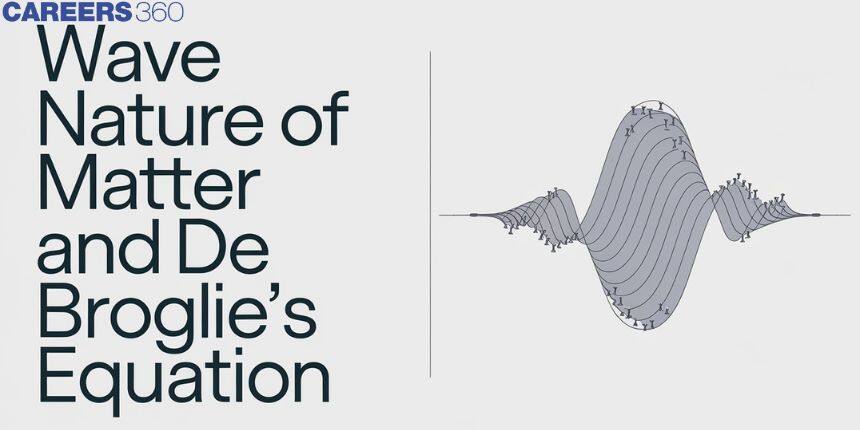
As we know light behaves both as a wave and particle. If you observe phenomena like interference, diffraction, or reflection, you will find that light is a wave. However, if you are looking at phenomena like the photoelectric effect, you will find that light has a particle character. De Broglie’s hypothesis stated that there is symmetry in nature and that if the light behaves as both particles and waves, matter too will have both the particle and wave nature. i.e. if a lightwave can behave as a particle then the particle can also behave as waves.
De Broglie’s equation is a fundamental concept in quantum mechanics that reveals the wave-particle duality of matter. Proposed by Louis de Broglie in 1924, the equation states that any moving particle or object has an associated wavelength, given by
Law Admissions 2026 Open | Avail Merit-Based Scholarships
BBA/MBA/PGDM Early Bird Applications Deadline 06th Nov'26. Apply now using coupon code CAREER250 and get ₹250 off the application fee
According to De Broglie, A moving material particle can be associated with the wave.
De Broglie proposed that the wavelength $\lambda$ associated with the moving material particle of momentum p is given as
where
Furthermore, we can write De-Broglie wavelength as
where
So from De Broglie’s Equation, we can conclude that
i.e. Wavelength associated with a heavier particle is smaller than that with a lighter particle.
i.e when the Particle moves faster, then the wavelength will be smaller and vice versa
if the particle is at rest then De - Broglie wavelength will be infinite
De - Broglie wavelength
The de Broglie wavelength of an electron is a concept that highlights the wave-particle duality of matter, particularly for subatomic particles like electrons
De Broglie’s Equation is given as
So for an electron having velocity v attained by it when it is accelerated through a potential difference of V.
then (Kinetic energy gain by the electron)=(work is done on an electron by the electric field)
i.e
So De - Broglie wavelength of Electron is given as
using
(i.e answer will be in
Similarly, we can find De - Broglie wavelength associated with charged particle
The de Broglie wavelength is a concept in quantum mechanics that describes the wave nature of particles.
De - Broglie wavelength of the proton
using
we get
De - Broglie wavelength of Deuteron
using
we get
De - Broglie wavelength of an Alpha particle (He2+)
using
we get
An electron microscope is an important application of de-Broglie waves designed to study very minute objects like viruses, microbes and the crystal structure of solids. In the electron microscope, by selecting a suitable value of potential difference V, we can have an electron beam of as small a wavelength as desired. And this de-Broglie wavelength is calculated by using the formula
1)
2)
3)
4)
Solution:
Wave-particle duality postulates that all particles exhibit both wave and particle properties
At equilibrium:
Net force = 0
Hence, the answer is the option (1).
Example 2: What is the wavelength of a photon with energy 1 ev?
1)
2)
3)
4)
Solution:
Hence, the answer is the option (1).
Example 3: An electron beam is accelerated by a potential difference V to hit a metallic target to produce X-rays. It produces continuous as well as characteristic X-rays. If λmin is the smallest possible wavelength of X-ray in the spectrum, the variation of log λmin with log V is correctly represented in :
1)

2)

3)

4)

Solution:
De - Broglie wavelength
wherein
Take logs on both sides
Hence, the answer is the option (1).
Example 4: Particle A of mass m and initial velocity
1)
2)
3)
4)
Solution:
mA = Mass of particle A
mB= Mass of particle B
vA= velocity of Particle A
vb= Velocity of particle B
The velocity of the particle After the collision,
The velocity of particle B after the collision,
Hence, the answer is the option (2).
Example 5: De-Broglie wavelength associated with the electron in the n=4 level is :
1) two times the de-Broglie wavelength of the electron in the ground state
2) four times the de-Broglie wavelength of the electron in the ground state
3) half of the de-Broglie wavelength of the electron in the ground state
4) M1/4th of the de-Broglie wavelength of the electron in the ground state
Solution:
De - Broglie wavelength
wherein
From de broglie equation:
In ground state n = 1
and in n = 4,
Hence, the answer is the option (2).
The wave nature of matter, proposed by Louis de Broglie in 1924, suggests that particles such as electrons exhibit wave-like properties, encapsulated in the equation λ=h/p. This wave-particle duality is foundational in quantum mechanics and is utilized in technologies like electron microscopes for high-resolution imaging. The de Broglie wavelength of a particle depends on its momentum and is significant in understanding phenomena at the atomic and subatomic levels.

Law Admissions 2026 Open | Avail Merit-Based Scholarships
BBA/MBA/PGDM Early Bird Applications Deadline 06th Nov'26. Apply now using coupon code CAREER250 and get ₹250 off the application fee
Ranked #36 amongst institutions in Management by NIRF | 100% Placement
Globally Recognized by AACSB (US) & AMBA (UK) | 18 LPA Avg. CTC for PGPM 2026
NEET PG All India & State College Predictor with Admission Process Guide
Top B-School: Ranked #9 in NIRF Management Rankings 2025.